

Why Your Past Budgeting Attempts Felt Like a Second Job
We have all been there. You sit down with a fresh notebook or a complicated spreadsheet, determined to finally get your money under control. You list out every single expense, promise yourself you will never buy coffee out again, and feel a surge of financial motivation. Two weeks later, life happens. The car needs an oil change, a friend invites you to dinner, and suddenly, your perfect plan falls apart. You abandon the spreadsheet entirely, feeling guilty and defeated. Budgeting is hard. But it does not have to be a miserable experience.
In my experience working with everyday people, I’ve seen many people make this mistake. They try to adopt a financial plan that requires the discipline of a monk and the accounting skills of a CFO. When you attempt to track every single penny without a flexible system in place, you set yourself up for failure. The goal is to figure out how to create a monthly budget that is easy to follow, not one that makes you feel trapped.
When you rely on overly restrictive financial advice or bad information, you run into serious problems that can derail your financial future. Consider how poor budgeting strategies actively harm your progress:
- Burnout and frustration: Micromanaging every transaction drains your energy and makes managing your personal budget feel like a punishment rather than a tool for freedom.
- The “all-or-nothing” trap: One small slip-up makes you abandon the entire monthly expenses tracker, leading to binge spending.
- Strained relationships: Constant financial stress and unrealistic rules often lead to arguments with your partner over basic household purchases.
- Missed savings opportunities: Because the plan is too complex, you never actually automate your savings or investments, leaving you stuck in the exact same financial position month after month.
Professionally speaking, the impact of a failed budget extends far beyond your bank account. It directly attacks your mental peace and confidence. When you constantly worry about overdrawing your account or hiding purchases, you carry a heavy psychological burden. A simple budget planner removes this anxiety. It provides clarity, showing you exactly where your money goes and giving you permission to spend on the things you actually enjoy. When you build a system tailored to your actual lifestyle, financial anxiety drops, and your confidence skyrockets.

The Foundation of Managing Your Personal Budget
Building a successful financial plan requires a solid foundation based on reality, not optimism. Many people base their spending plans on what they wish they earned or how they wish they spent. To break this cycle, you must look at the hard numbers. The most effective systems start with absolute honesty about your incoming cash and your outgoing obligations. Let us walk through the practical, scientifically backed steps to build a framework you can actually stick to.
Tracking Your Actual Take-Home Pay
The very first action you must take is calculating your exact net income. I have seen countless individuals build their budget around their gross salary. If your offer letter says you make $75,000 a year, you cannot budget based on that number. Taxes, health insurance premiums, retirement contributions, and other payroll deductions take a significant bite out of your paycheck.
You must base your entire spending plan on your net income- the money that actually hits your checking account. If you receive a regular salary, this process is incredibly straightforward. Just look at your last two pay stubs and add up the final deposit amounts. If you are married or combine finances with a partner, add both of your net incomes together.
If your income fluctuates because you work on commission, run a business, or pick up freelance gigs, you need a different approach. Look at your lowest earning month over the past year. Use that baseline number to cover your essential living costs. When you have a high-earning month, you can allocate the surplus directly toward debt payoff, savings, or investments. This conservative approach prevents you from falling behind on bills during slow seasons.
The 30-Day Expense Audit
Before you can tell your money where to go, you must understand where it has been going. You cannot build an accurate monthly expenses tracker without data. Print out your bank and credit card statements from the last 30 to 60 days. Sit down with a highlighter and review every single transaction.
This exercise is often eye-opening. You might discover you are spending hundreds of dollars on unused subscription services, multiple daily coffee runs, or impulse online purchases. Do not judge yourself during this process. The goal is simply to gather data. Categorize these past expenses into clear buckets: housing, groceries, transportation, debt payments, and entertainment.
According to the Consumer Financial Protection Bureau (CFPB), tracking your spending is one of the most effective ways to spot unhealthy financial habits. Once you see the hard numbers on paper, you naturally start making better choices. You might realize that cooking at home two more nights a week could free up enough cash to fully fund your emergency savings.
Sorting Fixed Costs from Variable Spending
Once you have your historical data, you must separate your expenses into two main categories: fixed and variable. Fixed expenses are the bills that stay the same (or very close to the same) every single month. These are usually your absolute necessities.
Examples of fixed expenses include your rent or mortgage, car payments, auto insurance, internet bills, and student loan payments. Because these numbers do not change, they are the easiest to budget for. Housing is typically your largest fixed cost. If you are planning to buy a home soon, estimating these costs accurately is highly recommended. You can easily determine comfortable housing limits using our Mortgage Affordability Calculator.
Variable expenses, on the other hand, change from month to month based on your lifestyle choices. This category includes groceries, dining out, entertainment, clothing, and hobbies. This is exactly where most budgets fail. People set an unrealistically low number for variable spending, blow past it by the second week of the month, and give up. When setting your variable limits, give yourself a small buffer. It is much better to budget slightly more for groceries and stay under the limit than to budget too little and feel like a failure.
Finding the Right Framework for Your Personality
There is no single “correct” way to manage your money. The best method is the one you will actually use. If you hate spreadsheets, do not use a spreadsheet. If you love technology, automate your tracking with a secure app. Let us examine a few popular, easy budgeting methods so you can choose the one that matches your personality.
The Proportional Approach (50/30/20 Rule)
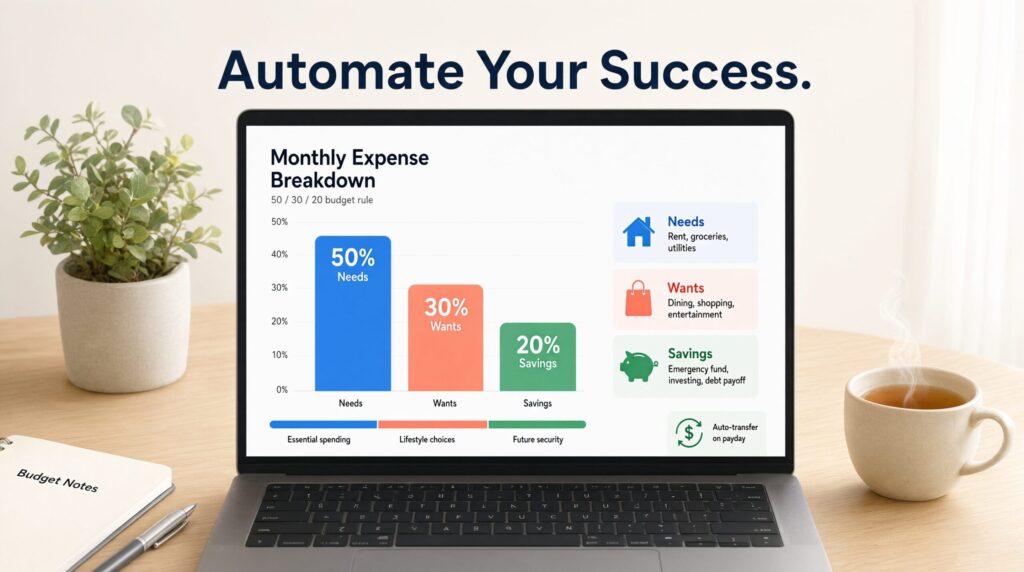
The 50/30/20 rule is widely considered one of the best frameworks for beginners. It divides your net income into three simple categories. You allocate 50% of your take-home pay to needs, 30% to wants, and 20% to savings and debt repayment.
Your needs encompass housing, utilities, basic groceries, and minimum loan payments. If you want to understand the exact breakdown of a major need like a home loan, looking at how US mortgage payments are calculated will give you a clear picture of principal, interest, taxes, and insurance.
Your wants cover the fun stuff- vacations, restaurants, and premium cable packages. The final 20% aggressively targets your financial future. This proportional approach is brilliant because it does not require you to track pennies. As long as your overall spending stays within these three broad percentages, you will remain financially healthy.
The Envelope System for Overspenders
If you struggle with impulsive credit card spending, the envelope system might be your perfect solution. This tactile method forces you to confront your spending physically. At the beginning of the month, you cash out your budget for specific variable categories like groceries and entertainment.
You label physical envelopes for each category and place the allotted cash inside. When you go to the grocery store, you only take the grocery envelope. Once the cash is gone, you cannot spend another dime in that category until the next month. This method completely eliminates accidental overspending. If carrying physical cash feels unsafe or outdated, many modern banking apps offer “digital envelopes” or sub-savings accounts that replicate this exact strategy without the paper money.
Advanced Strategies to Keep Your Finances on Autopilot
Once you establish the basic foundation of your personal budget plan, it is time to optimize it. The most successful money managers do not spend hours every week staring at their bank accounts. Instead, they set up systems that do the heavy lifting for them. Implementing advanced strategies removes the emotional friction from money management and ensures long-term consistency.
The Magic of Zero-Based Budgeting
If you want absolute control over your money, zero-based budgeting is a powerful tool. The core philosophy is simple: your income minus your expenses must equal exactly zero by the end of the month. This does not mean you spend your bank account down to zero. It means every single dollar is assigned a specific job before the month even begins.
For example, if you bring home $4,000 a month, you must assign exactly $4,000 to various categories. You might allocate $2,500 to living expenses, $500 to debt payoff, $500 to an emergency fund, and $500 to investments. At the end of your planning session, no money is left floating aimlessly.
According to financial experts at Forbes, assigning every dollar a job prevents wasteful spending. When money sits in a checking account without a designated purpose, it usually gets spent on random, forgotten purchases. Zero-based budgeting forces you to be intentional. You take command of your cash flow rather than wondering where it disappeared to at the end of the month.
Automating Transfers to Remove Willpower
Willpower is a finite resource. If you rely on your own discipline to manually transfer money into savings every month, you will eventually fail. You might have a stressful week, decide you deserve to splurge, and skip your savings contribution. The secret to wealth building is removing willpower entirely through automation.
Log into your banking portal and set up automatic transfers that trigger the day after your paycheck hits. Direct a specific amount immediately into your high-yield savings account and your retirement accounts. By paying yourself first, you force your lifestyle to adapt to the remaining balance. If the money is not in your checking account, you cannot spend it on impulse purchases.
You should also automate your fixed bills. Set your utilities, car insurance, and minimum credit card payments to auto-pay. This guarantees you will never miss a payment, protects your credit score, and frees up massive amounts of mental energy.
Pro Tip: Handling Irregular and Freelance Income
Budgeting with a consistent salary is manageable, but what if your paycheck bounces up and down? Freelancers, real estate agents, and gig workers face unique challenges. The most effective strategy here is the “Valley and Peak” method.
First, determine your absolute baseline living expenses- the bare minimum you need to survive, keep the lights on, and feed yourself. This is your “Valley” number. You must keep at least one month of this Valley number in a buffer checking account.
When you have a massive “Peak” earning month, do not inflate your lifestyle. Cap your personal paycheck at a reasonable limit and dump the surplus into a business holding account or tax savings fund. This way, when a slow month inevitably arrives, you pay yourself from the surplus buffer. You create an artificial, steady salary for yourself out of a volatile income stream.
Fatal Money Traps: Common Mistakes to Avoid
Even with the best intentions, people fall into predictable traps when managing their personal budget. Recognizing these pitfalls early will save you time, money, and unnecessary stress. Let us look at the most dangerous mistakes that cause budgets to fail and how you can easily avoid them.
Underestimating Hidden and Irregular Expenses
The most common budget-killer is the irregular expense. People plan perfectly for rent, groceries, and gas. But they completely forget about annual car registrations, quarterly insurance premiums, holiday gifts, or routine medical visits. When these bills arrive, they blow up the monthly plan, forcing people to rely on credit cards.
To fix this, you must create “sinking funds.” Review your calendar for the entire year and estimate all upcoming non-monthly expenses. Let us say you spend roughly $600 a year on car maintenance and $600 on holiday gifts. That totals $1,200 annually. Divide that by 12 months, and you get $100 a month. You must add a $100 line item to your monthly budget right now and transfer that cash into a separate savings bucket. When December rolls around, the money is already waiting for you.
Setting Unrealistic Perfectionist Goals
Another massive mistake is attempting to change all your bad habits overnight. I’ve seen many people make this mistake: they realize they spend $800 a month dining out, so they immediately slash their dining budget to $0 for the next month. This is the financial equivalent of a crash diet. You might last four days before you cave and order a pizza.
Budgeting is about sustainable progress, not painful perfection. If you currently spend $800 a month at restaurants, a realistic goal is cutting it to $600 next month. Give yourself room to breathe. Allow a small line item for “fun money” or “guilt-free spending.” When you give yourself permission to spend a small, controlled amount on things you enjoy, you are much more likely to stick to the overall plan.
Ignoring the Math on High-Interest Debt
A budget is practically useless if you are slowly bleeding out from high-interest credit card debt. Many people budget just enough to make the minimum payments across all their accounts, never making a dent in the principal balance. This keeps you trapped in a cycle of debt for decades.
You must optimize your debt payoff strategy within your budget. Choose either the Debt Snowball method (paying off the smallest balances first for psychological wins) or the Debt Avalanche method (targeting the highest interest rates first for mathematical efficiency). If you plan to aggressively tackle housing debt as well, running the numbers through a Mortgage Payoff Calculator can show you exactly how much interest you save by adjusting your monthly allocations. Redirect every spare dollar you find during your expense audit toward these debts until you are entirely free.
Your Action Plan for Tomorrow
Reading about financial strategies will not change your bank balance. Action does. You now know exactly how to create a monthly budget that is easy to follow. You understand the necessity of tracking your net income, auditing your past expenses, and choosing a framework that fits your natural tendencies.
Your task for tomorrow morning is simple. Set aside exactly 30 minutes. Pull up your primary bank account and write down your total income for the last 30 days. Then, categorize your spending into fixed needs, variable wants, and savings. Compare those numbers against the 50/30/20 rule. Find just two subscription services or recurring expenses you can cancel immediately. Finally, set up one automatic transfer of $50 from your checking to your savings account. Small, decisive steps build massive financial momentum. Take control of your money today, and watch your financial stress disappear.
Frequently Asked Questions (FAQs)
How do I start a budget if I live paycheck to paycheck?
Start by tracking every dollar you spend for 30 days without trying to change your habits. When you live paycheck to paycheck, you must identify exactly where minor leaks are occurring. Once you see the data, cut non-essential spending ruthlessly and direct those funds strictly toward building a small emergency buffer. Even saving twenty dollars a week breaks the cycle and creates breathing room.
What is the simplest budgeting method for beginners?
The simplest method for beginners is the 50/30/20 rule. This framework divides your net income into 50% for needs, 30% for wants, and 20% for savings and debt repayment. It is highly effective because it focuses on broad categories rather than micro-managing individual transactions. You gain clear boundaries for your spending without the headache of tracking every single coffee purchase.
How much of my income should go to savings each month?
You should aim to save at least 20% of your net income each month. This percentage includes contributions to emergency funds, retirement accounts, and extra debt payments. If 20% feels impossible right now, start with 5% or 10% and slowly increase the amount every time you get a raise or pay off a debt. Consistency matters more than the initial dollar amount.
Should I use a spreadsheet or a budgeting app?
You should use whichever tool you will consistently open and check. Budgeting apps are excellent because they link directly to your bank accounts, automatically categorize transactions, and send you push notifications when you near your limits. Spreadsheets are better for people who prefer total customization and hands-on control over their data. Pick one method and commit to it for 90 days.
How do I handle unexpected expenses in my monthly budget?
You handle unexpected expenses by proactively creating an emergency fund and dedicated sinking funds. An emergency fund covering three to six months of living expenses protects you from job loss or major medical bills. Sinking funds are smaller savings buckets designed for predictable but irregular bills, like annual car repairs or home maintenance, ensuring these costs never derail your primary monthly plan.
Can I still buy things I enjoy while on a strict budget?
Yes, you absolutely can and should budget for things you enjoy. A realistic financial plan must include a “guilt-free spending” or entertainment category. If you eliminate all fun, you will quickly experience budget burnout and abandon the plan entirely. The goal is to plan for your fun purchases intentionally rather than spending money impulsively on a credit card.
How often should I review or adjust my budget?
You should review your budget weekly and adjust it at the end of every month. A weekly check-in takes five minutes and ensures you are on track with your variable spending limits. At the end of the month, sit down to adjust your categories for the upcoming month based on new bills, changing income, or upcoming social events.
The information provided in this article is for educational and informational purposes only. It does not constitute professional financial, investment, tax, or legal advice. The content on Nxfly Finance (nxfly.com) is intended to help you understand general financial concepts and should not be used as a substitute for personalized advice from a qualified financial advisor, CPA, tax professional, or licensed attorney.
Every individual’s financial situation is unique. Results, outcomes, and experiences discussed or implied in this article may vary significantly based on your personal circumstances, income, credit profile, location, and market conditions. No financial outcome, return, or result is guaranteed.
Nxfly Finance does not endorse, promote, or recommend any specific financial product, service, lender, institution, or investment. Any tools, calculators, or estimates provided on this website are for illustrative and planning purposes only and should not be solely relied upon for making financial decisions.
Always conduct your own due diligence and consult with a licensed financial professional before making any financial, investment, or borrowing decisions. By reading and using this content, you acknowledge and agree that Nxfly Finance and its authors are not liable for any financial decisions made based on the information provided here.
For more information on financial regulations and consumer protections in the United States, visit the Consumer Financial Protection Bureau (CFPB) or the U.S. Securities and Exchange Commission (SEC).