

By James Sterling, CFP® | Reviewed by the Nxfly Finance Team
Credit card debt is a financial emergency. Banks will rarely tell you this. They want you comfortable. They want you complacent. They want you making the minimum payment month after month, decade after decade.
If you want to stop bleeding cash, you need hard math. You need our credit card payoff calculator.
Most consumers look at their monthly statement and feel completely disconnected from the actual cost of their debt. You see a $10,000 balance. You see a $200 minimum payment. You pay it. You feel productive. But behind the scenes, compounding interest is quietly devouring your future wealth. When you carry a balance, you are effectively paying a premium on every single item you purchased months or even years ago. That dinner out didn’t cost $100. At a 24% APR, it cost substantially more.
Our credit card payoff calculator stops the illusion. It strips away the bank’s marketing and hands you the raw, unedited truth about your balance.
Understanding this math separates those who build wealth from those who stay trapped in a cycle of revolving payments. When you punch your numbers into the credit card payoff calculator, you force reality into the open. You discover the precise date you will be entirely debt-free. You see exactly how many thousands of dollars you will burn on interest charges. More importantly, you see how adding just $50 or $100 extra to your monthly payment dramatically alters the trajectory of your financial life.
This guide is blunt. We do not sugarcoat bad debt. We break down exactly how credit card companies calculate your interest, why your balance seems to drop at a snail’s pace, and how to use our tool to build an aggressive, realistic exit strategy.
Prepare your current statements. Find your actual interest rates. Let’s look at the numbers.
💳 Credit Card Payoff Calculator
See exactly how long it will take to pay off your balance & how much interest you’ll save
The Mechanics: How to Use the Nxfly Credit Card Payoff Calculator
A calculator is only as effective as the data you feed it. Guessing your balance or estimating your interest rate will give you useless projections. To get a razor-sharp timeline from the credit card payoff calculator, you must understand the specific inputs and why each one dictates your financial future.
Step 1: Input Your Exact Current Balance
Log into your credit card portal. Do not rely on your memory. Look for the "Current Balance," not the "Statement Balance." Your statement balance only reflects what you owed at the end of the last billing cycle. The current balance includes every pending transaction, recently posted charge, and freshly accumulated interest fee. Enter this exact dollar amount into the calculator. This is your principal—the foundation of the mathematical problem we are going to solve.
Step 2: Track Down Your True APR
Your Annual Percentage Rate (APR) is the engine driving your debt. Finding it often requires digging. Banks routinely bury the APR on the second or third page of your PDF statement under "Interest Charge Calculation." Do not assume your rate is 15%. Average rates frequently push past 20% or even 25% depending on the current prime rate and your credit score. If you have a promotional 0% APR that expires in three months, use the standard "Go-To" rate that will apply afterward for a realistic long-term calculation.
Step 3: Set Your Monthly Payment Strategy
Here is where you take back control. The credit card payoff calculator allows you to manipulate your payment variables. You can approach this from two distinct angles:
- The Payment Target: Enter the maximum dollar amount you can comfortably afford to send the bank every month. The calculator will spit out the exact month and year you will hit a zero balance.
- The Timeline Target: Enter your desired payoff timeframe. Let's say you want to be completely debt-free in 18 months. The tool works backward, calculating the exact monthly payment required to hit that specific deadline.
Step 4: Analyze the Interest Damage
Once you hit calculate, look directly at the "Total Interest Paid" figure. This number often shocks people. It represents the penalty you pay for carrying the debt. If your balance is $8,000 and your total interest paid over three years is $3,500, your actual debt load was $11,500. Use this shock as fuel. Start adjusting your monthly payment input higher. Watch how rapidly the total interest paid figure drops when you commit an extra $100 per month.

The Anatomy of the Calculation: Key Terms & Deep Concepts
Financial literacy requires speaking the language of the lenders. Banks rely heavily on consumer ignorance. They use complex terminology to obscure simple, brutal math. If you want to use the credit card payoff calculator effectively, you must understand exactly how the terms on your statement interact with your money.
Here is your expanded, plain-English glossary for credit card mathematics.
Principal Balance
This is the raw amount of money you actually borrowed. If you buy a $1,200 laptop on a credit card, your principal is $1,200. However, the moment your billing cycle closes and interest is applied, unpaid interest gets added to your balance. Your principal grows. You end up paying interest on top of your previous interest.
Annual Percentage Rate (APR)
APR represents the yearly cost of borrowing money. But credit cards do not calculate interest yearly. They calculate it daily. Banks take your APR, divide it by 365, and multiply that daily periodic rate by your average daily balance. According to the Federal Reserve, credit card interest rates consistently rank among the highest consumer borrowing costs in the financial sector. A high APR acts like a severe headwind against your monthly payments.
Revolving Debt
Credit cards are revolving debt. This means the line of credit remains open, and your minimum payment fluctuates based on your current balance. This is fundamentally different from installment loans. If you read our breakdown on How US Mortgage Payments are Calculated, you know that mortgages have fixed amortization schedules. With revolving debt, if you only pay the minimum, the finish line constantly moves further away.
Minimum Payment Floor
Your statement shows a minimum payment due. This is generally calculated as 1% to 2% of your total balance, plus the accrued interest for that month. However, banks establish a "floor"—a hard minimum dollar amount, usually $25 or $35. If your calculated minimum falls below the floor, you pay the floor amount. Minimum payments are engineered to keep you in debt as long as legally possible while maximizing the bank's interest revenue.
Compounding Interest
This is the math that breaks you. Every single day you carry a balance, the bank calculates a small interest charge and tacks it onto your total. The next day, the bank calculates interest on the new, slightly larger balance. The interest compounds. If you want to see how this compares to massive installment loans, run your numbers through our Mortgage Payoff Calculator. You will quickly see why knocking out rapidly compounding credit card debt must always take priority over prepaying a low-interest home loan.
Total Interest Paid
This metric defines the true cost of your debt. It calculates every single dollar you send to the bank above your original principal balance. When using our credit card payoff calculator, this is the most critical metric to monitor. Your primary financial goal is to drive this specific number as close to zero as humanly possible by accelerating your payment schedule.
Debt-Free Date
This is the exact month and year your balance will hit $0.00, assuming you make the exact fixed payment you entered into the calculator, without adding a single new charge to the card. It provides a definitive timeline. A timeline builds discipline. Discipline builds wealth.
Unveiling the Formula: The Math Behind the Calculator
Banks build massive glass skyscrapers using the math they hope you never learn.
When you use our credit card payoff calculator, you are not just plugging numbers into a black box. You are leveraging the exact mathematical principles that lenders use to dictate your financial life. We believe in absolute transparency. You need to know how the machine operates.
Unlike an installment loan, where the payments are fixed over a set period, revolving debt is fluid. If you want to see a fixed timeline, you can review our Mortgage Amortization Calculator to see how clean those schedules look. Credit cards are messier. They require you to solve for time (N) based on a fixed payment, or solve for the payment (P) based on a fixed timeframe.
To calculate exactly how many months it will take to reach a zero balance when making a fixed monthly payment, our tool uses a variation of the standard amortization formula. Because compound interest is an exponential growth problem, we use logarithms to isolate the time variable.
The formula looks like this:
N = -log(1 - (B * r) / P) / log(1 + r)
Here is the exact breakdown of the variables feeding this equation:
- N (Number of Months): This is your definitive timeline. This tells you exactly how many billing cycles stand between you and financial freedom.
- B (Principal Balance): This is the total amount you currently owe the bank. It serves as the starting baseline for the calculation.
- r (Monthly Periodic Interest Rate): Credit card companies quote you an Annual Percentage Rate (APR). However, to calculate your monthly interest charge, that annual rate must be divided by 12. If your APR is 24%, your monthly periodic rate (r) is 2% (expressed in the math as 0.02).
- P (Monthly Payment): This is the fixed dollar amount you commit to sending the bank every single month.
The math is unforgiving. Look closely at the numerator: (B * r). That represents the interest generated in a single month. If your chosen monthly payment (P) is equal to or less than (B * r), the formula physically breaks. You will get a mathematical error. Why? Because you are not covering the interest generated. Your debt will grow to infinity.
By hard-coding this formula into our tool, we remove the guesswork. The outputs you see are mathematically flawless. If you execute the payment plan precisely as calculated, without adding new debt, the date projected is exactly when your balance will hit zero.
5 Critical Factors That Influence Your Numbers
Plugging numbers into a tool gives you a baseline. Reality introduces friction. The financial landscape shifts constantly, and the way credit card companies structure their billing directly impacts your trajectory.
Understanding these five variables will completely change how you approach your debt elimination strategy.
The Variable Rate Trap
Most credit cards do not have fixed interest rates. They feature variable rates tied to the U.S. Prime Rate. When the Federal Reserve raises benchmark interest rates to combat inflation, your credit card APR increases automatically. You do not get a vote. You simply receive a notice on your statement that your debt just became more expensive. According to the Consumer Financial Protection Bureau (CFPB), credit card interest rate margins recently hit their highest levels in history, heavily burdening consumers. If macroeconomic conditions push rates higher, a timeline you calculated six months ago might suddenly be extended by several months.
The Average Daily Balance Method
You might assume banks charge interest based on what you owe at the exact end of the month. They do not. Almost all issuers use the "Average Daily Balance" method. The bank tracks your balance on day one, day two, day three, and so on. They add those daily balances together and divide by the number of days in the billing cycle. The faster you pay down the principal within a given month, the lower your average daily balance becomes. Making your payment two weeks before the due date mathematically reduces your interest charge.
The Psychological Floor of Minimum Payments
Banks anchor your expectations. By prominently displaying a tiny minimum payment—often just 1% of your balance plus interest—they manipulate consumer psychology. They make a $15,000 debt feel affordable because the monthly requirement is only $350. This is a behavioral trap designed to maximize their total interest revenue. Your success depends entirely on ignoring that printed number.
Residual Interest (Trailing Interest)
If you calculate your payoff date and make a final massive payment to wipe out your balance, you might still receive a small bill the following month. This infuriates consumers. It is called residual interest. Because you carried a balance from the day your statement was cut until the day your final payment cleared, interest accrued during those few days. Always call your issuer and request a "payoff quote" for a specific date to ensure you kill the debt entirely.
The Cost of Continuing to Swipe
This sounds obvious, but it ruins more debt-elimination plans than anything else. When you carry a balance, you lose your grace period. Every new purchase you make on that card begins accruing interest the very second the transaction posts. If you are actively aggressively paying down a balance, you must stop using that specific piece of plastic immediately. Otherwise, you are bailing water out of a boat while simultaneously drilling new holes in the hull.
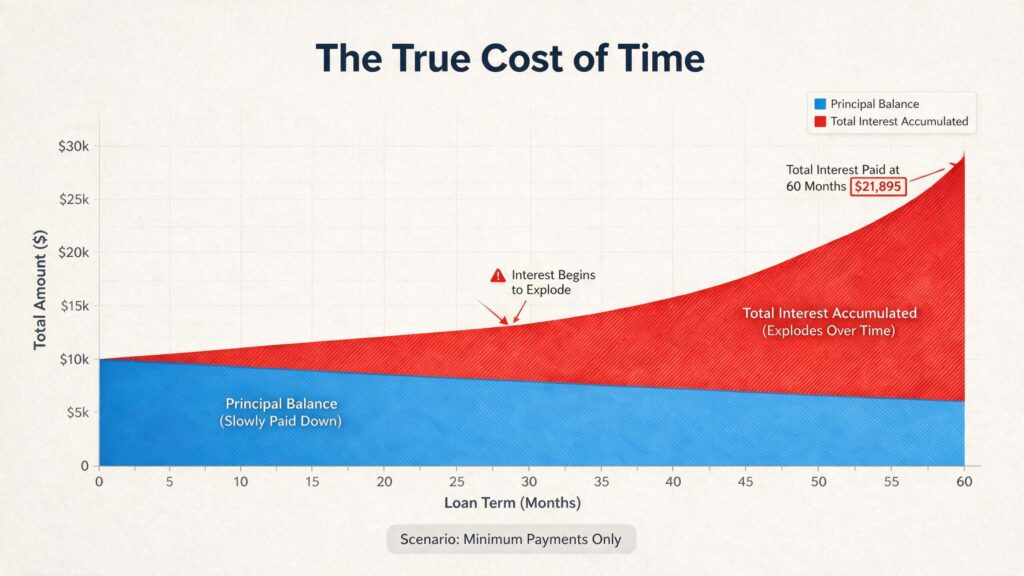
Real-World Scenarios: The Calculator in Action
Theory only gets you so far. To truly understand the power of our credit card payoff calculator, you must see the math applied to real human situations. Different financial goals require entirely different payment strategies.
Here are three highly detailed case studies demonstrating how individuals manipulate the variables to take back control of their cash flow.
Scenario 1: The Trap of the Minimum (Sarah's Slow Bleed)
Sarah is a 32-year-old public school teacher. During a period of medical emergencies, she racked up $8,500 on a single rewards card. She feels overwhelmed. Her current approach is defensive. She pays the bank’s suggested minimum payment every month to protect her cash flow. She feels responsible because she never misses a due date.
Sarah finally runs her numbers through the calculator to see the reality of her defensive strategy.
| Input Variable | Sarah's Data |
|---|---|
| Principal Balance | $8,500.00 |
| Current APR | 24.99% |
| Monthly Payment Strategy | $250.00 (Fixed) |
| Result: Months to Payoff | 56 Months (4.6 Years) |
| Result: Total Interest Paid | $5,431.18 |
| Total Out of Pocket Cost | $13,931.18 |
Strategic Analysis:
Sarah’s situation is a slow financial bleed. Her $8,500 emergency is ultimately going to cost her nearly $14,000. She is spending over $5,400 just for the privilege of holding the debt. For almost five years, she will carry this weight. By seeing this stark reality in the data table, Sarah realizes that protecting her monthly cash flow by paying the minimum is actually destroying her long-term net worth. She needs to temporarily cut her lifestyle expenses to boost that monthly payment to at least $400.
Scenario 2: The Aggressive Debt Destroyer (Mark's Timeline)
Mark is a 28-year-old software developer making a strong salary. However, reckless spending in his early twenties left him with a massive $18,000 balance across two consolidated cards. Mark wants out. He wants to buy his first home within two years. He knows that his debt-to-income ratio must drop dramatically before he even thinks about using the Mortgage Affordability Calculator to see how much house he can buy.
Mark works backward. He sets a hard deadline of 18 months to clear the $18,000 completely. He uses our tool to calculate exactly what it takes.
| Input Variable | Mark's Data |
|---|---|
| Principal Balance | $18,000.00 |
| Current APR | 19.50% |
| Payoff Target Timeline | 18 Months |
| Result: Required Monthly Payment | $1,162.34 |
| Result: Total Interest Paid | $2,922.12 |
| Total Out of Pocket Cost | $20,922.12 |
Strategic Analysis:
Mark has to send $1,162 to the bank every single month for a year and a half. This requires extreme financial discipline. It means skipping vacations, eating at home, and perhaps picking up freelance work. But the payoff is immense. Not only does he save thousands in potential interest compared to a normal payoff schedule, but in exactly 18 months, his cash flow frees up dramatically. He instantly reclaims $1,162 a month, which he can rapidly redirect into a down payment fund.
Scenario 3: The Promotional Rate Strategist (Elena's Arbitrage)
Elena, an independent graphic designer, has a $6,000 balance sitting on a card charging 26%. The interest is choking her variable income. She makes a highly strategic move: she opens a new balance transfer credit card offering a 0% introductory APR for 15 months. She transfers the full $6,000 (paying a standard 3% transfer fee, adding $180 to her principal).
She uses the calculator to ensure she never pays a dime of interest on the new card.
| Input Variable | Elena's Data |
|---|---|
| Principal Balance | $6,180.00 (Includes Fee) |
| Current APR | 0.00% |
| Payoff Target Timeline | 14 Months (Beating the promo) |
| Result: Required Monthly Payment | $441.43 |
| Result: Total Interest Paid | $0.00 |
| Total Out of Pocket Cost | $6,180.00 |
Strategic Analysis:
Elena plays the game perfectly. She calculates the payoff for 14 months, purposely aiming to finish a full month before the promotional 0% window slams shut. If she fails and carries the balance past month 15, the rate skyrockets to 23%, and she loses her advantage. The math proves that the one-time $180 balance transfer fee is mathematically brilliant compared to paying 26% interest on $6,000 for over a year. She escapes the compounding trap entirely.
Hidden Pitfalls: 3 Biggest Mistakes People Make
Using a credit card payoff calculator gives you a pristine, mathematical roadmap. Reality is rarely pristine. Debt elimination requires brutal consistency. People frequently sabotage their own timelines by fundamentally misunderstanding how banks process transactions.
Here is exactly how borrowers derail their progress and burn through thousands of dollars in unnecessary interest.
Mistake 1: The "New Charge" Sabotage
You calculate a strict 18-month payoff plan. You commit to sending $500 a month to the bank. Then, you use that same credit card to buy a $40 tank of gas. You just broke the math.
When you carry a revolving balance, you lose your grace period entirely. Every single new purchase you make begins generating interest the absolute microsecond the transaction posts to your account. You are effectively financing a $40 tank of gas at a 25% APR. The calculator assumes you have completely stopped using the card. If you are serious about hitting your target debt-free date, you must freeze the account. Remove the card from your digital wallets. Cut the physical plastic in half. Stop bailing water out of a boat while simultaneously drilling new holes in the hull.
Mistake 2: Chasing Cash Back Illusions
Consumers fall deeply into the rewards trap. Banks heavily market 2% cash back or airline miles to keep you swiping. They know the psychology works. People will carry a $10,000 balance at 24% interest because they refuse to stop using the card for their daily expenses, terrified of missing out on a few airline points.
Let’s look at the raw data. Earning 2% cash back on a $1,000 monthly spend yields $20. Paying a 24% APR on a $10,000 carried balance costs you roughly $200 in interest for that exact same month. You are spending $200 to earn $20. It is a catastrophic financial strategy. If you carry a balance, points do not matter. Rewards are mathematically irrelevant until you achieve a zero balance.
Mistake 3: Treating the Minimum as a Target
Banks anchor your expectations. By printing a brightly colored "Minimum Payment Due" box on the front page of your statement, they subliminally train you to view that specific number as the goal. It is not a goal. It is a legally required baseline designed to maximize bank profits.
If your minimum is $150, paying $160 feels like an accomplishment. It is not. You are barely outpacing the compound interest. Relying on minimum payments transforms a short-term emergency expense into a permanent, multi-decade financial anchor. You must entirely ignore the bank’s suggested number and rely exclusively on the outputs generated by the credit card payoff calculator to set your actual monthly payment target.
Expert Strategies: How to Optimize Your Results
You have your baseline numbers. You see your exact timeline. Now, it is time to manipulate the system to your advantage. Financial planning is about leverage. Here are five expert-level strategies to actively accelerate your debt elimination and slash your total interest costs.
Strategy 1: Execute Mid-Cycle Micro-Payments
Credit card interest is calculated using the Average Daily Balance method. The bank looks at what you owe every single day of the month, averages it out, and applies the interest rate. You can weaponize this rule. Do not wait for your due date to make your massive monthly payment. If your credit card payoff calculator tells you to pay $600 a month, break it up. Pay $150 every single week. By forcefully driving down the principal balance earlier in the billing cycle, you mathematically reduce your average daily balance. This immediately lowers your monthly interest charge.
Strategy 2: Pause the Asset Prepayment Fallacy
Many aggressive savers try to pay off all their debts at once. They send an extra $300 a month to their mortgage, while simultaneously carrying $15,000 in credit card debt. This is highly inefficient. Look at the math using our Extra Mortgage Payment Calculator. Shaving time off a fixed 4% or 6% home loan is a great long-term strategy, but it completely fails mathematically when you have revolving debt compounding at 25%. You must redirect every single available dollar of your "extra" cash flow toward the credit card. Pause the mortgage prepayments. Kill the 25% debt first. You can resume building home equity later.
Strategy 3: The Avalanche Method Execution
If you have multiple credit cards, you need a sequencing strategy. The Avalanche Method is the mathematically superior approach. List all your cards. Rank them entirely by their Annual Percentage Rate (APR), from highest to lowest. The balances do not matter.
Take all your available extra cash and attack the card with the highest APR. Pay the strict minimums on everything else. Once the highest-rate card hits zero, take that entire payment block and roll it into the next highest rate. This method minimizes total interest paid across your entire portfolio.
Strategy 4: Exploit Balance Transfer Arbitrage
If your credit score remains strong (above 700), you can essentially buy time. Apply for a balance transfer card offering a 0% introductory APR for 12 to 18 months. You will typically pay an upfront fee of 3% to 5% of the transferred balance.
Do not guess the outcome. Run the new total balance (including the fee) through the credit card payoff calculator with the APR set strictly to 0%. Set the target payoff timeline to one month before the promotion expires. This locks in your required fixed payment. You completely halt the daily compounding interest machine and force 100% of your capital directly into principal reduction.
Strategy 5: Demand Hardship Rates
Stop assuming the printed APR is fixed in stone. If you are drowning, pick up the phone. Call the bank’s retention department. Tell them directly that you are facing financial hardship, analyzing bankruptcy options, and cannot afford the current 26% APR. Many banks have internal hardship programs. They may temporarily drop your rate to 9%, 12%, or even 0% for a period of six to twelve months while freezing the account. They would rather collect the principal slowly than sell your defaulted debt to a collection agency for pennies on the dollar.
Frequently Asked Questions (FAQs)
Q: How does a credit card payoff calculator work?
A: A credit card payoff calculator uses a logarithmic mathematical formula to solve for time or payment based on your balance and APR. You input your current debt load, interest rate, and desired monthly payment. The tool calculates exactly how many months it will take to hit a zero balance while factoring in compounding daily interest.
Q: Does paying my credit card multiple times a month save money?
A: Yes, making multiple payments throughout the month mathematically lowers your total interest charges. Because banks calculate interest based on your average daily balance, reducing the principal balance earlier in the 30-day billing cycle reduces the daily average. This shrinks the baseline number the bank uses to multiply against your daily periodic interest rate.
Q: Should I drain my savings to pay off credit card debt?
A: You should retain a small starter emergency fund of $1,000 to $2,000 to prevent you from taking on new debt for unexpected expenses. However, keeping $20,000 in a high-yield savings account earning 4% while carrying $15,000 in credit card debt costing 24% is mathematically destructive. You are losing money every single day. Use the bulk of your cash reserves to instantly eliminate the high-interest debt.
Q: Why does my payoff date change even if I make fixed payments?
A: Your payoff date will shift if your credit card has a variable Annual Percentage Rate (APR). Unlike fixed home loans—which you can track perfectly using a Mortgage Interest Calculator—credit card rates float with the U.S. Prime Rate. If the Federal Reserve raises benchmark rates, your APR goes up, your monthly interest charge increases, and a larger portion of your fixed payment gets absorbed by interest rather than principal reduction.
Q: What happens to my credit score when I pay off a massive balance?
A: Paying off a massive balance typically results in a rapid and significant increase in your credit score. The most heavily weighted factor in credit scoring models is your credit utilization ratio (how much debt you carry compared to your total available limits). Driving a maxed-out card down to a zero balance drastically lowers your utilization ratio, signaling to scoring algorithms that you are a highly responsible, low-risk borrower.
Q: Should I consolidate my credit card debt into a personal loan?
A: Consolidating debt into a personal installment loan is an excellent strategy if the new fixed interest rate is substantially lower than your current credit card APRs. This move forcefully converts compounding revolving debt into a fixed amortization schedule with a hard end date. However, this strategy fails completely if you immediately start making new purchases on the newly emptied credit cards, effectively doubling your total debt load.
Q: Can I use a credit card payoff calculator for 0% promotional cards?
A: Absolutely. To use the calculator for a promotional card, enter your total balance and set the interest rate exactly to 0%. Then, select a target payoff timeline that ends at least one full month before the promotional period expires. The calculator will provide the exact fixed monthly payment required to clear the debt entirely before the bank can apply any deferred or go-to high-interest rates.
Stop guessing your debt-free date and take back control of your financial timeline. Scroll to the top of this page to use our free Credit Card Payoff Calculator today, and once your debt is mapped out, check out our Mortgage Affordability Calculator to start planning your next major wealth-building asset.
Disclaimer: The Credit Card Payoff Calculator provided by Nxfly Finance is for educational and informational purposes only. It does not constitute specific financial, investment, or tax advice. Please consult with a licensed financial advisor, fiduciary, or CPA before making any major financial decisions.