

By Sarah Jenkins, CFP® | Reviewed by the Nxfly Finance Team
Let’s understand the Mortgage Affordability Calculator. Here is a hard truth most lenders will not tell you: what you qualify for is not what you can afford. Lenders love to push your borrowing capacity to its absolute limit. They look at your gross income, run some automated debt calculations, and hand you a pre-approval letter for a staggering amount. It feels like a badge of honor. You feel wealthy. But that piece of paper only tells you what the bank is willing to risk—not what your lifestyle can sustain.
If you max out your pre-approval limit, you risk entering a state of constant financial stress. We call this being “house poor.” You own a beautiful home, but your bank account is completely drained every single month. There is no money left for retirement savings, family vacations, home repairs, or emergency funds. One broken water heater or a brief gap in employment can send your entire household budget into a tailspin.
This is why you must calculate your own limits before you ever set foot in an open house. Our mortgage affordability calculator acts as your financial reality check. It bypasses the sales pitches and focuses strictly on the math. By analyzing your income, current monthly debts, down payment, and local housing expenses, our tool determines a safe, realistic purchase price.
Understanding this math is the single most important step in protecting your long-term wealth. If you overspend on your mortgage, you hobble your ability to invest in other compounding assets.
We designed this tool to give you a clear, realistic picture of your purchasing power. Let us break down the exact variables that dictate your home budget so you can buy with total confidence.
Affordability Calculator
Find out how much home you can comfortably afford
The Mechanics: How to Use the Nxfly Mortgage Affordability Calculator
Our tool uses your personal financial profile to construct a realistic purchasing budget. To get an accurate result, you must input your true numbers rather than rough guesses. Here is how each input field shapes your final housing budget.
Step 1: Input Your Annual Household Income
Enter your total pre-tax gross annual household income. This includes your base salary, regular bonuses, commissions, and any secondary income streams. Lenders use your gross income as the baseline for all debt-to-income calculations. If you are buying a home with a partner, make sure to combine your incomes to get a true picture of your household capacity.
Step 2: Enter Your Monthly Debt Payments
This is where many buyers make massive mistakes. You must list all recurring monthly debt obligations. This includes credit card minimums, auto loans, student loans, personal loans, and child support. Do not include current rent or utility bills, as your new mortgage payment will replace your rent. To see how these debts combine with a potential loan payment, you can run a quick simulation using our base mortgage payment calculator.
Step 3: Input Your Down Payment and Saved Funds
Enter the total amount of cash you plan to put down on the home. This is not your entire savings account. You must keep some cash reserves liquid for closing costs, moving expenses, and post-purchase emergencies. The larger your down payment, the lower your loan balance will be, which directly expands your total buying power.
Step 4: Specify Interest Rate and Loan Term
Input your expected interest rate and chosen loan term. If you do not have a quote yet, use current market averages for a 30-year fixed-rate mortgage. Even a 1% change in your interest rate dramatically shifts your purchasing capacity. If you want to see how different interest rates impact your lifetime borrowing costs, check out our mortgage interest calculator to test different scenarios.

The Anatomy of the Calculation: Key Terms & Deep Concepts
To find your true home buying capacity, you must understand the financial metrics lenders use to judge your application. Here is a clear, plain-English breakdown of the key concepts that run behind our mortgage affordability calculator.
- Front-End DTI Ratio (Housing Ratio): This is the percentage of your gross monthly income that goes toward your total housing costs (PITI). Lenders generally prefer this ratio to remain at or below 28%.
- Back-End DTI Ratio (Total Debt Ratio): This is the percentage of your gross monthly income used to pay all recurring monthly debts, including your new mortgage payment, auto loans, and credit cards. Most conventional lending guidelines prefer a back-end DTI of 36% or lower, though some programs allow up to 43% or even 50% under strict conditions. You can read the official guidelines on consumer debt limits directly from the Consumer Financial Protection Bureau (CFPB) to understand how lenders assess these ratios.
- PITI: This stands for Principal, Interest, Taxes, and Insurance. This is your true monthly housing cost, and it is the figure our calculator uses to test your budget against your income limits.
- Private Mortgage Insurance (PMI): An extra monthly fee required if your down payment is less than 20% on a conventional loan. This cost is added to your monthly PITI, which reduces your total purchasing power. To see exactly how this insurance premium impacts your monthly cash flow, try using our dedicated PMI calculator.
- The 28/36 Rule: This is the golden standard of home affordability. It dictates that your housing expenses (front-end) should not exceed 28% of your gross income, and your total debt payments (back-end) should not exceed 36%.
- Affordability Formula: To find your maximum monthly housing payment capacity based on the 28/36 rule, the calculator runs two separate calculations and takes the lower of the two results:
Calculation A (Front-End Limit) = Gross Monthly Income * 0.28
Calculation B (Back-End Limit) = (Gross Monthly Income * 0.36) – Current Monthly Debts
Once the calculator determines your maximum affordable monthly housing payment (M), it reverses the standard amortization formula to calculate the maximum loan amount (P) you can qualify for at your specified interest rate (r) and term (n):
Our interactive mortgage affordability calculator executes this multi-step mathematical check instantly, giving you a safe, clear target price range for your home search.
Unveiling the Formula: The Math Behind the Calculator
Lenders do not use guesswork to determine how much house you can buy. Instead, they run your financial profile through two rigid, mathematical filters: the Front-End Debt-to-Income (DTI) ratio and the Back-End DTI ratio.
Our mortgage affordability calculator mimics this exact underwriting process. To find your maximum purchase price, the calculator first determines your maximum monthly housing payment limit using the following two equations:
Limit A (Front-End Housing Limit) = Gross Monthly Income * 0.28
Limit B (Back-End Total Debt Limit) = (Gross Monthly Income * 0.36) – Monthly Debt Payments
The calculator selects the lower of these two results as your maximum allowable monthly PITI (Principal, Interest, Taxes, and Insurance) payment. This ensures you do not violate the golden 28/36 rule of home affordability.
Once the maximum monthly payment () is locked in, the calculator must subtract estimated property taxes (), homeowners insurance (), and private mortgage insurance () to isolate the pure monthly principal and interest limit ():
M_PI = M – T – I – PMI
Finally, the calculator reverses the standard amortization formula to translate this monthly payment limit into a maximum loan principal amount (). We present this equation below in its clean, WordPress-compatible format:
Let us break down each variable used in this algebraic calculation:
- P: The maximum loan amount you can afford to borrow.
- M_PI: Your maximum monthly payment limit isolated for principal and interest.
- r: Your monthly interest rate (annual interest rate divided by 12 months).
- n: The total number of monthly payments over the term (360 payments for a 30-year loan).
A Practical Mathematical Proof
Let’s walk through a real-world example.
Imagine your household earns $10,000 in gross monthly income ($120,000 per year) and has $500 in monthly student loan payments. You’re considering a 30-year mortgage with an annual interest rate of 6.5%.
First, we calculate the front-end limit:
Limit A = $10,000 * 0.28 = $2,800
Next, we calculate the back-end limit:
Limit B = ($10,000 * 0.36) – $500 = $3,600 – $500 = $3,100
The calculator selects the lower limit, which is $2,800.
Let us assume your monthly property taxes, insurance, and PMI add up to $600.
We subtract this from our total limit to find our maximum principal and interest payment (Mₚᵢ):
Maximum Principal & Interest Payment (Mₚᵢ) = Total Monthly Payment Limit − $600
M_PI = $2,800 – $600 = $2,200
Now, we calculate the amortization factor: [ (1 + r)^n - 1 ] / [ r * (1 + r)^n ]
Factor = [ (1.0054167)^360 – 1 ] / [ 0.0054167 * (1.0054167)^360 ]
Factor = [ 7.0016 – 1 ] / [ 0.0054167 * 7.0016 ]
Factor = 6.0016 / 0.037925
Factor = 158.25
Now, we multiply this factor by our limit:
P = $2,200 * 158.25 = $348,150
Your maximum affordable loan amount is exactly $348,150.
If you have a down payment of $50,000, our mortgage affordability calculator adds that to the loan amount to output a maximum home purchase price of $398,150.
5 Critical Factors That Influence Your Numbers
Your ultimate home purchasing power is not a static number. It fluctuates constantly based on your personal financial health and shifting market conditions. Here are the five most influential factors that shape your results.
1. Shifting Market Interest Rates
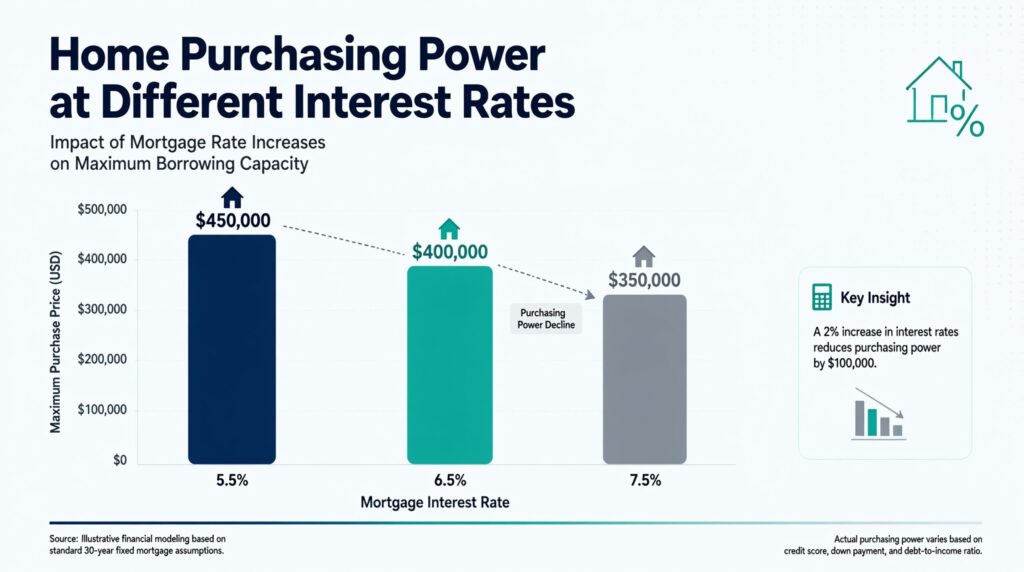
Interest rates represent the cost of borrowing, and they directly dictate your monthly payment capacity. When mortgage rates climb, your purchasing power drops precipitously.
For example, on a fixed $2,500 monthly payment budget, a 5.5% interest rate allows you to borrow roughly $440,000. If rates climb to 7.5%, that same $2,500 monthly budget only allows you to borrow about $357,000. That is an $83,000 loss in purchasing power from a 2% rate spike.
2. Your Debt-to-Income (DTI) Ratio
Your DTI ratio is the primary metric lenders use to gauge your default risk. Recurring debts like car payments, student loans, and credit card minimums eat directly into your back-end DTI limit.
Every dollar you pay toward existing debts is a dollar that cannot be used toward your housing budget. If you want to see how reducing your total loan balance can boost your purchasing power, run your numbers through our Mortgage Amortization Calculator to see how debt reduction speeds up equity.
3. Macroeconomic Inflation and Living Costs
Inflation silently erodes your home buying budget. When the costs of groceries, energy, and building materials rise, homeowners insurance premiums and property tax rates follow suit.
Higher tax and insurance rates increase the non-loan portion of your monthly mortgage payment, leaving less room for principal and interest. You can review detailed historical inflation and cost-of-living data directly from the U.S. Bureau of Labor Statistics (BLS) to see how consumer price shifts impact your local market.
4. The Size of Your Down Payment
Your down payment has a double impact on your purchasing capacity. First, it directly increases your home budget dollar-for-dollar because you do not have to borrow those funds.
Second, putting down 20% or more completely eliminates private mortgage insurance (PMI). By removing that monthly PMI fee, you free up more of your monthly payment budget for principal and interest, allowing you to qualify for a larger base loan.
5. Your Personal Credit Score
Your credit score is the gatekeeper of your interest rate. Lenders reserve their lowest, most competitive rates for buyers with credit scores above 760.
If your score is sitting at 640, you will be penalized with a much higher interest rate, which increases your monthly payment and lowers your maximum home budget. If you are working to optimize your credit and lower your potential monthly payments, try using our Mortgage Rate Calculator to analyze different rate scenarios.
Real-World Scenarios: The Calculator in Action
To understand how these mathematical rules work in different financial situations, let us run three distinct homebuyer profiles through our mortgage affordability calculator.
Scenario 1: The Conservative Savers (Marcus & Elena)
Marcus and Elena are highly risk-averse. They earn a combined gross income of $150,000 annually ($12,500/month) and carry zero debt.
They have saved a massive $80,000 down payment and want to limit their housing budget strictly to the front-end 28% limit to ensure they have plenty of cash left over for investments.
| Input Variable | Value | Output Metric | Value |
|---|---|---|---|
| Gross Monthly Income | $12,500 | Front-End PITI Limit (28%) | $3,500 |
| Existing Monthly Debts | $0 | Back-End PITI Limit (36%) | $4,500 |
| Down Payment Saved | $80,000 | Calculated Max Monthly Payment | $3,500 |
| Assumed Interest Rate | 6.50% | PMI Required | No (20%+ Down) |
| Loan Term | 30 Years | Maximum Home Purchase Price | $535,000 |
Strategic Analysis:
Because Marcus and Elena have zero existing debt, their back-end DTI limit is very high ($4,500). However, they choose to stick to the more conservative front-end limit of $3,500 per month.
With their $80,000 down payment, they can safely buy a $535,000 home without stretching their budget. This conservative planning keeps their finances balanced and ensures they can continue to fund their retirement accounts aggressively.
Scenario 2: The Aggressive Tech Professional (Sarah)
Sarah is a high-earning software engineer making $180,000 gross annually ($15,000/month). She carries a $600 monthly car payment and $400 in student loans ($1,000 total monthly debt).
She wants to maximize her borrowing capacity to buy a modern condo in a prime downtown location, putting down 10% ($50,000).
| Input Variable | Value | Output Metric | Value |
|---|---|---|---|
| Gross Monthly Income | $15,000 | Front-End PITI Limit (28%) | $4,200 |
| Existing Monthly Debts | $1,000 | Back-End PITI Limit (36%) | $4,400 |
| Down Payment Saved | $50,000 | Calculated Max Monthly Payment | $4,200 |
| Assumed Interest Rate | 6.75% | PMI Required | Yes (10% Down) |
| Loan Term | 30 Years | Maximum Home Purchase Price | $550,000 |
Strategic Analysis:
Sarah’s existing debt of $1,000 per month drags down her back-end limit to $4,400. Because our calculator takes the lower of the two ratios, her budget is capped at the front-end limit of $4,200 per month.
Even with a 10% down payment requiring monthly PMI, Sarah’s high income allows her to purchase a $550,000 condo. However, she must keep in mind that her monthly budget will be highly leveraged, leaving less room for liquid savings.
Scenario 3: The Squeezed First-Time Buyer (David)
David earns $72,000 gross annually ($6,000/month) and has a $350 monthly car payment. He has saved a modest $15,000 down payment.
David needs to find a realistic home budget that allows him to buy a starter home without putting his budget under constant strain.
| Input Variable | Value | Output Metric | Value |
|---|---|---|---|
| Gross Monthly Income | $6,000 | Front-End PITI Limit (28%) | $1,680 |
| Existing Monthly Debts | $350 | Back-End PITI Limit (36%) | $1,810 |
| Down Payment Saved | $15,000 | Calculated Max Monthly Payment | $1,680 |
| Assumed Interest Rate | 7.00% | PMI Required | Yes (<20% Down) |
| Loan Term | 30 Years | Maximum Home Purchase Price | $215,000 |
Strategic Analysis:
David’s budget is highly sensitive. His car payment reduces his back-end capacity, and his lower down payment means he must pay monthly PMI.
Our calculator caps his maximum monthly PITI payment at $1,680, which yields a maximum purchase price of $215,000. David now knows that looking at properties above this price point will put his monthly budget under severe financial pressure.
Hidden Pitfalls: 3 Biggest Mistakes People Make
Buying a home based on raw emotion rather than cold mathematical reality is a quick path to financial stress. Many buyers ignore the warnings of a mortgage affordability calculator and end up making critical errors that take years to correct.
1. Maxing Out the Bank’s Pre-Approval Limit
Lenders base your pre-approval amount on a rigid mathematical model designed to maximize their loan volume while keeping default risks within acceptable limits. They do not factor in your lifestyle, your desire to travel, your daycare costs, or your personal savings goals.
If you buy a home at your maximum pre-approval limit, you hand over your financial independence to the bank. You will likely find yourself unable to fund your retirement accounts or build a liquid emergency fund.
2. Underestimating the True Cost of Homeownership
Many first-time buyers compare a potential mortgage payment directly to their current monthly rent and assume they can afford the transition. This is a dangerous comparison.
As a renter, your rent is the maximum amount you will pay for housing each month. As a homeowner, your mortgage payment is the bare minimum you will pay.
You must assume full responsibility for property taxes, homeowners insurance, HOA fees, and ongoing maintenance costs, which typically run 1% to 2% of the home’s value annually. Ignoring these non-loan expenses when calculating your budget will quickly drain your savings.
3. Carrying High-Interest Debt into a Home Purchase
Attempting to purchase a home while carrying credit card debt, personal loans, or expensive auto loans severely limits your purchasing power. These monthly payments inflate your back-end debt-to-income ratio, which forces lenders to slash your maximum loan approval amount.
If you do manage to qualify, carrying these competing debts alongside a new mortgage leaves your household budget with zero margin for error.
Expert Strategies: How to Optimize Your Results
If you want to maximize your home buying budget without putting your financial health at risk, you need to play offense. Here are five practical, expert-level strategies to optimize your financial profile and increase your purchasing power.
1. Execute a Debt Paydown Plan Before Applying
The fastest way to increase your home buying budget is to lower your back-end debt-to-income ratio. Focus on paying off small, high-interest debts like credit cards or short-term personal loans to free up monthly cash flow.
For example, paying off a $400 monthly car payment can boost your borrowing capacity by over $60,000 at current interest rates. To track how lowering your baseline debt improves your long-term payment structure, run your numbers through our Mortgage Payment Calculator.
2. Optimize Your Debt-to-Income Ratio
Lenders analyze your credit file with extreme care. To secure the lowest interest rates and highest borrowing limits, aim to keep your back-end DTI ratio below 36%.
Avoid taking on new debt, financing a vehicle, or opening new credit cards in the six months leading up to your home purchase. Keeping your credit clean ensures you qualify for competitive rates, which directly lowers your monthly payment and expands your overall purchase budget.
3. Maximize Your Down Payment to Eliminate PMI
If you can stretch your down payment to reach the 20% mark, you should do so. Eliminating private mortgage insurance (PMI) removes a significant, non-equity-building expense from your monthly PITI payment.
If you are struggling to reach that 20% threshold, try using our PMI calculator to see exactly how much that monthly premium will cost you, and adjust your down payment target accordingly.
4. Leverage Low-Cost Loan Structures
If you plan to stay in your home for less than seven years, consider using a hybrid Adjustable-Rate Mortgage (ARM) rather than a traditional 30-year fixed loan.
ARMs offer lower introductory interest rates for the first three, five, or seven years. This lower rate reduces your initial monthly payments, allowing you to qualify for a larger purchase price while keeping your monthly costs manageable during your stay.
5. Investigate Local First-Time Homebuyer Grants
Many state and local housing authorities offer down payment assistance programs, silent second mortgages, or tax credits for first-time buyers.
These programs can inject extra capital into your transaction, instantly boosting your down payment and lowering your primary loan balance. Reducing your required loan size helps you secure a lower interest rate, which you can analyze in detail using our Mortgage Rate Calculator to measure your savings.
Frequently Asked Questions (FAQs
Q: How much house can I afford based on my income?
A: You can estimate your safe home price by using the 28/36 rule of thumb, which limits housing costs to 28% of your gross monthly income. For a more personalized assessment that includes your down payment and real-time interest rates, use our interactive mortgage affordability tool.
Q: What is the 28/36 rule of home affordability?
A: The 28/36 rule is a standard lending guideline stating your housing expenses should not exceed 28% of your gross monthly income. Additionally, your total recurring monthly debt payments, including your mortgage, should not exceed 36% of your income.
Q: Does a car payment affect how much home I can buy?
A: Yes, any recurring monthly debt payment like a car loan directly reduces your home buying capacity by inflating your back-end DTI ratio. Paying off these debts before applying for a mortgage is an easy way to boost your maximum purchase limit.
Q: Can I buy a house with a 10% down payment?
A: Yes, you can buy a house with a 10% down payment using a conventional or FHA loan. However, because your down payment is below 20%, your lender will require you to pay private mortgage insurance (PMI), which increases your monthly payment.
Q: How do interest rates impact my overall home affordability?
A: Rising interest rates increase your monthly principal and interest payment, which directly reduces the total loan amount you can qualify for. On a fixed monthly budget, even a 1% rate hike can drop your maximum purchase price by tens of thousands of dollars.
Q: What household expenses are included in my monthly mortgage payment (PITI)?
A: Your monthly mortgage payment, also known as PITI, includes your loan principal, compounding interest, local property taxes, and homeowners insurance. If applicable, it will also include monthly private mortgage insurance (PMI) and home owners association (HOA) dues.
Q: How do lenders calculate my debt-to-income (DTI) ratio?
A: Lenders calculate your DTI ratio by dividing your total recurring monthly debt payments by your gross pre-tax monthly income. They use this percentage to gauge your repayment capacity and determine your maximum mortgage loan approval limits.
[Disclaimer & CTA]
Find your safe purchasing limit today by running your personal numbers through our interactive mortgage affordability calculator at the top of this page. Once you have established your target purchase price, check out our Mortgage Loan Calculator to build a custom amortization schedule for your future home.
Disclaimer: The Mortgage Affordability Calculator provided by Nxfly Finance is for educational and informational purposes only. It does not constitute specific financial, investment, or tax advice. Please consult with a licensed financial advisor, fiduciary, or CPA before making any major financial decisions.