

Exhausted by Financial Stress? Stop Guessing and Start Organizing
Money stress can keep you awake at night. You work hard for your paycheck, yet you might find yourself wondering where all your cash went by the end of the month. I have seen many people make this mistake. They try to track every single penny, get overwhelmed, and abandon their personal budget completely. This cycle of financial frustration leaves you feeling guilty and trapped.
When you use bad information or overly complicated budgeting methods, your daily life becomes a struggle. You might notice these common problems:
- You feel intense anxiety every time you open your banking app.
- You constantly transfer money out of your savings account to cover basic bills.
- You fight with your partner about unexpected expenses.
- You dread the arrival of your credit card statement.
- You feel like you are working merely to survive, without building real wealth.
Living paycheck to paycheck destroys your mental peace. Constant worry about money drains your energy and lowers your confidence. But it does not have to be this way. You need a system that brings order to chaos without requiring a degree in accounting. This is exactly where the 50/30/20 budget rule comes into play. It offers a simple, highly effective framework to organize your income, pay your bills, and still enjoy your life.
The Core Mechanics of the 50/30/20 Budget Rule
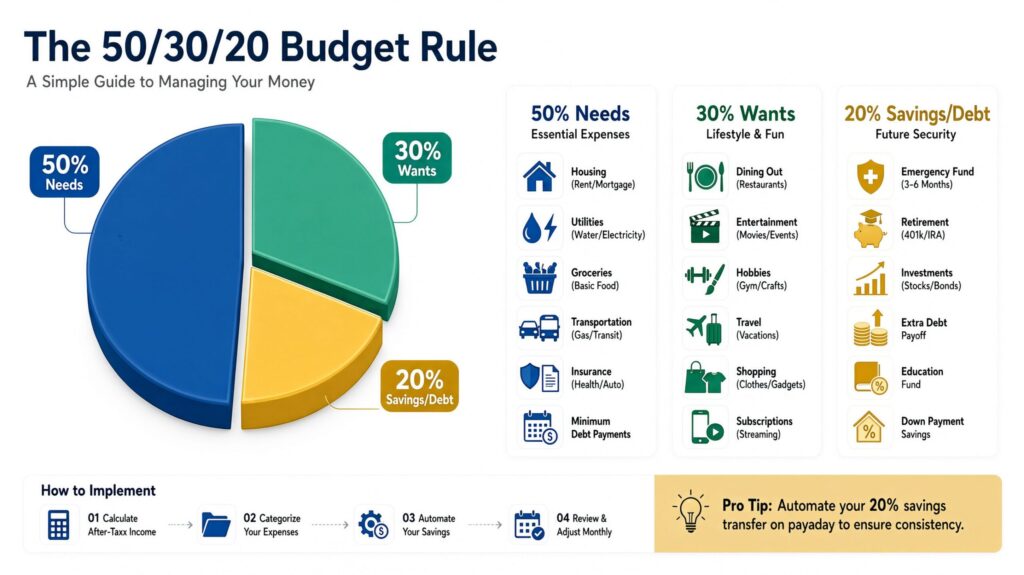
The 50/30/20 budget rule is a highly popular and effective personal finance strategy. It divides your after-tax income into three distinct categories. You allocate 50 percent to essential needs, 30 percent to your lifestyle wants, and 20 percent to your savings and debt payoff goals.
This framework takes the heavy lifting out of financial planning. Instead of tracking 50 different micro-categories, you only manage three main buckets. I always tell my clients that the 50/30/20 budget rule provides guardrails. As long as you stay within the percentages, you can spend your money without guilt.
To start, you must calculate your net income. This is the money that actually hits your bank account after taxes and employer deductions. For more information on how the government views taxable income, you can review the official resources on the IRS website. Once you know your exact monthly take-home pay, you apply the 50/30/20 budget rule percentages to see your target numbers.
Breaking Down the 50 Percent Category: Essential Needs
The largest portion of the 50/30/20 budget rule focuses on your absolute survival and legal obligations. You should spend no more than 50 percent of your net income on essential needs. These are bills that you must pay to live safely and keep your job. If you lose your job tomorrow, these are the expenses that remain.
Your needs category includes:
- Housing Costs: This includes your rent or your mortgage payment, property taxes, and home insurance.
- Basic Utilities: Electricity, water, trash collection, and natural gas fall into this bucket.
- Groceries: This covers basic food items required to feed your family, not luxury items or restaurant meals.
- Transportation: Car payments, basic auto maintenance, gas, and standard public transit passes.
- Insurance: Health, auto, life, and disability insurance premiums.
- Minimum Debt Payments: The minimum required payment on your credit cards, student loans, or personal loans.
In my experience, many people struggle because their needs consume 70 or 80 percent of their income. When your fixed expenses run too high, the entire 50/30/20 budget rule breaks down. If your housing and car payments take up too much of your paycheck, you will never have enough left over for saving or having fun.
Pro Tip: If your essential needs exceed 50 percent, you have two choices. You must either increase your income or aggressively cut your fixed expenses. Consider moving to a cheaper apartment, getting a roommate, or trading in an expensive car for a reliable used vehicle. Managing your housing cost is the fastest way to fix your 50/30/20 budget rule ratios.
Breaking Down the 30 Percent Category: Discretionary Wants
Life is meant to be lived, and the 50/30/20 budget rule fully recognizes this fact. You are allowed to spend up to 30 percent of your after-tax income on wants. These are discretionary expenses. They upgrade your quality of life, but you could survive without them if necessary.
Common items in the 30 percent category include:
- Dining Out: Restaurant meals, coffee shop visits, and food delivery services.
- Entertainment: Concert tickets, movies, sporting events, and hobbies.
- Subscriptions: Streaming services, gym memberships, and premium apps.
- Travel and Vacations: Weekend getaways, flights, and hotel stays.
- Shopping: New clothes, the latest electronics, and home decor that you do not strictly need.
Many traditional budgets fail because they demand extreme deprivation. People try to cut out all fun, which leads to budgeting burnout. The 50/30/20 budget rule gives you permission to spend money on things that make you happy. As long as your wants stay under 30 percent, you are succeeding.
However, you must be honest with yourself. One of the biggest traps in the 50/30/20 budget rule is labeling a want as a need. Upgrading to an unlimited 5G data plan when you have Wi-Fi at home is a want. Buying organic, premium snacks instead of basic groceries is a want. You have to clearly separate these categories to make the math work.

Breaking Down the 20 Percent Category: Savings and Debt Payoff
The final pillar of the 50/30/20 budget rule secures your financial future. You should direct 20 percent of your net income toward saving, investing, and paying off toxic debt. This category builds your wealth and protects you from unforeseen disasters.
This 20 percent bucket includes:
- Emergency Funds: Building a cash cushion for unexpected car repairs or medical bills.
- Retirement Contributions: Money you send to your IRA or 401(k) beyond your employer match.
- Extra Debt Payments: Any money you pay above the minimum requirement to crush your credit card balances or auto loans faster.
- Sinking Funds: Saving up cash for a future down payment on a house or a new car.
If you have high-interest consumer debt, such as credit cards, I highly recommend prioritizing those balances first. You can easily speed up your progress by learning how to create a monthly budget that is easy to follow. By directing the full 20 percent toward debt, you eliminate the high interest charges dragging you down.
Once your bad debt is gone, shift this 20 percent toward building a fully funded emergency reserve. Most experts recommend saving three to six months of essential living expenses. After you secure your emergency fund, focus the 20 percent of your 50/30/20 budget rule solely on long-term wealth building and investing.
A Real-Life Example of the 50/30/20 Budget Rule in Action
To truly understand how the 50/30/20 budget rule works, let us look at a practical example. Meet Alex. Alex is a graphic designer who brings home exactly $4,000 every month after taxes.
According to the 50/30/20 budget rule, Alex breaks down his money like this:
- 50% Needs = $2,000: Alex allocates this money to his $1,200 rent, $300 for groceries, $200 for utilities, $150 for car insurance, and $150 for minimum loan payments.
- 30% Wants = $1,200: Alex uses this money for weekend outings with friends, two restaurant meals a week, his gym membership, and a new video game.
- 20% Savings = $800: Alex sends $400 straight to his high-yield savings account and applies an extra $400 to his student loan principal to pay it off early.
Notice how clean and clear this system is. Alex does not have to worry if he spends $50 on a steak dinner, because he knows it fits safely inside his $1,200 wants allowance. This is the beauty of the 50/30/20 budget rule. It removes the stress of micro-managing every transaction.
Advanced Strategies for Mastering the 50/30/20 Budget Rule
Once you understand the basic framework, you can use advanced strategies to optimize your money. Many people start the 50/30/20 budget rule with high motivation, but they fall off track after a few weeks. To make this system a permanent part of your life, you have to build systems that protect you from your own spending habits.
Here are the best expert strategies for long-term success.
Automate Your 20 Percent Immediately
The most common reason people fail at the 50/30/20 budget rule is that they wait until the end of the month to save. By the time the month ends, the 20 percent is completely gone. You must pay yourself first.
Set up an automatic transfer with your bank. On the exact day your paycheck clears, automatically move your 20 percent into a separate savings account or an investment portfolio. If you are focused on saving for a specific goal, you should use our Savings Calculator to project exactly how fast your wealth will grow. When the money leaves your main checking account instantly, you remove the temptation to spend it on unnecessary wants.
Perform a Quarterly Expense Audit
Your expenses will constantly shift. Your utility bills might rise in the winter, or your car insurance premium might increase. Because of these changes, you cannot just set up the 50/30/20 budget rule and ignore it forever.
I suggest sitting down every three months to audit your spending. Print out your last three bank statements. Grab three different colored highlighters. Highlight your needs in green, your wants in yellow, and your savings in pink. Add up the totals. If your needs have crept up to 60 percent, you know exactly where the problem lies. You can then immediately start cutting back to get your 50/30/20 budget rule back in balance.
Adjust for High-Cost-of-Living Areas
Many young professionals ask me how to manage the 50/30/20 budget rule when they live in expensive cities like New York or San Francisco. In these locations, rent alone can easily consume 40 to 50 percent of a paycheck.
If you live in an expensive area, you might need to temporarily modify the percentages. You might use a 60/20/20 split instead. You would spend 60 percent on needs, cut your wants down to 20 percent, and keep your savings at 20 percent. The specific numbers can flex slightly, but the core philosophy of prioritizing savings and limiting discretionary spending remains unchanged.
Calculating Your True Take-Home Pay
To execute the 50/30/20 budget rule correctly, you must start with the right income number. Many beginners make the fatal error of using their gross income – the big number at the top of their offer letter. If you base your budget on your gross income, you will overspend massively.
You must use your after-tax income, also known as net pay. This is the amount that actually deposits into your checking account after the government takes income tax, Social Security, and Medicare.
However, things get tricky when you have automatic payroll deductions. If your employer automatically deducts money for health insurance premiums, that money counts toward your 50 percent “Needs” category, even though it never hit your bank account. You have to add that amount back into your total income calculation, and then assign it to the needs bucket.
Similarly, if you contribute directly to a traditional 401(k) from your paycheck, that money belongs in your 20 percent “Savings” bucket. To get a highly accurate picture, you need to read your pay stub carefully. Add your direct deposit amount together with any pre-tax health or retirement deductions. That final number is your true income base for the 50/30/20 budget rule. For a deep dive into how taxes and deductions impact your money, check out the resources from the Federal Reserve.
Disastrous Budgeting Traps You Must Avoid
Even with a simple system like the 50/30/20 budget rule, people stumble. I see the same costly mistakes repeated over and over again. If you can avoid these pitfalls, you will guarantee your financial success.
Mistaking Lifestyle Upgrades for Basic Needs
This is the most common trap. You convince yourself that a luxury apartment with a rooftop pool is a “need” because everyone needs a place to live. Or you justify a brand-new $50,000 SUV as a “need” because you require transportation to work.
You must be ruthless when categorizing your expenses for the 50/30/20 budget rule. Shelter is a need; a luxury high-rise is a want. Basic transportation is a need; heated leather seats are a want. If you blur these lines, your 50 percent category will explode, leaving you with zero cash for savings or debt payoff. If you are struggling with high vehicle costs, use our Auto Loan Calculator to see how much a cheaper car could save you every month.
Ignoring Irregular Annual Expenses
The 50/30/20 budget rule is usually applied on a monthly basis. Because of this, people often forget about massive expenses that only happen once or twice a year. Your annual car registration, holiday gift shopping, or back-to-school supplies can completely ruin a perfectly planned month.
To prevent this, you should estimate your total yearly irregular expenses and divide them by 12. Take that monthly amount and set it aside in a dedicated sinking fund within your 20 percent savings category. When December arrives, you will have all the cash ready for holiday gifts without disrupting your monthly 50/30/20 budget rule flow.
Quitting After One Bad Month
Perfection is the enemy of progress. You will have a month where your car breaks down, your dog gets sick, and you accidentally spend 45 percent of your income on wants. It happens to everyone.
The biggest mistake you can make is viewing one bad month as a total failure and giving up on the 50/30/20 budget rule completely. Financial planning is a lifelong marathon. If you mess up in October, forgive yourself, reset your trackers, and start fresh in November. Consistency always beats intensity when it comes to managing your money.
Your Monday Morning Action Plan
Reading about the 50/30/20 budget rule will not change your life unless you actually implement it. You do not need to wait for the new year or even the start of a new month. You can take control of your financial destiny today.
Here is your exact checklist to get started tomorrow morning:
- Find Your Net Income: Pull up your last two pay stubs and calculate exactly how much money hits your bank account every month.
- Calculate Your Targets: Multiply your net income by 0.50 for your needs, 0.30 for your wants, and 0.20 for your savings goals. Write these three numbers down on a sticky note.
- Review Last Month: Look at your previous month’s bank statement. Add up your basic needs and see how close you are to the 50 percent mark.
- Set Up One Automation: Log into your banking app and set up a recurring transfer that moves your 20 percent savings out of your checking account the day you get paid.
By applying the 50/30/20 budget rule, you remove the stress and anxiety from your financial life. You give every dollar a specific job. You ensure your bills get paid, you fund your future, and you still enjoy the fruits of your labor today.
Frequently Asked Questions (FAQs)
Is the 50/30/20 budget rule realistic for low-income earners?
Yes, but it requires strict discipline and careful adjustments. For low-income earners, basic needs like rent and groceries often consume far more than 50 percent of their take-home pay, leaving very little room for flexibility. If your needs take up 70 percent of your income, you must temporarily shrink your wants category to 10 percent to ensure you still hit your 20 percent savings goal. Over time, your primary focus should be increasing your income through a better job or side hustle to bring your ratios back into balance.
Does the 50/30/20 budget rule use gross or net income?
No, the rule does not use gross income; it strictly uses your net income. Net income is your take-home pay after taxes, Social Security, and Medicare have been deducted from your paycheck. If you use your gross income, you will calculate inflated numbers and end up drastically overspending. Always base your budget percentages on the actual cash that lands in your checking account each month.
Can I change the percentages in the 50/30/20 budget rule?
Yes, the percentages serve as a guideline rather than a rigid legal requirement. If you have aggressive financial goals, such as retiring early or paying off a massive amount of high-interest debt, you might prefer a 50/20/30 split, pushing 30 percent toward savings and only 20 percent toward wants. You have full permission to modify the ratios to match your current life circumstances, as long as you prioritize your needs and savings first.
Do credit card payments count as needs or wants?
Yes, minimum credit card payments strictly count as a basic need. You are legally obligated to make the minimum monthly payment to avoid late fees, penalty interest rates, and damage to your credit score. However, any extra money you send above the minimum payment belongs in your 20 percent savings and debt payoff category. You should check out our Credit Card Payoff Calculator to see how extra payments can save you thousands in interest charges.
How does the 50/30/20 budget rule help with inflation?
Yes, this rule naturally helps you adapt to rising prices without breaking your budget. Because the 50/30/20 budget rule is based on percentages rather than fixed dollar amounts, it forces you to adjust your lifestyle when costs go up. If inflation causes your grocery bill to spike, you will immediately see your “Needs” category exceed 50 percent. This acts as an early warning system, prompting you to cut back on discretionary “Wants” to cover the higher cost of living.
Should I include my 401(k) contributions in the 50/30/20 budget rule?
Yes, workplace retirement contributions must be factored into your calculations. Even though 401(k) money is taken out before you get your paycheck, it is highly active money working for your future. You should add your monthly 401(k) contribution amount back into your total net income figure. Then, ensure that specific amount is counted toward your 20 percent savings category to get an accurate picture of your true savings rate.
The information provided in this article is for educational and informational purposes only. It does not constitute professional financial, investment, tax, or legal advice. The content on Nxfly Finance (nxfly.com) is intended to help you understand general financial concepts and should not be used as a substitute for personalized advice from a qualified financial advisor, CPA, tax professional, or licensed attorney.
Every individual’s financial situation is unique. Results, outcomes, and experiences discussed or implied in this article may vary significantly based on your personal circumstances, income, credit profile, location, and market conditions. No financial outcome, return, or result is guaranteed.
Nxfly Finance does not endorse, promote, or recommend any specific financial product, service, lender, institution, or investment. Any tools, calculators, or estimates provided on this website are for illustrative and planning purposes only and should not be solely relied upon for making financial decisions.
Always conduct your own due diligence and consult with a licensed financial professional before making any financial, investment, or borrowing decisions. By reading and using this content, you acknowledge and agree that Nxfly Finance and its authors are not liable for any financial decisions made based on the information provided here.
For more information on financial regulations and consumer protections in the United States, visit the Consumer Financial Protection Bureau (CFPB) or the U.S. Securities and Exchange Commission (SEC).