

By Marcus Vance, CFP® | Reviewed by the Nxfly Finance Team
Lenders want you to stare exclusively at the interest rate.
They market rock-bottom percentages to get you in the door. They print those low numbers in massive, bold font across every billboard and digital ad on the internet. But as a Certified Financial Planner, I have to tell you the blunt truth. That eye-catching interest rate is only half the story.
You need a reliable mortgage APR calculator to see the whole picture.
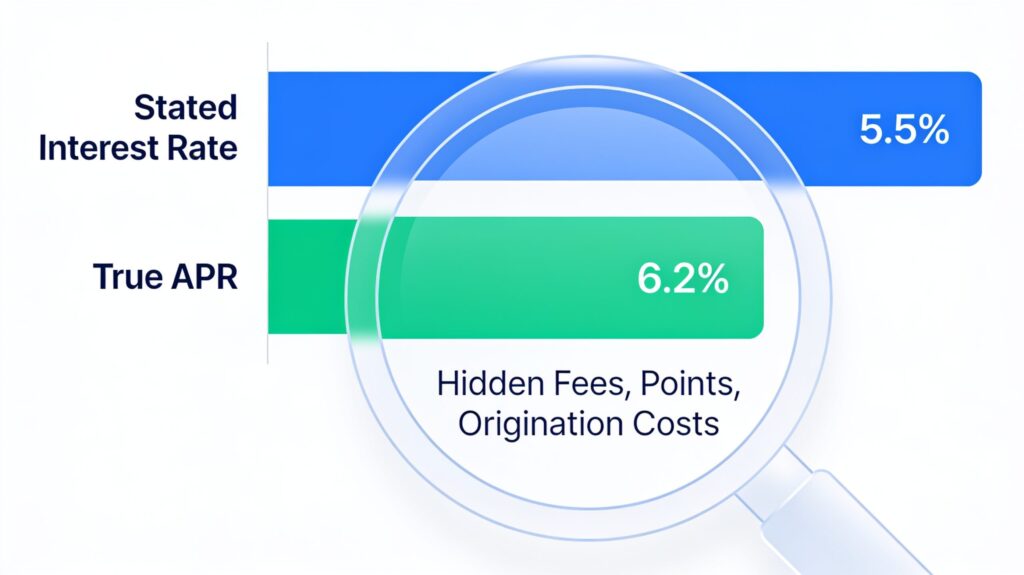
The Annual Percentage Rate (APR) includes the actual interest rate plus the hidden fees, lender charges, and closing costs rolled into your loan. When you ignore the APR, you fall into a very expensive trap. You might sign paperwork for a loan with a 5.5% interest rate, thinking you scored a massive victory. Then you get to the closing table. Suddenly, you are hit with thousands of dollars in origination fees, underwriting charges, and discount points.
Your actual cost of borrowing shoots through the roof.
We built the Nxfly Finance mortgage APR calculator to stop this from happening to you. This tool strips away the marketing hype. It forces lenders to show their hand. By running your loan estimates through our calculator, you instantly translate confusing upfront fees into a single, standardized percentage.
This is how you compare apples to apples.
If Lender A offers a 6.0% rate with zero fees, and Lender B offers a 5.5% rate with $10,000 in upfront costs, which one is actually cheaper? You cannot guess the answer. You have to do the math. Understanding how US mortgage payments are calculated is a great starting point, but mastering your APR is how you protect your long-term wealth.
Do not let hidden fees drain your equity. Plug your numbers in below, look at the bottom line, and take back control of your real estate transaction.
📊 APR Calculator
Find the true cost of your mortgage including all fees
How to Use the Nxfly Mortgage APR Calculator
Our mortgage APR calculator is designed for ruthless accuracy. To get the most reliable output, you need to pull your official Loan Estimate document from your lender. Look at Page 2. That is where lenders bury the fees that impact your true APR.
Let’s break down exactly what you need to input.
Step 1: Input the Total Loan Amount
Do not enter the purchase price of the home. Enter the exact amount of money you are borrowing from the bank. If you are buying a $500,000 house and putting down $100,000, your loan amount is $400,000. The APR formula uses this specific baseline to determine how heavily your upfront fees impact your overall borrowing cost. A $5,000 fee hurts a lot more on a $100,000 loan than it does on a $500,000 loan.
Step 2: Enter the Stated Interest Rate
This is the advertised rate. It is the percentage the lender promised you before they started adding their fees. You will use this number to generate your baseline monthly payment. If you don’t know your exact payment yet, you can easily verify it using a standard Mortgage Payment Calculator. Your stated rate dictates your principal and interest (P&I) payment, but it ignores the cost of acquiring the loan itself.
Step 3: Add the Loan Term
How long are you borrowing this money for? The standard options are 30 years or 15 years. This input is wildly important for your APR. Why? Because the APR calculation takes all your upfront fees and spreads them out over the life of the loan. If you pay $6,000 in fees on a 15-year mortgage, your APR will jump significantly higher than if you spread those same $6,000 fees over 30 years.
Step 4: Include All Lender Fees (Closing Costs)
This is where the magic happens. You must separate standard real estate costs from lender-specific costs. Do not include things like property taxes, homeowner’s insurance, or title search fees. Those are third-party costs you pay regardless of who gives you the loan.
You only want to input the fees the lender charges to give you the money. Enter your origination fees. Add in your application fees. Include any underwriting fees and the cost of discount points. If the bank is charging you directly for a service required to get the loan, put that number in the box.
Hit calculate. The number that spits out is your true, standardized cost of borrowing.

Key Terms & Concepts Behind Your Mortgage APR
To use this tool effectively, you have to understand the math behind the curtain. Financial jargon is intentionally confusing. Lenders use complicated terms to keep borrowers in the dark.
We are going to fix that right now. Here is exactly what these concepts mean in plain English.
Annual Percentage Rate (APR)
Think of the APR as the overall price tag of your mortgage. As defined by Investopedia’s guide to the Annual Percentage Rate, this metric reflects the broader, true cost of borrowing money. It takes the stated interest rate and blends it together with all the mandatory upfront fees you pay the lender. The federal government requires lenders to disclose this number so you can compare two different loan offers accurately.
Stated Interest Rate (Base Rate)
This is the simple cost of borrowing the principal balance. It does not account for fees. Your stated interest rate determines the exact dollar amount of your monthly principal and interest payment. Lenders love to highlight this number because it always looks smaller and more attractive than the APR. Do not base your final financial decision on the stated rate alone.
Mortgage Origination Fees
This is the bank’s cover charge. Lenders charge an origination fee to process your application, underwrite your file, and actually fund the loan. It is usually calculated as a percentage of your total loan amount—often between 0.5% and 1.0%. Because this fee is a direct cost of securing the financing, it is baked heavily into your APR calculation.
Discount Points
Discount points are prepaid interest. You are literally paying the bank a lump sum of cash upfront to artificially lower your stated interest rate over the life of the loan. One point typically costs 1% of your loan amount and lowers your rate by about 0.25%.
Buying points lowers your monthly payment. But because you are paying thousands of dollars at closing to get that lower rate, your APR will often end up higher than the stated rate you just bought.
Amortization Schedule
Amortization is the mathematical schedule of how your loan is paid off over time. In the early years of a 30-year mortgage, the vast majority of your monthly payment goes toward interest. Only a tiny fraction chips away at the principal balance.
Your APR assumes you will keep the loan for the full 30-year amortization period. If you sell the house or refinance in five years, you won’t actually spread those upfront closing costs across three decades. Your effective APR for those five years will be much, much higher.
Truth in Lending Act (TILA)
This is the federal law that forces lenders to be transparent. TILA requires banks to clearly disclose your APR, your finance charges, the amount financed, and your total payments within three days of your loan application. They provide this via a standardized document called the Loan Estimate. Without TILA, lenders could hide their fees entirely. With it, you get the raw data needed to run our mortgage APR calculator and protect your money.
Unveiling the Formula: The Math Behind the Calculator
You cannot find your APR by simply adding a few numbers together. The calculation is surprisingly complex.
Lenders do not want you to do this math by hand. They rely on the confusion to slip heavy fees past you. To calculate the exact Annual Percentage Rate, you have to reverse-engineer your mortgage. You are essentially calculating the internal rate of return (IRR) on your loan, treating the upfront fees as a reduction in the actual cash you received from the bank.
First, the bank determines your monthly principal and interest payment based on your stated interest rate. If you want to see exactly how that payment is generated, run your numbers through our Mortgage Amortization Calculator.
Once you have that monthly payment, the APR formula kicks in. Here is the mathematical equation used to find your true borrowing cost:
Adjusted Loan Amount = PMT × [ (1 – (1 + r)^-n) / r ]
To make sense of this, let’s break down exactly what these variables mean in the real world:
- Adjusted Loan Amount (Present Value): This is your total loan amount minus the upfront lender fees and points. If you borrow $300,000 but pay $6,000 in closing costs, your adjusted loan amount is $294,000. You are paying interest on $300k, but you only practically received $294k.
- PMT (Monthly Payment): This is your required monthly principal and interest payment based on the original $300,000 loan and the stated interest rate.
- n (Total Months): The total number of payments in your loan term. A standard 30-year mortgage equals 360 months.
- r (Periodic Interest Rate): This is the monthly APR. This is the variable the formula is trying to solve for.
Here is the catch. You cannot isolate “r” using basic algebra.
Because the “r” appears in both the numerator and the denominator as an exponent, the equation requires a mathematical process called “iteration.” You have to plug in estimated rates, test the result, and adjust up or down until the right side of the equation exactly matches your Adjusted Loan Amount. Once you find that exact monthly rate (r), you multiply it by 12.
That final number is your Annual Percentage Rate.
Our tool runs this algorithmic iteration in milliseconds. It processes the exact same mathematical logic used by bank underwriters and federal regulators. When you use our calculator, you bypass the manual guesswork and instantly expose the real mathematics governing your debt.
5 Critical Factors That Influence Your Numbers
Your APR is not generated in a vacuum. It is directly tied to a mix of personal financial decisions and massive global economic forces.
If you want to lower your APR, you have to understand the levers that control it. Some of these variables are entirely within your control. Others are dictated by Wall Street. Let’s look at the five primary factors that force your true borrowing costs up or down.
1. Your FICO Credit Score
Your credit score dictates your risk profile. Banks price loans based on risk. If you have a 620 FICO score, lenders view you as a high-risk borrower. To compensate for the chance that you might default, they will hit you with what the industry calls Loan-Level Price Adjustments (LLPAs). These are mandatory extra fees tagged onto your mortgage based purely on your credit history. Because your fees increase, your APR spikes. Borrowers with an 800 FICO score pay significantly lower fees and secure a much lower APR.
2. Upfront Lender Fees and Origination Costs
This is the biggest variable separating your base rate from your APR. Every bank charges different administrative fees. One lender might charge a flat $1,000 underwriting fee. Another might charge a 1% origination fee, which equals $4,000 on a $400,000 loan. The heavier the upfront fees, the wider the gap between your advertised interest rate and your final APR. You can negotiate some of these fees. Always ask lenders to itemize their origination charges.
3. The Length of Your Loan Term
Time drastically alters your APR calculation. When you pay upfront fees, the APR formula spreads the cost of those fees over the entire life of your loan. If you take out a 30-year loan, you have 360 months to absorb the impact of a $5,000 fee. If you take out a 15-year loan, you only have 180 months. Because the fees are compressed into a shorter time frame, the same $5,000 fee will cause a much larger spike in the APR on a 15-year loan than on a 30-year loan.
4. Buying Discount Points
Buying points is a direct trade-off between upfront cash and long-term interest. You pay the bank thousands of dollars at closing to permanently lower your stated interest rate. While your monthly payment drops, that massive upfront cash payment gets factored directly into your APR. Often, buying points creates an APR that is higher than the discounted rate you just purchased. You have to stay in the house long enough to break even on that upfront cost.
5. Macroeconomic Market Conditions
You do not control the broader economy. Lenders base their baseline mortgage rates on the yields of 10-year Treasury bonds, which react directly to inflation and Federal Reserve policies. According to the Consumer Financial Protection Bureau (CFPB), base interest rates shift daily based on economic data. When inflation runs hot, bond yields rise, base mortgage rates rise, and your resulting APR climbs with it. You have to lock in your rate at the right time to protect yourself from sudden market spikes. If your down payment is less than 20%, you will also face mortgage insurance costs. Check your exposure with our PMI calculator to see how insurance premiums further impact your total monthly obligations.
Real-World Scenarios: The Calculator in Action
Theory is fine. But personal finance requires execution.
To show you exactly how this math impacts your bank account, let’s run three completely different real-world scenarios through the Nxfly mortgage APR calculator. These case studies represent actual situations I see daily as a financial planner. Watch how the hidden fees completely alter the financial reality for each of these buyers.
Scenario 1: The Cash-Strapped First-Time Homebuyer
Sarah is buying her first condo for $350,000. She only has a 5% down payment. After draining her savings to cover the down payment, she is extremely sensitive to monthly costs. She needs the lowest possible payment. She gets two loan estimates. Lender A offers a 6.5% rate with $8,500 in upfront origination and processing fees. Lender B offers a 6.75% rate but only charges $1,500 in fees. Sarah naturally gravitates toward Lender A because the 6.5% rate sounds cheaper.
Let’s plug her numbers into the tool. Loan amount: $332,500. Term: 30 years.
| Input Variable | Lender A Offer | Lender B Offer |
|---|---|---|
| Loan Amount | $332,500 | $332,500 |
| Loan Term | 30 Years | 30 Years |
| Stated Interest Rate | 6.50% | 6.75% |
| Upfront Lender Fees | $8,500 | $1,500 |
| Calculated APR Output | 6.75% | 6.79% |
| Monthly P&I Payment | $2,101 | $2,156 |
Strategic Analysis:
The APR reveals the truth. Lender A’s “cheap” 6.5% rate carries an APR of 6.75% due to massive junk fees. Lender B’s higher 6.75% rate has an APR of 6.79%. The true cost of these two loans is nearly identical over 30 years. However, Lender A expects Sarah to hand over $8,500 in cash right now. She does not have it. By focusing on the APR rather than the base rate, Sarah realizes Lender B is the safer financial move for her current liquidity crisis. She saves $7,000 upfront for a negligible long-term APR difference.
Scenario 2: The Aggressive Real Estate Investor
David is a seasoned investor. He owns a rental property and wants to pull equity out to buy another building. He plans to hold this property for the rest of his life. He goes to his bank for a $500,000 cash-out refinance. The bank offers him a 7.0% rate with zero upfront fees. But David wants to maximize his monthly cash flow on the rental. He decides to buy down his rate by paying $15,000 in discount points upfront to secure a 6.25% base rate. He verifies his new payment limits with a Mortgage Refinance Calculator.
Is buying those points actually a smart move? Let’s check the APR.
| Input Variable | Zero-Fee Refinance | Buying Points Refinance |
|---|---|---|
| Loan Amount | $500,000 | $500,000 |
| Loan Term | 30 Years | 30 Years |
| Stated Interest Rate | 7.00% | 6.25% |
| Upfront Lender Fees | $0 | $15,000 (Points) |
| Calculated APR Output | 7.00% | 6.54% |
| Monthly P&I Payment | $3,326 | $3,078 |
Strategic Analysis:
David pays $15,000 upfront. His monthly payment drops by $248. The mortgage APR calculator shows his true borrowing cost drops from 7.00% to 6.54%. Because David is an aggressive investor who will absolutely keep this loan for 30 years, paying the massive upfront fee is mathematically sound. His lower APR proves the long-term cost is cheaper. If he planned to sell in three years, the APR would look horrific, and he would lose money.
Scenario 3: The Conservative Wealth Builder
Mark and Elena despise debt. They want to pay their house off aggressively before they retire. They are borrowing $400,000. They are deciding between a standard 30-year mortgage and a heavily compressed 15-year mortgage. The bank charges a flat $6,000 in origination fees for either loan. The 30-year rate is 6.0%. The 15-year rate is 5.5%.
Let’s look at how the exact same $6,000 fee impacts their APR depending on the loan term.
| Input Variable | 30-Year Mortgage | 15-Year Mortgage |
|---|---|---|
| Loan Amount | $400,000 | $400,000 |
| Loan Term | 30 Years | 15 Years |
| Stated Interest Rate | 6.00% | 5.50% |
| Upfront Lender Fees | $6,000 | $6,000 |
| Calculated APR Output | 6.15% | 5.74% |
| Total Interest Paid | $463,352 | $188,303 |
Strategic Analysis:
Notice the APR gap. On the 30-year loan, the $6,000 fee only pushes the APR up by 0.15% (from 6.0% to 6.15%). On the 15-year loan, that exact same $6,000 fee pushes the APR up by 0.24% (from 5.5% to 5.74%). Shorter loan terms magnify the impact of upfront fees. However, because the base rate is significantly lower on the 15-year loan, the overall APR remains vastly superior. Mark and Elena choose the 15-year option, accepting the slightly harsher fee penalty to save nearly $275,000 in total lifetime interest.
Hidden Pitfalls: 3 Biggest Mistakes People Make
Most borrowers blindly trust their loan officers. That is a massive financial mistake. The bank is not your friend. They are a business optimizing for their own profit margins. When you do not understand how your Annual Percentage Rate actually works, you bleed money. I have reviewed thousands of loan estimates throughout my career. Borrowers consistently fall into the same three mathematical traps.
Here is how you avoid them.
Ignoring the APR to Chase the Lowest Base Rate
People get obsessed with the lowest possible interest rate. Lenders know this. They exploit it by advertising incredibly low base rates to make the phone ring.
Borrowers see a 5.0% rate and sign the paperwork immediately. They completely ignore the APR. When you do this, you are effectively ignoring the price tag of the loan itself. To give you that shiny 5.0% rate, the lender might be charging you 2% in origination fees and $4,000 in mandatory processing costs. You end up draining your cash reserves at the closing table just to save twenty dollars a month on your payment. The APR exposes this illusion. If the interest rate is 5.0% but the APR is 5.8%, you are being taken for a ride.
Assuming the APR Matters if You Sell in Five Years
Your APR calculation assumes you will keep your mortgage for the entire 30-year term. It takes your upfront fees and divides them by 360 months.
Most people do not stay in their homes for 30 years. Life happens. You switch jobs, have kids, or downsize. The average homeowner moves or refinances every five to seven years. If you pay heavy closing costs to get a low APR, but you sell the house in year five, you never actually realized those long-term savings. You just handed the bank thousands of dollars in upfront fees and walked away before breaking even. If you know you are moving within a decade, stop obsessing over a fractionally lower APR. Prioritize a loan with zero or negative points to protect your upfront cash.
Blindly Accepting Junk Fees in the Calculation
Not all fees belong in your loan estimate. Some lenders pad their margins by inventing administrative charges.
They will add “document preparation fees,” “funding fees,” and “application review fees” directly into your total closing costs. These junk fees artificially inflate your APR. Borrowers assume these costs are legally mandated. They are not. They are entirely negotiable. When you run your numbers through the mortgage APR calculator and see a massive discrepancy between your base rate and your final APR, you need to interrogate the lender. Demand an itemized list. Force them to justify every single dollar pushing that percentage up.
Expert Strategies: How to Optimize Your Results
You ran the math. You see the true cost of your mortgage. Now you have to do something about it.
Do not just accept the first set of numbers your bank hands you. As a financial planner, I train my clients to treat mortgages as aggressive negotiations. The lender wants your debt. You have the leverage. Here are five strict strategies to optimize your loan offer, lower your overall borrowing costs, and keep more equity in your pocket.
1. Demand an Itemized Loan Estimate and Negotiate
Never accept a bundled number for your closing costs. Demand the official, legally required Loan Estimate document. Turn directly to Page 2. Look at “Box A: Origination Charges.” This is the only section the lender controls.
If you see vague fees, push back immediately. Tell the loan officer you are shopping their rate against a competitor who waived all application and underwriting fees. In a competitive market, loan officers will often slash their administrative fees to keep your business. When those fees drop, your APR drops with them.
2. Calculate Your Exact Break-Even Point on Discount Points
Lenders will relentlessly pressure you to buy discount points to lower your APR. Before you write a check, do the math.
Divide the total upfront cost of the points by your monthly payment savings. If buying points costs you $4,000 and saves you $80 a month, your break-even point is 50 months. That is just over four years. If you absolutely plan to stay in the property for ten years, buy the points. It is a smart, guaranteed return on investment. If you plan to sell in three years, paying for those points is a catastrophic destruction of your cash.
3. Compare APRs on the Exact Same Day
Mortgage rates are not static. They are tied directly to the bond market and fluctuate daily.
You cannot compare an APR from Bank A that you received on Monday with an APR from Bank B that you received on Thursday. A major economic report could have spiked yields on Wednesday, altering the math entirely. You must gather your Loan Estimates on the exact same day. If you want a quick baseline of where the daily market stands before negotiating, run a scenario through our Mortgage Rate Calculator to see current trends.
4. Optimize Your FICO Score Before Application
Your credit score is the single heaviest weight on your APR. Federal housing agencies use Loan-Level Price Adjustments (LLPAs) to penalize lower credit scores.
If your FICO score is 680, you are going to pay massive surcharges simply to access the money. These surcharges are baked right into your APR. Before applying for a mortgage, pause. Spend six months aggressively optimizing your credit. Pay your credit card balances down to 5% of their total limit to manipulate your credit utilization ratio. Do not close old accounts. Pushing your score above 760 completely eliminates those LLPA penalties, dropping your true borrowing cost instantly.
5. Accelerate Your Principal Paydown Post-Closing
Your legal APR is locked in at closing. But you can still mathematically destroy the bank’s profit margin by aggressively paying down your principal balance.
By making just one extra mortgage payment per year, you completely alter the amortization schedule. You slash years off your loan and save tens of thousands of dollars in interest. The bank hates when you do this. It kills their internal rate of return. Use an Extra Mortgage Payment Calculator to model out exactly how an extra $100 or $200 a month will safely decouple your actual debt timeline from the bank’s projected APR timeline.
Frequently Asked Questions (FAQs)
Q: What is a good APR for a mortgage?
A: A good mortgage APR is typically within 0.1% to 0.25% of the current market interest rate. If your APR is more than 0.5% higher than your base rate, your lender is charging excessive upfront fees. Always shop multiple banks to find the narrowest gap between the two numbers.
Q: Can my APR change over time?
A: Your APR remains permanently fixed if you have a standard fixed-rate mortgage. If you have an Adjustable-Rate Mortgage (ARM), your APR will fluctuate whenever your base interest rate resets according to the broader market index. ARM calculations are inherently unpredictable after the introductory fixed period ends.
Q: Does the APR include property taxes and home insurance?
A: No, your mortgage APR does not include property taxes, homeowner’s insurance, or HOA dues. It only accounts for the base interest rate and the specific fees your lender charges to originate and process your loan. Taxes and insurance are third-party costs disconnected from your borrowing cost.
Q: Why is my APR higher than my interest rate?
A: Your APR is mathematically higher because it adds all your mandatory upfront closing costs and origination fees into your base interest rate. It spreads those cash costs out as a percentage over the life of your loan. The base rate only represents the cost of the principal balance.
Q: How do I lower my mortgage APR?
A: You lower your APR by negotiating away junk fees, boosting your credit score, or paying points at closing. Lenders will frequently drop their processing and origination fees if you prove another bank offered you a more competitive loan estimate. Shopping around is your greatest leverage.
Q: Does paying extra principal reduce my APR?
A: Paying extra principal reduces your total interest paid, but it does not change your official legal APR. Your APR is legally fixed at closing based on your original 30-year amortization schedule and your upfront closing costs. You can verify your exact time savings using a Mortgage Payoff Calculator.
Q: Is it better to have a lower rate or a lower APR?
A: It is almost always better to choose the loan with the lower APR because it represents the true, total cost of the debt. A surprisingly low interest rate packaged with a massive APR means you are heavily overpaying the bank in hidden upfront fees.
Stop guessing about hidden lender fees. Scroll back to the top of the page and plug your loan estimate into the Nxfly Finance Mortgage APR Calculator right now to expose the truth. Once you verify your exact costs, head over to our All Tools page to chart your complete homeownership journey.
Disclaimer: The Mortgage APR Calculator provided by Nxfly Finance is for educational and informational purposes only. It does not constitute specific financial, investment, or tax advice. Please consult with a licensed financial advisor, fiduciary, or CPA before making any major financial decisions.