
By Marcus Vance, CFP® | Reviewed by the Nxfly Finance Team
The banking industry created a brilliant financial trap. They call it Private Mortgage Insurance.
Most people assume that because the word “insurance” is in the name, this policy protects them. It does not. Private Mortgage Insurance (PMI) exists solely to protect the bank. If you lose your job and default on your loan, the PMI company steps in and reimburses the lender for their losses. You still lose the house. You still face foreclosure. You still destroy your credit score.
The bank gets total protection. But you pay the premium.
As a Certified Financial Planner, I have to be blunt with my clients. PMI is dead money. It builds zero equity. It provides you with absolutely zero financial benefit. It is a mandatory penalty fee lenders force you to pay when you do not bring a 20% cash down payment to the closing table. If you want to build wealth through real estate, you must understand exactly how much this penalty drains from your checking account every single month.
You cannot afford to guess. You need an exact number.
That is exactly why we built the Private Mortgage Insurance Calculator. This tool strips away the lender’s marketing language. It isolates the specific dollar amount you are throwing away every 30 days to insure the bank’s profit margins. When you look at how US mortgage payments are calculated, PMI is often the most destructive variable hiding inside your monthly escrow charge.
If you buy a $400,000 house with a 5% down payment, your PMI could easily cost you $180 a month. Over five years, that is $10,800 in pure sunk costs. This money could have funded your retirement. Instead, it vanishes into a corporate insurance pool.
You must take control of these numbers.
By plugging your specific data into our Private Mortgage Insurance Calculator, you will instantly reveal your exact monthly PMI premium. More importantly, this tool will calculate the exact month and year you can legally force the bank to cancel this toxic fee. Stop paying the bank blindly. Enter your numbers below, expose the penalty, and execute a plan to eliminate it.
🏠 PMI Calculator
Estimate your Private Mortgage Insurance cost
📊 Your PMI Estimate
The Mechanics: How to Use the Nxfly Private Mortgage Insurance Calculator
Your PMI premium is not a flat fee. It is a highly volatile metric based entirely on your personal risk profile.
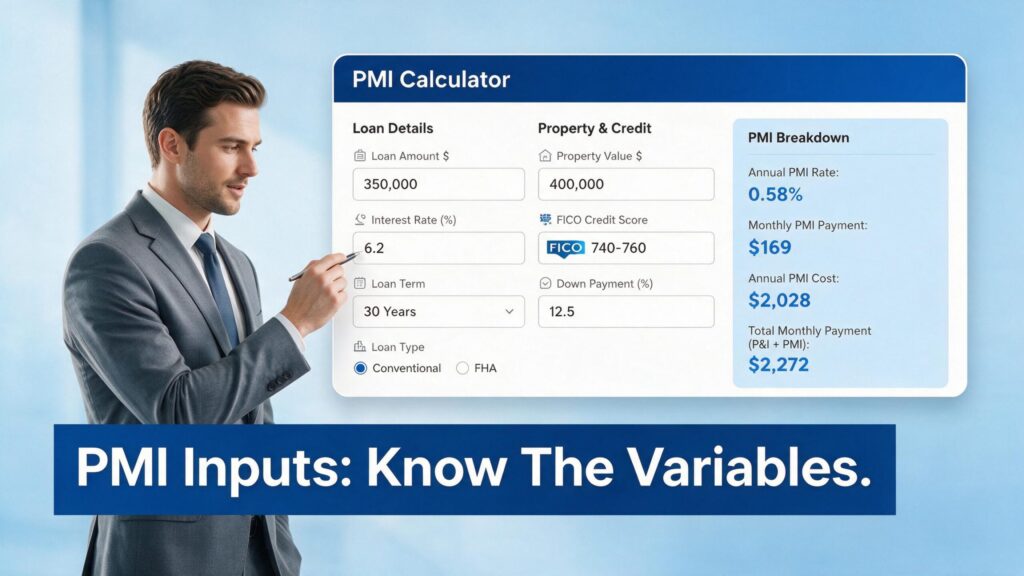
Mortgage insurance companies like Radian, Enact, and MGIC use complex underwriting algorithms to price your policy. Our Private Mortgage Insurance Calculator mirrors this exact logic. To get a perfectly accurate monthly cost, you have to feed the tool precise data. Do not use rough estimates.
Here is exactly how to structure your inputs for flawless mathematical accuracy.
Step 1: Enter the Total Home Purchase Price
Do not input your loan amount here. Input the exact gross purchase price of the property. If you agreed to buy the home for $500,000, type $500,000 into the box. The calculator uses this gross asset value as the foundational baseline to determine your equity position later in the equation.
Step 2: Input Your Exact Down Payment
You can enter this as a flat dollar amount or a percentage. This is the most critical variable in the entire calculation. Your down payment dictates your starting equity. If you input 20% or higher, the calculator will immediately drop your PMI cost to zero. If you input 3%, the tool will register you as a maximum-risk borrower and assign the highest possible insurance multiplier to your loan.
Step 3: Provide Your FICO Credit Score
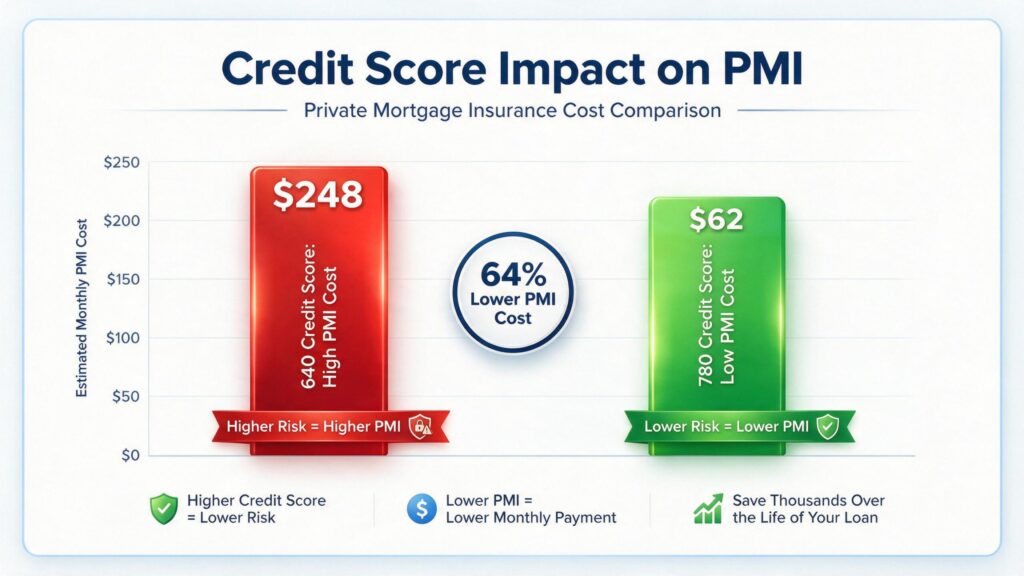
This is the hidden lever of PMI pricing. Many homebuyers think PMI is only based on their down payment. That is false. Insurance companies price their premiums heavily on your credit score. A borrower with a 5% down payment and a 780 FICO score might pay $120 a month in PMI. A borrower with the exact same 5% down payment and a 640 FICO score might pay $300 a month. Use your exact middle credit score to force the Private Mortgage Insurance Calculator to accurately assess your risk tier.
Step 4: Select Your Loan Term
Are you taking out a 30-year fixed mortgage or a 15-year fixed mortgage? This matters immensely. A 15-year loan amortizes rapidly. Because you pay down the principal balance at an accelerated rate, the insurance company’s exposure to risk drops much faster. As a result, PMI premiums on 15-year mortgages are significantly cheaper than premiums on 30-year mortgages. Select your exact timeline.
Step 5: Input Your Quoted Interest Rate
While your base interest rate does not directly change the insurance multiplier, our tool needs this figure to calculate your complete amortization schedule. It uses this schedule to map out exactly how many months it will take for your loan to reach the legal cancellation threshold. If you are unsure of your baseline rate, cross-reference your numbers using a standard Mortgage Payment Calculator before proceeding.
The Anatomy of PMI: Key Terms & Deep Concepts
Real estate finance is purposely opaque. Lenders use complex acronyms to keep you confused at the closing table. When you do not understand the vocabulary, you cannot negotiate effectively.
Before you act on the output of your Private Mortgage Insurance Calculator, you need to understand the structural rules governing this fee. Here is your definitive breakdown of the core financial concepts driving your PMI policy. I will explain these in plain English.
Loan-to-Value (LTV) Ratio
This is the strict mathematical boundary that triggers PMI. Your LTV ratio compares the size of your loan to the appraised value of the home. The formula is simple: LTV = (Loan Amount / Appraised Value) * 100. If you buy a $400,000 house and borrow $380,000, your LTV is 95%. Anytime your LTV exceeds 80%, the banking system views you as a high-risk borrower. That 80% mark is the exact threshold where lenders legally mandate PMI to cover their exposure.
BPMI (Borrower-Paid Mortgage Insurance)
This is the standard form of PMI. It is exactly what our tool calculates. With BPMI, the insurance company calculates an annual premium based on your loan amount and risk profile. The lender divides that annual premium by 12 and adds it directly to your monthly mortgage payment. You pay this fee every single month until your equity reaches the required legal threshold, at which point you can cancel the policy.
LPMI (Lender-Paid Mortgage Insurance)
This is a dangerous alternative to standard PMI. With LPMI, the lender technically pays the mortgage insurance premium on your behalf. But they do not do this out of charity. To recoup the cost, they permanently inflate your base interest rate. If standard rates are 6.0%, a lender offering LPMI might charge you 6.375%. While you avoid a separate line item for PMI on your monthly statement, you cannot cancel LPMI. That higher interest rate is permanently baked into your loan for 30 years.
The Homeowners Protection Act (HPA)
This is your legal shield against the banking industry. The Consumer Financial Protection Bureau (CFPB) officially enforces the Homeowners Protection Act, which guarantees your right to cancel PMI. According to this federal law, you have the right to request PMI cancellation the exact day your mortgage balance drops to 80% of the home’s original value. Furthermore, the law forces the lender to automatically terminate the PMI when your balance drops to 78% of the original value. Our calculator maps this exact timeline for you.
PMI Coverage Requirement
Lenders do not require the PMI company to insure the entire loan. They only require coverage for the top portion of the risk. Fannie Mae and Freddie Mac dictate these requirements. If you put down 5%, the lender might require a 30% coverage policy. This means if you default, the PMI company covers 30% of the bank’s total losses. The higher the coverage requirement, the higher the monthly premium you are forced to pay.
Escrow Account
Your PMI is not a standalone bill you pay directly to the insurance provider. The bank collects it via an escrow account. Every month, you pay your principal, interest, taxes, homeowner’s insurance, and PMI in one lump sum to the mortgage servicer. The servicer holds the PMI portion in the escrow account and pays the insurance premium annually on your behalf. This forced collection guarantees the bank’s protection is never interrupted by a missed premium payment.
Unveiling the Formula: The Math Behind the Calculator
You cannot estimate your PMI by simply picking a random dollar amount.
The mortgage insurance industry uses a rigid, percentage-based calculation to drain your account. Our tool executes this exact formula instantly. To understand exactly how much the bank is taking from you, we have to expose the math.
Here is the foundational formula used to calculate your monthly Private Mortgage Insurance payment:
Monthly PMI = (Loan Amount × PMI Rate) / 12
At first glance, this looks like basic middle-school algebra. But the complexity lies entirely inside that “PMI Rate” variable. Let’s break down exactly what these components mean in the real world:
- Loan Amount: This is the raw debt. It is your total purchase price minus your down payment.
- PMI Rate: This is the annualized percentage the insurance company charges to cover your specific loan. This rate typically ranges from 0.3% to 1.5%. You cannot guess this number. The insurer generates it using a massive matrix that factors in your credit score, LTV ratio, and loan term.
- 12: The formula divides the annual premium by 12 to generate the exact dollar amount added to your monthly mortgage statement.
But finding your monthly payment is only the first step. The real power of our Private Mortgage Insurance Calculator is the cancellation timeline.
To tell you exactly when you can legally stop paying this fee, the calculator runs a complete algorithmic amortization schedule behind the scenes. It calculates how much of your monthly payment reduces your principal balance over time. It continuously tracks that shrinking principal balance against the original appraised value of your home.
The exact month your principal balance hits 80% of that original value, the tool flags your “Request Cancellation Date.” The exact month your balance hits 78%, the tool flags your “Automatic Termination Date.”
If you want to manually verify the speed at which your principal drops, you can run your base numbers through our standard Mortgage Amortization Calculator. Our PMI tool fuses that amortization math with strict federal HPA guidelines to give you institutional-grade accuracy on your exact cancellation timeline.
5 Critical Factors That Influence Your Numbers
Your PMI premium is highly personalized. Two neighbors buying identical houses on the same street could pay drastically different PMI rates.
Insurance companies are essentially bookies. They measure the statistical probability that you will stop making payments. If you look risky on paper, they inflate your premium. If you want to force this monthly penalty down, you must optimize the variables that control it. Here are the five critical factors that dictate the cost of your PMI.
1. Your Exact Down Payment Percentage
This is the heaviest weight in the calculation. If you put down 19.9%, you pay PMI. If you put down 3%, you pay PMI. But those two premiums will not look the same. The mortgage industry uses strict LTV tier brackets: 97%, 95%, 90%, and 85%. Every time your down payment crosses one of these thresholds, your required insurance coverage drops, and your monthly premium plummets. Saving an extra $2,000 to hit the 10% down payment bracket instead of settling for 9% will drastically reduce your monthly penalty.
2. Your FICO Credit Score
Insurance companies analyze massive data sets to price risk. Statistically, borrowers with high credit scores rarely default on their mortgages. If you have an 800 FICO score, your PMI rate will be incredibly cheap—often hovering around 0.3%. If your credit score sits at 640, you are viewed as a high-risk liability. The insurer will aggressively inflate your PMI rate, often pushing it to 1.2% or higher. According to FICO’s official scoring models, paying off revolving credit card debt rapidly boosts your score, giving you direct leverage to secure a lower PMI premium.
3. The Type of Mortgage Program
Conventional loans handle PMI very differently than government-backed loans. Standard conventional loans follow the rules we outlined above. But if you take out an FHA loan because you have a low credit score, you do not pay standard PMI. You pay a Mortgage Insurance Premium (MIP). FHA MIP is mathematically punishing. It includes a massive upfront fee charged at closing, plus a monthly premium. If you put down less than 10% on an FHA loan, that monthly premium is permanent. You can never cancel it. You must refinance into a conventional loan to escape it.
4. Your Chosen Loan Term
Your loan term dictates your amortization speed. On a 30-year fixed mortgage, you pay down your principal balance very slowly during the first five years. The insurance company remains exposed to high risk for a long time. They charge a higher premium for that prolonged exposure. On a 15-year fixed mortgage, you aggressively crush the principal balance. The insurer’s risk plummets rapidly. Because of this, PMI premiums on 15-year loans are significantly cheaper than on 30-year loans.
5. Fixed-Rate vs. Adjustable-Rate Mortgages
Insurance companies hate uncertainty. A fixed-rate mortgage provides total stability. The underwriter knows exactly what your payment will be in year five. An Adjustable-Rate Mortgage (ARM) is volatile. If the broader economic market spikes and your interest rate resets much higher, your monthly payment will skyrocket. This causes “payment shock,” which drastically increases the statistical likelihood of a default. Because ARMs carry this built-in volatility, insurers frequently charge higher PMI rates to cover the added risk.
Real-World Scenarios: The Calculator in Action
The rules of PMI seem rigid, but they play out completely differently depending on your personal financial strategy.
To show you exactly how this math impacts your long-term wealth, let’s run three completely different real-world scenarios through the Private Mortgage Insurance Calculator. These case studies represent exact situations I encounter as a financial planner. Watch how these three buyers use the tool to expose their exact costs and build actionable strategies to escape the penalty.
Scenario 1: The Cash-Strapped First-Time Homebuyer
Sarah makes a strong salary but lives in a highly expensive market. She is buying a $450,000 starter home. She has only managed to save $22,500 (5%) for a down payment. Her credit score is a solid 740. She knows she has to pay PMI, but she needs to know exactly how much it will cost her every month and exactly when she can legally stop paying it.
She runs her numbers through the calculator to establish her baseline.
| Input Variable | Sarah’s Loan Data |
|---|---|
| Home Purchase Price | $450,000 |
| Down Payment | $22,500 (5%) |
| Loan Amount | $427,500 |
| FICO Credit Score | 740 |
| Estimated Monthly PMI Cost | $195 |
| Months Until 80% LTV (Cancellation) | 104 Months (8.6 Years) |
| Total Sunk PMI Cost | $20,280 |
Strategic Analysis:
The tool exposes a brutal reality. Sarah’s monthly PMI is $195. If she just makes her standard minimum payments, it will take her 104 months (over eight and a half years) to hit the 80% LTV cancellation threshold. Over that timeframe, she will hand the bank $20,280 in dead money. Because she now has this exact data, she refuses to wait eight years. She decides to use our Extra Mortgage Payment Calculator to model out exactly how an extra $300 a month toward her principal will accelerate her equity and chop years off her PMI timeline.
Scenario 2: The Strategic Compromiser
Mark is buying a $500,000 house. He has $75,000 in cash reserves. He could put down the full $100,000 (20%) to avoid PMI entirely, but he would have to drain his emergency fund and sell stocks from his brokerage account to do it. He refuses to be house-poor. He decides to put down 15% ($75,000) and accept the PMI penalty. His credit score is excellent at 800.
Mark uses the tool to verify exactly how much this compromise will actually cost him.
| Input Variable | Mark’s Loan Data |
|---|---|
| Home Purchase Price | $500,000 |
| Down Payment | $75,000 (15%) |
| Loan Amount | $425,000 |
| FICO Credit Score | 800 |
| Estimated Monthly PMI Cost | $67 |
| Months Until 80% LTV (Cancellation) | 39 Months (3.2 Years) |
| Total Sunk PMI Cost | $2,613 |
Strategic Analysis:
The calculation proves Mark’s strategy is brilliant. Because he put down 15% and has an elite credit score, his monthly PMI is incredibly cheap—only $67 a month. Furthermore, he only has to endure this penalty for 39 months before hitting 80% LTV. His total sunk cost is $2,613. By paying a mere $2,600 over three years, Mark kept $25,000 heavily invested in the stock market and protected his emergency cash reserves. The calculator proved that avoiding PMI is not always the smartest financial move.
Scenario 3: The Credit Score Victim
Elena is buying a $300,000 condo. She is putting down 5% ($15,000). She makes plenty of money, but she recently missed two credit card payments, tanking her FICO score to 640. She assumes her PMI will be roughly $100 a month based on what her friends pay.
Before she signs the final closing disclosure, she runs her exact profile through the tool.
| Input Variable | Elena’s Loan Data |
|---|---|
| Home Purchase Price | $300,000 |
| Down Payment | $15,000 (5%) |
| Loan Amount | $285,000 |
| FICO Credit Score | 640 |
| Estimated Monthly PMI Cost | $356 |
| Months Until 80% LTV (Cancellation) | 112 Months (9.3 Years) |
| Total Sunk PMI Cost | $39,872 |
Strategic Analysis:
Elena is horrified. Her low credit score triggered the maximum risk penalty. Her PMI is $356 a month. If she rides this loan out to the natural 80% cancellation date, she will throw away nearly $40,000 in pure insurance fees. This calculation completely alters her plan. Elena immediately pauses the home-buying process. She dedicates the next six months to aggressively repairing her credit score, knowing that pushing her FICO above 720 will instantly slash that $356 monthly penalty in half.
Hidden Pitfalls: 3 Biggest Mistakes People Make
Borrowers treat Private Mortgage Insurance like an inescapable tax. They assume they just have to pay it until the bank tells them otherwise. The bank will never proactively help you stop paying them.
As a financial planner, I watch buyers throw thousands of dollars into the fire because they misunderstand the legal rules of PMI. When you misuse a private mortgage insurance calculator, or ignore the timeline it generates, you actively destroy your net worth. Avoid these three massive blunders at all costs.
1. Waiting for the Bank’s Automatic Termination
This is the most expensive mistake you can make. The Homeowners Protection Act (HPA) forces lenders to automatically terminate your PMI when your principal balance reaches 78% of the original appraised value. Lenders strictly follow this law.
But you do not have to wait for 78%.
The law also explicitly states you have the legal right to request cancellation the exact moment your balance hits 80%. That 2% gap is massive. Depending on your loan size, it can take 12 to 18 months of regular payments to drop your balance from 80% to 78%. If your PMI is $200 a month, waiting for the bank to automatically terminate it costs you $3,600 in dead money. Track your exact 80% date using the calculator and initiate the cancellation request manually.
2. Ignoring Rapid Market Appreciation
Your original amortization schedule assumes your home value never changes. It calculates your 80% LTV threshold based strictly on the purchase price.
Real estate rarely stays flat. If you buy a house in a booming market, your home might appreciate by 15% in two years. This completely alters your equity position. You do not need to pay down your principal to hit 20% equity if the asset itself skyrockets in value. Borrowers completely ignore this fact. They keep paying PMI for seven years because their original paperwork told them to. If your market spikes, your equity spikes. You are likely paying an insurance premium you no longer legally owe.
3. Falling for Lender-Paid Mortgage Insurance (LPMI)
Loan officers love to sell LPMI. They pitch it as a “no PMI” loan. This is a brilliant, highly deceptive marketing trap.
The insurance still exists. The lender just pays the premium upfront and permanently raises your interest rate to recoup their cost. Borrowers take this deal because they love the idea of avoiding a separate PMI line item on their monthly statement. This is a catastrophic financial error. Standard PMI falls off when you hit 20% equity. LPMI is permanently baked into your interest rate for the entire 30-year life of the loan. You will pay tens of thousands of dollars more over the decades because you cannot cancel an inflated interest rate.
Expert Strategies: How to Optimize Your Results
You ran the math. You see the exact dollar amount draining from your account every month. Now you have to kill it.
I do not let my clients passively accept PMI. We treat it as a short-term financial emergency. You have leverage, and you have legal rights. Use these five advanced strategies to bypass the penalty, accelerate your equity, and force the bank to drop your insurance requirement years ahead of schedule.
1. Force an Early Cancellation with a Strategic Appraisal
Do not wait for your principal balance to drop. If you have owned the home for at least two years, and homes in your neighborhood are selling for significantly higher prices, take action.
Contact your mortgage servicer. Tell them you want to initiate a PMI cancellation based on current market value. They will require you to pay for a new, bank-approved appraisal. This typically costs around $500. If that new appraisal proves your current loan balance is 80% or less of the new market value, the bank must drop your PMI immediately. Spending $500 to eliminate a $2,500 annual insurance penalty is one of the highest returning investments you can make.
2. Execute an 80-10-10 Piggyback Loan
If you only have a 10% down payment, you do not have to accept PMI. You can completely bypass the system using a piggyback loan structure.
Instead of taking out one massive loan at 90% LTV, you break it up. You take out a primary mortgage for 80% of the home’s value. You take out a second mortgage (often a Home Equity Line of Credit) for 10% of the home’s value. You bring your 10% cash to the closing table. Because the primary mortgage sits exactly at the 80% LTV threshold, standard PMI is legally waived. You will pay a slightly higher interest rate on that smaller 10% second loan, but it is almost always mathematically cheaper than paying a dead PMI premium.
3. Attack the Principal Balance Aggressively
The fastest way to kill your PMI policy is to brutally attack your principal debt.
Your monthly PMI premium provides zero financial return. But every extra dollar you put toward your principal builds permanent net worth. Take your annual tax refund, your work bonuses, or an extra $200 from your monthly budget, and apply it strictly to the principal balance. This accelerates your amortization curve instantly. You will hit that magical 80% LTV threshold years ahead of the bank’s projected schedule.
4. Refinance to Escape Permanent FHA MIP
If you bought your home using an FHA loan with less than a 10% down payment, your mortgage insurance is permanent. You can never cancel it, regardless of how much equity you build.
You only have one escape route. You must refinance. Track your local market value closely. The moment you verify you have 20% equity in the property, immediately run your numbers through a Mortgage Refinance Calculator. Refinancing into a conventional loan completely wipes out the FHA MIP requirement. Even if your new conventional interest rate is slightly higher, shedding that permanent insurance premium frequently saves you massive amounts of monthly cash flow.
5. Demand an APR Comparison on “No PMI” Offers
If a lender pitches you an LPMI loan to “save you from PMI,” force them to prove the math.
Do not look at the monthly payment. Look at the Annual Percentage Rate. Ask the lender to provide two separate Loan Estimates: one with standard, borrower-paid PMI, and one with their LPMI offer. Take both documents and run them directly through a Mortgage APR Calculator. The APR exposes the true cost of the inflated interest rate over 30 years. In almost every scenario, the standard PMI option is cheaper because you can legally cancel it, whereas the LPMI forces you to overpay for decades.
Frequently Asked Questions (FAQs)
Q: How do I completely avoid paying PMI?
A: You can completely avoid PMI by bringing a 20% cash down payment to the closing table. Alternatively, qualifying veterans can use a VA loan, and rural buyers can use a USDA loan; neither of these government-backed programs requires standard private mortgage insurance.
Q: Can PMI be removed if my house goes up in value?
A: Yes, you can remove PMI if rapid market appreciation pushes your equity past 20%. You must contact your lender and pay for a new, official appraisal to legally prove your current loan balance is now 80% or less of the newly appraised value.
Q: Does PMI go away automatically?
A: Yes, lenders are legally required by the Homeowners Protection Act to automatically terminate your PMI when your principal balance reaches 78% of the original appraised value. However, you should manually request cancellation the moment your balance hits 80% to save money.
Q: Is private mortgage insurance tax deductible?
A: Private mortgage insurance tax deductibility is completely dependent on current, highly volatile IRS tax codes. Congress frequently allows the deduction to expire, and it is strictly limited by specific household income caps. You must consult a licensed CPA to verify the current tax year’s rules.
Q: Do I have to pay PMI on an FHA loan?
A: You do not pay standard PMI on an FHA loan; you pay a Mortgage Insurance Premium (MIP). This includes a heavy upfront fee paid at closing and a monthly premium that remains permanently attached to the loan if your down payment was less than 10%.
Q: How much is PMI typically per month?
A: Monthly PMI typically costs between $30 and $70 per $100,000 borrowed, heavily depending on your exact risk profile. A borrower with a 5% down payment and a 640 credit score will pay a drastically higher monthly premium than a borrower with a 15% down payment and an 800 score.
Q: Does paying extra principal reduce my monthly PMI cost?
A: No, making extra principal payments will not lower your monthly PMI premium. The specific dollar amount you pay for insurance remains fixed. However, paying extra principal aggressively shortens the total timeline you are required to pay that fee by reaching the 80% LTV cancellation point faster.
Stop letting the bank drain your equity in secret. Scroll back to the top of the page and use the Nxfly Finance Private Mortgage Insurance Calculator to expose your exact PMI penalty and find your cancellation date. Once you know your numbers, check out our Mortgage Payoff Calculator to map out an aggressive strategy to reach 20% equity faster.
Disclaimer: The Private Mortgage Insurance Calculator provided by Nxfly Finance is for educational and informational purposes only. It does not constitute specific financial, investment, or tax advice. Please consult with a licensed financial advisor, fiduciary, or CPA before making any major financial decisions.