

By Radhika, CFP® | Reviewed by the Nxfly Finance Team
Here’s the number that will quietly run your financial life for the next thirty years: your monthly mortgage payment. Not the listing price. Not the figure your agent tosses out at the open house. The real number — principal, interest, property taxes, homeowners insurance, and sometimes private mortgage insurance stacked on top. Most buyers get this wrong. Badly wrong.
They fall in love with a kitchen, glance at the asking price, and assume the payment will sort itself out. A mortgage payment calculator exists to kill that assumption before it gets expensive. Here’s how the mistake usually unfolds. The first loan disclosure arrives, and the true monthly cost is $400 higher than expected. I’ve sat across from clients in that exact moment. It’s a lousy feeling — and completely avoidable.
That’s why we built the mortgage payment calculator at Nxfly Finance. Enter a handful of numbers — home price, down payment, loan term, interest rate, taxes, insurance — and the tool shows your full monthly obligation in seconds. No sign-up walls. No sales pitch. Just math.
Why does this matter for wealth? Because a mortgage is almost certainly the largest debt you’ll ever carry, and small structural changes produce enormous lifetime swings. Take a $320,000 loan over 30 years:
At 6.5%, principal and interest run about $2,023 a month.
At 7.0%, the same loan costs about $2,129.
That half-point gap is roughly $106 a month — more than $38,000 over the life of the loan. One rate quote. Thirty-eight grand. Guessing is expensive. Calculating is free.
There’s a second reason to run the numbers early: honesty. A calculator doesn’t care about the farmhouse sink or the school district. It tells you, in plain dollars, what a home actually costs to own each month. That clarity keeps you from becoming house poor — owning a beautiful home and nothing else.
In this guide, I’ll walk you through the calculator input by input, explain what each field does to your payment, and define the core terms — amortization, PITI, LTV, escrow — in plain English. Later parts cover worked examples, rate-shopping strategy, and the mistakes that quietly cost buyers thousands. One note before we start. A payment calculator tells you what a loan costs — not what you can comfortably afford. For that, run your income and debts through our Mortgage Affordability Calculator first, then come back here. Let’s get into it.
🏡 Mortgage Payment Calculator
Estimate your total monthly housing payment
📊 Monthly Payment Breakdown
How to Use the Nxfly Mortgage Payment Calculator, Step by Step
The mortgage payment calculator takes about ninety seconds to complete. But don’t let the speed fool you — each field carries real weight. Here’s what every input does, and why you shouldn’t gloss over any of them.
Step 1: Enter the Home Price
This is your starting point — the purchase price you expect to pay, not the loan amount. First-time buyers confuse these two constantly. Buy a $400,000 home with $60,000 down, and the calculator bases your payment on the $340,000 you actually borrow.
Why it matters: at a 6.75% rate over 30 years, every extra $10,000 of price adds roughly $65 to your monthly principal-and-interest payment. Try it yourself — bump the price by $25,000 in the mortgage payment calculator and watch the payment jump. That’s the cost of “just one more bedroom.”
Step 2: Set Your Down Payment
Your down payment shrinks the loan and reshapes the entire deal. Put down less than 20% and most conventional lenders will require private mortgage insurance, which can add $100 to $300 a month depending on loan size and credit. Cross the 20% line and PMI disappears.
That threshold is the single biggest reason buyers pause to save longer. Want to see the exact PMI hit for your scenario? Run it through our PMI calculator — it takes thirty seconds and might change your entire timeline.
Step 3: Choose Your Loan Term
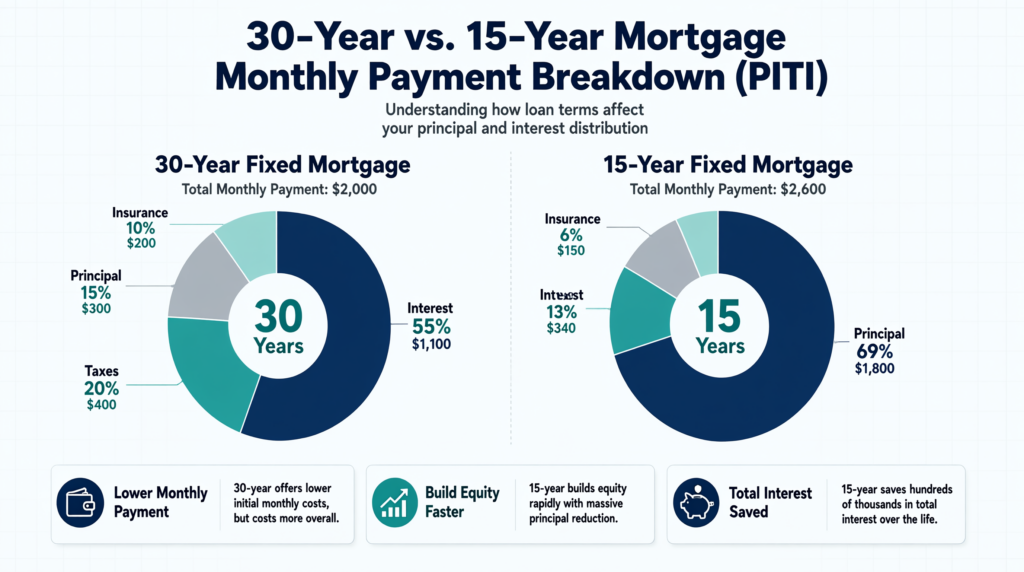
The 30-year fixed is America’s default for a reason: it keeps payments low. But a 15-year term, while raising the monthly bill, can cut your total interest by more than half.
On a $300,000 loan at 6.5%, a 30-year term costs about $382,000 in interest over its life. A 15-year term at a similar rate? Roughly $170,000. Same house. Six-figure difference. The mortgage payment calculator makes this comparison painless — toggle between terms and watch the tradeoff happen in real time.
Step 4: Enter Your Interest Rate
Of all the inputs, this one moves your payment the most — and you have the least direct control over it. Your rate depends on your credit score, down payment, loan type, and the broader bond market.
Here’s the part people miss: rates are negotiable across lenders. Collect at least three quotes on the same day, then test each one in the mortgage payment calculator. A 0.25% improvement on a $350,000 loan saves roughly $58 a month — about $21,000 over 30 years. That’s a new car, earned with a few phone calls.
Step 5: Add Property Taxes, Insurance, and HOA Dues
Principal and interest are only part of the story. Your lender will almost certainly collect property taxes and homeowners insurance through escrow, and if you’re buying a condo or a home in a planned community, HOA dues join the pile.
Taxes vary wildly — a $400,000 home might carry a $3,000 annual tax bill in one county and $9,000 in another. Skip these fields and your “payment” will be understated by hundreds of dollars. The full PITI figure at the bottom of the mortgage payment calculator is the number to budget around. Always.
The Anatomy of a Mortgage Payment: Key Terms Explained in Plain English
The mortgage payment calculator handles the heavy math for you. But if you want to make genuinely smart decisions — not just lucky ones — you need to speak the language. Here are the seven terms that control your payment, stripped of jargon.
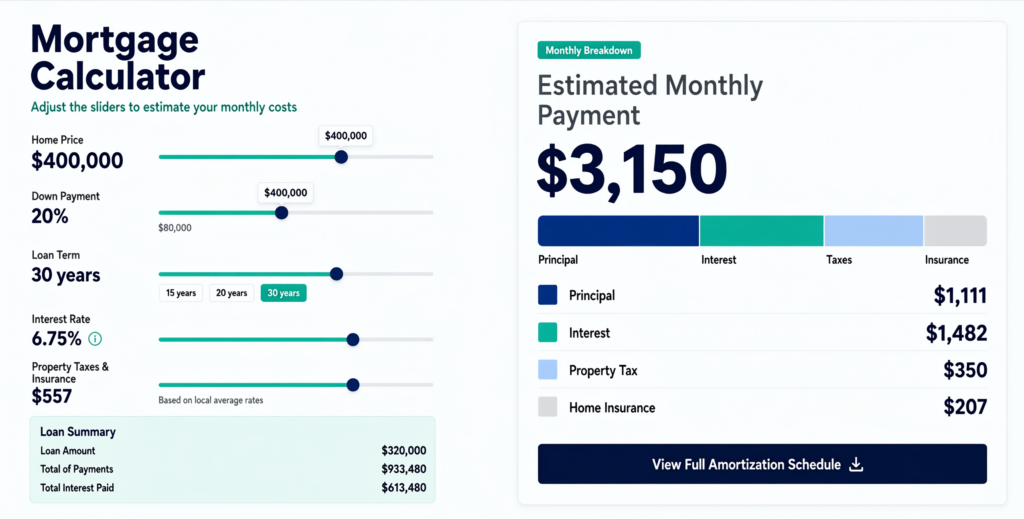
Principal. The amount you actually borrow. Buy a $400,000 home with $80,000 down, and your principal is $320,000. Every monthly payment chips away at this balance — though, fair warning, the early chips are small. On a new 30-year loan at 6.75%, about 87% of your first payment goes to interest, not principal. That ratio flips slowly over time.
Interest Rate. The price you pay to borrow money, expressed as a yearly percentage. Lenders apply it monthly to your remaining balance, which is why a falling balance means shrinking interest charges over the life of the loan. It’s the single biggest lever in your payment — and the one most worth shopping for.
Amortization. The schedule that spreads your loan into equal monthly payments across the full term. Each payment covers that month’s interest first; whatever is left over reduces principal. Because the balance drops a little every month, the interest portion shrinks and the principal portion grows — same payment, shifting mix. Investopedia’s definition of amortization gives you the textbook version. Better yet, plug your numbers into our Mortgage Amortization Calculator and watch the year-by-year breakdown yourself. It’s genuinely eye-opening the first time you see how little equity you build in year one.
PITI. Short for principal, interest, taxes, and insurance — the four parts of a full housing payment. Lenders don’t qualify you on principal and interest alone; they qualify you on PITI, because that’s what actually leaves your bank account each month. The PITI figure at the bottom of the mortgage payment calculator is your real budget number. Never plan around anything smaller.
Private Mortgage Insurance (PMI). A monthly premium that protects your lender — not you — if you default. Conventional loans with less than 20% down almost always require it, typically running 0.5% to 1.5% of the loan amount per year. The good news: PMI isn’t forever. You can usually request cancellation once you reach 20% equity, and under the federal Homeowners Protection Act, lenders must drop it automatically at 78% loan-to-value.
Loan-to-Value Ratio (LTV). Your loan amount divided by the home’s price, expressed as a percentage. Borrow $320,000 against a $400,000 home and your LTV is 80%. This one number quietly controls your interest rate, your PMI obligation, and sometimes your approval odds. Lower LTV means less risk for the lender — and better pricing for you.
Escrow. A holding account your lender manages on your behalf. Each month, they collect one-twelfth of your annual property tax and insurance bills alongside your payment, stash it in escrow, and pay those bills when they come due. The Consumer Financial Protection Bureau’s guide to escrow accounts covers the mechanics in detail. Practical takeaway: your escrow portion changes as taxes and insurance premiums rise — so even a “fixed-rate” payment isn’t entirely fixed.
Unveiling the Formula: The Math Behind the Calculator
You do not need a degree in quantitative finance to buy a home, but you should absolutely understand the math that determines your monthly payment. Behind the clean interface of our mortgage payment calculator lies a standard, time-tested amortization formula.
Lenders worldwide use this exact equation to calculate a fixed-rate monthly payment:
M = P × [r(1 + r)ⁿ] / [(1 + r)ⁿ − 1]
Let’s pull this formula apart so you can see exactly how the variables interact:
- M = Monthly principal and interest payment. This is your base monthly mortgage payment before property taxes, homeowners insurance, PMI, HOA fees, or other costs.
- P = Loan principal (the amount borrowed). For example, if you buy a home for $350,000 and make a $50,000 down payment, your loan principal (P) is $300,000.
- r = Monthly interest rate. Convert the annual interest rate to a monthly rate using:
r = Annual Interest Rate ÷ 12 ÷ 100 Example: 6.0% ÷ 12 = 0.005 - n = Total number of monthly payments.
- 30-year mortgage: 30 × 12 = 360 payments
- 15-year mortgage: 15 × 12 = 180 payments
A Quick Mathematical Proof
Example Calculation:
Let’s walk through a real-world example to see how the formula works.
Loan Details
- Loan Amount (P): $300,000
- Annual Interest Rate: 6.00%
- Monthly Interest Rate (r): 0.005 (6% ÷ 12)
- Loan Term: 30 years
- Total Payments (n): 360
Step 1: Calculate the Numerator
r × (1 + r)ⁿ
= 0.005 × (1.005)³⁶⁰
≈ 0.005 × 6.022575
≈ 0.030113
Step 2: Calculate the Denominator
(1 + r)ⁿ − 1
= (1.005)³⁶⁰ − 1
≈ 6.022575 − 1
≈ 5.022575
Step 3: Divide the Numerator by the Denominator
0.030113 ÷ 5.022575
≈ 0.0059955
Step 4: Multiply by the Loan Amount
Monthly Payment = 300,000 × 0.0059955
= $1,798.65
Result
Your estimated monthly principal and interest payment is $1,798.65.
If you enter these same values into the Nxfly Finance Mortgage Payment Calculator, you’ll receive the same result. The calculator performs these calculations instantly, helping you estimate your monthly mortgage payment without doing the math by hand.
5 Critical Factors That Influence Your Numbers
Your monthly housing payment does not exist in a vacuum. It is the product of personal financial habits and massive, macroeconomic forces. If you want to lower your monthly obligation, you must understand the five primary factors that drive these numbers up or down.
1. Your Credit Score
Think of your credit score as a financial trust metric. Lenders use it to price risk. A borrower with a 760 credit score will secure a significantly lower interest rate than someone with a 640 score.
On a $350,000 mortgage, that rate difference can easily translate to $250 a month. Over 30 years, that single score saves or costs you upwards of $90,000. Before you apply for a loan, check your reports, pay down credit card balances, and resolve any errors.
2. Federal Reserve Policy and Market Yields
The Federal Reserve does not directly set mortgage rates. However, its monetary policy strongly influences them. Mortgage rates closely track the 10-year Treasury yield, which responds directly to inflation expectations and the Fed’s benchmark rate hikes or cuts.
When inflation runs hot, the Fed raises rates to cool the economy, pushing mortgage rates higher. You can track these historic shifts and current market averages directly through the Federal Reserve Bank of St. Louis (FRED) database.
3. Down Payment Size and Loan-to-Value (LTV)
Your down payment directly determines your starting equity and your LTV ratio. Putting down 20% or more completely eliminates the need for private mortgage insurance, instantly lowering your monthly cash outlay.
Additionally, a larger down payment shrinks your principal loan balance, which directly reduces the amount of interest you accumulate. If you are struggling to reach that 20% mark, try using our Mortgage Loan Calculator to see how adjusting your loan size affects your payments.
4. Local Property Tax Rates and Homeowners Insurance
Principal and interest are fixed, but taxes and insurance are highly volatile. Property taxes are set by local county governments and school districts to fund public services. In low-tax states, you might pay 0.5% of your home’s value annually. In high-tax areas, that rate can exceed 2.5%.
Insurance costs are also rising rapidly due to climate risks and increased building material costs. A home in a high-risk flood or wildfire zone will carry massive insurance premiums that can break an otherwise balanced monthly budget.
5. The Loan Term (15-Year vs. 30-Year)
The length of your loan dictates how fast you pay back the principal. A 15-year mortgage compresses the repayment window, which increases your monthly payment but drastically lowers the total interest you pay.
Conversely, a 30-year mortgage offers lower, more manageable monthly payments but costs far more over time. If you want to analyze the long-term trade-offs of interest accumulation over different terms, check out our dedicated Mortgage Interest Calculator to run the numbers.
Real-World Scenarios: The Calculator in Action
To show you how these variables play out in real life, let’s look at three distinct homebuyer profiles. Each scenario uses our mortgage payment calculator to solve a different financial puzzle.
Scenario 1: The Conservative Saver (Marcus & Elena)
Marcus and Elena are debt-averse savers. They want to buy a $450,000 suburban home but refuse to carry a mortgage into retirement. They have saved a massive $150,000 down payment and want a 15-year term to wipe out the debt fast.
Because they have excellent credit (780+), they qualify for a highly competitive 5.5% interest rate.
| Input Variable | Value | Output Metric | Value |
|---|---|---|---|
| Home Price | $450,000 | Monthly Principal & Interest | $2,451.25 |
| Down Payment | $150,000 (33.3%) | Property Taxes (Est. 1.2%) | $450.00 |
| Loan Term | 15 Years | Homeowners Insurance | $120.00 |
| Interest Rate | 5.50% | Private Mortgage Insurance (PMI) | $0.00 |
| Loan Amount | $300,000 | Total Monthly PITI Payment | $3,021.25 |
Strategic Analysis:
By putting down more than 20%, Marcus and Elena completely bypass PMI. Opting for a 15-year term keeps their interest rate low and ensures they will own their home free and clear in 180 months.
Their total lifetime interest paid will be just $141,225. If they had chosen a 30-year term at 6.5%, they would have paid $382,000 in interest. That is a savings of over $240,000.
Scenario 2: The Aggressive Investor (Sarah)
Sarah is a high-earning software engineer who values opportunity cost. She is buying a $600,000 condo. She has the cash to put down 20%, but she prefers to put down the bare minimum (5%) to keep her capital working in the stock market.
She opts for a 30-year fixed loan at 6.75%, betting that her investment portfolio will outperform the cost of her mortgage debt over the long run.
| Input Variable | Value | Output Metric | Value |
|---|---|---|---|
| Home Price | $600,000 | Monthly Principal & Interest | $3,702.14 |
| Down Payment | $30,000 (5.0%) | Property Taxes (Est. 1.5%) | $750.00 |
| Loan Term | 30 Years | Homeowners Insurance | $150.00 |
| Interest Rate | 6.75% | Private Mortgage Insurance (PMI) | $237.50 |
| Loan Amount | $570,000 | Total Monthly PITI Payment | $4,839.64 |
Strategic Analysis:
Sarah’s strategy is aggressive. By putting only 5% down, she keeps $90,000 of liquid cash in her brokerage account. However, this move comes with a price.
She must pay an extra $237.50 every month in PMI until her loan balance drops to 80% of her condo’s value. Her monthly payment is steep, but for Sarah, maintaining liquid investment capital is worth the added monthly cost.
Scenario 3: The First-Time Buyer (David)
David is tired of renting and wants to buy a starter home priced at $275,000. He has saved $15,000 for a down payment and has decent credit (680).
Because his down payment is under 20%, his lender requires PMI. He needs to know his exact monthly cash outlay to make sure he can comfortably manage the payment on his salary.
| Input Variable | Value | Output Metric | Value |
|---|---|---|---|
| Home Price | $275,000 | Monthly Principal & Interest | $1,691.07 |
| Down Payment | $15,000 (5.4%) | Property Taxes (Est. 1.1%) | $252.08 |
| Loan Term | 30 Years | Homeowners Insurance | $95.00 |
| Interest Rate | 6.875% | Private Mortgage Insurance (PMI) | $140.83 |
| Loan Amount | $260,000 | Total Monthly PITI Payment | $2,178.98 |
Strategic Analysis:
David’s total payment is $2,178.98. Crucially, the non-loan costs (taxes, insurance, and PMI) make up $487.91 of that total. If David had only calculated his principal and interest ($1,691.07), he would have under-budgeted by nearly $500 a month.
Using our mortgage payment calculator gives David a realistic view of his monthly obligations, ensuring he does not buy a home that strains his finances.
Hidden Pitfalls: 3 Biggest Mistakes People Make
Most homebuyers do not lose money because the math of a mortgage is hard. They lose money because they ignore the math entirely, or they let wishful thinking override the numbers on the screen. Here are the three most common blunders I see buyers make when planning their monthly housing costs.
1. Calculating Principal and Interest Alone
This is the single biggest trap in residential real estate. You find a home, use a basic online tool, and see a monthly payment of $1,800. You know your budget can handle $2,000, so you make an offer.
Then reality hits.
Once property taxes, homeowners insurance, and HOA dues are added, your actual monthly check climbs to $2,500. Suddenly, you are financially squeezed.
Never analyze a property based solely on the loan payment. Always calculate the complete PITI payment before you sign a purchase agreement.
2. Assuming Escrow Estimates Stay Flat
Many buyers assume their monthly payment is locked in for the next thirty years because they chose a fixed-rate loan. This is a dangerous misunderstanding.
Your interest rate and principal payment will remain constant, but your property taxes and insurance premiums will fluctuate.
In high-growth markets, local municipalities reassess home values regularly, which can cause property taxes to climb. Insurance companies also raise rates annually to keep pace with inflation and rising construction costs.
If your escrow accounts run short, your lender will adjust your monthly payment upward to cover the difference. Always leave a buffer in your monthly budget to absorb these inevitable cost increases.
3. Choosing a Lender Based Only on the Advertised Rate
The lowest advertised rate is not always the cheapest loan. Many lenders advertise artificially low interest rates by bundling expensive discount points into the closing costs.
Paying “points” means you are paying prepaid interest upfront to secure a lower monthly rate. If you plan to sell or refinance the home within three to five years, you will likely move before reaching the break-even point on those upfront fees.
To compare loan offers accurately, look at the annual percentage rate (APR) rather than the nominal interest rate. If you want to analyze the impact of upfront fees on your overall loan costs, use our Mortgage APR Calculator to see the true cost of your borrowing.
Expert Strategies: How to Optimize Your Results
Once you use our mortgage payment calculator to establish your baseline monthly payment, you can take proactive steps to optimize your loan. Here are five expert-level strategies to help you pay off your debt faster and minimize your lifetime interest costs.
1. Implement a Bi-Weekly Payment Schedule
Rather than making twelve standard monthly payments each year, split your monthly payment in half and pay it every two weeks. Because there are 52 weeks in a year, you will make 26 half-payments.
This adds up to thirteen full monthly payments over a twelve-month period.
This simple adjustment shortens a standard 30-year amortization schedule by four to five years. It also saves you tens of thousands of dollars in interest without requiring a major change to your monthly cash flow.
2. Make Target Principal Payments Early in the Loan Term
Amortization schedules are heavily front-loaded with interest. In the early years of your mortgage, very little of your monthly payment goes toward reducing your actual debt.
You can counter this by making extra principal-only payments during the first five years of the loan.
Even an extra $100 a month paid directly toward the principal balance early on has a compounding effect. It shortens your loan term and reduces the total interest you owe over the life of the mortgage. To see the long-term impact of making extra payments, run your numbers through our Extra Mortgage Payment Calculator.
3. Monitor Your LTV to Remove PMI Automatically
If you bought your home with less than 20% down, you are likely paying for private mortgage insurance. Do not rely on your lender to cancel this coverage the moment you hit 20% equity.
Keep a close eye on your home’s market value and your remaining loan balance.
If home prices in your neighborhood rise, you may reach an 80% loan-to-value ratio ahead of schedule. Once you hit this milestone, contact your servicer immediately to request a new appraisal and cancel your PMI payments.
4. Avoid the Temptation to Buy Down the Rate Blindly
Paying upfront points to secure a lower rate is a common strategy, but it is not always the best financial move.
Calculate your break-even point by dividing the upfront cost of the points by your monthly savings.
For example, if paying $4,000 upfront saves you $80 a month, your break-even point is 50 months (just over four years). If there is a chance you will relocate, upgrade, or refinance before those 50 months are up, you will lose money on the transaction. Keep your cash in hand instead.
5. Recast Your Mortgage Instead of Refinancing
If you inherit money or receive a large bonus, you can use it to lower your monthly mortgage payment without going through a full refinance.
Ask your lender about “mortgage recasting.”
In a recast, you make a large lump-sum payment toward your principal balance. The lender then recalculates your monthly payments based on the new, lower balance while keeping your original interest rate and term intact. Recasting typically costs a small administrative fee ($250 to $500) and allows you to bypass the high closing costs of a traditional refinance.
Frequently Asked Questions
Q: What is included in a standard monthly mortgage payment?
A: It provides a reliable estimate based on the information you entA: A standard monthly mortgage payment consists of principal, interest, property taxes, and homeowners insurance, collectively known as PITI. If your down payment was less than 20% on a conventional loan, your payment will also include private mortgage insurance (PMI). HOA dues may also apply but are paid separately.
er. Actual payments may vary because of taxes, insurance, lender fees, and escrow requirements.
Q: How does interest affect my mortgage payment over time?
A: Your interest rate determines the cost of borrowing your loan principal, which is front-loaded in your early years of amortization. As you pay down your loan balance, the monthly interest portion decreases while the principal portion increases. This shifting balance ensures your total monthly payment stays the same while your equity grows faster over time.
Q: Can my monthly mortgage payment change if I have a fixed-rate loan?
A: Yes, your overall monthly mortgage payment can change even with a fixed-rate loan if your property taxes or homeowners insurance premiums rise. Your lender holds these funds in an escrow account and adjusts your monthly payment annually to cover any changes in those rates. The principal and interest portions of your payment will remain completely unchanged.
Q: How much should I put down to avoid paying private mortgage insurance (PMI)?
A: You must make a down payment of at least 20% of the home’s purchase price to avoid paying private mortgage insurance on a conventional loan. For a $300,000 home, this means putting down $60,000. If you put down less than 20%, PMI will be added to your monthly payment until your equity reaches 80%.
Q: What is the difference between a 15-year and a 30-year mortgage?
A: A 15-year mortgage has higher monthly payments but allows you to pay off your loan faster and save thousands of dollars in interest. A 30-year mortgage offers lower, more flexible monthly payments but costs significantly more in total interest over the life of the loan. Choosing between them depends on your budget and long-term financial goals.
Q: How do lenders calculate my maximum monthly mortgage payment?
A: Lenders use your debt-to-income (DTI) ratio to calculate your maximum monthly payment, typically capping housing expenses at 28% to 36% of your pre-tax income. They compare your projected PITI payment and other recurring monthly debts against your gross monthly earnings. A lower DTI ratio improves your approval odds and helps you secure better loan terms.
Q: Should I choose a fixed-rate or an adjustable-rate mortgage (ARM)?
A: A fixed-rate mortgage offers stable, predictable payments for the entire term of your loan, making it the safest option for long-term homeowners. An adjustable-rate mortgage (ARM) offers a lower introductory rate for a set period, after which the rate adjusts based on market conditions. ARMs can be useful if you plan to sell the home before the initial rate period ends.
[Disclaimer & CTA]
Ready to take control of your homebuying journey? Scroll to the top of this page to use our free mortgage payment calculator and estimate your monthly housing costs with confidence. Once you have calculated your monthly payment, head over to our Mortgage Refinance Calculator to see how much you could save by securing a lower interest rate.
Disclaimer: The mortgage payment calculator provided by Nxfly Finance is for educational and informational purposes only. It does not constitute specific financial, investment, or tax advice. Please consult with a licensed financial advisor, fiduciary, or CPA before making any major financial decisions.