

By Marcus Sterling, CFP® | Reviewed by the Nxfly Finance Team
Taking out a loan is serious business. Lenders actively want you focused on just one thing: the monthly payment. They will gladly stretch your loan term across five or seven years. They will lower that monthly payment until it looks like a fantastic deal.
It is not a fantastic deal.
You just agreed to pay them thousands of dollars in hidden, unnecessary interest. That ends right here. Understanding the raw math behind your debt stops you from getting ripped off by predatory lending terms. A reliable personal loan calculator strips away the slick marketing noise and hands you the absolute truth about your money.
Banks package personal loans as quick fixes for credit card debt, medical bills, or sudden home repairs. The problem? Most consumers blindly accept the first offer they receive from their bank. They look at the monthly payment, check their budget, and sign the digital paperwork.
They ignore the origination fees.
They completely misunderstand how daily compound interest attacks their principal balance. This financial blindness destroys wealth.
Using our personal loan calculator allows you to reverse-engineer the lender’s math. You instantly see how much of your hard-earned paycheck goes toward the actual loan, and how much goes straight into the bank’s profit margins. If you are consolidating high-interest credit cards, you need to know exactly when you will break even. If you are borrowing cash to prepare your home for a sale, you need to ensure the interest costs do not eat your entire equity profit.
By running your numbers through this personal loan calculator, you take the power back.
- You can tweak the interest rates to match your current credit score.
- You can shorten the term length by just twelve months and watch the total interest drop drastically.
- You can instantly visualize the complete, unvarnished picture of your financial commitment.
Let’s break down exactly how to force this tool to work for your wealth-building strategy.
💵 Personal Loan Calculator
Calculate monthly payments, total interest, and see how origination fees impact your loan
| Year | Interest Paid | Principal Paid | Remaining Balance |
|---|
The Mechanics: How to Use the Nxfly Personal Loan Calculator
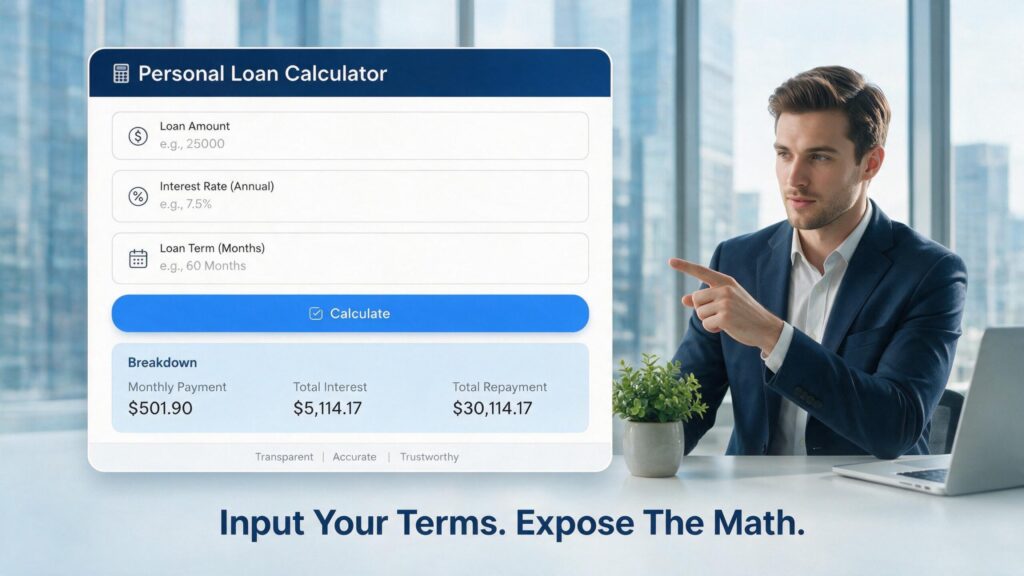
Lenders build personal loans with rigid mathematical formulas. Our personal loan calculator uses those exact same formulas to give you bank-level accuracy. To get the most accurate results, you need to understand exactly what you are typing into these fields. Garbage inputs equal garbage outputs.
Here is exactly how to enter your data into the personal loan calculator to get a flawless projection of your future debt.
Step 1: Entering Your Exact Loan Amount (The Principal)
This is the exact dollar amount you plan to borrow. However, you must be highly strategic here. Do not just type in the cost of the project or the exact amount of your credit card debt. You must account for hidden lender fees.
- Factor in Origination Fees: Many personal loans charge an upfront fee ranging from 1% to 8%.
- Do the Net Payout Math: Lenders deduct this fee directly from your loan proceeds. If you need exactly $15,000 to cover a massive medical bill, and the bank charges a 5% origination fee ($750), they will only deposit $14,250 into your checking account. You will come up short.
- Adjust Your Ask: To get your required $15,000, you actually need to borrow $15,789.
Always use the personal loan calculator to test different borrowed amounts so you know precisely what will hit your bank account.
Step 2: Setting the Interest Rate (APR)
Your interest rate dictates the price of your borrowed money. Personal loan rates vary wildly depending on your FICO credit score, your income, and the overall economic climate.
- Excellent credit (720+): Might secure a rate between 7% and 10%.
- Average credit (630 to 689): Usually sees rates soaring between 15% and 25%.
When using the personal loan calculator, input your expected Annual Percentage Rate (APR). The APR includes both the base interest rate and the origination fees rolled into a yearly percentage. This gives you the truest representation of your cost. Test a few different rates. See how a 3% rate jump drastically inflates your monthly payment.
Step 3: Choosing the Loan Term (Months or Years)
The loan term is the exact amount of time you have to pay the lender back. Personal loans typically range from 12 to 84 months (1 to 7 years).
This field is a massive wealth trap.
Lenders push borrowers toward 60-month or 72-month terms. Why? The longer you take to pay off the loan, the lower your monthly payment becomes. It feels highly affordable. Meanwhile, the bank quietly collects double or triple the total interest over the life of the loan. Use the personal loan calculator to compare a 36-month term versus a 60-month term. Your goal is always to choose the shortest loan term your monthly budget can comfortably handle.
The Anatomy of the Calculation: Key Terms & Deep Concepts
Financial institutions rely on your ignorance. They use dense industry jargon to keep you confused during the borrowing process. If you do not understand the terminology on your loan agreement, you cannot make an educated decision.
Before you run your numbers through the personal loan calculator, you must master the vocabulary. Here is a grounded, plain-English breakdown of the heavy financial terms dictating your debt.
- Principal Balance: The principal is the pure, raw amount of money you are borrowing before any interest is applied. If you take out a $20,000 personal loan, your starting principal is $20,000. Every single month, a portion of your payment goes toward reducing this number. The faster you shrink the principal, the less interest the bank can legally charge you.
- Annual Percentage Rate (APR): APR is the single most important number on your loan document. While the “interest rate” only covers the cost of borrowing the principal, the APR rolls in all the extra lender fees, origination charges, and administrative costs into one annualized percentage. It is the true, comprehensive cost of your loan. For a highly technical, federally recognized definition of how APR works, you can read the Investopedia guide on Annual Percentage Rate (APR). Always input the APR into your personal loan calculator, not just the base interest rate.
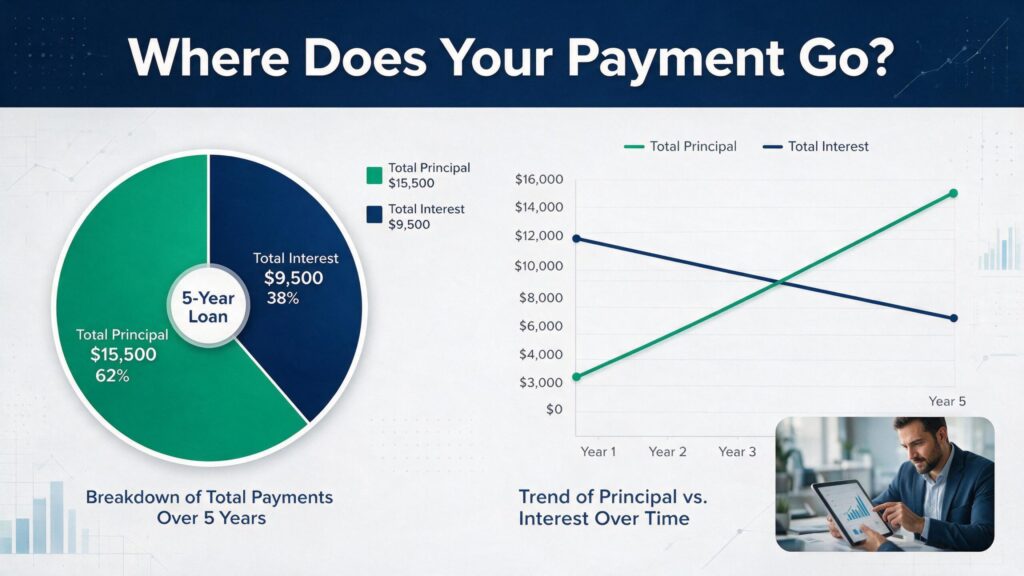
- Amortization: Amortization is the mathematical schedule mapping out every single payment you will make until the loan hits zero. At the beginning of your loan term, the bank front-loads the interest. The majority of your monthly payment pays off the interest, and only a tiny fraction touches the principal. As the months pass, this ratio flips. Amortization works the exact same way here as it does for your house. If you are curious about how this applies to real estate, check out our Mortgage Amortization Calculator to see the long-term math in action.
- Origination Fee: Think of this as an administrative tax just for the privilege of borrowing money. Lenders charge this upfront to cover the cost of processing your application and checking your credit. As mentioned earlier, they usually subtract it from your payout. It is a one-time fee, but it aggressively alters the math of your personal loan calculator.
- Total Interest Paid: This represents the absolute total of all interest charges you will hand over to the bank by the end of your loan term. This is the exact dollar amount the lender profits off your need for cash. Your primary goal as a borrower is to keep this number as close to zero as humanly possible.
- Debt-to-Income Ratio (DTI): While not an input on the personal loan calculator, DTI is the metric the bank uses to approve or deny you. It compares your gross monthly income to your mandatory monthly debt payments. If your current debts eat up more than 36% to 40% of your income, lenders view you as high-risk. They will either deny your application outright or slam you with a brutal 25% interest rate. Always verify that your new loan payment will not push your DTI into the danger zone.
By understanding these terms, you change the dynamic. You no longer walk into a bank as a target. You walk in as an informed consumer armed with the exact numbers generated by your personal loan calculator.
Unveiling the Formula: The Math Behind the Calculator
Math does not lie. Bankers do.
When a lender hands you a proposed monthly payment, they rarely show you the underlying arithmetic. They prefer you view their numbers as magic. They are not magic. Every single time you hit compute on our personal loan calculator, a rigid, uncompromising mathematical equation runs in the background. It is the exact same fixed-rate amortization equation that Wall Street financial institutions use to project debt.
Interestingly, personal loans operate on the exact same mechanical chassis as a fixed-rate house loan. If you read our deep dive on how US mortgage payments are calculated, you will recognize the structure immediately. The only real difference is the timeline. Instead of stretching over thirty years, personal loans compress this aggressive math into three to five years.
If you want to manually verify the outputs of the personal loan calculator, here is the standard amortization formula.
M = P × [ r(1 + r)^n ] / [ (1 + r)^n – 1 ]
Do not let the brackets intimidate you. Here is the exact breakdown of each variable running inside the tool:
- M (Monthly Payment): This is your final result. This is the exact dollar amount that will leave your checking account every thirty days.
- P (Principal Amount): The total amount of money you are borrowing. If you roll your origination fee into the loan, the principal increases.
- r (Monthly Interest Rate): This is where lenders confuse people. Your Annual Percentage Rate (APR) is for the whole year. To find “r”, you divide your APR by 12. If your APR is 12%, your monthly interest rate (r) is 1% (or 0.01 in decimal form).
- n (Number of Payments): The total number of months in your loan term. A five-year loan means “n” equals 60.
Attempting to run this calculation by hand for a 60-month term requires graphing out 60 separate rows of compounding interest equations. One minor mathematical error on month three throws off the entire schedule. That is an exhausting waste of your time. Our personal loan calculator automates this heavy lifting instantly. It processes the fractional compounding, isolates the interest from the principal, and spits out a flawless amortization table. We use standard WP-friendly coding to ensure our tool exactly matches standard banking compliance documents. You get bank-level precision without the bank-level sales pitch.
5 Critical Factors That Influence Your Numbers
Your loan terms do not exist in a vacuum. You cannot simply demand a 6% interest rate because you saw it on a billboard.
The numbers you input into a personal loan calculator are dictated by aggressive macroeconomic forces and your own personal financial hygiene. Lenders scrutinize your life. They weigh global market trends against your paycheck. If you want better outputs from the calculator, you have to optimize the inputs.
Here are the five massive factors controlling your loan.
1. FICO Credit Score (The Ultimate Gatekeeper)
Your credit score is your financial reputation. Lenders lean entirely on your FICO score to price your risk. Borrowers with a 750+ credit score get access to premium, single-digit interest rates. If your score sits at 620, the lender views you as a statistical flight risk. They will penalize you with interest rates exceeding 20%. Before you even touch a personal loan calculator, pull your official credit reports. According to the Consumer Financial Protection Bureau, regularly checking your credit report protects you from costly errors that artificially inflate your borrowing costs.
2. The Federal Reserve’s Benchmark Rate
You are at the mercy of the Federal Reserve. When inflation runs hot, the Fed raises the federal funds rate to cool down the economy. This makes borrowing money more expensive for banks. Banks immediately pass those higher costs directly to you. If the macro economy is experiencing high interest rates, personal loan rates skyrocket across the board. You cannot control this. You can only react to it.
3. The Debt-to-Income Ratio (DTI)
Income alone does not impress lenders. They want to know how much of your monthly income is already promised to other creditors. If you make $10,000 a month, but $4,500 goes toward a mortgage, auto loans, and credit cards, your DTI is 45%. Lenders hate this. A high DTI drastically limits the maximum principal amount you can borrow. It also guarantees a higher interest rate because you are technically over-leveraged.
4. Secured vs. Unsecured Loan Types
Most personal loans are unsecured. You do not put down collateral. The bank just trusts you to pay. Because the bank takes on 100% of the risk, unsecured loans carry higher interest rates. However, if you opt for a secured personal loan—putting up a vehicle, a savings account, or other assets as collateral—the bank’s risk drops. They reward this reduced risk by dropping your APR.
5. Loan Term Length
Time is expensive. The duration of your loan radically changes the math influencing the numbers staring back at you from the personal loan calculator. Lenders penalize longer terms. A 72-month loan will almost always carry a higher APR than a 36-month loan. The lender knows that over six years, you might lose your job, get divorced, or face a medical crisis. They charge a higher rate to compensate for that extended timeline of uncertainty. Keep your terms short.
Real-World Scenarios: The Calculator in Action
Theory is useless without execution.
To truly understand how this tool builds wealth, we need to look at raw data. We are putting the personal loan calculator to work across three entirely different financial lives. Watch closely how slight changes in the terms generate wildly different outcomes.
Scenario 1: Sarah, The Aggressive Debt Consolidator
Sarah is drowning in $18,000 of credit card debt scattered across three different cards. Her average credit card interest rate is a brutal 24.5%. She is making minimum payments and getting absolutely nowhere. Her credit score is a solid 710. She approaches a local credit union and secures an unsecured personal loan offer to consolidate her debt. She wants to be debt-free in exactly 3 years. She loads up the personal loan calculator with her credit union’s terms to see if the math makes sense.
| Calculator Input Field | Sarah’s Exact Data |
|---|---|
| Loan Amount (Principal) | $18,000 |
| Interest Rate (APR) | 10.5% |
| Loan Term | 36 Months |
| Monthly Payment Result | $585.15 |
| Total Interest Paid | $3,065.41 |
Strategic Analysis:
Sarah’s move is brilliant. By utilizing the calculator, she visualizes a hard finish line. At her old 24.5% credit card rate, paying $585 a month would have cost her over $7,000 in interest and taken much longer. By locking in a 36-month personal loan at 10.5%, she stops the compound interest bleeding. The calculator proves that debt consolidation only works if you aggressively compress the timeline.
Scenario 2: Mark, The Home Equity Chaser
Mark is preparing to list his house on the market. His realtor tells him a $25,000 kitchen renovation will boost his home’s sale value by $40,000. Mark lacks the cash. He decides to take out a personal loan. Because he wants to preserve his monthly cash flow, he asks the bank for a 60-month (5-year) loan term at an 8.5% rate. Before signing, he tests his assumptions using our personal loan calculator.
| Calculator Input Field | Mark’s Exact Data |
|---|---|
| Loan Amount (Principal) | $25,000 |
| Interest Rate (APR) | 8.5% |
| Loan Term | 60 Months |
| Monthly Payment Result | $512.91 |
| Total Interest Paid | $5,774.56 |
Strategic Analysis:
Mark almost made a massive mistake. He sees the $5,774 in total interest. If his kitchen renovation only adds $15,000 in actual net profit after realtor fees, paying nearly $6,000 in interest destroys his margin. Mark realizes he needs to pay this off the second his house sells. Instead of letting this drag on, he should explore our Mortgage Payoff Calculator to properly map out how his home sale proceeds will clear both his primary mortgage and this short-term personal loan instantly.
Scenario 3: David, The Medical Emergency
David faces an unexpected $12,000 medical bill. His credit was recently damaged by a missed auto payment, dropping his FICO score to 635. He desperately needs the cash. The only approval he gets is from an online subprime lender offering a punishing 21% APR. The lender pushes him toward a 48-month term to “keep payments low.” David turns to a personal loan calculator out of desperation to see the damage.
| Calculator Input Field | David’s Exact Data |
|---|---|
| Loan Amount (Principal) | $12,000 |
| Interest Rate (APR) | 21.0% |
| Loan Term | 48 Months |
| Monthly Payment Result | $374.31 |
| Total Interest Paid | $5,966.97 |
Strategic Analysis:
The math is horrifying. Over four years, David will pay almost $6,000 just in interest. He is paying a 50% premium on his initial medical bill. The personal loan calculator proved that a longer term was a financial trap. Armed with this harsh reality, David decides to slash his budget, borrow $5,000 from a family member, and only take a $7,000 loan on a strictly 24-month term. The calculator didn’t just show him a number. It forced him to change his behavior.
Hidden Pitfalls: 3 Biggest Mistakes People Make
Most borrowers walk right into financial traps. Lenders build these traps intentionally. They rely on your fatigue. They hope you will ignore the math and simply sign the contract. Using a personal loan calculator exposes these traps, but only if you know exactly what to look for.
Avoid these three massive mistakes. They cost average borrowers thousands of dollars every single year.
Mistake 1: Shopping by Monthly Payment Alone
This is the single biggest wealth killer in consumer finance. Car salesmen use this tactic. Bankers use it too. When you tell a lender, “I can afford $400 a month,” you hand them complete control. They will stretch your loan term out to 72 months to hit that $400 target.
It looks affordable on paper. It is financial suicide.
By stretching the term, they quietly triple their total interest profit. Never shop by the monthly payment. Run your numbers through the personal loan calculator and focus exclusively on the “Total Interest Paid” field. Your goal is to compress the timeline, not lower the monthly obligation.
Mistake 2: Ignoring the Origination Fee Math
Lenders advertise a flat borrowed amount, but they rarely deliver it. If you apply for a $20,000 personal loan to fund an emergency house repair, the lender might charge a 6% origination fee. They deduct this upfront. The bank only deposits $18,800 into your account.
Now you have a $1,200 shortfall.
You still owe the contractors $20,000. People panic when this happens. They end up swiping high-interest credit cards to cover the gap. Always calculate your net payout before signing. If you need a hard $20,000, you must mathematically adjust your starting principal in the personal loan calculator to account for that fee.
Mistake 3: Treating the Loan Term as a Prison Sentence
People assume a five-year loan must take five years to pay off. That is false. Most reputable personal loans do not carry prepayment penalties. Yet, borrowers set up an auto-draft for the minimum payment and let it run for 60 months.
This guarantees maximum profit for the bank.
Every extra day you hold the balance, daily compound interest attacks your net worth. You are voluntarily bleeding cash. View the monthly payment generated by your personal loan calculator as the bare minimum required to avoid default. It is the floor, not the ceiling. You should constantly throw extra cash at the principal to break the amortization schedule.
Expert Strategies: How to Optimize Your Results
Knowing your numbers is just the starting point. Executing a strategy based on those numbers builds actual wealth.
As a Certified Financial Planner, I never let clients just accept a bank’s baseline offer. We manipulate the terms. We aggressively alter the payment structure. Here are five highly effective financial strategies you can apply immediately after running your data through our personal loan calculator.
Strategy 1: The Bi-Weekly Payment Hack
Banks structure loans on a monthly cycle. You do not have to play by that rule. Instead of making one full payment on the 1st of the month, split that exact payment in half. Pay half on the 1st, and half on the 15th.
Why does this work?
Interest accrues daily. By giving the bank half your money two weeks early, you reduce the average daily principal balance. The bank has less money to charge interest against. Over a 48-month loan, this simple structural shift shaves hundreds of dollars off your total interest without requiring a single extra dollar out of your pocket.
Strategy 2: Accelerated Principal-Only Payments
Your minimum monthly payment is highly skewed toward interest in the early months. To destroy the loan fast, you must attack the principal directly. Every time you get a bonus at work, a tax refund, or sell an old item, apply that cash strictly as a “principal-only” payment.
This forces the amortization schedule to recalculate in your favor. It permanently deletes future interest. If you want to see exactly how extra payments mathematically destroy debt over time, the logic works identically to real estate. Run a test scenario through our Extra Mortgage Payment Calculator to visualize the massive impact of accelerated paydowns.
Strategy 3: The 12-Month Refinance Trigger
Do not accept a bad interest rate as a permanent reality. If your FICO score is currently 610, you will get slammed with a 24% rate. Take the loan if you have a true emergency, but do not keep it for five years.
Spend the next twelve months obsessively fixing your credit. Pay all bills on time. Lower your credit card utilization. Once your score crosses 720, go to a local credit union and refinance that exact personal loan into a new one at 8%. Use the personal loan calculator to instantly verify the massive monthly savings before executing the refinance.
Strategy 4: Demand a True APR Breakdown
Lenders love to advertise their base “interest rate” because it looks incredibly low. They bury the true cost in the fine print. You must force them to reveal the Annual Percentage Rate (APR).
The APR rolls the origination fees, closing costs, and administrative fees into a single, honest percentage. A 6% interest rate with high fees might actually be a 9.5% APR. Always use the APR in your personal loan calculator. If you want a deeper understanding of how aggressive this difference can be, the exact same deceptive marketing happens with home loans. Our Mortgage APR Calculator explains how heavily fees distort your actual borrowing costs.
Strategy 5: Avoid Consolidating Bad Habits
Using a personal loan to pay off 25% credit card debt is a brilliant mathematical move. However, it requires intense psychological discipline.
The moment you consolidate the debt, your credit cards drop to a zero balance. They look shiny and empty. Far too many consumers immediately start swiping those cards again. Within a year, they have maxed out the credit cards and they still owe the massive personal loan payment. If you use a personal loan calculator to map out a debt consolidation strategy, you must physically lock your credit cards away until the personal loan is entirely dead.
Frequently Asked Questions (FAQs)
Q: Does using a personal loan calculator affect my credit score?
A: No. Using an online personal loan calculator has zero impact on your credit score. It is simply a mathematical tool. It does not pull your credit report or interact with credit bureaus. Your score is only affected when you formally submit an application to a lender.
Q: How much personal loan can I get approved for?
A: Your approval amount depends entirely on your Debt-to-Income (DTI) ratio and your credit history. Lenders cap your total monthly debt payments at roughly 36% to 40% of your gross income. If you have high income and low existing debt, banks may approve you for up to $100,000. If you are heavily leveraged, they might cap you at $5,000. Use a personal loan calculator to reverse-engineer exactly what monthly payment fits safely into your budget before you ask the bank.
Q: Are personal loan calculators 100% accurate?
A: Yes. The mathematical formula powering our personal loan calculator is perfectly accurate. However, the output is only as reliable as your input. If you guess your interest rate, ignore origination fees, or misunderstand your loan term, your real-world contract will look drastically different. Input exact data to get exact projections.
Q: Can I pay off my personal loan early to save interest?
A: Absolutely. Most modern personal loans do not carry prepayment penalties. Because interest compounds daily against your remaining principal, paying off the balance early stops the interest from accruing. Every single day you shave off your loan term saves you hard cash. Read your specific loan agreement to verify there are no hidden early payoff fees.
Q: What is a good interest rate for a personal loan?
A: A “good” rate is highly relative to current Federal Reserve benchmark rates and your personal credit score. Generally, excellent credit (750+) secures single-digit interest rates between 6% and 9%. Average credit (650) often sees rates between 15% and 20%. Any rate that is significantly lower than your current high-interest credit card debt is a mathematical win if you are using the loan for consolidation.
Q: Should I use a personal loan to pay off credit cards?
A: Yes, if the math works strictly in your favor. Credit cards often charge revolving interest rates exceeding 24%. By securing a fixed-term personal loan at 10%, you immediately stop the massive interest bleed. Run both scenarios through a personal loan calculator. If the new loan offers a lower rate and a clear, defined payoff date, it is a highly strategic financial move.
Q: Is the origination fee included in the monthly payment?
A: Usually, no. Most lenders deduct the origination fee from your initial payout before the money hits your bank account. However, this fee is factored into your APR. Because the fee reduces the actual cash you receive, it artificially inflates your true cost of borrowing. Always ask your lender exactly how they process origination fees before you sign the documents.
Stop letting banks dictate your financial future in the dark. Scroll back up to the top of this page, plug your exact numbers into our free Personal Loan Calculator, and expose your true costs immediately. Once your short-term debt is mapped out, take control of your biggest asset by running your numbers through our Mortgage Payment Calculator.
Disclaimer: The Personal Loan Calculator provided by Nxfly Finance is for educational and informational purposes only. It does not constitute specific financial, investment, or tax advice. Please consult with a licensed financial advisor, fiduciary, or CPA before making any major financial decisions.