

By Sarah Jenkins, CFP® | Reviewed by the Nxfly Finance Team
When you sign a home loan, you enter a quiet war of attrition against compounding interest.
Lenders do not explain this clearly. They show you a neat, predictable monthly payment. It feels safe. It looks manageable.
But what they hide in the fine print is the structural design of the amortization curve. During the first few years of your home loan, your monthly cash outlay barely touches the principal. Instead, a massive percentage of that hard-earned money goes straight into the bank’s interest pool.
You pay. The bank profits. Your equity barely budges.
This is the exact financial trap that catches millions of first-time homebuyers off guard. They buy a house, pay on it faithfully for five years, and then go to sell. When the payoff statement arrives, they are shocked to find their outstanding principal balance has barely dropped.
They did not understand the math behind their amortization schedule.
You do not have to fly blind. Our mortgage amortization calculator is designed to pull back the curtain on this process. It maps out your entire repayment timeline, showing you precisely how each dollar of your monthly payment is divided between the bank’s interest and your personal wealth.
More importantly, it shows you how simple, targeted adjustments can break the bank’s hold on your cash.
By visualizing how interest burns off and how equity builds, you gain the power to make strategic decisions. Do you pay bi-weekly? Do you throw extra cash at the principal?
Let’s look at the numbers. Knowing this math is not just about keeping a neat spreadsheet. It is the literal foundation of long-term wealth creation.
Here is a realistic look at how home equity is built, how loans are structured, and how you can use this interactive tool to reclaim control of your financial future.
📊 Amortization Calculator
See exactly how your loan pays off over time
The Mechanics: How to Use the Nxfly Mortgage Amortization Calculator
Using our interactive tool is straightforward, but garbage inputs will yield garbage results. To get a perfectly accurate view of your financial trajectory, you must understand what each input field represents and why those specific numbers dictate your long-term success.
Step 1: Input Your Total Loan Amount
This is the total amount of money you are borrowing from the lender, not the purchase price of the home. If you buy a house for $450,000 and put $50,000 down, your actual loan amount is $400,000. Make sure you subtract your down payment from the home value before entering this number. If you are still trying to figure out what your baseline monthly payment will look like, check out our mortgage payment calculator to lock in that number first.
Step 2: Enter Your Annual Interest Rate
Input the exact interest rate quoted by your lender. Even a tiny fraction of a percentage point alters your amortization schedule by thousands of dollars over the lifetime of the loan. For instance, a 0.5% rate reduction on a $350,000 loan completely reshapes how fast your principal balance drops in those critical early years. If you want to analyze how your rate stacks up against the broader market, our mortgage rate calculator can give you immediate context.
Step 3: Select Your Loan Term
This is the length of your mortgage, usually set at 15 or 30 years. A 15-year term compresses the amortization window, which forces you to pay down the principal at an accelerated pace. A 30-year term keeps your mandatory monthly cash outlay lower but drags out the interest accumulation period. Our calculator allows you to swap between these terms instantly so you can compare the structural trade-offs.
Step 4: Add Your Start Date and Optional Extra Payments
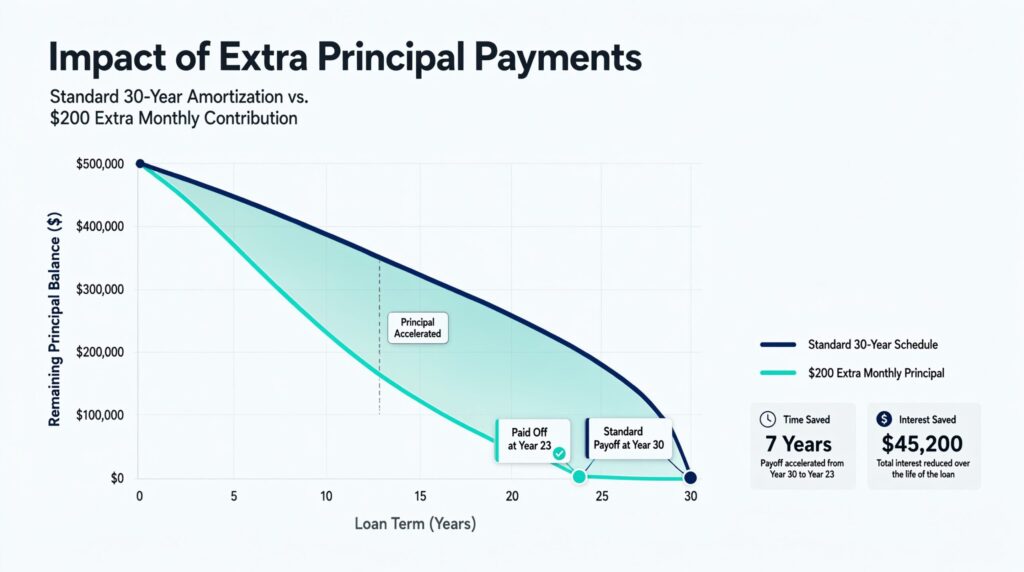
Enter the month and year you will make your first payment. This synchronizes the table with your real-world calendar. The magic of our tool lies in the optional “Extra Payments” field. Here, you can enter monthly, yearly, or one-time extra payments to see exactly how much interest you can save and how many years you can shave off your repayment timeline.

The Anatomy of the Calculation: Key Terms & Deep Concepts
To master your home loan, you must understand the vocabulary that drives the amortization process. Lenders rely on buyers staying ignorant of these concepts because ignorance is highly profitable. Here is an plain-English breakdown of the terms that govern our mortgage amortization calculator.
- Amortization Schedule: This is a complete table showing every single monthly payment over the life of your loan. It breaks down each payment into principal and interest, showing you the exact remaining balance after every cycle.
- Principal: This is the actual cash balance of your outstanding debt. It is the money you originally borrowed to buy the home. When you make extra payments, they go directly toward reducing this balance, which permanently lowers your interest charges for all subsequent months.
- Compounding Interest: This is the cost of borrowing the lender’s money, calculated monthly based on your remaining principal balance. Because your balance drops slightly with each payment, the interest portion of your next payment also drops. For a deep look at how mortgage interest is calculated and how you can minimize it, see our mortgage interest calculator.
- Loan-to-Value (LTV) Ratio: This ratio measures your outstanding loan balance against your home’s appraised value. Lenders track this closely. Once your LTV drops to 80%, you can legally request to cancel your private mortgage insurance (PMI), instantly lowering your monthly costs.
- Equity: This is the portion of the property you truly own. It is calculated by taking the current market value of your home and subtracting your remaining mortgage balance. Amortization is the slow, systematic process of turning paper debt into real home equity.
- Escrow Account: This is a separate account where your lender holds funds collected each month to pay for your property taxes and homeowners insurance. These costs do not affect your amortization schedule because they do not reduce your loan balance.
- Amortization Formula: The actual mathematical engine that drives the monthly calculation is standard across the banking industry. The math relies on the standard equation used by the Federal Reserve Board to ensure uniform amortization calculations across all US financial institutions:
In this formula, M is your total monthly principal and interest payment. P is the initial principal loan balance. i is the monthly interest rate (your annual rate divided by 12 months). n is the total number of payments (for example, 360 payments for a 30-year mortgage).
Our tool calculates this complex formula instantly, showing you the exact month-by-month breakdown of your entire home loan in seconds.
Unveiling the Formula: The Math Behind the Calculator
Amortization looks like a complex mystery, but it is actually driven by a fixed, elegant algebraic equation. To determine your exact monthly principal and interest payment, our tool utilizes the standard amortization formula. We present this mathematical engine below in a clean, WordPress-friendly format:
Let us dissect each variable in this equation so you can see exactly how the gears turn:
- M: This is your total monthly principal and interest payment. This number remains completely identical from month one to month 360.
- P: This is your principal loan amount. It represents the starting balance of your mortgage after your down payment has been subtracted.
- r: This is your monthly interest rate. Lenders quote rates as an annual percentage (APR), which must be converted to a monthly decimal. To find this, divide your annual rate by 12. For example, a 6.0% annual rate is expressed as 0.005 (
0.06 / 12). - n: This is the total number of monthly payments required over the life of your loan. For a standard 30-year fixed mortgage, this is 360 payments (
30 * 12). For a 15-year mortgage, it is 180 payments (15 * 12).
Proving the Math with an Example
Let us run a real-world scenario through this equation to prove its absolute accuracy. Imagine you borrow $300,000 on a 30-year fixed term at an annual interest rate of 6.0%.
- Our Principal (P) is $300,000.
- Our monthly interest rate (r) is
0.06 / 12 = 0.005. - Our total number of payments (n) is 360.
First, let us calculate the numerator: r * (1 + r)^n
Next, let us calculate the denominator: (1 + r)^n - 1
Now, we divide the numerator by the denominator:
0.030113 / 5.022575 = 0.0059955
Finally, we multiply this result by our principal loan amount (P):
M = 300,000 * 0.0059955 = $1,798.65
M = 300,000 * 0.0059955 = $1,798.65
Your base monthly payment is exactly $1,798.65.
Our mortgage amortization calculator runs this precise math instantly. However, the calculation does not stop at your monthly payment. Each month, the calculator computes your interest charge by multiplying your remaining principal by your monthly interest rate:
Monthly Interest = Remaining Principal * r
For month one, your interest is 300,000 * 0.005 = $1,500.00. The remainder of your payment, $298.65, goes toward reducing your principal.
For month two, your principal is now $299,701.35. The math repeats. This ensures that every single penny of your mortgage is accounted for down to the decimal point.
5 Critical Factors That Influence Your Numbers
Your amortization schedule is highly sensitive. It responds to your personal financial habits, your lender’s terms, and major macroeconomic shifts. Understanding the five primary factors that influence your numbers allows you to manipulate them in your favor.
1. Your Personal Credit Score
Lenders use your credit score to determine your risk profile, which directly dictates the interest rate they offer you. A borrower with an excellent credit score of 780 will secure a far lower rate than a borrower with a 650 score.
Because amortization is highly sensitive to your interest rate, a lower score means you will spend your first ten years paying off interest rather than building real equity. Improving your credit score before applying for a loan is the most effective way to optimize your amortization timeline.
2. Down Payment Size and Initial Equity
Your down payment directly impacts your starting principal balance. A larger down payment reduces the total amount you need to borrow, which shrinks your monthly interest charges from day one.
Furthermore, if your down payment is under 20% on a conventional loan, your lender will tack on private mortgage insurance. To see how these upfront costs affect your starting balance, run your planned purchase through our Mortgage Loan Calculator to optimize your down payment strategy.
3. Macroeconomic Inflation and the Federal Reserve
The broader economy plays a direct role in your amortization numbers. When inflation runs hot, the Federal Reserve raises benchmark interest rates to cool the market. This economic pressure drives mortgage interest rates higher.
Borrowers who lock in loans during high-inflation periods face steeper amortization curves, meaning their early payments are heavily dominated by interest rather than principal paydown. You can review current mortgage market trends and consumer credit reports directly through the Consumer Financial Protection Bureau (CFPB) to time your loan application strategically.
4. The Frequency of Your Payments
Most homeowners make one mortgage payment per month, resulting in twelve payments per year. However, changing your payment frequency can alter your amortization schedule entirely.
By switching to a bi-weekly payment schedule, you effectively make 26 half-payments, which equates to thirteen full payments annually. This simple shift quietly strips years off your mortgage timeline without requiring you to restructure your base budget.
5. Loan Refinancing Options
If interest rates drop significantly after you buy your home, you can refinance your mortgage to optimize your amortization schedule. Refinancing allows you to replace your existing high-rate loan with a new one at a lower rate.
This move resets your amortization timeline, but at a far lower interest cost. If you are considering this strategy, use our Mortgage Refinance Calculator to verify if the closing costs of refinancing outweigh your monthly interest savings.
Real-World Scenarios: The Calculator in Action
Amortization is not just abstract math. It is a real-world reality that looks different for every homeowner. Let us explore three distinct real-world scenarios to see how our mortgage amortization calculator helps buyers make smarter financial moves.
Scenario 1: The Conservative Saver (Marcus & Elena)
Marcus and Elena are highly conservative savers who want to buy a $400,000 suburban home. They have saved a massive $100,000 down payment. They want to pay off their home as fast as possible to minimize interest, so they opt for a 15-year fixed mortgage at 5.5%.
| Input Variable | Value | Output Metric | Value |
|---|---|---|---|
| Home Price | $400,000 | Monthly Principal & Interest | $2,451.25 |
| Down Payment | $100,000 | Total Payments (15 Years) | 180 |
| Loan Term | 15 Years | Total Interest Paid | $141,225.15 |
| Interest Rate | 5.50% | PMI Required | No |
| Loan Amount | $300,000 | Total Cost of Loan | $441,225.15 |
Strategic Analysis:
By choosing a 15-year term, Marcus and Elena face higher monthly payments, but their amortization schedule is incredibly efficient. From their very first payment, over 50% of their money goes directly toward reducing their principal balance.
By the end of year five, they will have built over $81,000 in home equity through principal paydown alone. This rapid equity accumulation gives them absolute financial security and saves them over $200,000 in lifetime interest compared to a standard 30-year mortgage.
Scenario 2: The Aggressive Investor (Sarah)
Sarah is an aggressive real estate investor buying a $500,000 property. She has the cash for a 20% down payment but chooses to put down only 5% ($25,000).
She wants to keep her liquid cash working in the stock market, where she expects a 9% annual return. She signs a 30-year fixed mortgage at 6.5%.
| Input Variable | Value | Output Metric | Value |
|---|---|---|---|
| Home Price | $500,000 | Monthly Principal & Interest | $3,002.32 |
| Down Payment | $25,000 | Total Payments (30 Years) | 360 |
| Loan Term | 30 Years | Total Interest Paid | $605,835.32 |
| Interest Rate | 6.50% | PMI (Monthly estimate) | $215.00 |
| Loan Amount | $475,000 | Total Cost of Loan | $1,080,835.32 |
Strategic Analysis:
Sarah’s amortization schedule is highly inefficient. Because she put only 5% down, she must pay an extra $215 a month in PMI, which does nothing to reduce her loan balance. Furthermore, during her first five years, over 83% of her monthly payment goes toward paying off interest.
However, because Sarah is investing her remaining $75,000 down payment capital elsewhere at a higher return, she accepts this trade-off. Running her numbers through our mortgage amortization calculator helps her visualize this cost of capital clearly.
Scenario 3: The First-Time Homebuyer (David)
David is a first-time homebuyer with a tight budget. He is purchasing a $280,000 townhome with a 10% down payment ($28,000) using a 30-year fixed loan at 6.75%.
David wants to keep his monthly payments low, but he plans to add an extra $150 a month toward his principal to speed up his equity growth.
| Input Variable | Value | Output Metric | Value |
|---|---|---|---|
| Home Price | $280,000 | Monthly Principal & Interest | $1,634.79 |
| Down Payment | $28,000 | Extra Payment (Monthly) | $150.00 |
| Loan Term | 30 Years | Interest Saved with Extra $150 | $74,821.40 |
| Interest Rate | 6.75% | Time Shaved Off Loan | 5 Years, 4 Months |
| Loan Amount | $252,000 | Total New Interest Cost | $262,401.12 |
Strategic Analysis:
By using our mortgage amortization calculator to run an “extra payment” scenario, David realizes how much leverage he has over his debt. By adding a modest $150 a month to his principal, he alters the entire trajectory of his amortization schedule.
He shaves over five years off his payoff timeline and saves $74,821 in total interest. This strategy allows him to maintain a comfortable 30-year budget buffer while quietly paying down his home like a 25-year loan.
Hidden Pitfalls: 3 Biggest Mistakes People Make
Amortization math is cold, predictable, and entirely unforgiving. If you ignore how your home loan is structured, you will quietly hand over tens of thousands of dollars to your lender. Here are the three most common structural blunders buyers make when dealing with their amortization schedule.
1. Relying on “Natural” Equity Growth
Many homeowners believe that simply paying their mortgage every month will quickly build substantial net worth. This is a mirage.
Because standard home loans are heavily front-loaded with interest, you build almost no principal equity during the first seven to ten years of a 30-year term. If you sell the property in the early years without having made extra principal payments, you will realize that your housing wealth was largely swallowed up by bank interest and transaction fees.
2. Resetting the Clock When Refinancing
Refinancing is an excellent way to lower your interest rate, but it can backfire if you are not careful.
If you have paid your 30-year mortgage for eight years and refinance into a brand-new 30-year term, you reset your amortization schedule back to year one. You are effectively paying interest on interest, extending your total repayment timeline to 38 years.
Unless you refinance into a shorter term or maintain your original payoff timeline by paying extra principal, refinancing can actually increase your lifetime interest costs.
3. Making Extra Payments Without Specifying “Principal-Only”
If you send extra money to your loan servicer without explicit instructions, they may apply those funds to your next scheduled monthly payment instead of your principal balance.
This is a massive mistake.
Applying funds to the next monthly payment does not lower your outstanding debt or reduce your interest charges; it simply pays your interest in advance. You must explicitly select the “principal-only” option on your online payment portal to ensure your extra cash directly lowers your interest-bearing balance.
Expert Strategies: How to Optimize Your Results
Knowing your amortization schedule is only half the battle. The real value lies in manipulating that schedule to maximize your personal wealth. Here are five practical, expert-level strategies to optimize your repayment timeline.
1. Accelerate Your Amortization with Micro-Payments
You do not need to wait for a massive windfall to shorten your repayment timeline. Adding even a small, consistent amount to your monthly payment yields massive savings over time.
For instance, adding $100 per month to a $300,000 loan at 6.5% shaves nearly four years off your mortgage and saves you over $50,000 in interest. Run your numbers through our Mortgage Payoff Calculator to see how small, calculated increases can fast-track your path to full homeownership.
2. Implement the Bi-Weekly Payment Hack
If your cash flow is tightly budgeted, switch your payment frequency from monthly to bi-weekly. By paying half of your mortgage payment every two weeks, you end up making 26 half-payments over the course of the year.
This equals thirteen full monthly payments instead of twelve.
This single extra payment per year reduces your principal balance consistently, shaving roughly four to five years off a 30-year mortgage without requiring you to make a major sacrifice to your monthly budget.
3. Pay Your Interest Off Early with the 1/12th Rule
If a bi-weekly schedule is too difficult to coordinate with your employer’s payroll cycle, you can mimic the strategy using the 1/12th rule.
Divide your standard monthly principal and interest payment by 12, and add that exact amount to every monthly payment.
By the end of the year, you will have effortlessly made an extra full payment directly toward your principal balance. This systematically flattens your amortization curve and reduces the total compounding interest you owe over the life of your home loan.
4. Leverage the Mortgage Rate Environment for Refinancing
If market interest rates drop by 1% or more below your current rate, it is time to look at your amortization options.
When you refinance, try to secure a shorter loan term that matches your remaining timeline, or keep your payments high to pay off the principal faster. To evaluate your options and compare different loan offers, run your potential numbers through our Mortgage Rate Calculator to ensure you are securing the best deal.
5. Recast Your Loan After a Windfall
If you receive a large lump sum of money, such as an inheritance, bonus, or tax refund, do not simply throw it at your mortgage without talking to your lender first.
Ask your lender to “recast” your existing loan.
In a mortgage recast, you pay a large lump sum toward your principal, and the lender recalculates your remaining monthly payments based on that lower balance. Unlike a traditional refinance, a recast does not change your interest rate or reset your amortization timeline, allowing you to lower your monthly costs for a minimal fee.
Frequently Asked Questions (FAQs)
Q: What is a mortgage amortization schedule?
A: A mortgage amortization schedule is a complete table showing every monthly payment required over the life of your loan. It breaks down each payment into principal and interest while showing your remaining balance after every payment cycle.
Q: Why is my mortgage payment mostly interest in the early years?
A: Mortgage interest is calculated monthly based on your remaining principal balance, which is at its highest point early in the loan term. Because the balance is so large, the interest charges dominate your early payments, leaving very little of your cash to go toward principal reduction.
Q: Can I change my amortization schedule without refinancing?
A: Yes, you can accelerate your amortization schedule by making consistent, extra principal-only payments or switching to a bi-weekly payment schedule. These extra payments go directly toward lowering your principal balance, which automatically reduces your interest charges for all subsequent months.
Q: Does a 15-year mortgage amortize faster than a 30-year mortgage?
A: Yes, a 15-year mortgage amortizes far faster because its compressed timeline forces you to pay down the principal at an accelerated rate. While your monthly payment will be higher, you will build home equity much faster and save tens of thousands of dollars in interest.
Q: How do extra principal payments affect my amortization timeline?
A: Extra principal payments reduce your outstanding loan balance immediately, bypassing the interest portion of your amortization schedule. This shrinks your remaining balance, which permanently lowers the amount of interest that can accumulate in all future billing cycles.
Q: What is the difference between a mortgage payment and an amortization schedule?
A: A mortgage payment is the fixed dollar amount you pay to your lender every month, which includes principal, interest, taxes, and insurance. An amortization schedule is the detailed roadmap that shows exactly how the principal and interest portions of those payments shift over time.
Q: How do I read an amortization table?
A: To read an amortization table, locate the payment number or date on the left, then look across the row to see how your payment is split. You will see the exact portion that goes to interest, the portion that goes to principal, and your new remaining loan balance.
[Disclaimer & CTA]
Take control of your home loan today by utilizing our interactive mortgage amortization calculator at the top of this page to map out your payoff timeline. Once you have visualized your amortization schedule, check out our Mortgage Refinance Calculator to see if you can lower your rate and speed up your path to financial freedom.
Disclaimer: The Mortgage Amortization Calculator provided by Nxfly Finance is for educational and informational purposes only. It does not constitute specific financial, investment, or tax advice. Please consult with a licensed financial advisor, fiduciary, or CPA before making any major financial decisions.