

By Michael Velez, CFP® | Reviewed by the Nxfly Finance Team
Your house is a massive liability until you own it outright.
Banks structure standard 30-year mortgages to extract maximum interest from your wallet. It is a highly engineered, deeply profitable business model for them. It is terrible for you. Most homeowners blindly send in their minimum payment every single month. They never look at the underlying math. They just accept that they will remain in debt for three decades.
Stop accepting the minimum. You need a fast, mathematically sound mortgage payoff calculator to take back control of your money.
Interest is simply the penalty you pay for lacking upfront cash. Over a 30-year timeline, you often end up paying almost double the actual purchase price of your property. Think about that reality. You buy one house for yourself, and you slowly buy a second, invisible house for your lender.
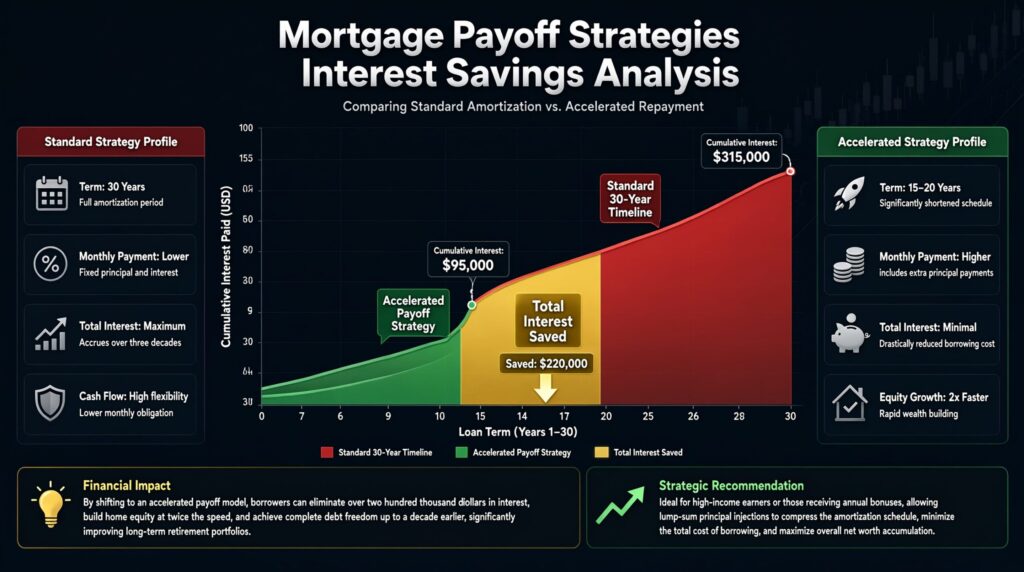
You can break this cycle. The math is incredibly predictable. Adding even a small amount of extra cash to your monthly principal payment creates a violent ripple effect over the lifespan of your loan. You cut years off your timeline. You save tens of thousands of dollars in interest. You just need to know exactly how much extra to send.
This tool gives you that exact mathematical roadmap. It removes the guesswork. You plug in your current loan details. You experiment with different extra payment amounts. The tool instantly shows you your new payoff date and your total interest saved.
Do not rely on your loan servicer to tell you how to pay them less money. They will not help you. You need independent, raw numbers to make smart financial decisions. Whether you plan to add an extra $50 a month or drop a $20,000 lump sum from an inheritance directly onto your remaining balance, running the math is your first step. Check your numbers below, map your timeline, and start building true financial freedom.
🎯 Payoff Calculator
See how extra payments shorten your loan & save interest
The Mechanics: How to Input Your Numbers Accurately
Garbage in, garbage out. The integrity of your results depends entirely on the accuracy of the numbers you type into the fields. Do not guess your balance. Do not assume your interest rate based on memory from closing day. Log into your online lender portal right now and pull your exact, current numbers.
Let’s break down exactly how to use this mortgage payoff calculator to generate a flawless payoff plan.
Step 1: Your Current Principal Balance
This is the exact amount of money you owe the bank today. It is not your original loan amount. It does not include future interest charges. Look for the label reading “payoff quote” or “current principal balance” on your latest monthly statement. If you originally borrowed $400,000 but have paid it down to $342,500, you must input $342,500.
Step 2: Your Exact Interest Rate
Enter your annual interest rate as a percentage. This number dictates the speed at which your debt grows every single month. Even a fraction of a percent dramatically alters your amortization curve. Enter the exact figure, such as 6.25% or 7.125%.
Step 3: Your Remaining Loan Term
This is a massive point of failure for many users. Do not input 30 years if you are already five years into the loan. You must count the exact remaining months or years left on your original contract. If you have exactly 22 years and 4 months left until your original payoff date, format that into the calculator correctly.
Step 4: The Extra Payment Strategy
This field is the entire engine of the mortgage payoff calculator. Here, you test different aggressive financial scenarios. You can input a recurring extra monthly payment. You can test a one-time, lump-sum payment. You can even set an annual extra payment, like throwing your entire tax refund at the principal every April. Play with these variables aggressively. If you want a deep dive on how your base payment limits your progress, read our guide on how US mortgage payments are calculated. Watch how adding just $150 extra per month radically alters your trajectory and moves your debt-free date years closer to the present.

The Anatomy of Early Debt Demolition: Core Financial Terms
You must understand the vocabulary of your debt. The mortgage industry relies heavily on specific jargon. They do this to obscure the reality of your loan structure. If you do not know the fundamental difference between an escrow payment and a principal payment, you will make highly expensive mistakes.
Here is your blunt, plain-English guide to the exact financial terms running behind the scenes of our calculator.
Principal
The principal is the actual, raw amount of money you borrowed from the bank to buy the house. When you make an extra payment, you want 100% of those dollars applied directly to this balance. Lowering the principal is the only way to shorten your loan timeline. Every dollar wiped off the principal is a dollar the bank can no longer charge you interest on next month.
Interest
Interest is the fee the bank charges you for the privilege of holding their money. It is dead money. It buys you nothing. In the first decade of a standard mortgage, the vast majority of your monthly payment goes directly toward paying this interest fee, not paying down your house.
Amortization Schedule
This is the mathematical table dictating exactly how your monthly payment is split between principal and interest over time. Banks aggressively front-load the interest. On month one of a 30-year loan, nearly your entire payment goes to the bank’s profit margin. Very little touches the principal. Making extra payments disrupts this curve. If you want to see your exact month-by-month split, run your numbers through a dedicated Mortgage Amortization Calculator.
Prepayment Penalty
This is a trap. Some lenders actually penalize you financially for paying off your loan early. They lose out on decades of guaranteed interest income, so they charge you a fee to recoup their losses. These are less common today, but they still exist in specific subprime or non-conforming loans. The Consumer Financial Protection Bureau (CFPB) actively regulates how and when these penalties can be legally enforced. Always check your original loan estimate document to ensure your lender allows penalty-free extra payments.
Escrow (Taxes and Insurance)
Your total monthly payment to the bank usually includes property taxes and homeowners insurance. The bank holds this money in a separate escrow account and pays the bills on your behalf. Adding extra money to your escrow account does absolutely nothing to pay off your mortgage early. The mortgage payoff calculator completely strips away escrow. It focuses strictly on the principal and interest debt.
Lump-Sum Payment
A lump-sum payment is a single, large cash drop applied directly to your loan balance. People usually trigger these after selling a business, receiving an inheritance, or getting a massive corporate bonus. Dropping $25,000 on your loan in month 12 is mathematically vastly more powerful than dropping $25,000 on your loan in month 300. The earlier you apply the lump sum, the more compound interest you prevent from accumulating.
Unveiling the Formula: The Math Behind the Calculator
You must never trust a black-box financial tool. If a website gives you financial projections but refuses to show you the underlying math, close the tab immediately. True wealth requires total transparency.
To prove the accuracy of our tool, we must pull back the curtain. Our system calculates your new debt-free timeline using a complex logarithm derived from the standard amortization equation. When you add an extra payment, the calculator must isolate a single variable: “n”. This variable represents the total number of months remaining on your loan.
Here is the exact mathematical formula our engine runs:
n = -[ log( 1 – ( P × r ) / M ) ] / log( 1 + r )
Let’s break down the exact variables inside this equation.
- n represents the new total number of months until your loan balance hits zero.
- P represents your current principal loan balance.
- r is your monthly interest rate. To find this, take your annual interest rate and divide it by 12. If your quoted rate is 6%, your monthly rate (r) is 0.005.
- M is your new, proposed total monthly payment. This combines your required minimum principal and interest payment with your chosen extra payment amount.
- log refers to the mathematical logarithm. Because interest compounds on a curve, paying down the balance requires a logarithmic calculation, not simple division.
When you increase “M” by adding even $100 extra, the logarithm dramatically reduces “n”.
Let’s look at a practical application of the math. Assume you owe $200,000 at a 5% interest rate, and your standard payment is $1,073. You decide to pay $1,373 instead. You added $300 extra. The system plugs the new $1,373 value into the “M” variable. The math forces the “n” variable to collapse. Instead of paying for 360 months, the equation spits out roughly 230 months.
You just mathematically deleted 130 months of debt from your life.
By hardcoding this exact logarithmic standard into our system, we guarantee absolute precision. We calculate the exact point where your balance hits zero. If you want to isolate strictly how much the bank profits off your standard timeline, run your base numbers through our Mortgage Interest Calculator to see the baseline cost before you apply early payoff strategies.
5 Critical Factors That Influence Your Numbers
A calculator provides mathematical certainty based on your inputs. However, your inputs exist in the real world. Macroeconomic forces and personal financial habits heavily dictate how aggressively you should attack your mortgage.
Paying off your house early is generally a smart move, but it does not happen in a vacuum. Here are the five primary factors that dictate whether your payoff strategy will succeed or fail.
1. Inflation and Purchasing Power
Inflation is the silent thief of wealth. It degrades the value of a dollar over time. When inflation runs hot, your fixed-rate mortgage actually becomes an asset. You borrowed highly valuable dollars a decade ago. You are paying the bank back today using inflated, less valuable dollars. The Bureau of Labor Statistics (BLS) meticulously tracks the Consumer Price Index (CPI) to measure this inflation rate. If inflation sits at 4% and your mortgage rate is 3%, the math suggests you should stretch the debt out. Paying off a low-interest debt during high inflation destroys your purchasing power.
2. Opportunity Cost of Capital
Every dollar you send to the bank is a dollar you cannot invest in the stock market. This is called opportunity cost. Historically, the S&P 500 returns roughly 10% annually. If your mortgage rate is 4%, aggressively paying it off yields a guaranteed 4% return on your money. However, you sacrifice a potential 10% return in the market. You must weigh the psychological peace of a paid-off house against the raw mathematical superiority of compound market growth.
3. The Standard Tax Deduction Shift
Historically, financial advisors told clients to keep their mortgage for the tax deduction. That advice is largely obsolete today. Following the 2017 tax code changes, the standard deduction doubled. Most married couples simply take the standard deduction. They no longer itemize their taxes. If you do not itemize, you get absolutely zero tax benefit from paying mortgage interest. The bank takes your money, and the IRS gives you nothing in return. This makes early payoff significantly more attractive for the average homeowner.
4. Lender Application Rules
You must verify how your specific lender processes extra money. This sounds silly, but it is a massive roadblock. Many bad loan servicers will take your extra $500 check and apply it as an “early payment” for next month’s bill. They hold the money. They do not apply it directly to the principal balance. This completely neutralizes your mathematical progress. You must explicitly instruct your lender, in writing or via their portal, to apply all extra funds directly to “Principal Only.”
5. Your Discretionary Cash Flow
Aggressive debt payoff requires bulletproof cash flow. You cannot execute a rapid payoff strategy if you carry $15,000 in credit card debt at 24% interest. Mortgage debt is cheap debt. Credit card debt is an emergency. Your discretionary income must flow toward high-interest, toxic debt first. Once your consumer debt is completely zeroed out, you can redirect that massive monthly cash flow straight into the mortgage principal.
Real-World Scenarios: The Calculator in Action
Theory is useless without execution.
We built the mortgage payoff calculator to handle aggressive, real-world financial planning. No two homeowners share the exact same financial DNA. Some prefer slow, automated discipline. Others want to drop massive cash bombs on their debt to force immediate results. Some are racing against the clock of retirement.
Let’s explore three detailed, realistic case studies. We will analyze their financial backgrounds, run their exact inputs through the tool, and examine the strategic reality of their results.
Scenario 1: Mark and Lisa, The Consistent Budgeters
Mark and Lisa bought their starter home three years ago. They hold a $250,000 remaining principal balance at a 6.0% interest rate. They have 27 years left on the loan. Their standard monthly principal and interest payment is $1,598. They recently paid off their car loans and freed up some monthly cash flow. They are conservative savers. They do not want to risk their money in volatile markets. Instead, they decide to commit an extra $300 every single month directly toward their mortgage principal.
They input these figures into the mortgage payoff calculator.
| Input Variable | Standard Payment Plan | Accelerated Payoff Plan |
|---|---|---|
| Current Balance | $250,000 | $250,000 |
| Interest Rate | 6.0% | 6.0% |
| Remaining Term | 27 Years | 27 Years (Original) |
| Extra Monthly Payment | $0 | $300 |
| Total Monthly Payment | $1,598 | $1,898 |
| New Payoff Timeline | 27 Years | 17 Years, 2 Months |
| Total Interest Paid | $267,883 | $147,402 |
Strategic Analysis:
Look at the raw data. By scraping together just $300 extra per month, Mark and Lisa completely destroy their loan schedule. They chop nearly ten full years off their mortgage. More importantly, they save over $120,000 in raw interest. That is $120,000 of post-tax cash staying inside their family tree instead of funding a bank’s corporate retreat. This slow, steady, automated approach is incredibly reliable. They can easily track this trajectory using an Extra Mortgage Payment Calculator to adjust the $300 figure as their income grows.
Scenario 2: James, The Lump-Sum Attacker
James owes $380,000 on his home. His interest rate is 7.2%, meaning his debt is compounding viciously fast. He has 28 years left on his loan. His base payment is $2,630. James just sold a small side-business and netted a $60,000 post-tax windfall. He strongly dislikes carrying high-interest debt. Instead of dripping the money in slowly, he drops the entire $60,000 as a one-time, lump-sum payment directly onto the principal balance today.
| Input Variable | Standard Payment Plan | Lump-Sum Payoff Plan |
|---|---|---|
| Current Balance | $380,000 | $380,000 |
| Interest Rate | 7.2% | 7.2% |
| Remaining Term | 28 Years | 28 Years (Original) |
| One-Time Lump Sum | $0 | $60,000 |
| New Payoff Timeline | 28 Years | 15 Years, 8 Months |
| Total Interest Paid | $503,800 | $230,100 |
Strategic Analysis:
This is the power of upfront capital. James’s regular monthly payment remains exactly $2,630. The bank does not lower your payment when you drop a lump sum unless you specifically request a recast. However, because his principal instantly dropped to $320,000, his daily interest accrual plummets. He shaves over 12 years off his mortgage timeline instantly. He saves a staggering $273,000 in future interest. Dropping cash early in the amortization curve yields the highest possible mathematical return on investment.
Scenario 3: The Henderson Family, Racing Retirement
Robert and Susan Henderson are 55 years old. They made a major financial mistake five years ago. They did a cash-out refinance to pay for a kitchen remodel and reset their mortgage back to a 30-year term. They currently owe $180,000 at a 5.5% interest rate. They plan to retire at age 65. If they enter retirement with a mortgage, their fixed-income budget will collapse. They have exactly 10 years to completely eliminate this debt. Their base payment is only $1,022.
They run the math in reverse. They need to figure out exactly how much extra to pay every month to force the calculator to show a 10-year timeline.
| Input Variable | Standard Payment Plan | Forced 10-Year Plan |
|---|---|---|
| Current Balance | $180,000 | $180,000 |
| Interest Rate | 5.5% | 5.5% |
| Remaining Term | 25 Years | 25 Years (Original) |
| Target Payoff Date | 25 Years | 10 Years |
| Required Extra Payment | $0 | $931 |
| Total Monthly Payment | $1,022 | $1,953 |
Strategic Analysis:
The Hendersons face a harsh reality. To fix their past mistake, they must act aggressively. The calculator reveals they must increase their monthly payment by $931 to guarantee a paid-off house by their 65th birthday. This forces them to cut lifestyle expenses heavily for the next decade. However, the reward is total security. By forcing a 10-year payoff, they secure a debt-free retirement and save over $95,000 in interest that would have drained their retirement accounts.
Hidden Pitfalls: 3 Biggest Mistakes People Make
Aggressive debt payoff requires laser focus. The bank profits heavily off your ignorance. They structure their payment systems to keep you in debt for as long as possible. When you run your numbers through a mortgage payoff calculator, you generate a perfect mathematical roadmap. But that roadmap shatters the second you make a mechanical error with your loan servicer.
Avoid these three destructive blunders. They cost homeowners tens of thousands of dollars every single year.
Mistake 1: Failing to Specify “Principal Only”
This is the single most common error. You write an extra check for $500. You mail it to your lender. You assume they will apply it directly to your principal balance. They will not. Most loan servicers automatically apply extra funds as an “early payment” toward next month’s bill. They hold your money in suspense. They prepay your future interest charges instead of reducing your current balance. This completely neutralizes your mathematical progress. You must explicitly instruct your lender. Check the exact box online or write “Apply to Principal Only” on the memo line of your check. Check your next statement to verify they processed it correctly.
Mistake 2: Starving Your Emergency Fund
Math creates tunnel vision. You see how fast you can eliminate your mortgage, and you get greedy. You start draining your cash reserves to make massive extra principal payments. Then your roof leaks. Or you lose your job. Because you tied all your liquid cash up in home equity, you cannot pay for the emergency. You are forced to use credit cards charging 24% interest to survive. Do not put yourself in this highly dangerous position. Your house is a highly illiquid asset. You cannot buy groceries with drywall. Never sacrifice a six-month liquid emergency fund just to pay off a 5% mortgage faster.
Mistake 3: Attacking Cheap Debt Before Toxic Debt
Mortgage debt is generally the cheapest money you will ever borrow. It is amortized over decades and backed by a hard asset. Credit card debt, personal loans, and auto loans are toxic. They carry exorbitant interest rates. One of the dumbest financial moves you can make is sending an extra $200 a month to your mortgage while carrying a $10,000 balance on a credit card. The math fails instantly. The credit card drains your wealth ten times faster than the mortgage. You must clear all high-interest consumer debt before you even think about accelerating your mortgage payoff schedule.
Expert Strategies: How to Optimize Your Results
You want to destroy your debt. You have your cash flow ready. Now you need execution tactics. Running the mortgage payoff calculator is step one. Applying those results via highly optimized banking strategies is step two.
Here are five expert-level tactics to accelerate your payoff date with zero wasted effort.
1. The Automated Bi-Weekly Payment Hack
This is the easiest way to shave years off your loan without feeling a squeeze in your budget. Instead of paying your mortgage once a month, split your payment exactly in half. Pay that half every two weeks. Because there are 52 weeks in a year, this schedule forces you to make 26 half-payments. That equals exactly 13 full monthly payments per year. You effectively sneak one entire extra payment onto your principal balance annually. You barely notice the cash leaving your account, but you cut roughly four to five years off a standard 30-year term.
2. Isolate the Rate Before You Accelerate
If you are currently sitting on a massive interest rate, attacking the principal is like running uphill in the mud. Sometimes the smartest first move is fixing the underlying math of the loan contract. Run your numbers through a baseline Mortgage Rate Calculator to see what the current market offers. If you can drop your rate by more than 1%, refinance the house first. Once you secure the lower rate, keep making your old, higher monthly payment. You instantly force hundreds of dollars straight to the principal every month without changing your current lifestyle budget.
3. Deploy the Annual Bonus Drop
Many corporate employees struggle to find extra cash in their monthly budget. Their fixed expenses are too high. If you rely on variable income—like an annual performance bonus, commission check, or tax refund—use it as a tactical strike. Commit to dropping 50% of any massive cash windfall directly onto your mortgage principal within 48 hours of it hitting your checking account. This removes the temptation to inflate your lifestyle. A single $5,000 lump-sum payment made early in your amortization schedule eliminates tens of thousands of dollars in future interest.
4. Implement the Round-Up Method
This strategy relies on human psychology. Odd numbers are hard to track. Round numbers feel clean. Look at your current base payment. If your lender charges you $1,842 a month for principal and interest, round that number up to $2,000. Set your bank’s auto-pay to deliver exactly $2,000 every month. You force an extra $158 strictly to the principal balance without having to think about the math ever again. Over twenty years, this microscopic adjustment yields massive wealth retention.
5. Check Your Base Trajectory First
Before you start throwing random amounts of cash at the bank, establish your baseline. You must know exactly what your loan costs you on its default setting. Take your original contract numbers and feed them into a standard Mortgage Loan Calculator. Document the total lifetime interest the bank expects to collect from you. Write that massive number down on a sticky note. Put it on your monitor. Use the sheer anger of seeing how much profit the bank makes off your loan to fuel your discipline to pay it off early.
Frequently Asked Questions (FAQs)
Q: Is it better to pay off my mortgage or invest the extra money?
A: This depends strictly on your interest rate and risk tolerance. If your mortgage rate is under 4%, investing in index funds typically yields a higher mathematical return. If your rate is above 7%, paying off the mortgage guarantees a massive, risk-free return on your money.
Run the math on the exact spread. The stock market historically returns about 10% before inflation. Paying down a 7% mortgage is a guaranteed 7% return. Many investors prefer the guaranteed return because it carries zero market volatility. However, if you have a historically low 3% rate, aggressively paying it off while the market booms leaves hundreds of thousands of dollars in compound growth on the table.
Q: Does paying off my mortgage early lower my monthly payment?
A: No, making extra principal payments will not lower your required monthly bill. Your standard monthly payment is permanently locked in your original loan contract. Extra payments simply shorten the total timeline.
The only way to reduce your actual monthly payment after paying down the principal is to request a “mortgage recast” from your lender. For a small fee, the lender recalculates your monthly bill based on your newly reduced balance, spreading it across the remaining months. Otherwise, you must keep paying the full amount until the balance hits zero.
Q: How much does one extra mortgage payment a year save?
A: Making exactly one extra payment per year typically knocks four to five years off a standard 30-year mortgage timeline. It also saves you tens of thousands of dollars in lifetime interest.
Because mortgages are heavily front-loaded with interest, this strategy is vastly more effective in the first ten years of the loan. One extra payment made in year two of your mortgage prevents decades of compound interest from forming. The exact dollar amount saved depends entirely on your specific loan balance and interest rate.
Q: Will a bank penalize me for paying my mortgage off early?
A: Most modern, conforming mortgages do not carry prepayment penalties. You can aggressively pay down your balance with zero legal or financial consequences. However, some subprime or specialized loans still hide these fees in the fine print.
Always verify your contract. Look at your original Loan Estimate or Closing Disclosure document. There is a specific section titled “Prepayment Penalty.” If it says “No,” you are completely safe. If it says “Yes,” the document will explicitly detail exactly how much the lender will charge you for paying off the debt ahead of schedule.
Q: Does paying off a mortgage hurt your credit score?
A: Yes, completely paying off your mortgage often results in a temporary drop in your credit score. This happens because a major installment loan is marked as “closed” on your credit report.
Closing the account lowers your active credit mix and shifts your overall credit history profile. The drop is usually small, ranging from 10 to 20 points. Your score will organically recover within a few months. Never delay paying off your house just to protect a minor, temporary dip in your credit score. Total debt freedom is far more valuable.
Q: Should I pay off my mortgage before retiring?
A: Entering retirement with a completely paid-off house is one of the smartest financial moves you can make. It drastically lowers your required monthly living expenses and protects your fixed income.
When market volatility hits your retirement accounts, having no mortgage payment means you do not have to aggressively withdraw funds at the bottom of a market crash just to keep a roof over your head. It provides massive psychological and financial security. If you are five years from retirement, accelerate your payments immediately.
Q: Can I make a lump-sum payment to the principal at any time?
A: Yes, you can drop a lump-sum payment onto your mortgage balance on any day of the month. You do not have to wait for your regular billing cycle to clear.
However, you must ensure the lender categorizes the money correctly. Call your loan servicer before sending a massive wire transfer or mailing a large check. Explicitly instruct the representative that the entire amount must be strictly applied to the principal balance, and follow up in writing to document the transaction.
Stop guessing about your debt timeline and start executing a plan. Scroll back up to the top of this page, input your exact loan details into the Mortgage Payoff Calculator, and find your exact debt-free date. If you want to see exactly how much you can comfortably spend on your next property, use our accurate Mortgage Affordability Calculator today.
Disclaimer: The Mortgage Payoff Calculator provided by Nxfly Finance is for educational and informational purposes only. It does not constitute specific financial, investment, or tax advice. Please consult with a licensed financial advisor, fiduciary, or CPA before making any major financial decisions.