

By Marcus Vance, CFP® | Reviewed by the Nxfly Finance Team
Buying a house is the largest financial transaction of your life.
Yet, millions of people walk into this process completely blind. They find a house they love, look at the asking price, and guess what their monthly payment will be. They assume the bank will tell them if they can afford it. That is a massive mistake. The bank is a business. They want to sell you the largest loan legally possible. If you rely on a lender to dictate your budget, you will end up house-poor.
You have to take control of the math.
A reliable mortgage loan calculator is your first line of defense. This tool strips the emotion out of real estate. It forces you to look at cold, hard numbers. When you sign a 30-year contract, you are not just agreeing to pay back the seller’s asking price. You are agreeing to pay hundreds of thousands of dollars in interest. You are taking on compounding property taxes. You are legally binding yourself to expensive homeowner’s insurance policies.
If you do not calculate the exact sum of these moving parts, your budget will break.
We built the Nxfly Finance mortgage loan calculator to give you institutional-grade accuracy. It does not just show you a basic principal and interest payment. It models your total, real-world cash obligation. Understanding exactly how US mortgage payments are calculated is the foundation of financial independence. Every extra hundred dollars you spend on a mortgage is a hundred dollars you cannot invest for your retirement.
You need clarity. You need to know exactly what leaves your checking account on the first of every month.
Stop guessing. Plug your specific numbers into our mortgage loan calculator below. Expose your true monthly costs, adjust your variables, and find a loan structure that actually builds your wealth instead of draining it.
🏦 Loan Calculator
Calculate your exact loan amount & total borrowing cost
The Mechanics: How to Use the Nxfly Mortgage Loan Calculator
Garbage in equals garbage out. If you guess your inputs, the mortgage loan calculator will give you a useless output. To get an exact, bank-level monthly payment, you need to use precise data.
Do not rush this part. Treat these inputs like a legal contract. Let’s break down exactly how to fill out each field to guarantee accuracy.
Step 1: Input the Total Home Price
Enter the full purchase price of the property. Do not subtract your down payment yet. If the seller accepted your offer for $450,000, you enter $450,000. The calculator uses this baseline number to establish the raw value of the asset before applying your cash reserves.
Step 2: Define Your Down Payment
This is the actual cash you are bringing to the closing table. You can enter this as a flat dollar amount or as a percentage of the home price. If you put down 20%, you avoid paying extra insurance penalties. If you only put down 3% or 5%, your loan amount will be significantly higher. The calculator takes the total home price, subtracts this down payment, and generates your actual loan principal.
Step 3: Enter the Estimated Interest Rate
Your interest rate is the cost of borrowing the bank’s money. This number dictates how much of your monthly payment goes toward bank profits versus your own equity. If you have not locked in a rate with a lender, check the current national averages for your specific credit tier. Even a half-percent difference will radically change your monthly obligation.
Step 4: Select the Loan Term
How long do you want to be in debt? The standard options are 30 years or 15 years. A 30-year term stretches the debt out, giving you a lower monthly payment but costing you massive amounts of interest over three decades. A 15-year term forces a higher monthly payment, but it builds your equity aggressively. The mortgage loan calculator adjusts the amortization schedule based entirely on this selection.
Step 5: Add Property Taxes and Insurance
This is where most basic tools fail. Your real-world payment includes taxes and insurance. Find the exact property tax history for the specific home you want to buy on your local county assessor’s website. Divide that annual number by 12. Do the same for your quoted homeowner’s insurance premium. The calculator bundles these costs into your final monthly payment, giving you the exact cash requirement you need to survive.

The Anatomy of the Calculation: Key Terms & Deep Concepts
Real estate terminology is intentionally confusing. The banking industry relies on complex jargon to keep consumers slightly off-balance during negotiations.
When you use a mortgage loan calculator, you will see specific financial terms populating your results. You need to know exactly what these words mean in plain English. If you do not understand the vocabulary, you cannot optimize the math. Here is your definitive breakdown of the core concepts driving your loan.
Principal Balance
Your principal is the actual money you borrowed. If you buy a $500,000 house and put down $100,000, your principal balance is $400,000. It represents the raw debt. In the early years of a standard 30-year mortgage, very little of your monthly payment actually reduces this principal balance.
Interest
Interest is the rental fee the bank charges you for using their money. It is calculated as an annualized percentage against your outstanding principal balance. The higher your rate, the higher this fee. Because your principal balance is massive at the start of your loan, the total dollar amount of interest you pay every month is heavily front-loaded.
P&I (Principal and Interest)
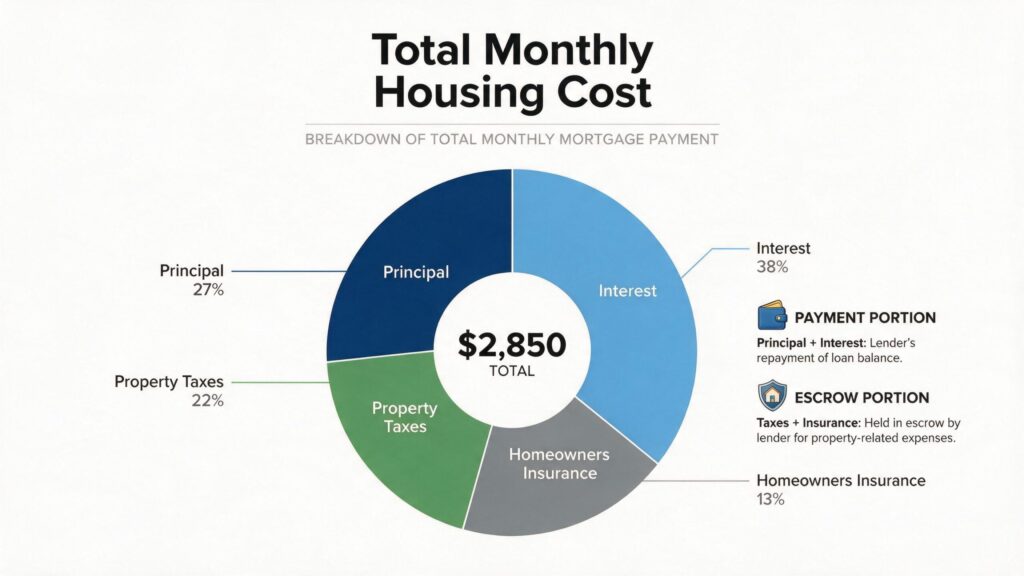
When you hear a loan officer talk about “P&I,” they are strictly referring to the debt-repayment portion of your monthly obligation. This number is static on a fixed-rate loan. It never changes. However, P&I is not your total out-of-pocket cost. It completely ignores taxes and insurance.
Escrow Account
An escrow account is a forced savings account managed by your lender. Instead of trusting you to pay your annual property taxes and insurance premiums on time, the bank divides those yearly bills by 12. They add that fraction to your monthly P&I payment. The bank collects this money every month, holds it in escrow, and pays the government and insurance company on your behalf. According to the Consumer Financial Protection Bureau (CFPB), lenders use escrow to protect their collateral against tax liens or uninsured property damage.
Loan-to-Value (LTV) Ratio
This is a risk metric. It compares the size of your loan to the total appraised value of the property. If you borrow $400,000 on a $500,000 house, your LTV is 80%. Lenders obsess over this number. A lower LTV means you have more equity in the home, which makes you a safer bet. A safer bet gets a lower interest rate.
Private Mortgage Insurance (PMI)
If your LTV is higher than 80% (meaning you put down less than 20% in cash), the bank forces you to buy an insurance policy that protects them if you stop making payments. You pay the premium. They get the protection. PMI is a wealth destroyer. It adds a completely dead expense to your monthly payment. You can track exactly how much this penalty costs you by verifying your numbers on our PMI calculator.
Unveiling the Formula: The Math Behind the Calculator
You cannot figure out your exact monthly mortgage payment by doing mental math.
Adding up the purchase price and dividing it by 30 years will leave you dangerously underfunded. The banking system uses a specific, aggressive mathematical formula to ensure they collect their profit upfront. Our calculator mimics this exact algorithmic logic. It processes the standard amortization formula used by every major financial institution in the United States.
Here is the exact mathematical equation used to generate your baseline Principal and Interest (P&I) payment:
M = P [ i(1 + i)^n ] / [ (1 + i)^n – 1 ]
To understand why your payment looks the way it does, we have to break down these variables. This is what the math represents in the real world:
- M (Monthly Payment): This is the final P&I dollar amount you owe the bank every 30 days.
- P (Principal Loan Amount): This is your raw debt. It equals the total purchase price of the home minus your exact cash down payment.
- i (Monthly Interest Rate): Do not plug your annual interest rate in here. You must take your quoted annual interest rate (e.g., 6.0%) and divide it by 12 to find your monthly periodic rate (0.5%).
- n (Number of Payments): This is your loan term expressed in months. A 30-year mortgage equals 360 payments. A 15-year mortgage equals 180 payments.
The formula guarantees that your monthly payment remains identical for the entire life of a fixed-rate loan. However, the internal ratio of what you are actually paying shifts dramatically every single month. During your first year, nearly all of your money pays the bank’s interest fee. Almost nothing goes toward your actual debt. You can visualize this exact breakdown by running your numbers through our Mortgage Amortization Calculator.
But the P&I formula is only step one.
Our tool takes this baseline mathematical output and layers on the real-world variables. It adds your monthly property tax burden (T). It adds your homeowner’s insurance premium (I). If you put down less than 20%, it calculates your Private Mortgage Insurance penalty. By fusing the rigid algebraic formula with localized tax and insurance data, our tool provides institutional-grade accuracy. You get the real number. Not a marketing estimate.
5 Critical Factors That Influence Your Numbers
Your final monthly payment is a living, breathing metric. It reacts violently to small changes in your financial profile and massive shifts in the global economy.
If you want to lower your monthly costs, you have to understand the specific levers controlling the math. Some of these variables are entirely in your hands. Others are dictated by government policies and bond markets. Here are the five primary factors that force your monthly mortgage payment up or down.
1. The Size of Your Down Payment
Cash is your greatest leverage. Your down payment directly dictates the size of your principal balance. The smaller your principal, the lower your monthly payment. It is that simple. Furthermore, if your down payment crosses the 20% threshold, you completely eliminate the monthly Private Mortgage Insurance (PMI) penalty. Bringing an extra $10,000 to the closing table does not just lower your debt. It lowers the compounding interest applied to that debt for the next three decades.
2. Macroeconomic Inflation Data
You do not control the broader economy. Lenders tie their mortgage rates directly to inflation expectations. When inflation runs hot, the purchasing power of the bank’s future profits drops. To protect themselves, they raise interest rates. When the Bureau of Labor Statistics (BLS) reports a spike in the Consumer Price Index (CPI), the bond market reacts instantly. Yields on 10-year Treasury bonds rise. Mortgage rates follow immediately. Even a half-percent increase in market rates can add hundreds of dollars to your monthly payment calculation.
3. Your FICO Credit Score Tier
Banks price their money based on risk. Your credit score is the exact metric they use to measure how likely you are to default on the loan. The mortgage industry uses strict brackets to assign risk penalties. A borrower with a 780 FICO score sits in the top tier and secures the baseline market rate. A borrower with a 650 FICO score gets hit with mandatory Loan-Level Price Adjustments (LLPAs). These adjustments artificially inflate your interest rate, drastically increasing your monthly payment requirement.
4. Local Property Tax Assessments
Your property taxes are not static. Local county assessors re-evaluate the value of your home periodically. If your local government decides they need more funding for schools or infrastructure, they raise the tax rate. Because your property taxes are held in escrow and paid via your monthly mortgage payment, a tax hike instantly increases your out-of-pocket housing cost. Always check the historical tax data of a property before running your final numbers.
5. Your Debt-to-Income (DTI) Ratio
Lenders calculate exactly how much of your gross monthly income goes toward your existing debts. If you make $8,000 a month and spend $4,000 on car loans, student loans, and credit cards, your DTI is 50%. A high DTI terrifies underwriters. If they approve the loan at all, they will often charge a higher interest rate to offset the risk of your over-extended budget. You can model out exactly how much debt you can safely carry before applying by using a Mortgage Affordability Calculator. Pay off your revolving credit cards before you apply for a mortgage to secure a cheaper monthly payment.
Real-World Scenarios: The Calculator in Action
Theory does not pay the bills. Execution does.
To show you exactly how this math impacts your checking account, I have built three detailed case studies. These scenarios represent actual situations I see constantly in my financial planning practice. Watch how these three different buyers use the mortgage loan calculator to test their assumptions, avoid financial traps, and optimize their long-term wealth.
Scenario 1: The Struggling First-Time Homebuyer
Sarah makes a modest salary and has been saving for three years to buy a starter home. She finds a property listed for $320,000. She only has $16,000 in cash for a down payment (5%). Because she is retaining so little equity, she knows she will be hit with a PMI penalty. The local property taxes are notoriously high in this county, sitting at $4,800 a year ($400/month). She gets quoted a 6.5% interest rate.
Sarah cannot afford a payment over $2,400 a month. Before she signs an offer, she runs the numbers to see if she will survive the actual monthly hit.
| Input Variable | Sarah’s Loan Data |
|---|---|
| Home Price | $320,000 |
| Down Payment | $16,000 (5%) |
| Loan Amount | $304,000 |
| Interest Rate | 6.50% |
| Loan Term | 30 Years |
| Property Taxes (Monthly) | $400 |
| Home Insurance (Monthly) | $120 |
| PMI (Monthly Estimate) | $150 |
| Total Calculated Payment | $2,591 |
Strategic Analysis:
The math does not lie. Sarah’s actual monthly payment comes in at $2,591. That is nearly $200 over her strict budget limit. If she had simply calculated the P&I payment ($1,921), she would have made an offer thinking she had plenty of room. Factoring in the taxes, insurance, and PMI saved her from financial disaster. Sarah decides to walk away from this property. She adjusts her search parameters and looks for homes priced under $285,000 to keep her total PITI payment safely below her $2,400 threshold.
Scenario 2: The Aggressive Real Estate Investor
David is an experienced investor buying a $600,000 duplex. He plans to live in one unit and rent the other out (house hacking). To secure an investment property interest rate without paying heavy points, he accepts a slightly higher rate of 7.25%. He is putting down $120,000 (20%) to completely avoid PMI.
David needs to know his exact monthly cash requirement so he can set the rent price for the second unit appropriately. His goal is to have his tenant cover at least 60% of his total monthly obligation.
| Input Variable | David’s Loan Data |
|---|---|
| Home Price | $600,000 |
| Down Payment | $120,000 (20%) |
| Loan Amount | $480,000 |
| Interest Rate | 7.25% |
| Loan Term | 30 Years |
| Property Taxes (Monthly) | $650 |
| Home Insurance (Monthly) | $200 |
| PMI (Monthly Estimate) | $0 |
| Total Calculated Payment | $4,124 |
Strategic Analysis:
David’s total payment is $4,124. Because he used the mortgage loan calculator to include the heavy $650 monthly tax burden, he knows exactly what his baseline operating expense is. To hit his target of having the tenant cover 60% of the mortgage, he must price the rental unit at $2,475 per month. The tool gave David the exact data he needed to formulate a profitable, cash-flowing business strategy before he ever signed the closing documents.
Scenario 3: The Conservative Wealth Builder
Mark and Elena are in their mid-forties. They are aggressively prioritizing retirement. They are buying a $450,000 forever home. They are bringing $90,000 (20%) to the closing table.
They are debating between a standard 30-year mortgage at 6.0% and a compressed 15-year mortgage at 5.5%. They know the 15-year payment will be painful, but they want to see exactly how much total interest they save by choosing the aggressive route.
| Input Variable | 30-Year Mortgage Option | 15-Year Mortgage Option |
|---|---|---|
| Loan Amount | $360,000 | $360,000 |
| Interest Rate | 6.00% | 5.50% |
| Loan Term | 30 Years | 15 Years |
| P&I Payment Only | $2,158 | $2,941 |
| Total Interest Paid | $417,015 | $169,451 |
Strategic Analysis:
The monthly P&I jumps from $2,158 to $2,941. That is a heavy $783 monthly increase. However, the tool exposes the long-term reality of bank debt. The 30-year loan costs them $417,015 in pure interest fees. The 15-year loan only costs them $169,451 in interest fees. By accepting a tighter monthly budget today, Mark and Elena mathematically guarantee themselves nearly $250,000 in saved wealth. They choose the 15-year option, ensuring they own the house free and clear right as they hit retirement age.
Hidden Pitfalls: 3 Biggest Mistakes People Make
Borrowers make terrible assumptions about their debt. They trust the bank to protect them. The bank is not your fiduciary. They are highly incentivized to sell you the most expensive product you can legally afford.
As a financial planner, I watch buyers destroy their net worth by making the exact same calculation errors. When you misuse a mortgage loan calculator, or ignore the long-term mathematical realities of your results, you bleed money. Avoid these three massive blunders before you sign a 30-year contract.
1. Believing a Fixed-Rate Payment Never Changes
This is the most common financial illusion. Borrowers secure a 30-year fixed-rate mortgage and assume their monthly payment is permanently locked. That is entirely false.
Your principal and interest (P&I) payment is fixed. But your total monthly payment includes escrow. Escrow covers your property taxes and homeowner’s insurance. These costs never stay flat. County assessors raise property tax rates to fund local governments. Insurance companies hike premiums due to regional weather risks or inflation. When those bills increase, your mortgage servicer legally adjusts your monthly payment to cover the difference. I see clients panic when their “fixed” payment jumps by $300 a month in year three. You must leave breathing room in your budget for inevitable escrow inflation.
2. Maxing Out the Bank’s Pre-Approval Limit
Lenders determine your pre-approval amount based on your gross income. They do not care about your net income.
The bank looks at your salary before taxes, before 401(k) contributions, and before your family’s health insurance premiums are deducted. They approve you for a massive monthly payment based on phantom money you never actually take home. If a lender approves you for a $4,500 monthly payment, and you buy a house that hits that exact ceiling, you will be instantly house-poor. You will have zero cash flow left for groceries, car repairs, or retirement investing. Never let the bank dictate your budget. Use the calculator to establish a payment that fits your actual net take-home pay, not your gross salary.
3. Draining All Cash Reserves for a 20% Down Payment
The financial industry pushes the 20% down payment rule relentlessly to avoid Private Mortgage Insurance (PMI). Generally, this is sound advice.
But it becomes a catastrophic mistake if hitting that 20% mark drains your entire savings account. If you put your last $80,000 into a down payment to avoid a $150 monthly PMI charge, you are financially naked. When the furnace dies in your first winter, or the roof leaks, you have zero cash to fix it. You end up putting emergency repairs on a credit card charging 24% interest. That completely negates the savings of avoiding PMI. Retain a six-month emergency cash reserve, even if it means putting 10% down and taking the temporary PMI penalty.
Expert Strategies: How to Optimize Your Results
You ran the math. You know your monthly payment. Now you have to aggressively manage it.
A mortgage is a financial tool. You can let the bank wield it against you, or you can weaponize it to build your own net worth. I do not let my clients just make their minimum payments and wait 30 years. We attack the debt strategically. Implement these five advanced tactics to lower your lifetime costs, eliminate hidden fees, and build home equity at an accelerated pace.
1. Execute a Mortgage Recast After a Windfall
If you receive a massive cash windfall—like an inheritance, a work bonus, or the sale of another asset—do not just make a massive extra principal payment. Ask your lender for a “mortgage recast.”
When you simply drop $50,000 onto your principal balance, your loan is paid off sooner, but your required monthly payment stays exactly the same. A recast forces the bank to recalculate your loan. For a small administrative fee (usually around $250), the bank takes your new, much lower principal balance and re-amortizes it over your remaining term. This permanently drops your required monthly payment, instantly freeing up massive cash flow for your daily budget.
2. Implement the 1/12th Extra Payment Strategy
You do not need a lump sum to break the bank’s profit curve. You just need consistency.
Take your base monthly principal and interest payment and divide it by 12. Add that exact dollar amount to every single monthly payment you make. By doing this, you are effectively making one entirely extra mortgage payment per year. This microscopic monthly increase goes 100% toward your principal balance. On a standard 30-year loan, this simple mathematical shift strips four to five years off your debt timeline. You can verify exactly how many years you will save by charting this strategy on our Mortgage Payoff Calculator.
3. Appeal Your Annual Property Tax Assessment
Your local county assessor does not manually inspect your home every year. They use automated mass appraisal systems to hike your home’s estimated value and raise your property taxes.
These automated systems are frequently wrong. When your property taxes go up, your monthly mortgage payment goes up. You have the legal right to fight this. Review your annual tax assessment the moment it arrives in the mail. Look for comparable homes in your specific neighborhood that recently sold for less than your assessed value. Submit these “comps” to the county review board and file a formal appeal. Winning this appeal lowers your assessed value, drops your tax bill, and immediately lowers your monthly escrow requirement.
4. Force Early PMI Cancellation via Appraisal
If you put less than 20% down, the bank automatically forces you to pay Private Mortgage Insurance. Federal law states the bank must automatically drop this penalty when your scheduled payments hit 78% of the original purchase price.
Do not wait for the schedule. You can force the issue early. If your local real estate market spikes, your home naturally appreciates in value. Your equity grows even if you haven’t paid down much principal. If you believe your home’s new value gives you 20% equity, contact your lender. Pay $500 for a fresh appraisal. If the new appraisal proves you cross the 20% threshold, the bank is legally required to remove the PMI immediately.
5. Harvest Your Amortization Data Annually
Set a calendar reminder for the first week of January every year. Pull your official mortgage statement and look at your exact principal balance.
Plug that remaining balance and your current interest rate into a standard Mortgage Interest Calculator. Review exactly how much interest you are scheduled to pay in the upcoming 12 months. Treating this debt as a living business metric forces you to stay financially disciplined. When you see exactly how many thousands of dollars the bank is taking from you this year, it incentivizes you to funnel extra cash flow toward your principal instead of wasting it on depreciating liabilities.
Frequently Asked Questions (FAQs)
Q: Does a mortgage calculator include taxes and insurance?
A: A high-quality calculator includes taxes and insurance, while basic tools only show principal and interest. Our tool allows you to input exact local tax rates and insurance premiums to generate a highly accurate PITI (Principal, Interest, Taxes, Insurance) payment requirement.
Q: How much mortgage can I get approved for?
A: You can generally get approved for a mortgage payment that equals up to 28% of your gross monthly income. However, lenders also enforce a strict total debt-to-income (DTI) limit. Your total monthly debts, including the new mortgage, usually cannot exceed 36% to 43% of your gross income.
Q: Is it better to get a 15-year or 30-year mortgage?
A: It is better to get a 15-year mortgage if you prioritize massive interest savings and fast equity growth. It is better to get a 30-year mortgage if you need a lower, safer monthly payment to protect your daily cash flow against financial emergencies.
Q: Can my fixed-rate mortgage payment go up?
A: Yes. Your core principal and interest portion remains permanently fixed, but the escrow portion of your payment will go up. When local municipalities raise property taxes or your insurance carrier increases your premium, your total monthly mortgage payment will increase to cover the difference.
Q: What is the rule of thumb for affording a house?
A: The standard financial rule of thumb is the 28/36 rule. Your total housing payment should not exceed 28% of your gross monthly income, and your total combined debt obligations (including car loans and credit cards) should not exceed 36% of your gross monthly income.
Q: How does my down payment affect my monthly cost?
A: Your down payment directly lowers your starting loan principal, which permanently decreases your monthly principal and interest obligation. Additionally, if your cash down payment equals 20% or more of the purchase price, you completely eliminate the expensive monthly Private Mortgage Insurance (PMI) fee.
Q: How can I pay off my mortgage faster?
A: You can pay off your mortgage faster by switching to a bi-weekly payment schedule, applying annual work bonuses directly to the principal, or adding a flat extra dollar amount to your payment every month. Every extra dollar paid goes entirely toward debt reduction, instantly bypassing bank interest.
Stop guessing what your future housing costs will be. Scroll back to the top of the page, plug your specific property data into the Nxfly Finance Mortgage Loan Calculator, and uncover your true monthly obligation. Once you verify your exact numbers, use our Mortgage Affordability Calculator to ensure this payment safely fits within your overarching wealth strategy.
Disclaimer: The Mortgage Loan Calculator provided by Nxfly Finance is for educational and informational purposes only. It does not constitute specific financial, investment, or tax advice. Please consult with a licensed financial advisor, fiduciary, or CPA before making any major financial decisions.