

A Clear Payment Estimate Can Protect Your Peace of Mind
Borrowing money can solve an immediate problem, fund a vehicle, support a home purchase, or help cover an important expense. Yet the payment can follow you long after the paperwork ends. A number that looks manageable in a loan advertisement may feel very different after interest, fees, insurance, taxes, and other bills enter the picture.
Before you borrow, learn to calculate monthly loan payments with figures you can verify. You do not need advanced math skills. You need the loan amount, interest rate, repayment term, and a clear view of extra costs. Once you understand the numbers, you can make a decision based on your real budget rather than pressure or guesswork.
When you calculate monthly loan payments, you gain more than a single dollar figure. You can also estimate total interest, compare repayment terms, test different rates, and decide whether the debt supports your larger financial goals.
Bad loan information can create problems such as:
- A rushed estimate can make it harder to calculate monthly loan payments accurately.
- Many people calculate monthly loan payments using only the advertised interest rate and ignore origination fees.
- Without checking the repayment term, you may calculate monthly loan payments that look low but cost more over time.
- A payment estimate may exclude taxes, insurance, maintenance, or other recurring costs.
- A lender’s maximum approval amount may exceed the payment you can comfortably manage.
Learning to calculate monthly loan payments can also improve your financial confidence. You can walk into a lender conversation with specific questions. You can spot differences between offers. You can explain why one payment fits your budget while another creates too much pressure.
When you calculate monthly loan payments before applying, you create a pause between wanting the purchase and accepting the debt. That pause matters. It gives you time to review your cash flow, consider alternatives, and protect your future choices.
In my experience, people rarely regret understanding a loan before signing. They often regret focusing only on approval and not on the full repayment cost.
You can calculate monthly loan payments as a planning exercise, not as a promise to borrow. A careful estimate gives you information while you still have room to change the loan amount, term, or purchase decision.

Build the Loan Picture Before You Touch the Formula
Identify the four numbers that drive the payment
To calculate monthly loan payments, start with four core figures:
- Principal: The amount you plan to finance.
- Interest rate: The lender’s stated cost for providing the money.
- Number of payments: The total number of scheduled installments.
- Payment frequency: Most consumer loans use monthly payments, but some contracts use a different schedule.
Before you calculate monthly loan payments, confirm whether the principal includes financed fees. A lender may add an origination fee, documentation fee, or other charge to the balance. If you borrow $20,000 but finance a $400 fee, the formula should use $20,400 as the principal.
Write down the figures from the actual loan offer so you can calculate monthly loan payments from the same information that appears in the contract. Do not rely on a verbal estimate when the written terms provide a more precise basis.
Also check whether the rate stays fixed. A fixed-rate loan keeps the same interest rate throughout the agreed repayment period. A variable-rate loan can change when its index or adjustment rules change.
Calculate the payment with the standard fixed-rate formula
For a typical fixed-rate installment loan, the standard formula uses:
Here is what each symbol means:
- M = monthly principal-and-interest payment
- P = principal, or starting loan balance
- r = monthly interest rate written as a decimal
- n = total number of monthly payments
This equation helps you calculate monthly loan payments when the loan uses a fixed rate and equal payments. To convert an annual interest rate into the monthly decimal rate, divide the percentage by 100, then divide by 12.
For example, an 8% annual rate becomes:
8% ÷ 100 ÷ 12 = 0.0066667
The formula does not include every cost connected to borrowing. It calculates the scheduled principal-and-interest amount. You must add other applicable charges separately.
A practical example with real numbers
Let’s calculate monthly loan payments for a $20,000 fixed-rate loan with an 8% annual interest rate and 60 monthly payments.
The inputs look like this:
| Loan detail | Example |
|---|---|
| Principal | $20,000 |
| Annual interest rate | 8% |
| Monthly rate | 0.0066667 |
| Number of payments | 60 |
| Payment frequency | Monthly |
The estimated monthly principal-and-interest payment comes to about $405.53. Across 60 payments, the borrower pays about $24,331.80. That produces approximately $4,331.80 in total interest, before any separate fees.
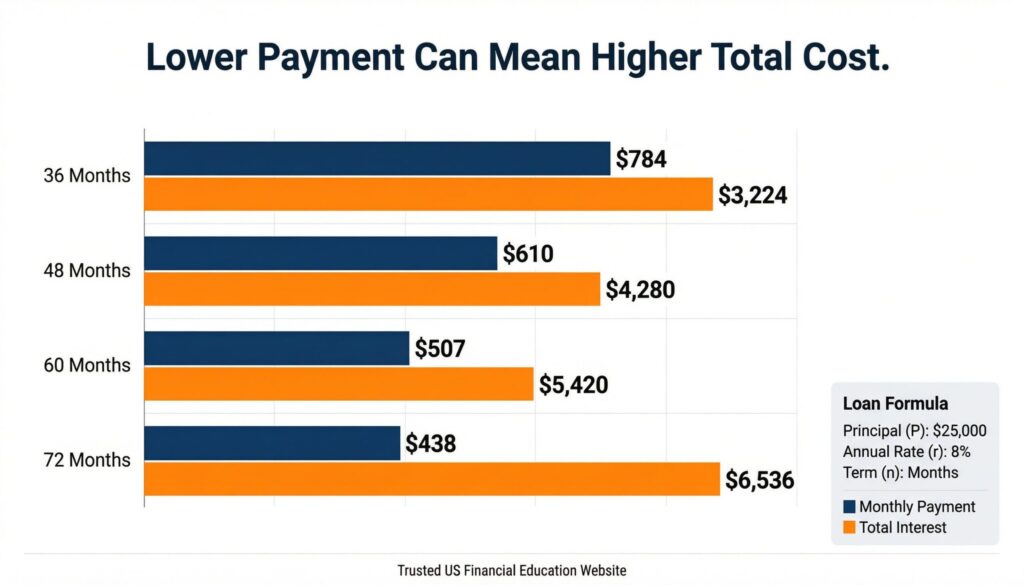
If you calculate monthly loan payments with a shorter term, the payment usually rises because you repay the balance through fewer installments. However, the loan may collect less interest overall. A longer term usually lowers the scheduled payment but can increase the total interest cost.
The first payment also shows how amortization works. At an 8% rate, the first month’s interest on a $20,000 balance equals about $133.33. The remaining portion of the payment reduces principal. As the balance falls, the lender calculates less interest during later payment periods.
Use the Mortgage Payment Calculator when you want a quick estimate for a home loan. It can help you review the effect of the loan balance, rate, and term without doing the formula by hand.
Separate loan types before comparing results
To calculate monthly loan payments for a mortgage, you may need more than principal and interest. Property taxes, homeowners insurance, mortgage insurance, association dues, and closing costs can affect the amount that leaves your bank account.
A mortgage payment estimate may show only the base payment. You can use the Mortgage Affordability Calculator to connect the payment with your income and broader housing budget.
For a full home-loan explanation, review how U.S. mortgage payments are calculated. That guide explains how loan balance, interest, taxes, insurance, and related costs can affect a mortgage payment.
An auto loan or personal loan may not include property taxes or homeowners insurance, but it can include a down payment, trade-in value, sales tax, dealer fees, or origination charges. Student loans may use different repayment structures, including fixed installments, graduated payments, or income-based formulas.
The type of loan determines which assumptions make sense. A calculator gives better results when you match its settings to the contract.
Review the amortization schedule
A single payment number cannot show the whole cost. An amortization schedule lists every payment, the interest amount, the principal amount, and the remaining balance.
Use the Mortgage Amortization Calculator to see how the balance changes over time. You can also review Investopedia’s definition of amortization for a plain-language explanation of how installment debt reduces through scheduled payments.
A schedule can answer practical questions:
- How much principal will I repay during the first 12 payments?
- How much interest will I pay before the balance falls by a specific amount?
- What happens if I add an extra $50 to each payment?
- How much interest could a shorter term save?
- How long will the balance remain high?
When you calculate monthly loan payments with an amortization schedule, you see the difference between a manageable payment and an expensive repayment structure. The lower payment does not always represent the lower-cost loan.
Connect the payment to your personal budget
A payment fits your budget only when your regular cash flow can support it. Start with take-home income, then subtract housing, utilities, food, insurance, transportation, existing debt, savings, and irregular expenses.
The monthly budget guide can help you organize those categories. A budget should reflect an ordinary month, not a month in which you cancel every optional activity or receive an unusual bonus.
To calculate monthly loan payments inside a budget, add the estimated payment to your existing obligations. Then ask:
- Can I make the payment if my income falls temporarily?
- Can I still save for emergencies?
- Can I handle routine repairs and medical costs?
- Will the payment delay retirement or education goals?
- Will I rely on credit cards to cover normal expenses?
Lenders often review a debt-to-income ratio. That ratio compares required monthly debt payments with gross monthly income. It helps a lender measure repayment risk, but it does not define your personal comfort level. Your budget may require a lower payment than the amount a lender approves.
Understand interest rate, APR, and fees
To calculate monthly loan payments using a quoted offer, first identify whether the quote shows the interest rate or the annual percentage rate, commonly called APR.
The interest rate helps determine the scheduled finance charge. APR can include certain fees and gives you a broader way to compare borrowing costs. The Consumer Financial Protection Bureau’s APR explanation explains why APR and the interest rate can show different figures.
For example, two lenders may offer the same interest rate but charge different upfront fees. Their scheduled principal-and-interest payments may look similar, while their total borrowing costs differ.
You can use the Mortgage APR Calculator to examine how fees can affect the cost of a mortgage. For a separate view of interest charges, use the Mortgage Interest Calculator.
Do not treat APR as a replacement for reading the loan agreement. Ask which fees the APR includes, which costs it excludes, and whether the lender calculates the figure under assumptions that match your situation.
Test the payment under more than one scenario
A strong estimate does not rely on a single optimistic result. You should calculate monthly loan payments twice or more by changing one input at a time.
Try these comparisons:
- Lower principal with a larger down payment
- Shorter term with a higher scheduled payment
- Higher rate to test a less favorable offer
- Lower rate to understand potential savings
- Extra payments toward principal
- Added taxes, insurance, or association dues
- A variable-rate adjustment if the contract allows one
This comparison lets you calculate monthly loan payments under conditions that resemble real life. If a small change makes the payment unaffordable, the original loan may leave too little room in your budget.
After you calculate monthly loan payments, save the assumptions beside the result. Record the principal, rate, term, fees, taxes, insurance, and date of the estimate. This record helps you compare a later lender quote with your original plan.
Advanced Ways to Calculate Monthly Loan Payments Before You Commit
Experienced borrowers calculate monthly loan payments in more than one way. They review the scheduled amount, the total cost, the risks around the rate, and the effect on future cash flow.
Compare the term, not just the payment
When you calculate monthly loan payments for two repayment terms, compare both the monthly amount and the total interest. A lower payment can look attractive because it creates more room today. Yet the longer term may keep the balance active for much longer and increase the cost of borrowing.
Using the earlier $20,000 example, a 48-payment term at the same 8% rate produces a payment of roughly $488.26 and total payments near $23,436. A 60-payment term produces a payment near $405.53 and total payments near $24,332. The lower-payment option saves about $82 each month but costs about $896 more in interest across the schedule.
The right choice depends on cash flow, savings, and risk. Do not choose a shorter term if it leaves you unable to cover basic bills or maintain emergency savings.
Run a rate-sensitivity test
To calculate monthly loan payments responsibly, test what happens if the interest rate changes. This matters most with a variable-rate loan or a loan that resets after an introductory period.
Use the same principal and payment count, then increase the rate by one or two percentage points for a planning exercise. The result does not predict the lender’s exact adjustment. It shows whether your budget has room for a higher payment.
Ask the lender:
- What index controls the rate?
- How often can the rate change?
- What caps limit each adjustment?
- Does a lifetime cap apply?
- Does the payment change with the rate, or does the balance grow?
- Can the loan create a balloon payment?
Keep the answers with your loan records. A rate description that sounds simple may contain adjustment rules that significantly affect repayment.
Add every monthly cost to the base payment
A second way to calculate monthly loan payments involves building an all-in monthly estimate. For a mortgage, add principal and interest to property taxes, homeowners insurance, mortgage insurance, and association dues when applicable.
For an auto loan, consider insurance, fuel, maintenance, registration, and parking. A personal loan may have fewer connected costs, but you should still account for the expense that prompted the borrowing.
If you calculate monthly loan payments without these related costs, you may understate the effect on your budget. The loan payment itself may fit, while the full expense creates a monthly shortfall.
Compare offers with matching assumptions
To calculate monthly loan payments from multiple offers, use the same principal, payment count, and payment frequency. Compare each offer’s interest rate, APR, upfront fees, recurring fees, prepayment terms, and late-payment charges.
Do not compare a quote based on $18,000 with another quote based on $20,000. Do not compare a payment that includes financed fees with one that requires those fees at closing.
Ask for a written payment breakdown. A clear quote should identify the amount financed, finance charge, total of payments, payment due date, and other costs. When a lender cannot explain a number in plain language, pause before accepting the offer.
Protect your cash flow after approval
A payment can fit your budget today and become difficult later. Before you borrow, keep room for income changes, insurance increases, repairs, health costs, and other regular surprises.
A practical planning method uses three payment levels:
- Target payment: The amount that feels comfortable in an ordinary month
- Stretch payment: The highest amount you could manage for a short period
- Stop point: The payment that would force you to miss savings goals or rely on new debt
If your estimated payment reaches the stop point, reduce the loan amount, delay the purchase, increase the down payment, or reconsider the term. This approach protects your options without relying on perfect financial conditions.
Understand extra payments before sending them
Extra principal payments can reduce the balance faster and may lower total interest. However, you should confirm how the lender applies additional money. Some lenders apply extra funds to future payments unless you give specific instructions.
Check the contract for prepayment penalties, minimum extra-payment amounts, and online payment settings. If the lender applies extra money to principal, keep confirmation records.
You can also compare the impact through the Extra Mortgage Payment Calculator. The tool can show how additional payments affect the repayment timeline and interest cost for a mortgage.
Keep an assumption sheet
A simple assumption sheet makes future decisions easier. Record:
- Loan type
- Principal
- Interest rate
- APR
- Payment count
- Monthly payment
- Total interest
- Upfront fees
- Taxes and insurance
- Prepayment rules
- Date of the lender quote
When you calculate monthly loan payments with this information, you create a record that another person can review. That can help a spouse, parent, or financial professional understand the decision without rebuilding the math.
Common Mistakes When You Calculate Monthly Loan Payments
Some borrowers calculate monthly loan payments correctly but still make a poor borrowing decision because they use incomplete information. The formula can produce an accurate answer while the decision remains too expensive.
Mistake: Using the purchase price as the loan amount
A home, vehicle, or other purchase may include a down payment, trade-in credit, taxes, and financed fees. The purchase price does not always equal the amount the lender finances.
If you calculate monthly loan payments from the purchase price instead of the financed balance, your estimate may differ from the written loan offer. Start with the amount financed shown in the disclosure.
Mistake: Ignoring the repayment term
A borrower may focus on the payment and overlook the number of scheduled installments. A long term can reduce the monthly amount while increasing total interest.
Before you calculate monthly loan payments, write down the total payment count. Then compare the total of payments, not just the first figure on the screen.
Mistake: Confusing interest rate with APR
An advertised rate may not include all borrowing costs. APR offers a broader cost comparison, but you still need to review the fee details and exclusions.
If you calculate monthly loan payments from the wrong rate, the estimate may not match the lender’s disclosure. Ask whether the quote uses the fixed rate, variable rate, or APR.
Mistake: Forgetting mortgage-related expenses
A home loan payment may include more than principal and interest. Property taxes, homeowners insurance, mortgage insurance, and association dues can change the amount you need each month.
Before you calculate monthly loan payments for a home, decide whether you want a base payment or an all-in housing estimate. Use both figures during budget planning.
Mistake: Choosing the maximum approved amount
A lender evaluates repayment risk under its own rules. Approval does not mean the payment supports your savings goals, family needs, or preferred lifestyle.
In my experience, people sometimes accept the maximum amount because they view approval as a spending target. A better approach uses your personal budget first and lender approval second.
Mistake: Rounding too early
Small rounding changes can affect the final result, especially across many payments. Keep several decimal places during the formula, then round the final payment to the nearest cent.
Also remember that a calculator estimate may differ slightly from a lender’s figure because the lender may use daily interest, odd first-payment periods, fee financing, or a different payment date.
Mistake: Treating a calculator as the contract
A calculator provides an estimate based on the numbers you enter. The loan agreement controls the actual obligation.
Review the promissory note, payment schedule, disclosures, rate-adjustment terms, fees, and prepayment rules. If the contract differs from your estimate, ask questions before signing.
Your Action Plan to Calculate Monthly Loan Payments
Use this short plan before you submit an application or accept a loan:
- Collect the written terms. Find the amount financed, interest rate, APR, payment count, and payment frequency.
- Check the loan type. Identify whether the rate stays fixed or can change.
- Calculate the base payment. Use the standard formula or a reputable calculator.
- Review total interest. Look at the full payment schedule, not only the monthly amount.
- Add connected expenses. Include taxes, insurance, fees, maintenance, or other costs that apply.
- Test a harder scenario. Increase the rate, lower your income assumption, or include an unexpected expense.
- Compare terms. Review how a shorter or longer repayment period changes the total cost.
- Set your personal stop point. Do not let approval decide what your budget can support.
- Save the estimate. Keep your assumptions and the lender’s written disclosure together.
Your goal is not to find the largest loan you can obtain. Your goal is to understand the payment well enough to make a calm, informed choice.
Frequently Asked Questions (FAQs)
How do I calculate monthly loan payments?
Use the fixed-rate loan formula, an online calculator, or an amortization table to find the scheduled payment. Enter the principal, monthly interest rate, and total number of payments. The formula then estimates the monthly principal-and-interest amount for a loan with equal payments.
For example, you can convert an annual rate into a monthly decimal by dividing the rate by 100 and then dividing by 12. Enter that result as r, the loan balance as P, and the total payment count as n. Add taxes, insurance, and fees separately because the standard formula may not include them.
Can I calculate monthly loan payments without an interest rate?
You can estimate a payment without an interest rate, but you cannot produce a reliable borrowing cost until you know the rate. A zero-interest estimate divides the principal by the number of payments, but most loans charge interest or fees.
Ask the lender for the fixed rate or the variable-rate formula before comparing offers. If the rate can change, run more than one estimate to see how a higher rate could affect your budget. Also request the APR and fee schedule so you can review the broader cost.
What information do I need before estimating a loan payment?
You need the amount financed, interest rate, total number of payments, payment frequency, and loan type. You may also need taxes, insurance, mortgage insurance, origination fees, association dues, or other connected costs.
Find these details in the written loan estimate, financing disclosure, or promissory note. If a lender gives you only a payment figure, ask for the inputs behind that figure. Without the principal, rate, and term, you cannot fairly compare the offer with another loan.
Does APR determine the monthly loan payment?
APR can help you compare the broader cost of loans, but the interest rate and loan balance usually determine the scheduled principal-and-interest payment. APR may include certain fees that do not appear in the stated rate.
Two loans can show similar monthly payments while carrying different upfront costs. Review the interest rate, APR, amount financed, finance charge, and total of payments together. The Consumer Financial Protection Bureau provides consumer information that can help you understand how APR differs from the interest rate.
Why does a longer repayment term lower the payment?
A longer term spreads the principal across more scheduled payments, which often lowers the required monthly amount. However, the lender may charge interest across more payment periods, increasing the total cost.
Compare both figures before choosing a term. A shorter term may cost more each month but reduce total interest. A longer term may improve cash flow but keep the debt active for a longer period. Choose the term that supports your budget without sacrificing basic savings and bill payments.
Do taxes and insurance belong in a mortgage payment estimate?
Taxes and insurance belong in an all-in housing estimate, even when they do not form part of the principal-and-interest formula. A lender may collect these costs through an escrow account, or you may pay them separately.
Ask whether the quoted mortgage payment includes property taxes, homeowners insurance, mortgage insurance, or association dues. If the quote excludes them, add your own estimates before judging affordability. Property taxes and insurance can also change, so leave room for future adjustments.
What should I do if the estimated payment feels too high?
If the payment feels too high, pause before signing and identify which input creates the pressure. You may need a smaller principal, a larger down payment, a different term, a lower-cost purchase, or more time to strengthen your savings.
Do not solve an unaffordable payment by ignoring insurance, taxes, maintenance, or emergency savings. Ask the lender to explain every cost and compare written offers using the same assumptions. A loan should support your broader financial plan rather than force you to depend on new debt for ordinary expenses.
The information provided in this article is for educational and informational purposes only. It does not constitute professional financial, investment, tax, or legal advice. The content on Nxfly Finance (nxfly.com) is intended to help you understand general financial concepts and should not be used as a substitute for personalized advice from a qualified financial advisor, CPA, tax professional, or licensed attorney.
Every individual’s financial situation is unique. Results, outcomes, and experiences discussed or implied in this article may vary significantly based on your personal circumstances, income, credit profile, location, and market conditions. No financial outcome, return, or result is guaranteed.
Nxfly Finance does not endorse, promote, or recommend any specific financial product, service, lender, institution, or investment. Any tools, calculators, or estimates provided on this website are for illustrative and planning purposes only and should not be solely relied upon for making financial decisions.
Always conduct your own due diligence and consult with a licensed financial professional before making any financial, investment, or borrowing decisions. By reading and using this content, you acknowledge and agree that Nxfly Finance and its authors are not liable for any financial decisions made based on the information provided here.
For more information on financial regulations and consumer protections in the United States, visit the Consumer Financial Protection Bureau (CFPB) or the U.S. Securities and Exchange Commission (SEC).