

By Michael Velez, CFP® | Reviewed by the Nxfly Finance Team
Refinancing your home is not a magic trick. It is basic math. Banks aggressively market lower monthly payments. They send you mailers. They promise thousands in savings. Do not fall for the hype. A lower monthly payment does not automatically mean you save money in the long run. Often, you just reset the clock on your debt. You end up paying the bank for another 30 years.
To beat the banks, you need hard data. You need a reliable mortgage refinance calculator.
Right now, homeowners face a wildly shifting interest rate environment. Rates drop, and suddenly everyone wants to break their current mortgage contract. Before you call a loan officer, you need to understand the true cost of that decision. Every time you refinance, you pay closing costs. These fees easily swallow up years of potential savings.
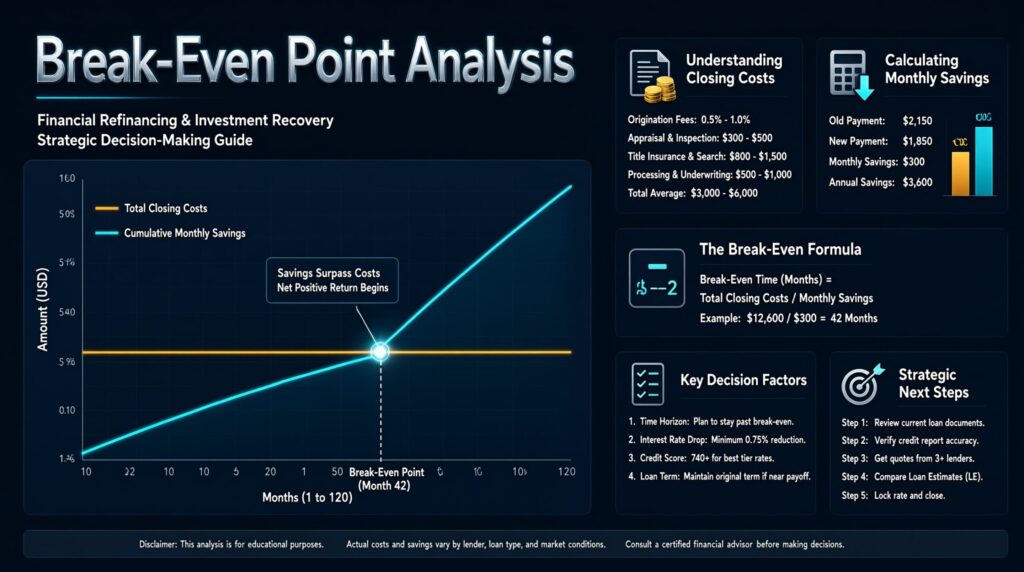
Our tool cuts through the marketing noise. It tells you exactly how many months it will take to recover your upfront costs. This is your break-even point. If you plan to sell your house before you hit that month, refinancing is a guaranteed loss.
Before you even think about signing a new loan agreement, you must establish a baseline. I highly recommend running your current numbers through a standard Mortgage Payment Calculator. This gives you a clear view of your existing principal and interest split.
Once you know exactly what you currently pay, you can use the mortgage refinance calculator below to model your new scenario. We built this tool for clarity. It strips away the confusion. You plug in your current loan balance, your current rate, and your new proposed rate. We handle the heavy lifting. We show you your monthly savings, your lifetime interest changes, and your exact break-even timeline.
Take control of your home equity. Run your numbers. Make a highly informed, mathematically sound decision.
🔄 Refinance Calculator
See if refinancing saves you money & how long it takes to break even
The Mechanics: How to Use the Nxfly Mortgage Refinance Calculator
Garbage in, garbage out. The accuracy of your output relies entirely on the accuracy of your inputs. Do not guess your loan balance. Do not estimate your interest rate. Pull your most recent mortgage statement and input the exact figures. Let’s break down exactly how to fill out the mortgage refinance calculator and why each number matters.
Step 1: Your Current Loan Balance
This is not the original amount you borrowed. This is the exact principal you still owe the bank today. You can find this on your online mortgage portal. If you owe $245,000 on a house you originally bought for $300,000, input $245,000. Your new loan will only cover this remaining balance, plus any closing costs you choose to roll into the new loan.
Step 2: Your Current Interest Rate vs. New Interest Rate
The interest rate spread is the heartbeat of your refinance. Enter the exact percentage you currently pay, followed by the rate your new lender quoted you. The old rule of thumb stated you should only refinance if you can drop your rate by a full 1%. That rule is outdated. If you carry a massive loan balance, even a 0.5% drop yields massive savings. Let the calculator do the math.
Step 3: Remaining Term vs. New Loan Term
This is where homeowners make their biggest financial mistake. Enter the number of years left on your current loan. If you are 5 years into a 30-year mortgage, your remaining term is 25 years.
Now, enter the term of your new loan. If you refinance into a new 30-year term, you just stretched a 25-year debt into a 30-year debt. Your monthly payment will drop drastically. You feel rich. But you will pay vastly more in total interest over your lifetime. If your goal is wealth accumulation, try modeling a 15-year or 20-year term to match or accelerate your current payoff schedule.
Step 4: Estimated Closing Costs
Refinancing is expensive. Lenders charge origination fees, appraisal fees, title searches, and recording fees. These usually total between 2% and 6% of your loan amount. You must input a realistic closing cost estimate. If you do not know the exact number, use 3% of your loan balance as a safe baseline. The mortgage refinance calculator uses this exact figure to determine your break-even point.
To see how these new terms impact your payment schedule month by month, take your new loan figures and run them through our Mortgage Amortization Calculator. This shows you exactly how much of your new payment goes toward principal versus interest in year one.

The Anatomy of the Calculation: Key Terms & Deep Concepts
Financial literacy protects your wallet. The mortgage industry uses jargon to keep you confused. When you use a mortgage refinance calculator, you will encounter specific industry terms. You need to understand exactly what these concepts mean and how they manipulate your money. Here is your plain-English guide to the mechanics of refinancing.
The Break-Even Point
This is the single most important metric in your refinancing journey. The break-even point is the exact moment when your accumulated monthly savings exceed the upfront cost of getting the new loan.
The math is simple: Total Closing Costs ÷ Monthly Payment Savings = Months to Break Even.
If your closing costs are $4,000 and your new loan saves you $100 per month, your break-even point is 40 months. If you sell your home or refinance again in month 30, you lost money on the deal. You never recovered your upfront investment. Our calculator does this math instantly.
Closing Costs (Settlement Fees)
Lenders do not work for free. Closing costs represent the administrative toll of creating a new mortgage. These include underwriting fees, credit report pulls, attorney fees, and local government taxes. Sometimes lenders offer a “no closing cost” refinance. This is a mathematical illusion. They simply charge you a higher interest rate or roll the fees directly into your total loan balance. You pay for it eventually.
Cash-Out Refinance vs. Rate-and-Term Refinance
A standard “rate-and-term” refinance simply replaces your current loan balance with a new loan at a better rate or a different timeframe. Your debt level stays the same.
A “cash-out” refinance strips equity from your home. You borrow more than you currently owe. The bank hands you the difference in cash. Homeowners use this for renovations or debt consolidation. Be very careful here. You are converting your home’s equity into fresh debt, which drastically alters your amortization curve.
Mortgage Discount Points
You can literally buy a lower interest rate. One “point” typically costs 1% of your total loan amount and lowers your interest rate by roughly 0.25%. If you borrow $300,000, buying one point costs you $3,000 upfront in cash. You must factor the cost of points into your closing costs when calculating your break-even timeline. If you plan to stay in the home for 20 years, buying points is highly profitable. If you plan to move in 4 years, it is a terrible waste of cash.
Annual Percentage Rate (APR)
Your interest rate is the base cost of borrowing the money. Your APR is the true, total cost of the loan. APR includes your base interest rate plus mortgage broker fees, discount points, and some closing costs, expressed as a yearly percentage. Because of this, your APR will always be slightly higher than your stated interest rate. The Consumer Financial Protection Bureau (CFPB) clearly outlines that comparing APRs is the most accurate way to judge two competing loan offers side-by-side.
Loan-to-Value Ratio (LTV)
Your LTV determines how much risk the bank takes by lending to you. You calculate this by dividing your current loan balance by the current appraised value of your home. If your home is worth $400,000 and you owe $300,000, your LTV is 75%. If your LTV is higher than 80%, most lenders will force you to pay Private Mortgage Insurance (PMI) on your new refinanced loan, which eats directly into your monthly savings.
Unveiling the Formula: The Math Behind the Calculator
You should never trust a financial tool blindly. If a website asks for your numbers but hides the math, run the other way. True financial planning requires total transparency.
To prove the accuracy of our tool, we must pull back the curtain. Our mortgage refinance calculator executes a sequence of three distinct mathematical equations in milliseconds. First, it calculates your current loan trajectory. Next, it calculates your proposed loan trajectory. Finally, it pits the two against each other to calculate your break-even point.
The core engine running these projections is the standard amortization formula. Banks use this exact equation to determine your monthly principal and interest payment.
Here is the mathematical formula formatted for clear reading:
M = P × [ r(1 + r)^n ] / [ (1 + r)^n – 1 ]
Let’s break down the variables inside this equation.
- M represents your total monthly payment. This does not include property taxes or insurance. It strictly covers principal and interest.
- P is your principal loan amount. In a refinance scenario, this is the exact balance you still owe your current lender.
- r represents your monthly interest rate. Banks quote you an annual interest rate, but mortgages compound monthly. You must divide your annual rate by 12. If your quoted rate is 6%, your monthly rate (r) is 0.005.
- n is the total number of months in your loan term. A 30-year mortgage equals 360 months. A 15-year mortgage equals 180 months.
Once the calculator computes your new monthly payment (M), it compares it directly to your old monthly payment. It takes the difference to find your monthly savings.
Then, it triggers the final, most important equation: the break-even calculation.
Break-Even Point (in months) = Total Closing Costs / Monthly Savings
Let’s look at a quick example. Assume the amortization formula determines your new loan payment drops by $200 a month. You input $5,000 in closing costs. The calculator divides $5,000 by $200. The result is 25. You hit your break-even point exactly 25 months after closing.
By hardcoding these exact mathematical standards into our system, we guarantee bank-level accuracy. You get the raw data you need to negotiate better terms with your loan officer.
5 Critical Factors That Influence Your Numbers
Refinance rates do not exist in a vacuum. Your exact quote depends on a massive web of economic triggers and personal financial habits. A calculator gives you the math based on your inputs, but you need to know what drives those inputs up or down.
Here are the five primary factors dictating the numbers you see on your screen.
1. Your FICO Credit Score
Your credit score is your financial resume. Lenders use it to measure default risk. When you apply for a refinance, banks sort you into pricing tiers based entirely on this three-digit number. Borrowers with a score above 760 get the absolute best rates available. If your score sits at 650, you will face severe rate penalties. A higher rate kills your monthly savings and pushes your break-even point years into the future. Before you refinance, pull your credit report. Fix errors. Pay down credit card balances to drop your utilization rate.
2. The Federal Reserve’s Monetary Policy
Local banks do not magically invent interest rates. They take their cues from the broader economy. When inflation runs hot, the central bank intervenes. The Board of Governors of the Federal Reserve System adjusts the federal funds rate to cool down the economy. While the Fed does not directly set mortgage rates, their policy shifts heavily influence the 10-year Treasury yield, which dictates your 30-year fixed mortgage rate. You must watch macro-economic trends. Refinancing during a rate-hiking cycle is extremely difficult.
3. Your Current Loan-to-Value (LTV) Ratio
Equity matters. LTV measures the size of your loan against the current market value of your home. If your home is worth $500,000 and you owe $400,000, your LTV is 80%. Lenders view an LTV of 80% or lower as a safe bet. If your LTV exceeds 80%, lenders usually require you to run a PMI calculator to see how much extra you will pay in Private Mortgage Insurance every single month. This insurance protects the bank, not you. It also dramatically eats into the savings you hoped to gain from refinancing.
4. Your Debt-to-Income (DTI) Ratio
High income does not guarantee a loan approval. Banks care about your cash flow. Your DTI compares your gross monthly income to your total monthly debt obligations. This includes your proposed new mortgage payment, auto loans, student loans, and minimum credit card payments. Most lenders strictly require a DTI below 43%. If you bought a car right before applying for a refinance, your DTI spikes. The lender might deny the loan or charge you a massive premium, destroying your calculator projections.
5. Cash-Out Demands
Pulling cash out of your house changes the risk profile of the loan. When you do a rate-and-term refinance, you simply swap old paper for new paper. When you do a cash-out refinance, you actively increase your total debt burden. Because you are borrowing more money against the same collateral, banks charge higher interest rates for cash-out loans. The math shifts completely. You must model this carefully to ensure the higher rate does not offset the benefit of the cash you receive.
Real-World Scenarios: The Calculator in Action
Theory is fine. Practice builds wealth.
To show you exactly how powerful this math can be, we need to look at real life. We designed the mortgage refinance calculator to handle highly specific, unique situations. No two homeowners have the same goals. Some want to pay off debt quickly. Others want to free up monthly cash to survive inflation. Some want to leverage their equity to build a real estate empire.
Let’s explore three detailed case studies. We will analyze their backgrounds, plug their numbers into the tool, and examine the strategic fallout of their results.
Scenario 1: Sarah, The Rate-Dropping Saver
Sarah bought her home four years ago when rates hovered around 7.5%. She holds a $350,000 remaining balance on a 30-year fixed loan. Her current monthly principal and interest payment is violently high. She hates debt. She wants to drop her rate, but she refuses to reset her loan back to 30 years. Doing so would mean paying interest for 34 total years. She decides to refinance into a 20-year term at a much lower current market rate of 5.5%. Her closing costs are estimated at $6,000.
She inputs these figures into the mortgage refinance calculator.
| Input Variable | Sarah’s Current Loan | Sarah’s Proposed Loan |
|---|---|---|
| Remaining Balance | $350,000 | $350,000 (Plus $6k closing costs) |
| Interest Rate | 7.5% | 5.5% |
| Remaining Term | 26 Years (312 months) | 20 Years (240 months) |
| Closing Costs | N/A | $6,000 (Rolled into loan) |
| Monthly P&I Payment | $2,499 | $2,449 |
Strategic Analysis:
Look closely at the numbers. Sarah’s monthly payment barely dropped. She only saves $50 a month. However, she just shaved six years off her loan schedule. She will own her home free and clear in 20 years instead of 26. Because she lowered her interest rate by a full 2%, she fundamentally altered her amortization schedule. Over the life of the loan, Sarah saves over $130,000 in total interest paid to the bank. To see how she can accelerate this even further with her leftover cash, she can run her new numbers through an Extra Mortgage Payment Calculator. This refinance is a massive wealth-building success.
Scenario 2: David, The Aggressive Investor
David owes $200,000 on a house currently valued at $450,000. He has a rock-bottom interest rate of 3.5% from a refinance he did years ago. He wants to buy a rental property. He needs a $50,000 down payment to secure the investment property. He decides to do a cash-out refinance to pull $50,000 in equity out of his primary home. Because rates have increased, his new loan will sit at 6.8%.
| Input Variable | David’s Current Loan | David’s Proposed Loan |
|---|---|---|
| Remaining Balance | $200,000 | $250,000 (Includes Cash-Out) |
| Interest Rate | 3.5% | 6.8% |
| Remaining Term | 22 Years | 30 Years |
| Closing Costs | N/A | $4,500 (Paid out of pocket) |
| Monthly P&I Payment | $1,114 | $1,630 |
Strategic Analysis:
David’s monthly payment jumps by $516. He gave up a historically low 3.5% rate to take on a 6.8% rate on a larger balance. The calculator flashes a stark warning. His break-even point does not exist because he is not saving any money. He is bleeding cash. However, for an aggressive investor, this might still make sense. David must calculate if the monthly cash flow and appreciation from his new rental property exceed the $516 extra he pays on his primary mortgage. He is using expensive debt to buy a cash-producing asset. It is a high-risk, high-reward maneuver that requires pristine math.
Scenario 3: The Martinez Family, Seeking Payment Relief
The Martinez family faces a financial crisis. Medical bills piled up. Inflation ate into their grocery budget. They owe $420,000 on their home with a 6.2% interest rate. They have 25 years left on the mortgage. Their primary goal is immediate monthly cash flow relief to keep food on the table. They do not care about the lifetime interest paid. They just need to survive today. They choose to refinance their balance back into a brand new 30-year term. The current market rate is exactly the same at 6.2%.
| Input Variable | Martinez’s Current Loan | Martinez’s Proposed Loan |
|---|---|---|
| Remaining Balance | $420,000 | $420,000 |
| Interest Rate | 6.2% | 6.2% |
| Remaining Term | 25 Years | 30 Years |
| Closing Costs | N/A | $5,000 (Paid upfront) |
| Monthly P&I Payment | $2,763 | $2,572 |
Strategic Analysis:
The Martinez family drops their monthly payment by $191. They get immediate breathing room in their monthly budget. But the math tells a brutal truth. Because they stretched out their payoff timeline by another five years at a high rate, they will pay roughly $90,000 more in total interest over the life of the loan. This scenario perfectly highlights why you must understand the math. Refinancing for payment relief comes at a massive long-term cost. It is a survival tactic, not a wealth-building strategy.
Hidden Pitfalls: 3 Biggest Mistakes People Make
Banks love uneducated borrowers. They structure their marketing to exploit human psychology. When you look at a mortgage refinance calculator, you might only stare at the monthly savings box. You ignore the hidden levers pulling money out of your pocket. Refinancing can build massive wealth. It can also trap you in a cycle of perpetual debt.
Here are the three most destructive mistakes homeowners make when signing a new loan agreement.
Mistake 1: Ignoring the Break-Even Point for a Short-Term Move
Life changes fast. Job relocations happen. Families outgrow their floor plans. You should never refinance if you plan to sell your home within three to five years. Yet, people do it constantly. They get excited about dropping their rate by 1%. They pay $8,000 in closing costs to save $150 a month. Run that math. It takes over 53 months just to break even. If you sell the house in month 36, you literally lost $2,600 on the transaction. The bank keeps your upfront cash. Always map your life goals against your exact break-even timeline.
Mistake 2: Blindly Rolling Closing Costs Into the Loan
Lenders frequently offer to roll your settlement fees directly into the new loan balance. You pay zero dollars out of pocket at the closing table. This feels like a massive win. It is not. You just financed your closing costs for the next 30 years. You will pay thousands of dollars in compound interest on those administrative fees. If your loan balance is $300,000 and you roll $6,000 of closing costs into a new 6% mortgage, that $6,000 actually costs you nearly $13,000 by the time you pay it off. If you cannot afford to pay closing costs in cash, you probably should not refinance.
Mistake 3: Chasing the Payment, Ignoring the Timeline
This is the most common financial blunder in real estate. You are ten years into a 30-year mortgage. You owe 20 years of payments. You refinance to lower your interest rate, but you choose a brand new 30-year term. Your monthly payment plummets. You feel like a financial genius. The reality is brutal. You just added ten extra years of interest payments to your life. You erased a decade of progress. Your total lifetime cost skyrockets. A lower monthly payment does not equal financial progress if you stretch out the debt schedule.
Expert Strategies: How to Optimize Your Results
You ran the numbers. The mortgage refinance calculator says you have a solid break-even timeline. Now you need to maximize the efficiency of your new debt. Good financial planning does not stop at the closing table.
Here are five expert strategies to engineer the absolute best outcome for your net worth.
1. Force a Shorter Amortization Schedule
If you want to build real wealth, attack your principal. Do not default to a standard 30-year loan. Look aggressively at 15-year or 20-year terms. Lenders heavily discount interest rates for shorter terms because they take on less risk. Yes, your monthly payment will be higher than a 30-year term. But you force yourself to build equity at a rapid pace. You cut hundreds of thousands of dollars in interest out of your life.
2. Compare the APR, Not Just the Stated Rate
Banks try to trick you with artificially low stated interest rates. They hide massive origination fees and discount points in the fine print. Stop looking at the advertised rate. Look exclusively at the Annual Percentage Rate (APR). The APR represents the true, annualized cost of your loan, including all those hidden lender fees. If two lenders offer you a 5.5% rate, but Lender A has a 5.6% APR and Lender B has a 6.1% APR, Lender B is overcharging you drastically on fees. Always run competing loan estimates through a dedicated Mortgage APR Calculator to expose the true cost.
3. Ask Your Lender for a Custom Term
You do not have to pick a 15-year, 20-year, or 30-year term. Most homeowners do not know this. If you are exactly 23 years away from paying off your current mortgage, you can ask your new lender to underwrite a 23-year loan. Many direct lenders and credit unions gladly write custom terms. This drops your interest rate without erasing your past progress. You keep your exact payoff date intact while harvesting the lower monthly rate.
4. Deploy Your Savings Systematically
What will you do with the extra $300 a month you save from refinancing? Most people absorb it into their lifestyle. They buy a nicer car or eat out more often. This destroys the financial benefit of the refinance. You must assign a job to every dollar. Set up an automatic transfer. Sweep those monthly savings directly into an S&P 500 index fund. Alternatively, you can reinvest those savings straight back into your new loan’s principal. Use our Mortgage Payoff Calculator to see how applying that extra $300 directly to your principal can shave years off your new loan.
5. Consider a Mortgage Recast Instead of a Refinance
If you recently received a large lump sum of cash—like an inheritance or a work bonus—you might not need to refinance at all. Look into a mortgage recast. You hand the bank a lump sum payment. They apply it to your principal. Then, instead of shortening your loan term, they recalculate and lower your monthly payment based on the new, smaller balance. A recast usually costs a flat administrative fee of a few hundred dollars. It completely bypasses the massive closing costs and credit checks associated with a full refinance.
Frequently Asked Questions (FAQs)
Q: Does a mortgage refinance hurt your credit score?
A: Yes, refinancing will cause a temporary dip in your credit score. When you apply, lenders execute a hard inquiry on your credit report, which typically drops your score by a few points. However, this dip is minor and usually recovers within a few months of on-time payments.
Your credit score drops slightly for two reasons. First, the hard pull. Second, you are closing an older credit account (your original mortgage) and opening a brand new one. This lowers your average age of credit history. Do not let a temporary 5-point drop stop you from saving thousands of dollars in interest. The long-term financial gain heavily outweighs the short-term credit impact.
Q: Can I refinance if I have no equity in my home?
A: Refinancing with little to no equity is highly difficult but not impossible. Conventional lenders require at least 3% to 5% equity to approve a rate-and-term refinance, and significantly more for a cash-out refinance.
If your home value dropped and you are underwater, look into government-backed programs. The FHA Streamline Refinance or the VA Interest Rate Reduction Refinance Loan (IRRRL) allow borrowers to refinance without a new appraisal. These programs strictly require you to hold an existing FHA or VA loan. They are designed specifically to help homeowners lower their payments without proving current home equity.
Q: How many times can you legally refinance a house?
A: There is no legal limit to how many times you can refinance a property. You can refinance your home as often as the math makes sense. However, lenders enforce their own “seasoning” requirements before writing a new loan.
Most lenders require you to wait at least six months between refinances. The real limit is mathematical. Every time you refinance, you pay closing costs. If you refinance too frequently, you never reach your break-even point. You bleed out your equity entirely in administrative fees and bank charges.
Q: Are my mortgage refinance closing costs tax-deductible?
A: Standard refinance closing costs like appraisal fees, title insurance, and attorney fees are not tax-deductible. You cannot write them off on your federal tax return.
However, mortgage discount points are treated differently. If you paid cash out of pocket to buy down your interest rate, the IRS considers those points as prepaid mortgage interest. You can usually deduct these points, but you must amortize the deduction over the entire life of the new loan. Always hand your closing disclosure document to a licensed CPA during tax season to capture any legally allowed deductions.
Q: What exactly is a “no-closing-cost” refinance?
A: A no-closing-cost refinance is a marketing illusion. The bank does not waive the administrative costs of underwriting your loan. They simply shift the burden of payment.
The lender will either roll the $5,000 in closing costs directly into your total loan balance, or they will charge you a slightly higher interest rate for the lifespan of the loan to absorb the cost. You avoid paying cash at the closing table, but you end up paying significantly more in total interest over 30 years. You must run both scenarios through the calculator to see the true cost.
Q: How long does a standard mortgage refinance take?
A: A typical mortgage refinance takes between 30 and 45 days from application to closing. The exact timeline depends heavily on the complexity of your finances and how fast the lender’s underwriting department moves.
The appraisal process is usually the biggest bottleneck. If local appraisers are backed up, your timeline extends. You can speed up the process by gathering all your documentation before you apply. Have your last two years of W-2s, two months of bank statements, and your most recent pay stubs sitting in a digital folder ready to upload the second the loan officer asks.
Q: Should I do a cash-out refinance to pay off high-interest credit card debt?
A: This is an incredibly dangerous financial maneuver. Mathematically, swapping 24% credit card debt for a 6% mortgage sounds brilliant. Behaviorally, it ruins families.
When you use home equity to pay off credit cards, you convert unsecured debt into secured debt. If you default on a credit card, your score tanks. If you default on your mortgage, you lose your house. Furthermore, most people who do this fail to fix their spending habits. Three years later, their credit cards are maxed out again, and their mortgage balance is $40,000 higher. Only do this if you have permanently fixed your budget.
[Disclaimer & CTA]
Stop guessing and start planning. Scroll back up to the top of this page, input your exact loan numbers into the Mortgage Refinance Calculator, and find your exact break-even timeline today. If you want to see exactly how much you can afford before upgrading to a new property, check out our highly accurate Mortgage Affordability Calculator next.
Disclaimer: The Mortgage Refinance Calculator provided by Nxfly Finance is for educational and informational purposes only. It does not constitute specific financial, investment, or tax advice. Please consult with a licensed financial advisor, fiduciary, or CPA before making any major financial decisions.