

By Marcus Vance, CFP® | Reviewed by the Nxfly Finance Team
Banks do not want to sell you an interest rate. They want to sell you a monthly payment.
This is a classic salesman tactic. You see it at car dealerships every day. A salesman asks what you want to pay per month, stretches the loan term out to 84 months, and traps you in a terrible financial deal. Mortgage lenders use the exact same psychological trick. They distract you with a manageable monthly payment to hide an inflated interest rate.
As a Certified Financial Planner, I refuse to let my clients fall for this.
You need to know the exact percentage the bank is charging you for their money. If you only know your loan amount and your proposed monthly payment, you are flying blind. You must use a highly accurate mortgage rate calculator to reverse-engineer the math. This tool strips away the marketing language. It isolates the exact interest rate baked into your loan documents.
Understanding how US mortgage payments are calculated is the foundation of wealth preservation. Every single percentage point dictates how much of your hard-earned money evaporates into bank profits.
If a lender quotes you a $400,000 loan with a principal and interest payment of $2,398 over 30 years, do you know what rate they are charging you? You cannot do this calculation in your head. The amortization formula is far too complex. When you plug those numbers into our mortgage rate calculator, the tool instantly spits out the truth: 6.0%.
If another lender offers that same $400,000 loan with a $2,527 payment, the rate jumps to 6.5%. That half-percent difference will cost you over $46,000 in additional interest over the life of the loan.
Do not sign a massive debt contract based on a “comfortable” monthly payment. You have to verify the underlying percentage. A fraction of a point changes your financial trajectory for decades.
Input your data below. Expose the math. Find out exactly what the bank is charging you to borrow their money.
Rate Estimator
Estimate your interest rate based on lender pricing adjustments
| Rate | Monthly PI | Total Interest | Diff vs Est. |
|---|
The Mechanics: How to Use the Nxfly Mortgage Rate Calculator
Our mortgage rate calculator relies on three very specific variables to reverse-engineer your interest rate. You cannot guess these numbers. You need exact figures to get an exact percentage.
Grab your official Loan Estimate document or your proposed loan term sheet. Look past the marketing fluff. We need raw data to force the algorithmic formula to isolate your rate. Here is exactly how to structure your inputs for flawless accuracy.
Step 1: Input Your Total Loan Amount (Principal)
This is not your home’s purchase price. This is the exact dollar amount of the debt you are taking on. If you are buying a $600,000 house and putting down a $120,000 cash deposit, your actual loan amount is $480,000. You only enter $480,000 into the mortgage rate calculator. The interest rate only applies to the money the bank is actually lending you. If you inflate this number by accident, the resulting interest rate will be completely wrong.
Step 2: Enter Your Monthly Principal and Interest (P&I) Payment
This requires serious attention to detail. Your total monthly housing payment includes property taxes, homeowner’s insurance, and potentially HOA fees. Do not enter that total number. The bank does not charge interest on your property taxes.
You must isolate the Principal and Interest (P&I) portion of the payment. If your total payment is $3,000, but $600 goes to taxes and insurance, your P&I payment is $2,400. That is the number you plug into the tool. If you are unsure what your baseline P&I should look like, you can cross-reference your total obligations using a standard Mortgage Payment Calculator to separate the tax data.
Step 3: Define the Loan Term
How many years will you be paying this debt? The industry standard is 30 years (360 months). However, you might be looking at a 15-year (180 months) or 20-year (240 months) loan. The time horizon is a strict mathematical boundary. The mortgage rate calculator uses this timeframe to figure out exactly how aggressively the interest is compounding against your monthly payment. A $2,000 payment on a 15-year loan implies a drastically different interest rate than a $2,000 payment on a 30-year loan. Input the correct timeline.

The Anatomy of the Calculation: Key Terms & Deep Concepts
Real estate finance relies heavily on jargon. Lenders use complex language to maintain an upper hand during negotiations. When you do not know the vocabulary, you lose your leverage.
Before you act on the output of your mortgage rate calculator, you need to understand the structural concepts driving that percentage. Here are the core financial terms defining your rate. I will explain them bluntly, in plain English.
Base Interest Rate (Note Rate)
This is the raw, unadjusted cost of borrowing the money. It is expressed as an annual percentage. Your base interest rate is the exact number printed on your promissory note. It dictates your monthly Principal and Interest (P&I) payment. This is the exact number our mortgage rate calculator is designed to find. It does not include closing costs or lender fees.
Basis Points (Bps)
Wall Street and mortgage lenders rarely talk in full percentages. They talk in “basis points.” One basis point is equal to one-hundredth of one percent (0.01%). If a lender tells you your rate just dropped by 50 basis points, they mean your rate dropped by 0.50%. If the market rate is 6.25% and you get a 25 basis point penalty for a low credit score, your new rate is 6.50%.
The Federal Funds Rate
You do not control the broader economic environment. Your mortgage rate is heavily influenced by the Federal Reserve’s target Federal Funds Rate. When inflation runs hot, the Fed raises this baseline rate to slow down the economy. While the Fed does not set mortgage rates directly, their actions cause a ripple effect in the bond market. When the Federal Funds Rate goes up, the yield on 10-year Treasury bonds goes up, and your mortgage interest rate spikes immediately.
Par Rate
The par rate is the baseline interest rate a lender offers you where you pay zero discount points, and the lender pays you zero credits. It is the “break-even” rate for that specific day. If you want a rate lower than par, you have to bring cash to the closing table to buy it down. If you accept a rate higher than par, the lender will actually give you a lender credit to help cover your closing costs.
Amortization
Amortization is the strict mathematical schedule of how your loan balance decreases over time. It dictates the split between interest and principal in every single payment. During the first five years of a 30-year mortgage, the vast majority of your monthly payment goes directly to the bank as interest. Only a tiny fraction pays down your actual debt. The higher the percentage you find using our mortgage rate calculator, the more violently this amortization schedule leans in the bank’s favor.
Yield Spread Premium (YSP)
This is a dirty industry secret. When a mortgage broker gets you to agree to an interest rate that is higher than the current par rate, the bank makes more money. To reward the broker for selling you a more expensive loan, the bank pays them a hidden commission called a Yield Spread Premium. If you do not reverse-engineer your payments to check your rate against current market averages, you might be funding your broker’s vacation fund. Always verify your numbers.
Unveiling the Formula: The Math Behind the Calculator
You cannot reverse-engineer a mortgage interest rate on a napkin. Basic algebra fails here.
When you know your principal, your interest rate, and your term, calculating your payment is a straight line. But when you only know your principal, your term, and your payment, finding the hidden interest rate requires a complex mathematical loop. Lenders rely on this complexity. They know the average consumer cannot verify the exact percentage buried inside a quoted monthly payment.
To expose the truth, our tool uses the standard present value of an annuity formula. It looks like this:
PV = PMT × [ (1 – (1 + r)^-n) / r ]
This equation dictates the relationship between your debt and your payments. Let’s break down exactly what these variables represent in the real world:
- PV (Present Value): This is your total loan amount. It is the raw starting balance of the money you borrowed.
- PMT (Monthly Payment): This is your exact monthly principal and interest obligation.
- n (Total Number of Periods): This represents the total months in your loan term. A 30-year mortgage equals 360 periods.
- r (Periodic Interest Rate): This is your monthly interest rate. This is the elusive variable we are trying to find.
Here is the mathematical problem. You cannot isolate the variable “r” on one side of the equals sign. Because “r” acts as both a denominator and an exponent within the same equation, a direct algebraic solution does not exist.
To solve this, our tool uses an algorithmic process called iteration. It is heavily based on the Newton-Raphson method.
The calculator takes your loan amount, your payment, and your term. It instantly guesses an interest rate, plugs it into the formula, and checks the output. If the result is too high, it adjusts the guess slightly lower. If the result is too low, it adjusts higher. It repeats this microscopic adjustment loop thousands of times per second until the equation balances perfectly to the exact penny. Once it isolates that monthly “r“, it multiplies it by 12 to hand you your official annual interest rate.
If you want to test the accuracy of this output, take the percentage our tool gives you and plug it into a standard Mortgage Amortization Calculator. The resulting monthly payment will match your original quote exactly. We built this engine to mirror the exact mainframe logic used by Wall Street underwriters. It leaves zero room for lender manipulation.
5 Critical Factors That Influence Your Numbers
Your interest rate is not a random number pulled from thin air. It is a highly calculated risk assessment.
Banks look at your personal financial data to measure the likelihood that you will default on the loan. Simultaneously, they look at massive global economic indicators to price their money against inflation. When you see a high number pop out of our tool, it is directly caused by one of these five specific factors. You have the power to control some of them. Others are entirely out of your hands.
1. Global Inflation Data
Inflation is the enemy of fixed-rate debt. If a bank lends you money at 5% for thirty years, but inflation spikes to 7%, the bank is actively losing purchasing power. To protect themselves, banks tie their mortgage rates to inflation expectations. When the Bureau of Labor Statistics (BLS) reports higher-than-expected Consumer Price Index (CPI) data, the bond market panics. Investors demand higher yields on mortgage-backed securities to outpace inflation. Lenders immediately pass those higher costs directly to you in the form of higher interest rates.
2. The 10-Year Treasury Yield
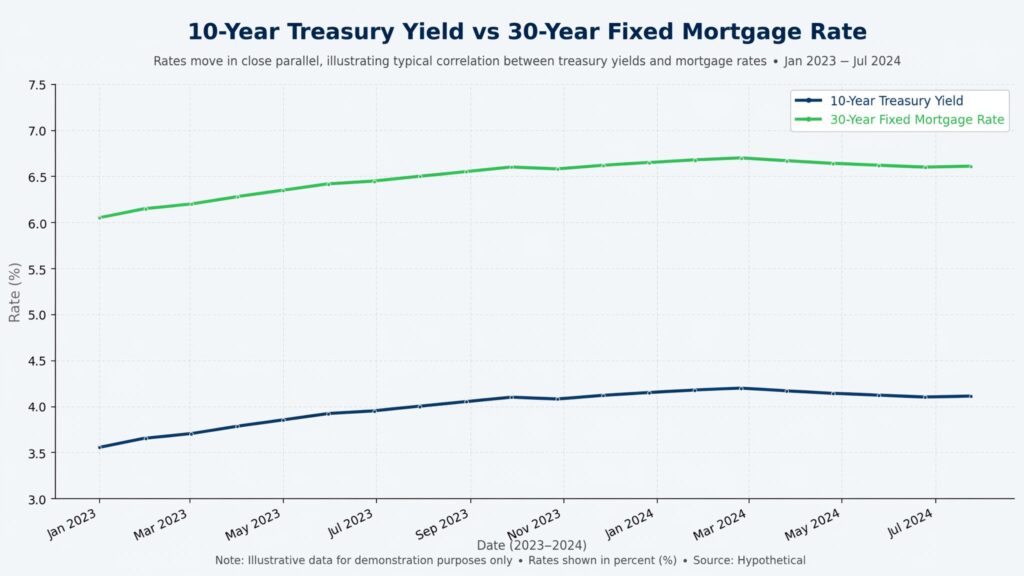
Mortgage rates do not strictly follow the Federal Reserve’s direct rate cuts or hikes. They track the 10-Year Treasury yield. Banks use this specific government bond as their baseline benchmark. Because a 30-year mortgage is typically paid off or refinanced within ten years, lenders view the 10-Year Treasury as the safest comparable investment. When bond yields rise due to economic strength or inflation, mortgage rates rise parallel to them. If the 10-Year yield spikes on a Tuesday, your quoted rate will absolutely be higher on Wednesday.
3. Your Loan-to-Value (LTV) Ratio
Your LTV represents how much of the home’s value you are actually borrowing. If you buy a $500,000 house and put down $100,000 (20%), your LTV is 80%. Lenders love borrowers with a low LTV. You have heavy skin in the game. If you default, the bank has plenty of equity to foreclose and recoup their cash. If you only put down 3%, your LTV is 97%. This is a massive risk for the bank. To compensate for that risk, they will slap you with a significantly higher interest rate.
4. FICO Credit Score Tiers
Your credit score is your financial reputation. The mortgage industry uses strict brackets to price your rate. A score of 780 or higher puts you in the elite tier, granting you the lowest possible baseline rate. If your score drops to 679, you cross a heavy penalty threshold. Fannie Mae and Freddie Mac mandate aggressive pricing hits for lower scores. A borrower with a 640 credit score will often pay an interest rate nearly a full percentage point higher than a borrower with an 800 score, purely due to the perceived risk of default.
5. Debt-to-Income (DTI) Ratio
Lenders calculate exactly how much of your gross monthly income goes toward paying your debts. This is your DTI. If you make $10,000 a month and your total debts (including the new mortgage, car loans, and credit cards) equal $4,500, your DTI is 45%. The higher your DTI, the tighter your budget. Tight budgets lead to missed mortgage payments. Once your DTI crosses the 43% threshold, many lenders will either deny the loan entirely or heavily inflate your interest rate to justify taking a chance on your stretched finances.
Real-World Scenarios: The Calculator in Action
Theory means nothing if you cannot apply it to your own bank account.
To demonstrate exactly how this mathematical reverse-engineering protects your wealth, I have detailed three specific case studies. These scenarios reflect actual conversations I have with clients. Watch how these individuals use the mortgage rate calculator to uncover hidden costs, negotiate better terms, and optimize their long-term debt strategies.
Scenario 1: The Struggling Homebuyer
Sarah is buying a starter home. She is severely budget-constrained. She applies with a local lender for a $320,000 mortgage. The loan officer calls her and says, “Great news, Sarah. I got you approved for a 30-year fixed loan. Your principal and interest payment is going to be exactly $2,150 a month. Does that fit your budget?”
Sarah feels relieved because $2,150 sounds affordable. However, the loan officer intentionally avoided stating the exact interest rate over the phone. Sarah refuses to agree to the payment blindly. She pulls out the calculator to check the math.
| Input Variable | Sarah’s Loan Data |
|---|---|
| Total Loan Amount | $320,000 |
| Monthly P&I Payment | $2,150 |
| Loan Term | 30 Years (360 Months) |
| Calculated Interest Rate | 7.11% |
Strategic Analysis:
Sarah discovers her interest rate is 7.11%. This is a massive problem. She checks current national averages and sees that the daily market par rate for borrowers with her credit profile is actually 6.5%. The loan officer padded her rate to increase his commission, hiding it behind a payment she could technically stomach. Armed with the mathematical proof, Sarah immediately contacts a competing lender. She secures a 6.5% rate, dropping her monthly payment to $2,022 and saving over $46,000 in total interest across the life of the loan. Do not guess. Do the math.
Scenario 2: The Aggressive Investor
David owns a commercial fourplex. Five years ago, he took out an Adjustable-Rate Mortgage (ARM) for $750,000. His introductory fixed period just ended, and his loan is resetting to current market conditions. The bank sends him a letter stating his new principal balance is $695,000. His remaining term is 25 years. They state his new monthly payment will be $5,120.
David wants to know if he should refinance immediately into a fixed-rate product. Before he pulls the trigger on a Mortgage Refinance Calculator to check his options, he needs to know exactly what rate his current bank is forcing onto his adjusting ARM.
| Input Variable | David’s Adjusted Loan Data |
|---|---|
| Total Loan Amount (Remaining) | $695,000 |
| Monthly P&I Payment | $5,120 |
| Loan Term (Remaining) | 25 Years (300 Months) |
| Calculated Interest Rate | 7.39% |
Strategic Analysis:
The tool reveals David’s new adjusting rate is 7.39%. Because he is an aggressive investor closely watching his cash-on-cash return, he knows 7.39% destroys the profit margin on his rental units. He quickly shops around and finds an investment-property refinance option locked at 6.75%. Reverse-engineering his bank’s proposed payment allowed David to make an immediate, data-driven decision to abandon the adjusting loan before it drained his operating capital.
Scenario 3: The Conservative Saver
Elena is a conservative saver who hates being in debt. She is purchasing a $450,000 home and taking out a $300,000 mortgage. Her priority is paying the loan off as fast as possible. A lender gives her two options: A standard 30-year mortgage with a $1,798 payment, or a 15-year mortgage with a $2,423 payment.
Elena knows the 15-year payment is higher, but she wants to know exactly how much of an interest rate discount the bank is offering her to aggressively compress the loan timeline. She runs both options through the tool.
| Input Variable | 30-Year Option | 15-Year Option |
|---|---|---|
| Total Loan Amount | $300,000 | $300,000 |
| Monthly P&I Payment | $1,798 | $2,423 |
| Loan Term | 30 Years | 15 Years |
| Calculated Interest Rate | 6.00% | 5.30% |
Strategic Analysis:
Elena isolates the math. The bank is offering a 6.00% rate on the 30-year, but heavily discounting the rate to 5.30% on the 15-year. The 15-year payment is $625 more per month. Because Elena is highly disciplined, she opts for the 15-year mortgage. Securing that 5.30% rate locks in her exact wealth-building timeline, saving her hundreds of thousands of dollars in long-term interest. She verified the bank’s actual risk pricing before signing any binding documents.
Hidden Pitfalls: 3 Biggest Mistakes People Make
Most borrowers walk into a bank completely unprepared for the financial realities of a mortgage. They trust the loan officer to give them a fair deal. That is a terrible strategy. Lenders maximize their profit margins when you stay ignorant of the underlying mathematics.
I see borrowers lose tens of thousands of dollars because they make the same basic calculation errors. When you misuse a mortgage rate calculator, or ignore the data it provides entirely, you actively destroy your long-term wealth. Avoid these three massive blunders.
1. Entering Your Total Payment Instead of P&I
This is the single most common mathematical error. Borrowers look at their proposed monthly mortgage statement and see a total payment of $3,500. They plug $3,500 directly into the tool.
The calculator spits out an impossibly high interest rate, like 14%. Why? Because that $3,500 includes property taxes, homeowner’s insurance, and potentially Private Mortgage Insurance (PMI). The bank does not charge you interest on your property taxes. They only charge interest on the principal loan amount. If you do not isolate the Principal and Interest (P&I) portion of your payment before running the calculation, the tool will reverse-engineer the wrong number entirely. Your data will be useless. Read your loan estimate carefully and separate your exact P&I.
2. Accepting the “Comfortable Payment” Illusion
Lenders love to sell you a monthly payment. They hate discussing the actual interest rate.
If you tell a loan officer you want to keep your payment under $2,500 a month, they will find a way to make that happen. But they might stretch your loan term, charge you heavy upfront fees, or put you in an adjustable-rate product to hit that target. Borrowers get so relieved that the monthly payment fits their budget that they blindly sign the contract. They never pause to reverse-engineer the math. By the time they realize they are paying a full percentage point above the market average, it is too late. The contract is signed. Never accept a payment without verifying the exact percentage driving it.
3. Ignoring the Yield Spread Premium Trap
Mortgage brokers often act like they are finding you the best possible deal. But brokers get paid on commission.
Banks frequently offer a hidden kickback called a Yield Spread Premium (YSP). If a broker gets you to agree to a 7.0% interest rate when you actually qualified for a 6.5% rate, the bank makes significantly more money over the life of the loan. The bank then splits that extra profit with the broker as a backdoor commission. If you do not independently run your payment numbers through a tool to verify the rate against current national averages, you will never know you were overcharged. You are simply funding the broker’s profit margin.
Expert Strategies: How to Optimize Your Results
Knowing your true interest rate is only the first step. Execution is what builds wealth.
As a financial planner, I do not let my clients just accept the bank’s first offer. We use the calculated rate as a baseline for aggressive optimization. You have leverage. You just have to know how to use it mathematically. Implement these five strict strategies to force your borrowing costs down and protect your equity.
1. Force Lenders into a Blind Bidding War
Never settle for one loan estimate. Get three. Take the proposed monthly payment from Lender A and run it through the calculator to isolate their exact rate.
Do the same for Lender B and Lender C. Once you expose their true baseline rates, pit them against each other. Call Lender A and tell them Lender B is offering a lower interest rate for the exact same loan amount. Ask them to beat it. In a competitive housing market, loan officers will frequently slash their margins to win your business. This simple phone call can drop your rate by 0.25%, saving you thousands.
2. Implement an Aggressive Bi-Weekly Payment Schedule
If you are stuck with a slightly higher interest rate than you wanted, you can mathematically neutralize it.
Instead of making one mortgage payment a month, cut that payment in half and pay it every two weeks. Because there are 52 weeks in a year, this strategy results in 26 half-payments. That equals 13 full payments per year instead of the standard 12. This extra principal payment completely disrupts the bank’s amortization schedule. You will shave years off your loan term. Use an Extra Mortgage Payment Calculator to see exactly how this bi-weekly frequency slashes your total interest burden without ever needing to refinance.
3. Execute a Temporary Rate Buydown
If interest rates are painfully high, do not buy permanent discount points. Look into a 2-1 temporary buydown.
This strategy lowers your interest rate by 2% in the first year and 1% in the second year before reverting to the fixed base rate in year three. Often, you can negotiate for the seller or the builder to pay the upfront cost of this buydown. It drastically lowers your P&I payment during the tightest years of homeownership. If market rates drop within those first two years, you refinance into a permanent lower rate. You bypass the high initial rate entirely.
4. Radically Optimize Your Debt-to-Income Profile
If the calculator reveals you are being quoted a sub-prime rate, your risk profile is the problem. Stop the mortgage process immediately.
Lenders heavily penalize borrowers with a high Debt-to-Income (DTI) ratio. Spend the next 90 days aggressively paying off your revolving credit card debt and auto loans. Do not just move money around. Eliminate the monthly obligations entirely. Lowering your DTI drastically improves your lending tier. Once your profile is clean, verify exactly how much house you can safely buy using a Mortgage Affordability Calculator. You will qualify for a significantly lower interest rate.
5. Strategically Time Your Rate Lock
Mortgage rates fluctuate daily based on bond market yields.
Do not lock your rate blindly. Watch the 10-Year Treasury yield. If the Federal Reserve is scheduled to release new inflation data on Thursday, expect massive rate volatility that morning. If you like the rate you calculated on Wednesday, lock it before the data drops. If you secure a rate but the market drops significantly before closing, exercise a “float down” option. This forces the lender to honor the new, cheaper rate.
Frequently Asked Questions (FAQs)
Q: How is my mortgage interest rate determined?
A: Your mortgage interest rate is determined by combining macroeconomic bond yields with your personal financial risk profile. Lenders take the baseline 10-Year Treasury yield and add specific percentage markups based on your credit score, loan-to-value ratio, and debt-to-income ratio to finalize your rate.
Q: What is a good mortgage interest rate right now?
A: A good mortgage rate is one that sits at or slightly below the current national par rate for your specific credit tier. Because rates shift daily, you must compare your quoted rate against weekly Freddie Mac market survey data to ensure you are not being overcharged.
Q: Why is the APR different from the interest rate?
A: The interest rate strictly represents the annual cost of borrowing the principal balance, while the APR includes that base rate plus all mandatory upfront lender fees. The APR will always be mathematically higher because it accounts for origination charges and discount points spread over the loan term.
Q: Can I negotiate my mortgage interest rate?
A: Yes. Your mortgage interest rate is highly negotiable before you sign the final closing documents. Lenders have discretionary margins they can cut to win your business, especially if you present a competing loan estimate from another bank offering a lower baseline percentage.
Q: Will paying extra principal lower my interest rate?
A: No, paying extra principal does not change your contractual interest rate. However, it significantly reduces your principal balance, which decreases the total dollar amount of interest you pay over time. You can verify these massive lifetime savings by running your numbers through a standard Mortgage Interest Calculator.
Q: Does my credit score heavily affect my mortgage rate?
A: Absolutely. Conventional lenders use strict Loan-Level Price Adjustments (LLPAs) that directly penalize lower credit scores with higher interest rates. Pushing your FICO score above 760 completely eliminates these penalties, guaranteeing you access to the lowest possible borrowing cost available that day.
Q: Should I lock my mortgage rate or float?
A: You should lock your rate immediately if the quoted payment fits your financial plan and market conditions are volatile. Floating is incredibly risky; if inflation data spikes unexpectedly, your interest rate could jump overnight, permanently increasing your monthly payment before you close on the home.
Stop trusting the bank’s marketing pitch. Scroll back to the top of the page and use the Nxfly Finance Mortgage Rate Calculator to reverse-engineer your payment and expose the exact percentage you are being charged. Once you know your true rate, head over to our Mortgage Loan Calculator to structure the perfect loan for your financial goals.
Disclaimer: The Mortgage Rate Calculator provided by Nxfly Finance is for educational and informational purposes only. It does not constitute specific financial, investment, or tax advice. Please consult with a licensed financial advisor, fiduciary, or CPA before making any major financial decisions.