

By Thomas Wright, CFP® | Reviewed by the Nxfly Finance Team
Money sitting idle in a traditional checking account loses purchasing power every single day.
Inflation actively eats your cash. Hope is not a viable financial strategy. If you want to build lasting wealth, you need to understand exactly how your money behaves over time. You need cold, hard math.
Most people guess how much cash they will have in five, ten, or thirty years. Guessing fails. Guessing leads to devastating retirement shortfalls. This is exactly why using a highly accurate savings calculator is a non-negotiable step in your personal finance journey.
We built the Nxfly Finance savings calculator to remove the guesswork from your future.
Whether you are stashing cash in a high-yield savings account, funding a brokerage account, or simply trying to figure out if you can afford a major purchase next year, this savings calculator gives you the exact numbers. It takes your starting balance, adds your recurring monthly deposits, and applies the aggressive math of compound interest.
The results often shock people.
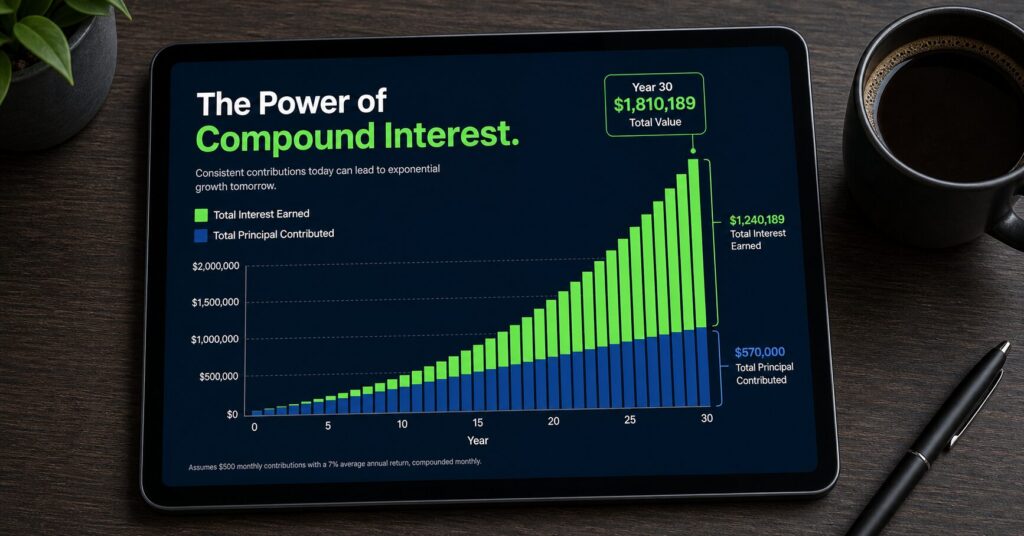
Seeing the sheer power of compounding interest visualized on your screen changes how you think about spending. Siphoning just $200 a month into a solid investment vehicle completely alters your financial trajectory. But you have to run the numbers first. A reliable savings calculator acts as your personal financial blueprint. It forces you to look at reality.
If you are planning to buy a house in the near future, precision matters even more. You absolutely must know how much cash you will have accumulated for a down payment before you start running amortization scenarios. Once this savings calculator shows you your exact future cash reserves, you can confidently plug that down payment number directly into our Mortgage Payment Calculator to see what house you can actually afford.
Math does not lie. Let’s get to work projecting your future.
The Mechanics: How to Use the Nxfly Savings Calculator
A tool is only as good as the operator.
If you put garbage numbers into a savings calculator, you will get garbage projections out. Financial planning requires ruthless honesty. To get the most accurate projection of your future wealth, you need to understand exactly how each input field inside the savings calculator alters your final payout.
Step 1: Determine Your Initial Deposit (Starting Principal)
This is the money you already have right now.
Look at your bank accounts. Check your current high-yield savings balance. Enter that exact number here. If you are starting from absolute scratch, enter zero. There is no shame in starting at zero. The savings calculator treats this initial deposit as the foundation of your compound interest engine. The larger this starting number, the faster your money snowballs, because interest immediately starts accruing on a heavier base.
Step 2: Set Your Monthly Contribution Amount
This input field dictates your discipline.
How much cash are you transferring into this account every single month? Do not enter a number you “hope” to save. Enter the number you can realistically afford to lock away. The savings calculator assumes this deposit happens consistently, like clockwork, every thirty days. Even small adjustments here—like bumping your contribution from $150 to $200 a month—create massive shifts in your final balance over a twenty-year timeline.
Step 3: Estimate the Annual Interest Rate (APY)
This is the engine of your growth.
If your money is in a traditional brick-and-mortar bank, your rate is likely a pathetic 0.01%. Enter that, and the savings calculator will depressingly show you how your money stagnates. If you use a high-yield savings account (HYSA), you might enter something between 4.00% and 5.25%. If you are using this savings calculator to project stock market returns via an index fund, a common historical benchmark to enter is 7% or 8%. Be conservative. Overestimating your rate of return is a dangerous game.
Step 4: Define Your Time Horizon (Years to Grow)
Time is the most aggressive multiplier in finance.
Enter the number of years you plan to leave this money completely untouched. Five years? Ten years? Thirty years? The longer you let the money sit, the more the savings calculator will show the exponential curve of compound growth. Messing with this single input demonstrates why investing in your twenties is vastly superior to starting in your forties.

The Anatomy of the Calculation: Key Terms & Deep Concepts
Running a savings calculator without understanding the underlying financial mechanics is like driving a sports car blindfolded.
You need to know what is happening under the hood. The financial industry intentionally overcomplicates terminology to confuse consumers. We strip that away here. To truly leverage the data our savings calculator provides, you must master the following foundational concepts.
Compound Interest
This is the single most important concept in wealth accumulation.
Compound interest is the interest you earn on your original money, plus the interest you earn on the interest that has already accumulated. It creates an accelerating snowball effect. As the U.S. Securities and Exchange Commission explains in their investor guidelines, understanding the math behind compound interest is the key to letting your money work for you. Our savings calculator runs this exact exponential math instantly, projecting how interest builds upon itself year after year.
Principal
The principal is the raw cash you actually put into the account out of your own pocket.
It includes your initial deposit and every single monthly contribution you make. When you look at the final chart inside the savings calculator, you will see a clear visual divide between your “Principal” (your actual sweat equity) and your “Interest Earned” (the free money generated by the bank or market). Your goal is to reach a point where your interest earned eclipses your principal.
Annual Percentage Yield (APY)
Do not confuse APY with APR (Annual Percentage Rate).
When you borrow money (like a mortgage or credit card), you look at APR. When you deposit money to earn a return, you look at APY. APY factors in the frequency of compounding over a full year. If a bank advertises a 5.00% APY, that is the exact number you plug into the savings calculator rate field. It already accounts for the fact that the bank is paying you interest daily or monthly throughout the year.
Compounding Frequency
How often does the bank calculate and pay you your interest?
Most high-yield savings accounts compound daily and pay out monthly. Some brokerage accounts or CDs compound monthly or annually. The more frequently your money compounds, the faster it grows. The standard math formula running silently behind our savings calculator looks like this: A = P(1 + r/n)^(nt).
In plain English: “A” is your final amount, “P” is your principal, “r” is your rate, “n” is the number of times it compounds per year, and “t” is the time in years. You do not have to do this math on paper. The calculator handles it.
Time Value of Money (TVM)
A dollar today is worth more than a dollar tomorrow.
This is the core principle behind TVM. Because you have the ability to invest a dollar today and earn interest on it, that present-day dollar holds vast future potential. When you delay saving by just one year, you permanently lose the interest that dollar would have generated. A good savings calculator brutally illustrates this concept by showing you the massive wealth gap between starting today versus starting five years from now.
Real Rate of Return (The Inflation Drag)
The savings calculator shows you your nominal return—the exact dollar amount you will have.
However, you must mentally account for inflation. If your savings calculator shows you growing your money at 4% a year, but the current inflation rate is 3%, your “Real Rate of Return” is only 1%. You are gaining purchasing power, but slowly. If inflation is 5% and you earn 4%, you are actually losing wealth in real terms. Always aim for an interest rate that outpaces inflation.
Unveiling the Formula: The Math Behind the Calculator
You should never blindly trust a financial tool without understanding how it generates its numbers.
Black-box algorithms hide flaws. We believe in total transparency. The Nxfly Finance savings calculator operates on standard, mathematically proven formulas used by actuaries and financial planners worldwide. It does not guess. It computes.
To project your exact future wealth, our savings calculator merges two distinct mathematical equations. It calculates the compound interest on your initial lump sum, and then it calculates the future value of an annuity (your recurring monthly deposits).
Here is the exact, WordPress-friendly formula running silently in the background:
Total Accrued Amount (A) = P(1 + r/n)^(nt) + PMT × { [(1 + r/n)^(nt) – 1] / (r/n) }
Let’s break down these variables in plain English so you know exactly what is happening to your cash.
- A (Total Accrued Amount): This is the final grand total. It represents every dollar you deposited plus every cent of interest earned over your specified timeframe.
- P (Principal Amount): This represents your initial starting balance. If you start with $10,000, that is your “P.”
- PMT (Monthly Payment/Contribution): This is the fixed dollar amount you transfer into the account every single month.
- r (Annual Interest Rate): This is your APY, converted into a decimal. A 5% interest rate is calculated as 0.05.
- n (Compounding Frequency): This denotes how many times per year the bank applies interest to your balance. For daily compounding, “n” equals 365. For monthly, it equals 12.
- t (Time in Years): This is the number of years your money sits in the account growing.
The first half of that equation, P(1 + r/n)^(nt), calculates the aggressive growth of your initial deposit. If you never added another dime, this is what your starting cash would become.
The second half of the equation, PMT × { [(1 + r/n)^(nt) – 1] / (r/n) }, handles the heavy lifting of your monthly discipline. It calculates how each new deposit you make starts generating its own interest from the exact moment it hits the account.
Doing this math manually requires a scientific calculator and a lot of patience. One slight miscalculation in the order of operations will ruin your entire financial forecast. This is why using a dedicated savings calculator is mandatory for accurate retirement and wealth planning. It processes both sides of the equation instantly, delivering a flawless projection of your future net worth. You supply the raw data. The algorithm supplies the unvarnished truth.
5 Critical Factors That Influence Your Numbers
Plugging numbers into a savings calculator is just step one.
To execute a successful financial plan, you must understand the external variables that will attack or accelerate your wealth. The real world is messy. Bank rates fluctuate. Economies shift. Human behavior derails the best-laid plans.
Here are five specific factors that directly impact the final number you see on your screen.
1. The Hidden Tax of Inflation
Your savings calculator shows you nominal growth. This means it displays raw dollars.
However, raw dollars do not matter. Purchasing power matters. If your account grows by 4%, but consumer prices rise by 3%, your actual, usable wealth only increased by 1%. The U.S. Bureau of Labor Statistics (BLS) tracks the Consumer Price Index, which measures this inflation rate. You must actively monitor this data. If inflation spikes higher than your savings rate, you are effectively losing money safely. You must ensure your selected investment vehicle outpaces the inflation drag.
2. Variable Interest Rate Volatility
Unless you lock your money into a fixed-rate Certificate of Deposit (CD), your interest rate is not guaranteed.
High-Yield Savings Accounts (HYSAs) feature variable APYs. When the Federal Reserve raises benchmark rates, your savings rate goes up. When the Fed cuts rates to stimulate the economy, your bank will slash your APY overnight. When you run long-term projections in a savings calculator, you should run multiple scenarios. Test a 5% environment. Test a 3% environment. Prepare for rate drops.
3. Compounding Frequency
Not all banks are created equal.
If Bank A offers 4.5% compounded daily, and Bank B offers 4.5% compounded annually, Bank A wins every single time. Daily compounding means your interest earns its own interest tomorrow. Annual compounding makes you wait 365 days to see a return on that growth. Always read the fine print on your account agreements. Ensure your money compounds as frequently as possible.
4. Taxation on Your Earned Interest
The IRS wants their cut.
The interest you generate in a standard savings account is taxed as ordinary income. If you earn $1,000 in interest this year, you will receive a 1099-INT form. You must pay taxes on that $1,000 at your current income tax bracket. This reduces your actual take-home yield. If you are in a high tax bracket, you need to factor this tax drag into your savings calculator projections. Tax-advantaged accounts, like Roth IRAs, bypass this specific hurdle entirely.
5. Compounding Interest vs. Amortized Debt
Earning compound interest builds wealth. Paying amortized interest destroys it.
Many people make the mistake of aggressively saving cash while simultaneously carrying high-interest debt. If you are earning 5% in a savings account but paying 7% on a mortgage or 24% on a credit card, you are bleeding net worth. The math is absolute. Before prioritizing massive cash reserves, you should run your debt numbers through a Mortgage Amortization Calculator to see exactly how much interest the bank is extracting from you. Stop the bleeding first. Then, pivot to aggressive saving.
Real-World Scenarios: The Calculator in Action
Theory is fine. Application is better.
To show you the exact power of this tool, we are going to run three highly detailed, realistic case studies. We will look at different life stages, different goals, and different financial constraints. By seeing how the inputs manipulate the final output in the savings calculator, you will learn exactly how to strategize your own wealth accumulation.
Scenario 1: Sarah, The Aggressive Early Retiree
Sarah is 28 years old. She hates corporate culture. Her absolute main goal is to achieve FIRE (Financial Independence, Retire Early) by age 43.
She has a highly aggressive savings rate. She currently has $25,000 sitting in a brokerage account. She plans to aggressively invest in broad-market index funds, which historically average an annualized 7% return after accounting for inflation. She refuses to touch this money for 15 years. She is willing to sacrifice current luxuries to funnel $1,500 every single month into this account.
Here is exactly what the savings calculator reveals about Sarah’s aggressive strategy:
| Savings Calculator Input | Sarah’s Data |
|---|---|
| Initial Deposit | $25,000 |
| Monthly Contribution | $1,500 |
| Interest Rate (APY) | 7.00% |
| Years to Grow | 15 Years |
| Total Principal Contributed | $295,000 |
| Total Interest Earned | $257,597 |
| Final Account Balance | $552,597 |
Strategic Analysis:
Sarah’s numbers are staggering. Look closely at the split between her principal and her interest. Over 15 years, she physically deposited $295,000 out of her own paycheck. However, the compound interest generated a massive $257,597 of completely free money. By age 43, her portfolio is worth over half a million dollars. This scenario proves that pairing a high monthly contribution with a solid interest rate over a decade creates massive, reliable wealth. The savings calculator validates her aggressive approach.
Scenario 2: David and Elena, The Future Homebuyers
David and Elena are 32. They are tired of renting and want to buy their first single-family home.
They have a strict timeline. They want to buy in exactly 4 years. Because their time horizon is incredibly short, they cannot risk putting their down payment cash into the stock market. A sudden market crash could wipe out their homeownership dreams. They choose a conservative High-Yield Savings Account (HYSA) offering a 4.5% APY. They are starting from absolute zero. They commit to saving $1,200 a month.
Here is what the savings calculator projects for their down payment fund:
| Savings Calculator Input | David & Elena’s Data |
|---|---|
| Initial Deposit | $0 |
| Monthly Contribution | $1,200 |
| Interest Rate (APY) | 4.50% |
| Years to Grow | 4 Years |
| Total Principal Contributed | $57,600 |
| Total Interest Earned | $5,431 |
| Final Account Balance | $63,031 |
Strategic Analysis:
This is a perfect example of short-term cash management. Over four years, David and Elena will stash $57,600 of their own money. The bank will pay them an extra $5,431 just for keeping the money parked there. They walk away with $63,031 in cold, hard cash. Now, they can take this exact number and plug it directly into the Mortgage Affordability Calculator to see what price range they can target in their local housing market. The savings calculator gave them a concrete target, not a vague hope.
Scenario 3: Mark, The Late Starter
Mark is 48 years old. Life happens. Between a divorce and a massive medical bill, his retirement accounts were completely drained.
Mark is panicking. He feels like he is too far behind to ever catch up. He has zero initial deposit. However, his expenses are finally low, and his income is stable. He plans to work until standard retirement age at 68, giving him exactly 20 years to rebuild. He commits to aggressively saving $1,000 every single month. He chooses a moderate investment portfolio projecting a 6% return.
Let’s look at what the savings calculator says about Mark’s “hopeless” situation:
| Savings Calculator Input | Mark’s Data |
|---|---|
| Initial Deposit | $0 |
| Monthly Contribution | $1,000 |
| Interest Rate (APY) | 6.00% |
| Years to Grow | 20 Years |
| Total Principal Contributed | $240,000 |
| Total Interest Earned | $222,041 |
| Final Account Balance | $462,041 |
Strategic Analysis:
Mark is not hopeless. The savings calculator proves it. Starting at zero at age 48 is mentally terrifying, but the math still works if you put in the time and the capital. By strictly adhering to a $1,000 monthly contribution for two decades, Mark builds nearly half a million dollars. The interest alone generates over $222,000. He will not be a multi-millionaire, but he will have a solid, highly functional safety net for his senior years. This scenario highlights exactly why you must run the numbers instead of giving up.
Hidden Pitfalls: 3 Biggest Mistakes People Make
Math is completely objective. It does not care about your intentions.
Even the most accurate savings calculator cannot protect you from your own behavioral errors. People consistently sabotage their financial growth by ignoring the fine print of their accounts or misunderstanding how macroeconomic forces degrade their cash. We see the same devastating mistakes repeated constantly. If you want the numbers on your screen to match your actual bank account in ten years, you must actively avoid these three traps.
1. Ignoring the Drag of Ordinary Income Taxes
Your savings calculator spits out a massive, beautiful final balance. You assume that money is yours to spend. It is not.
The IRS taxes the interest generated in a standard or high-yield savings account as ordinary income. If you are in the 24% tax bracket and you earn $5,000 in interest this year, you owe the government $1,200 of that growth. This drastically reduces the real-world power of your compound interest. People run projections pretending they get to keep 100% of their yield. This creates a dangerous shortfall when retirement actually arrives. You must mentally deduct your tax liability from your projected interest, or utilize tax-advantaged accounts to shield that growth entirely.
2. Stagnant Contributions in an Inflating Economy
Setting a fixed monthly contribution and never increasing it is a massive failure in strategy.
Let’s say you decide to save $500 a month at age 25. That feels like a heavy lift. By age 35, you have likely received multiple promotions and your income has doubled. If you are still only depositing $500 a month, you are actively moving backward. Inflation destroys the purchasing power of that flat $500 contribution. A fixed deposit amount buys less wealth every single year. You must aggressively scale your monthly inputs to match your income growth, or your final net worth will fall severely short of your actual lifestyle needs.
3. Hoarding Cash While Drowning in Bad Debt
This is the single most common mathematical error in personal finance.
People love the psychological safety of a massive cash reserve. They will proudly watch their savings calculator project a 4.5% yield on $50,000. Meanwhile, they are carrying $15,000 in credit card debt at a brutal 24% Annual Percentage Rate. This makes zero sense. The bank is charging you exponentially more than it is paying you. You are actively bleeding net worth. Keeping tens of thousands of dollars in a savings account while servicing high-interest debt is a toxic financial strategy. You must annihilate expensive debt before prioritizing liquid cash hoarding.
Expert Strategies: How to Optimize Your Results
Knowing the numbers is only half the battle. Execution is everything.
To maximize the output you see in our savings calculator, you have to deploy your capital with precision. Wealth is not built by accident. It requires calculated, aggressive action. Here are five expert-level strategies to force your money to grow faster, harder, and more efficiently.
1. Automate Your Deposits Immediately
Willpower is a terrible financial strategy. You will fail.
If you wait until the end of the month to save whatever cash is left over, you will save nothing. You must treat your savings contribution as a legally binding bill. Set up an automatic ACH transfer from your primary checking account to your savings or brokerage account exactly one day after your paycheck clears. Do not give yourself the opportunity to spend it. The savings calculator assumes perfect, robotic discipline. Automation is the only way to mimic that perfection in the real world.
2. Annually Escalate Your Contributions
You need to trick yourself into saving more money.
Every time you get a raise at work, immediately route 50% of that new net income directly into your savings contribution. If your take-home pay increases by $400 a month, increase your automated deposit by $200. You still get to enjoy a lifestyle upgrade with the remaining $200, but you drastically accelerate your compound interest curve. If you adjust your monthly contribution input in the savings calculator by just $100, the 20-year projection will explode. Never let lifestyle creep consume 100% of your new income.
3. Arbitrage Your Debt vs. Savings Rate
You must always compare your savings yield against your debt obligations.
If your savings account pays 4% APY, but you hold a mortgage at 7.5%, math dictates that paying down the mortgage is the superior financial move. Every extra dollar you throw at a 7.5% debt is a guaranteed, risk-free 7.5% return. Run your numbers through our Extra Mortgage Payment Calculator to see exactly how much interest you save by aggressively attacking the principal. Once the expensive debt is gone, pivot that heavy cash flow back into your savings investments.
4. Match Your Account Type to Your Time Horizon
Putting a 20-year investment into a basic bank account is financial malpractice.
If your time horizon is under three years—like saving for a house down payment or a wedding—cash is king. Use a High-Yield Savings Account or a Certificate of Deposit (CD) to protect the principal from market volatility. If your time horizon is ten, twenty, or thirty years, leaving that money in cash guarantees it will lose value to inflation. Long-term capital must be deployed into equities, index funds, or real estate to capture higher annualized returns.
5. Rebalance Based on Macroeconomic Rate Shifts
Do not set it and forget it. The financial environment changes rapidly.
When the Federal Reserve drops benchmark interest rates, your high-yield savings account will immediately slash your APY. A 5% yield can become a 2% yield in a matter of months. When you see rates dropping, you must recalculate your strategy. You may need to move your cash into fixed-rate CDs to lock in the yield before it disappears. Alternately, a dropping rate environment often signals a good time to shift heavy cash reserves back into the stock market. Stay vigilant. Update your savings calculator inputs quarterly to reflect reality.
Frequently Asked Questions (FAQs)
Q: How much money should I save every month?
A: You should aim to save a minimum of 20% of your gross income. This aligns with the classic 50/30/20 budgeting rule, ensuring you build adequate wealth while covering essential living expenses and discretionary spending. If 20% is mathematically impossible right now, start exactly where you can. Even 5% builds the habit. The core objective is to consistently increase that percentage every time your income rises.
Q: Is a high-yield savings account better than investing in stocks?
A: Neither is objectively better; they serve entirely different financial purposes. A high-yield savings account protects your principal and provides absolute liquidity for short-term goals. However, the interest rates barely outpace inflation. Investing in the stock market carries high short-term volatility but historically delivers much higher annualized returns. Use savings for emergency funds and short-term purchases. Use stocks for long-term wealth building and retirement.
Q: Does interest compound daily or monthly in a savings account?
A: Most modern high-yield savings accounts calculate your compound interest daily and credit the funds to your account monthly. This daily compounding structure is highly beneficial. It means the interest you earned yesterday starts generating its own interest today. Always verify the compounding schedule in your bank’s deposit agreement, as daily compounding mathematically beats monthly or annual compounding.
Q: Should I save money or pay off my mortgage early?
A: This decision strictly depends on comparing your mortgage interest rate against your potential savings rate. If you have an incredibly low mortgage rate of 3%, keeping your money in a 5% savings account is a smarter mathematical move. If you have a high rate, prioritizing the debt often wins. To fully grasp how the bank charges you, you must understand how US mortgage payments are calculated and exactly where your money goes every month.
Q: Why is my actual bank balance lower than the savings calculator predicts?
A: The most common reason for a discrepancy is fluctuating variable interest rates. The savings calculator assumes the APY you entered remains perfectly static for the entire timeline. In reality, banks change their interest rates frequently based on Federal Reserve policies. Additionally, if you withdraw funds, miss a monthly deposit, or owe taxes on the earned interest, your real-world balance will lag behind the sterile mathematical projection.
Q: Do I have to pay taxes on my savings account interest?
A: Yes. The IRS requires you to report all interest earned from traditional and high-yield savings accounts as ordinary income. If you earn more than $10 in interest during the calendar year, your bank will send you a 1099-INT tax form. You must pay taxes on this growth at your standard marginal tax bracket rate, which reduces your actual, usable return.
Q: Can I ever lose money in a high-yield savings account?
A: You cannot lose your absolute dollar amount if the account is FDIC-insured, as the government protects your principal up to $250,000 per depositor. However, you can lose purchasing power. If the inflation rate is higher than the APY your bank pays, the real-world value of your cash is silently shrinking. Your balance goes up, but what that money can buy goes down.
Stop guessing about your financial future. Scroll back to the top of this page, input your exact numbers into our Savings Calculator, and map out your true wealth trajectory today. If you are preparing to buy a home with those savings, head over to our Mortgage Payment Calculator next to ensure your budget is absolutely bulletproof.
Disclaimer: The Savings Calculator provided by Nxfly Finance is for educational and informational purposes only. It does not constitute specific financial, investment, or tax advice. Please consult with a licensed financial advisor, fiduciary, or CPA before making any major financial decisions.