

By David R. Thompson, CFP® | Reviewed by the Nxfly Finance Team
Your mortgage is likely your largest financial liability. It does not have to be a 30-year prison sentence. Banks construct standard loan schedules for a specific reason. They want to guarantee their profits upfront. During the first decade of a standard 30-year loan, your monthly payments are completely soaked in interest charges. You barely scratch the actual principal balance. That is exactly why you need a concrete exit strategy.
Using an extra mortgage payment calculator is the first step toward reclaiming your future wealth. Most homeowners simply accept their monthly statement as an unchangeable law. They pay the exact amount due. They wait three decades to own their home outright. You can do better. By applying even a modest amount of additional cash directly toward your loan’s principal, you completely alter the mathematical trajectory of your debt.
Fifty dollars extra per month might sound insignificant. It is not.
When you apply that money correctly, it bypasses the standard interest calculation entirely. It attacks the core balance of your house directly. Lowering that core balance means next month’s interest charge is calculated on a smaller number. The savings compound rapidly.
We built this extra mortgage payment calculator to show you the unvarnished mathematical truth. No fluff. Just raw data. You deserve to know exactly how much blood money the bank is extracting from you, and more importantly, exactly how to stop it. We will show you how making bi-weekly payments, annual lump sums, or small monthly additions drastically shifts your payoff date.
Before we dive into the numbers, it helps to understand how US mortgage payments are calculated. The entire banking system relies on you ignoring this math. Once you see the numbers on your screen, you cannot unsee them. You will realize that paying off your house early is not just for the ultra-wealthy. It is a simple matter of applied mathematics, consistency, and time.
Extra Payment Calculator
See how monthly, annual, or lump sum payments accelerate payoff
The Mechanics: How to Use the Nxfly Extra Mortgage Payment Calculator
Garbage in equals garbage out. If you guess your loan numbers, the calculator will give you a fantasy projection.
To get a brutally accurate look at your potential savings, you need to input the exact figures from your most recent mortgage statement. Do not rely on your memory. Log into your loan servicer’s portal right now. Pull up your current dashboard. This extra mortgage payment calculator requires precise data to map out your exact timeline to financial freedom.
Step 1: Your Current Principal Balance
Do not enter your original loan amount unless you closed on the house yesterday. We need today’s remaining balance. If you borrowed $400,000 five years ago, your current balance is lower. Entering the original amount will heavily skew the amortization timeline. Look for the line item explicitly labeled “Principal Balance” on your statement. Enter that exact dollar amount here.
Step 2: Your Current Interest Rate
Enter your annual fixed interest rate. This is the percentage the bank charges you to borrow their money. If you have an Adjustable Rate Mortgage (ARM), you will enter the rate you are currently paying today. Keep in mind that for ARM loans, your long-term projections will only be accurate until your rate adjusts again. If you are sitting on a 3% fixed rate from 2021, enter 3.00. If you just bought a house at 7.25%, enter 7.25.
Step 3: Remaining Loan Term
We measure this in years and months. Again, do not enter 30 years if you are four years into the loan. You have 26 years left. The extra mortgage payment calculator uses this timeline to establish the baseline—what you will pay if you make zero extra effort. This baseline is critical. It acts as the anchor point to prove exactly how many months (or years) you shave off by paying extra.
Step 4: Your Standard Monthly Payment (Principal and Interest Only)
This trips up almost everyone. Your total monthly payment probably includes property taxes, homeowners insurance, and maybe Private Mortgage Insurance (PMI). Do not include escrow items. Escrow amounts do not affect your loan amortization. Extra payments do not reduce your property taxes. Find the specific portion of your payment dedicated solely to Principal and Interest (P&I).
Step 5: Defining Your Extra Payment Strategy
This is where the magic happens. You have options based on your cash flow.
- Monthly Addition: The easiest method. You add a set amount (like $100 or $250) to every single monthly payment.
- Annual One-Time Payment: Ideal for people who get yearly corporate bonuses or tax refunds. You drop a lump sum on the principal once a year.
- One-Time Lump Sum: Did you sell a car? Inherit some money? Use this input to see how a single, massive principal reduction today accelerates your payoff date permanently.
Once you hit calculate, you will immediately see a side-by-side comparison. You will see your original payoff date versus your new, accelerated payoff date. If you want to compare how these extra payments stack up against a total loan restructure, you might later want to run your numbers through a Mortgage Refinance Calculator to see which strategy saves you more cash.

The Anatomy of the Calculation: Key Terms & Deep Concepts
Financial literacy is your best defense against predatory lending practices. The banking industry relies on complex terminology to keep borrowers confused and compliant.
When you use an extra mortgage payment calculator, you are manipulating several deeply interconnected financial variables. To truly understand how your extra dollars are dismantling your debt, you need to understand the mechanics happening under the hood. Let’s break down the exact terminology used in mortgage reduction math. No jargon. Just clear definitions.
1. Principal Balance
Your principal is the actual amount of money you owe on the house itself, stripped of all interest and fees. If you sell your house today, the principal balance is the exact check you must write to the bank to clear the lien. Every single extra payment strategy revolves around attacking this number. When you lower the principal, you starve the interest.
2. Amortization Schedule
This is the bank’s master blueprint for your money. Amortization is the schedule of your monthly payments mapped out over the life of the loan. Early on, the schedule heavily favors the bank. In month one of a 30-year standard loan, up to 80% of your payment might go straight to interest. When you make an extra payment, you essentially skip forward on this schedule, forcing the ratio of principal-to-interest to shift in your favor much faster.
3. Simple Interest on a Declining Balance
Most US mortgages do not use compounding interest on the debt itself. They use simple interest calculated monthly on your remaining principal.
Here is the exact formula your bank uses every 30 days:
Interest Charge = (Current Principal Balance x Annual Interest Rate) / 12
Look closely at that formula. The Annual Interest Rate is locked. The number 12 is locked. The only variable you have the power to change is the Current Principal Balance. By pushing extra cash into the principal, you force the next month’s Interest Charge to drop. That drop means more of your standard payment goes to principal the following month. It creates a snowball effect of wealth retention.
4. Escrow
Your escrow account is a side bucket managed by your lender. It holds money for your property taxes and homeowners insurance. It is completely irrelevant to your loan payoff math. Making an extra mortgage payment does absolutely nothing to lower your property taxes. When projecting your savings in our calculator, leave escrow numbers completely out of the equation.
5. Prepayment Penalty
Some older or specialized loans carry a toxic clause called a prepayment penalty. This means the lender will literally charge you a fee for paying off your loan early. Why? Because you are cutting into their projected interest profits. Fortunately, federal regulations have severely restricted these penalties on modern conventional mortgages. However, always verify with your servicer that your loan allows penalty-free extra payments before you start throwing thousands of extra dollars at it.
6. “Apply to Principal” Mandate
This is the most critical operational concept. If you blindly send your bank an extra $500 check without instructions, they might just apply it as an early payment for next month. That does not save you a dime in interest. You must explicitly instruct your loan servicer in writing (or via their online portal checkbox) that the extra funds are to be applied “Directly to Principal.” If you skip this step, your extra mortgage payment calculator projections will be worthless, and the bank will gladly hold your cash while continuing to charge you maximum interest.
Unveiling the Formula: The Math Behind the Calculator
Numbers do not lie. When you make extra payments, you are essentially hijacking the bank’s standard amortization formula and weaponizing it for your own benefit. Understanding the raw mathematics gives you absolute control over your debt.
Most people think about their loan in terms of the standard monthly payment. That standard payment is derived from a very specific, rigid equation. Before you can understand how an extra payment alters your timeline, you must look at the baseline.
The bank uses the standard amortization formula to determine your fixed monthly principal and interest payment (M). It looks like this in standard mathematical notation:
M = P [ i(1 + i)^n ] / [ (1 + i)^n – 1 ]
Let’s break down these variables in plain English:
- M = Your fixed monthly payment.
- P = Your total principal loan amount.
- i = Your monthly interest rate. You find this by taking your annual interest rate and dividing it by 12.
- n = The total number of months in your loan term. A standard 30-year loan is 360 months.
Once your loan is finalized, your bank locks in M. Under normal circumstances, you pay this exact amount for 360 months.
However, when you introduce an extra principal payment, you shatter that fixed timeline. You introduce a new variable into the ecosystem: E (Extra Payment). By paying M + E every month, you are no longer solving for the payment. You are solving for a new, much shorter timeline.
The mathematical formula to calculate your new payoff timeline (the new n) looks entirely different. To find out exactly how many months you have left when paying extra, the math shifts to:
Months to Payoff = – [ log( 1 – (P × i) / (M + E) ) ] / [ log( 1 + i ) ]
This equation calculates the exact velocity of your debt decay. Every single time you increase E (your extra payment), the numerator in that logarithm shrinks, causing the total number of months to plummet.
Our system processes this exact logarithm. It runs a month-by-month loop. It subtracts your specific extra payment directly from the remaining principal P, recalculates the interest i for the very next 30-day cycle based on that smaller balance, and maps it all out. If you want to see the detailed month-by-month breakdown of this math in action, you can run your base numbers through our Mortgage Amortization Calculator to compare the standard schedule against your accelerated one.
We built this tool with absolute mathematical precision. It accounts for the declining balance instantly. There are no estimation errors. When you see a projected interest savings of $45,210 on your screen, that is real cash kept in your bank account instead of the lender’s vault.
5 Critical Factors That Influence Your Numbers
Plugging numbers into a formula is easy. Executing a wealth-building strategy in the real world is hard. Your mortgage does not exist in a vacuum. It sits inside a complex web of economic forces, tax codes, and personal financial health.
Before you aggressively dump all your spare cash into your house, you must evaluate the wider financial landscape. Extra payments offer a guaranteed, risk-free return on your money equal to your interest rate. But is that the smartest place for your cash?
Here are five specific factors that dictate whether early payoff math actually works in your favor.
1. The Opportunity Cost of Capital
Every dollar you send to your mortgage lender is a dollar you cannot invest in the stock market, real estate, or a business. This is opportunity cost. If your mortgage rate is 3.5%, paying it off early yields a 3.5% risk-free return. However, if the S&P 500 historically returns an average of 8% to 10% annually, locking your cash in your home equity costs you potential wealth. You must weigh the psychological peace of a paid-off home against the mathematical reality of compound investing.
2. The Inflation Effect
Inflation secretly benefits borrowers holding fixed-rate debt. According to historical data from the Bureau of Labor Statistics, sustained inflation drastically reduces the purchasing power of the dollar over time. If you locked in a 30-year fixed mortgage, your monthly payment stays exactly the same for three decades. Meanwhile, your wages likely increase, and the actual value of the money you are paying the bank decreases. In high-inflation environments, rushing to pay off cheap, fixed-rate debt with today’s highly valuable dollars can be a strategic misstep.
3. Private Mortgage Insurance (PMI) Elimination
If you put down less than 20% when you bought your home, you are bleeding cash monthly via PMI. This insurance protects the lender, not you. It provides zero financial benefit to your household. Making aggressive extra principal payments accelerates your path to 20% equity. Hitting that threshold allows you to petition your lender to cancel this junk fee. You can use a PMI calculator to pinpoint exactly how many extra payments you need to reach the 80% Loan-to-Value (LTV) ratio and drop that monthly drain forever.
4. The Mortgage Interest Tax Deduction
The federal government allows homeowners to deduct mortgage interest from their taxable income, provided they itemize their deductions. When you make extra principal payments, you shrink your loan balance. A smaller balance means you pay less interest over the year. Consequently, your tax deduction shrinks. For high-income earners in top tax brackets, this lost deduction alters the net benefit of paying off the house early. You must calculate the after-tax cost of your debt to get the true picture.
5. Liquidity Risk
Home equity is highly illiquid. You cannot buy groceries with drywall. If you aggressively overpay your mortgage and subsequently lose your job, the bank will not care that you are five years ahead on your amortization schedule. They still expect next month’s payment in full. If you lack cash reserves, that trapped equity is useless unless you sell the home or take on new debt via a HELOC. Always build a robust six-month liquid emergency fund before initiating an extra payment strategy.
Real-World Scenarios: The Calculator in Action
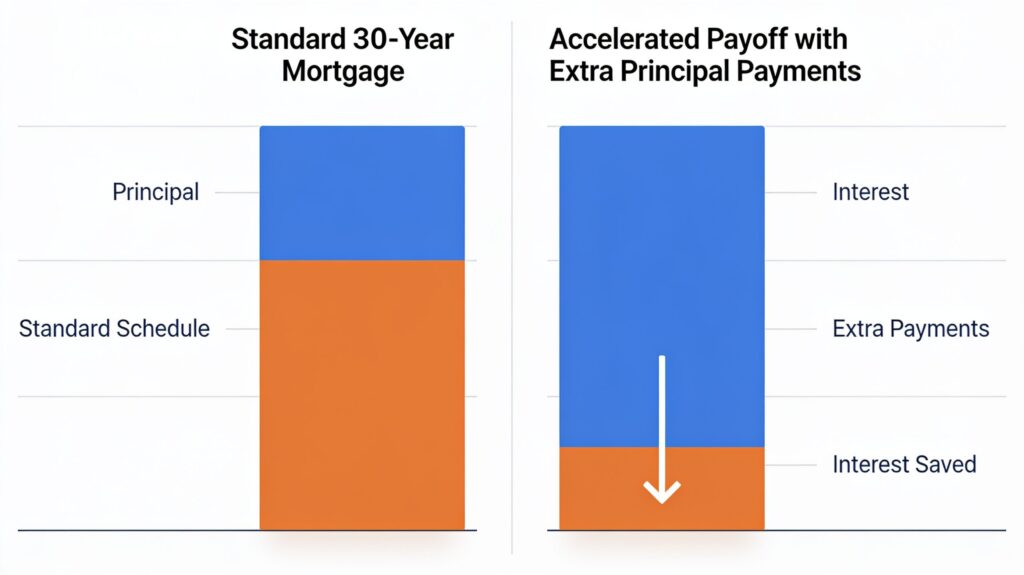
Theory only gets you so far. To truly grasp the power of this math, you need to see it applied to real life. We modeled three distinct financial profiles using the extra mortgage payment calculator.
Each scenario demonstrates a totally different strategy. Pay close attention to the interest saved. These are not hypothetical concepts. This is exact math based on current market conditions.
Scenario 1: Sarah, The Conservative Saver
Sarah is 34 years old. She bought a starter home three years ago. She has a stable government job and hates the idea of carrying debt into her fifties. She does not have massive amounts of disposable income, but she runs a tight budget. After analyzing her monthly expenses, Sarah realizes she can comfortably squeeze an extra $200 out of her budget every month by cutting back on dining out and unused subscriptions. She decides to automate a $200 extra monthly payment directly to her principal.
The Calculator Inputs:
- Current Principal Balance: $285,000
- Interest Rate: 5.5%
- Remaining Term: 27 Years (324 Months)
- Standard Monthly P&I: $1,618.23
- Extra Payment Strategy: $200 Monthly
| Metric | Standard Schedule (No Extra) | Accelerated Schedule ($200 Extra) | The Real Net Impact |
| Payoff Date | 27 Years | 21 Years & 4 Months | Saved 5 Years & 8 Months |
| Total Interest Paid | $239,306 | $180,442 | Kept $58,864 in her pocket |
| Total Out-of-Pocket | $524,306 | $465,442 | Reduced total cost of housing |
Strategic Analysis:
Sarah’s consistency yields massive results. By sacrificing just $200 a month, she essentially buys back nearly six years of her life from the bank. That $58,864 in saved interest is a guaranteed return. More importantly, she eliminates her housing payment well before her peak retirement saving years, freeing up serious cash flow in her late fifties.
Scenario 2: Marcus, The Aggressive Earner
Marcus is a 42-year-old software sales director. His income fluctuates wildly based on quarterly commissions. A strict monthly extra payment feels suffocating to him during slow sales months. However, he receives a reliable, hefty year-end bonus every December. He recently refinanced into a larger home. He decides to ignore the monthly addition strategy and instead drops a $12,000 lump sum onto his mortgage principal every single January.
The Calculator Inputs:
- Current Principal Balance: $550,000
- Interest Rate: 6.8%
- Remaining Term: 29 Years (348 Months)
- Standard Monthly P&I: $3,586.13
- Extra Payment Strategy: $12,000 Annually
| Metric | Standard Schedule (No Extra) | Accelerated Schedule ($12k Annually) | The Real Net Impact |
| Payoff Date | 29 Years | 16 Years & 2 Months | Saved 12 Years & 10 Months |
| Total Interest Paid | $697,973 | $331,418 | Kept $366,555 in his pocket |
| Total Out-of-Pocket | $1,247,973 | $881,418 | Averted hundreds of thousands in bank profits |
Strategic Analysis:
Marcus’s numbers are staggering. Because his interest rate is relatively high (6.8%), the bank is charging him a fortune every month. By attacking the principal with an annual sledgehammer, he cuts his loan term almost in half. The extra mortgage payment calculator proves that Marcus saves over a third of a million dollars. He bypasses the risk of standard market investing and guarantees a massive reduction in his lifetime liabilities.
Scenario 3: The Ramirez Family, The Bi-Weekly Hackers
The Ramirez family just bought their first home. They are house-poor. They literally cannot afford to increase their monthly housing budget by a single dollar. Their cash flow is entirely maxed out. However, they both get paid bi-weekly (every two weeks). They decide to switch their mortgage servicer settings to process half of their standard payment every two weeks instead of a full payment once a month.
The Calculator Inputs:
- Current Principal Balance: $350,000
- Interest Rate: 6.25%
- Remaining Term: 30 Years (360 Months)
- Standard Monthly P&I: $2,155.01
- Extra Payment Strategy: Bi-weekly payments (Equates to 1 extra full payment per year)
| Metric | Standard Schedule (Monthly) | Accelerated Schedule (Bi-Weekly) | The Real Net Impact |
| Payoff Date | 30 Years | 24 Years & 7 Months | Saved 5 Years & 5 Months |
| Total Interest Paid | $425,803 | $328,114 | Kept $97,689 in their pocket |
| Total Out-of-Pocket | $775,803 | $678,114 | Achieved early payoff with $0 monthly budget increase |
Strategic Analysis:
This is the ultimate budgeting hack. Because there are 52 weeks in a year, paying half the mortgage every two weeks results in 26 half-payments. That equals 13 full monthly payments across a 12-month calendar year. The Ramirez family tricks their budget into making one full extra payment annually. Without feeling the pain of a tighter monthly budget, they shave over five years off their loan and dodge nearly $100,000 in interest.
Hidden Pitfalls: 3 Biggest Mistakes People Make
You can run the numbers perfectly in the extra mortgage payment calculator and still fail. Execution matters. The banking system is inherently designed to extract maximum interest from your wallet. Lenders will not stop you if you make a mathematical error that benefits them.
Many homeowners let their emotions drive their financial decisions. They attack their debt blindly. This results in trapped cash, wasted effort, and massive opportunity costs. Here are the three most common blunders people make when trying to accelerate their payoff date.
Mistake 1: Ignoring the “Apply to Principal” Mandate
This happens every single day. A homeowner sends a check for an extra $1,000 to their loan servicer. They feel great about it. They assume the bank will automatically deduct that money from the core balance. The bank does not.
Instead, the servicer simply applies that $1,000 as a prepayment for next month’s standard bill. The money sits in a holding account. It does absolutely nothing to lower your current principal. Your amortization timeline remains entirely unchanged. You must explicitly instruct your lender that all extra funds are to be applied as a “Principal Only” payment. Check the correct box on your online portal. If you mail a physical check, write “Apply to Principal Only” directly in the memo line.
Mistake 2: Draining Emergency Reserves to Chase a Paid-Off House
A paid-off house feels safe. Being completely broke while sitting inside a paid-off house is terrifying. Home equity is highly illiquid. You cannot buy groceries or pay medical bills with the equity trapped in your living room walls.
Aggressively dumping every spare dollar into your mortgage leaves you highly vulnerable to sudden life shocks. If you lose your job, the bank still demands next month’s payment. They do not care that you are five years ahead on your payoff schedule. If you lack cash reserves, you will face foreclosure just as fast as someone who never made a single extra payment. Never deploy aggressive extra mortgage payments until you have a fully funded, highly liquid six-month emergency fund sitting in a high-yield savings account.
Mistake 3: Paying Extra on Low-Interest Debt While Carrying Toxic Debt
Basic math dictates your debt strategy. Do not pay extra on a 4% mortgage if you are carrying a $10,000 balance on a credit card charging 24%.
This is financial suicide. Many people hyper-focus on their mortgage because it is their largest debt by volume. They ignore the toxic, high-interest consumer debt silently eating away at their net worth. Every dollar you push toward a low-interest mortgage is a dollar you failed to use against a high-interest credit card. You must ruthlessly eliminate all high-yield consumer debt, personal loans, and auto loans before you even think about accelerating your mortgage payoff.
Expert Strategies: How to Optimize Your Results
Knowing the math is only half the battle. You need a tactical plan to execute it efficiently. The extra mortgage payment calculator gives you the raw data. Now you need to weaponize it.
Here are five highly actionable strategies that certified financial planners use to help clients systematically crush their mortgage debt without ruining their standard of living.
Strategy 1: Recast Your Loan Instead of Refinancing
If you receive a massive windfall—like an inheritance, a business sale, or a large bonus—you might drop a huge lump sum onto your mortgage. A lump sum drastically shortens your payoff date. However, your required monthly payment remains exactly the same.
If you want to lower your actual monthly payment without the massive closing costs of a refinance, ask your lender for a “mortgage recast.” For a small administrative fee (usually around $250), the bank will recalculate your monthly payment based on your newly reduced principal balance, while keeping your original low interest rate intact. This frees up massive monthly cash flow immediately.
Strategy 2: Deploy the “One Extra Payment Per Year” Bi-Weekly Hack
You do not need to overhaul your entire budget to make a dent in your mortgage. The bi-weekly payment hack is the most painless wealth-building strategy available.
Contact your loan servicer and switch your payment schedule. Instead of paying once a month, you pay exactly half of your monthly payment every two weeks. Because there are 52 weeks in a year, this results in 26 half-payments. That equals 13 full payments over a 12-month cycle. You seamlessly make one full extra payment directly to principal every year without feeling the pinch in your monthly cash flow.
Strategy 3: Align Extra Payments with Annual Windfalls
Lifestyle creep destroys wealth. When people get a tax refund or an annual corporate bonus, they immediately upgrade their lifestyle. They buy a new car. They take an expensive vacation.
Stop doing this. Earmark a specific percentage of every annual windfall exclusively for your mortgage principal. If you get a $5,000 tax refund, commit to dropping $3,000 directly onto your loan balance the day the check clears. This strategy requires zero changes to your day-to-day monthly budget, yet it consistently slashes years off your amortization schedule over a decade.
Strategy 4: Funnel Freed-Up Escrow into Principal
Your mortgage payment often drops over time if you successfully petition to remove Private Mortgage Insurance (PMI) or if your local property tax rates decrease. Most people simply absorb this extra money back into their checking account and spend it.
Use a smarter approach. If your required monthly payment drops by $150, do not change your auto-pay amount. Keep paying the exact same total amount you were already accustomed to paying. Instruct the bank to funnel that newly freed-up $150 directly into the principal balance every single month. You accelerate your payoff date using money you are already used to living without.
Strategy 5: Monitor the Amortization Crossover Point
In the early years of a standard mortgage, the bank takes the lion’s share of your payment for interest. Eventually, you hit a crossover point where more of your standard monthly payment goes to principal than to the lender.
Run your base numbers through our Mortgage Interest Calculator to find this exact month. Aggressive extra payments yield the highest ROI before you hit this crossover point. Once your loan is heavily principal-weighted in its final years, the mathematical benefit of paying extra diminishes rapidly. At that late stage, redirecting your extra cash into high-yield investments often makes far more mathematical sense.
Frequently Asked Questions (FAQs)
Q: Is it better to make one extra mortgage payment a year or pay extra monthly?
A: Paying extra monthly is mathematically superior because it reduces your principal faster. Mortgages calculate interest based on your daily or monthly outstanding balance. Shrinking that balance earlier in the year starves the interest calculation sooner, saving you slightly more money compared to a single year-end lump sum.
Q: Does paying an extra $100 a month on a mortgage make a difference?
A: Yes, it makes a massive difference over the life of your loan. An extra $100 a month on a $300,000 mortgage at 5% interest will shave nearly five years off your standard 30-year term. It bypasses the standard amortization curve and directly attacks the core debt.
Q: How much faster will I pay off my mortgage if I pay an extra $500 a month?
A: You will typically cut a 30-year mortgage timeline nearly in half, depending on your specific interest rate and starting balance. To see your exact personalized timeline down to the very month, run your current loan figures through our comprehensive Mortgage Payoff Calculator.
Q: Can my bank penalize me for paying my mortgage early?
A: Modern conventional mortgages rarely include prepayment penalties. Federal laws highly restrict lenders from charging you a fee for paying off your primary residence early. However, if you have a specialized portfolio loan or a subprime product, you must read your promissory note to verify penalty-free terms.
Q: Does making an extra mortgage payment lower my monthly bill?
A: No, making an extra principal payment does not lower your next required monthly bill. Your standard monthly obligation remains strictly fixed. The extra money simply shortens the total number of months you will have to make that fixed payment before the house is completely yours.
Q: Should I pay off my mortgage early or invest the extra money?
A: This depends entirely on your mortgage interest rate compared to your expected investment return. If your mortgage rate is 3%, you mathematically lose money by paying it off early instead of investing in index funds yielding 8%. If your rate is 8%, early payoff offers an incredible guaranteed return.
Q: How do extra payments affect my escrow account?
A: Extra principal payments have zero impact on your escrow account. Escrow holds funds strictly for property taxes and homeowners insurance. These costs are completely independent of your loan balance. Reducing your principal will never lower your local property tax assessment or your home insurance premiums.
Stop guessing about your financial future and start running the hard numbers. Scroll back to the top of this page to use the Extra Mortgage Payment Calculator right now. Want to explore entirely different exit strategies for your current home loan? Check out our Mortgage Refinance Calculator to see if securing a lower baseline rate makes more sense for your portfolio.
Disclaimer: The Extra Mortgage Payment Calculator provided by Nxfly Finance is for educational and informational purposes only. It does not constitute specific financial, investment, or tax advice. Please consult with a licensed financial advisor, fiduciary, or CPA before making any major financial decisions.