

By Robert Vance, CFP® | Reviewed by the Nxfly Finance Team
Personal finance is rarely about pure mathematics. It is overwhelmingly about human behavior.
If debt elimination were strictly a math problem, nobody would ever carry a credit card balance. You would simply look at the compounding interest, recognize the financial destruction, and pay the balance in full. But human beings are emotional creatures. When you are staring at eight different minimum payments across credit cards, medical bills, and student loans, the math does not motivate you. It paralyses you.
You need a psychological weapon. You need the debt snowball calculator.
Most financial institutions want you focused entirely on the math of your highest interest rate. Why? Because while you spend three grueling years trying to pay down one massive $15,000 credit card, they continue collecting monthly minimum payments and late fees on your seven other smaller accounts. You get fatigued. You feel no sense of progress. You eventually give up and accept your debt as a permanent lifestyle constraint.
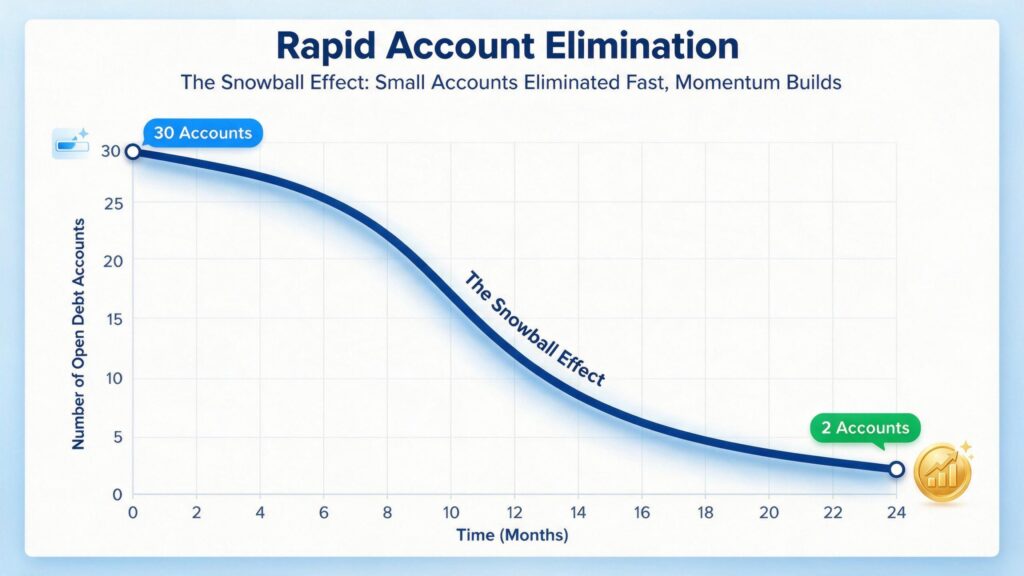
The debt snowball calculator completely flips this script. It operates on a brutally effective behavioral premise: ignore the interest rates.
Instead, you list your debts from the smallest total balance to the largest total balance. You pay the absolute legal minimum on everything. You then take every single extra dollar you can find and attack the smallest balance with ruthless aggression. It dies quickly. You cross it off the list. You experience a massive spike in dopamine and financial confidence. You take the payment from that dead debt and roll it into the next smallest balance.
This guide will not lecture you about perfect interest optimization. We are going to build a machine. We will break down exactly how this snowball rollover effect works, why small psychological victories prevent financial relapse, and how to use our tool to build an aggressive, behaviorally sound exit strategy.
Gather your account statements. Ignore the APR for now. Look strictly at the total balances. Let’s build your momentum.
❄️ Debt Snowball Calculator
Pay off smallest balances first for quick wins & unstoppable momentum
| Payoff Order | Original Balance | APR | Months to Clear | Interest Paid |
|---|
The Mechanics: How to Use the Nxfly Debt Snowball Calculator
A calculator is only as effective as the data you feed it. If you guess your minimum payments, your rollover calculations will be entirely wrong. To extract maximum value from the debt snowball calculator, you must approach your inputs methodically.
Here is exactly how to structure your financial data to generate a realistic, high-momentum timeline.
Step 1: Inventory Your Entire Portfolio (By Balance)
Open every single lending app and statement. You need to pull the exact “Current Balance” for every account you hold. Do not round these numbers. Enter them directly into the calculator’s ledger. The tool will automatically sort them from the smallest dollar amount to the largest. This visual hierarchy is the core foundation of your new strategy. The $400 medical bill sits at the top. The $25,000 student loan sits at the absolute bottom.
Step 2: Lock Down Your Minimum Payment Floor
Every debt requires a monthly sacrifice to keep the bank away. This is your minimum payment. Enter the exact required minimum for each account. The calculator totals these figures. This total represents your baseline financial floor. If your minimums equal $750 across six accounts, that $750 is non-negotiable. You must pay it simply to survive the month without triggering defaults or credit score damage.
Step 3: Inject Your “Snowball” Cash
This variable dictates your speed. Your snowball cash is the extra money you generate above your minimum payment floor. You create this cash by slashing your discretionary budget, selling items you do not need, or working overtime. If you can squeeze an extra $300 out of your monthly income, enter $300 into the extra payment field. The calculator instantly routes this entire $300 directly to the smallest balance on your list.
Step 4: Map the Rollover Execution
Once you run the calculation, watch the cascade effect. When debt number one hits zero, the tool does not let you absorb that old payment back into your lifestyle. It takes the minimum payment from the dead debt, combines it with your $300 extra cash, and slams the entire sum into debt number two. The payment grows heavier with every account you kill. You will physically see your exact debt-free date accelerate as the snowball gains mass.

The Anatomy of the Calculation: Key Terms & Deep Concepts
Financial literacy acts as your shield against predatory lending. Banks purposely overcomplicate the mechanics of borrowing. They use complex terminology to hide the fact that they are draining your cash flow.
If you want to use the debt snowball calculator successfully, you must understand how these specific terms interact with your daily life. Here is your expanded, plain-English glossary for behavioral debt mechanics.
The Snowball Method
This is a debt reduction strategy rooted strictly in behavioral psychology. You organize all liabilities in ascending order based purely on the total principal balance. You ignore the interest rate completely. You attack the smallest balance with every extra dollar you have while maintaining minimums on the rest. It provides rapid, visible victories that condition your brain to stay disciplined over a multi-year repayment journey.
Principal Balance
This is the total amount you currently owe the lender. In the snowball method, the principal balance is the single most important metric. A smaller principal represents an easier target. Killing a $300 principal balance provides immediate psychological relief and instantly removes one monthly obligation from your mental load.
Debt Rollover (The Cascade)
This is the mathematical engine of the strategy. A rollover occurs the exact moment a debt is paid off. You take the money you were previously sending to that lender and forcefully reassign it to the next lender on your list. Your total monthly cash outflow remains completely identical from month one until you are entirely debt-free. You simply consolidate your firepower into fewer targets.
Debt-to-Income (DTI) Ratio
Your DTI is the percentage of your gross monthly income that goes toward paying debts. Lenders scrutinize this number intensely. If you intend to purchase real estate, a high DTI will instantly disqualify you from securing a home loan. By using the snowball method to rapidly eliminate smaller accounts, you forcefully lower your required monthly obligations. You can clearly see how DTI constraints limit your buying power by running your income through our Mortgage Affordability Calculator. Killing small debts is the fastest way to fix a broken DTI.
Minimum Payment Floor
Every revolving account sets a minimum payment. Lenders calculate this number to keep you in debt for the maximum legal timeframe. The snowball method respects the minimum payment floor only as a defensive measure. You pay it to prevent late marks on your credit report. According to the Consumer Financial Protection Bureau (CFPB), paying only the minimum drastically increases your total cost. The snowball method actively destroys this floor by throwing heavy, consolidated payments at your targeted accounts.
Behavioral Attrition
This is the psychological fatigue you experience when trying to pay off massive debts with no visible progress. It is the primary reason people abandon their financial plans. The debt snowball calculator is specifically engineered to combat behavioral attrition by manufacturing rapid, undeniable progress in the first three to six months of your journey.
The Interest Tradeoff
This is the blunt reality of the strategy. Because you are targeting small balances first, you are actively choosing to ignore high-interest accounts that may have larger balances. Mathematically, the snowball method costs you more in total interest than strict rate-based targeting. You are paying a slight premium to guarantee execution. It is a necessary tradeoff. A perfectly optimized math plan is utterly worthless if you abandon it in month two.
Unveiling the Formula: The Math Behind the Calculator
Executing the snowball method on a spreadsheet is a logistical nightmare.
You are not dealing with a single math equation. You are managing a constantly shifting, multi-variable algorithm. Every time a debt hits zero, your cash flow redistributes. A manual calculation requires you to rebuild your entire spreadsheet every single time you cross a balance off your list.
Our tool handles the heavy lifting instantly. It relies on the absolute mathematical truth of amortization, applied in a highly specific, looping sequence.
To determine the exact number of months it will take to eliminate an individual debt, the calculator uses the standard logarithmic equation for solving time (N):
N = -log(1 – (B * r) / P) / log(1 + r)
Here is exactly how the algorithm interprets your inputs:
- N (Time in Months): This is the definitive timeline. It tells you exactly how many billing cycles exist until the account is dead.
- B (Principal Balance): The total dollar amount owed on the specific account being targeted.
- r (Monthly Periodic Rate): Lenders quote you an Annual Percentage Rate (APR). The formula divides that APR by 12 to find your monthly interest multiplier. A 24% APR equals a 2% monthly rate (r = 0.02).
- P (Total Monthly Payment): This is the variable that gives the snowball its power. For your smallest debt, P equals the required minimum payment plus your entire extra snowball cash.
The genius of the calculator lies in the looping sequence.
Once the formula solves for N on your first, smallest debt, it logs that exact month. Then, it instantly shifts to your second debt. For the first few months, the formula applies only the basic minimum payment to debt number two. But the precise month debt number one hits zero, the algorithm violently alters the math for debt number two.
It takes the entire payment (P) from the first debt and physically stacks it on top of the minimum payment for the second debt. The variable P instantly doubles or triples. The formula recalculates. Because P is now massively larger than the remaining balance (B), the time (N) plummets.
Our calculator runs this complex sequence across your entire portfolio in a fraction of a second. It proves mathematically that while you might pay a little more interest compared to the avalanche method, the snowball method guarantees a violently accelerating timeline.
5 Critical Factors That Influence Your Numbers
A calculator creates a perfect, frictionless environment. Real life introduces heavy resistance.
Your financial landscape is volatile. If you want the projected debt-free date on your screen to match reality, you must actively defend your snowball against these five specific external threats.
1. The Inflationary Squeeze on Snowball Cash
Your entire strategy relies on excess cash flow. You need that extra $200 or $500 to attack your smallest balance. However, severe inflation directly attacks your discretionary income. When the cost of housing, food, and fuel spikes, your extra cash vanishes. According to the Bureau of Labor Statistics (BLS), sustained inflation rapidly erodes consumer purchasing power. If your grocery bill increases by $150 a month, and you absorb that cost by reducing your snowball payment, your timeline extends dramatically. You must aggressively cut lifestyle expenses to protect your snowball cash from inflation.
2. The Minimum Payment Recalculation Trap
This is the most common reason the snowball method fails. As you aggressively pay down a balance, your lender will quietly lower your required minimum payment. If your minimum was $100 on a $3,000 balance, the bank might drop it to $35 when the balance hits $800. Do not fall for this. If you drop your payment to $35, you instantly lose the momentum of your snowball. You must manually force your payments to remain flat. Never lower your payment just because the bank gives you permission to do so.
3. Variable Interest Rate Creep
The snowball method explicitly ignores interest rates to focus on balances. However, interest rates still exist in the background. Most consumer credit cards use variable rates tied to federal monetary policy. If the prime rate jumps, the APR on your largest debt at the bottom of your list might climb from 18% to 24%. While you are busy paying off your small medical bills, the compounding interest on the larger debt accelerates. You must monitor your statements. If a large debt begins compounding too aggressively, you may need to temporarily pause the snowball to address the emergency.
4. The “New Charge” Derailment
Momentum requires a frozen environment. You cannot successfully execute a debt snowball if you continue to borrow money. When you carry a balance, you lose your interest grace period entirely. Every new charge immediately generates compounding interest. If you are paying $300 a month toward a small credit card, but you continue to use that card for a $50 weekly grocery run, you are actively drilling holes in the boat you are trying to bail out. You must completely freeze your accounts.
5. Credit Score Utilization Spikes
The snowball method delivers rapid collateral benefits. By rapidly killing small credit card balances, you instantly lower your credit utilization ratio. This causes your FICO score to surge. A surging credit score gives you leverage. Halfway through your snowball journey, your improved score might allow you to qualify for a lower-interest consolidation loan for your remaining large balances. Always monitor your score. If you can refinance your remaining expensive debt into a cheaper product, you alter the math in your favor while maintaining the behavioral momentum.
Real-World Scenarios: The Calculator in Action
Theory only gets you so far. To truly understand the behavioral leverage this strategy provides, you must observe it applied to messy, real-world situations. Borrowers rarely have perfectly organized finances. They hold bizarre mixes of student loans, medical debt, and retail cards.
Here is exactly how the debt snowball calculator slices through the chaos to engineer three highly specific financial rescues.
Scenario 1: The DTI House Hunter (Jessica’s Clean-Up)
Jessica is a 29-year-old nurse earning $75,000. She wants to buy a modest starter home. However, she has five different debts. None of the balances are catastrophically huge, but combined, the five separate minimum payments are crushing her Debt-to-Income (DTI) ratio. She cannot accurately use a Mortgage Loan Calculator because mortgage lenders see her five monthly obligations and immediately flag her as a high-risk borrower. She has an extra $400 a month to fix the problem.
She uses the tool to systematically eliminate the individual monthly payments, prioritizing total accounts closed over interest rates.
| Debt Account | Balance | Minimum Payment | Snowball Order |
|---|---|---|---|
| Retail Store Card | $600 | $35 | Target 1 |
| Medical Bill | $1,200 | $50 | Target 2 |
| Visa Credit Card | $2,500 | $85 | Target 3 |
| Personal Loan | $5,000 | $150 | Target 4 |
| Auto Loan | $12,000 | $320 | Target 5 |
| Snowball Cash | $400/mo | ||
| Result: Target 1 Cleared | Month 2 | ||
| Result: Target 3 Cleared | Month 8 |
Strategic Analysis:
Jessica experiences massive psychological relief. In just eight months, she completely vaporizes three of her five debts. She physically removes three monthly payments from her life. Her DTI ratio drops dramatically. By month nine, she is rolling a massive $570 payment straight into her personal loan. Because she targeted the smallest balances first, she transformed her credit profile in less than a year, putting her in a prime position to qualify for a highly competitive mortgage rate.
Scenario 2: The Overwhelmed Graduate (Michael’s Defense)
Michael is 24. He recently graduated and is completely overwhelmed. He has three different federal student loan tranches, a car payment, and a maxed-out credit card from moving expenses. He makes $50,000 a year and feels completely suffocated by the sheer number of bills hitting his inbox every month. He only has $150 of extra snowball cash.
He needs quick wins to prevent a complete financial relapse. He runs the numbers to build a psychological defense.
| Debt Account | Balance | Minimum Payment | Snowball Order |
|---|---|---|---|
| Student Loan Tranche A | $1,500 | $40 | Target 1 |
| Credit Card | $3,800 | $120 | Target 2 |
| Student Loan Tranche B | $4,500 | $65 | Target 3 |
| Student Loan Tranche C | $8,000 | $110 | Target 4 |
| Auto Loan | $16,000 | $350 | Target 5 |
| Snowball Cash | $150/mo | ||
| Result: Target 1 Cleared | Month 9 | ||
| Result: Target 2 Cleared | Month 22 |
Strategic Analysis:
Michael’s progress is slower, but the strategy saves him from defaulting. Without the snowball method, he would have spread his $150 randomly across his debts, achieving nothing. By hyper-focusing the $150 (plus the $40 minimum) on the smallest student loan tranche, he kills it in nine months. He gets a dopamine hit. He feels successful. He takes that $190 and attacks the high-stress credit card. The debt snowball calculator proves that focused intensity prevents burnout, even on a tight budget.
Scenario 3: The Strategic Refinancer (Linda’s Setup)
Linda is 41. She holds a heavy mix of consumer debt. She wants to use a Mortgage Refinance Calculator to pull cash out of her home’s equity to pay off her debts. However, her credit score is currently too low to get a favorable refinance rate because she has too many active credit cards carrying balances.
She uses the snowball strategy specifically to game the credit scoring algorithm.
| Debt Account | Balance | Minimum Payment | Snowball Order |
|---|---|---|---|
| Home Depot Card | $800 | $45 | Target 1 |
| Target Card | $1,500 | $60 | Target 2 |
| Capital One Card | $4,000 | $120 | Target 3 |
| Auto Loan | $22,000 | $450 | Target 4 |
| Snowball Cash | $600/mo | ||
| Result: Target 2 Cleared | Month 4 | ||
| Result: Strategy Shift | Month 5 Refinance |
Strategic Analysis:
Linda executes a highly tactical maneuver. She throws her heavy $600 snowball entirely at the two small retail cards. They are completely gone in exactly four months. Her number of accounts with balances drops. Her credit utilization improves rapidly. Her FICO score jumps 45 points. She immediately stops the snowball, goes to the bank with her new, higher credit score, and secures an excellent rate on a cash-out refinance to wipe out the remaining $26,000 of debt. The calculator showed her exactly how fast she could manipulate her credit profile to force a better macroeconomic outcome.
Hidden Pitfalls: 3 Biggest Mistakes People Make
The debt snowball calculator provides a perfect behavioral map. It manufactures momentum out of thin air. However, financial plans do not execute themselves. Human nature is highly prone to self-sabotage.
Borrowers fail at the snowball method because they suddenly doubt the strategy, or they allow lifestyle creep to devour their newly freed cash flow. If you want to successfully execute this aggressive timeline, you must aggressively defend your behavior against these three massive financial blunders.
Mistake 1: The High-Interest Panic
This destroys more snowball plans than anything else. You list your debts by balance. You start attacking a $400 medical bill. Then, you look at your statements and notice a massive $14,000 credit card balance compounding at 26% APR sitting at the bottom of your list. You panic. You abandon the medical bill and start throwing your extra cash at the 26% card.
You just broke the machine. You ruined your momentum. By attacking the $14,000 card, you consign yourself to months—or years—of slogging without a single closed account. Fatigue will set in. You will likely quit. The snowball method requires you to willfully ignore the interest rate. Trust the behavioral psychology. Kill the small targets first.
Mistake 2: Absorbing the Rollover Cash
The entire snowball strategy relies mathematically on the rollover sequence. When you pay off your first targeted account, you instantly free up a block of monthly cash flow. If your extra snowball payment was $200 and the old minimum was $50, you suddenly have $250 floating in your checking account.
Most people view this freed-up cash as a raise. They upgrade their smartphone. They go out to expensive dinners. If you absorb that capital back into your lifestyle, your debt elimination completely stalls. You revert back to making slow, expensive minimum payments on your remaining accounts. You must forcefully roll that entire $250 directly into the next balance on your list. No exceptions.
Mistake 3: Accumulating New Debt on Zeroed Accounts
Lenders hate the snowball method. When you aggressively zero out a credit card, you take away their profit. They will immediately retaliate by sending you “exclusive” offers, increased credit limits, and zero-fee cash advance checks.
Do not take the bait. You might think you can safely use the newly cleared card for a tank of gas. You are wrong. When you carry balances on other cards, your financial discipline is already strained. Swiping the cleared card immediately reintroduces a new monthly minimum payment into your life. You are literally building a snowball while simultaneously shoveling snow back into your own path. Freeze the cleared accounts entirely.
Expert Strategies: How to Optimize Your Results
You have your list. You understand the required psychological discipline. Now, we manufacture more speed.
Financial planning is about finding hidden leverage. You can manipulate your budget and your assets to forcefully accelerate your snowball timeline. Here are five expert-level strategies to deploy immediately.
Strategy 1: The Bi-Weekly Payment Hack
Do not let your snowball cash sit in a checking account waiting for the end of the month. Weaponize it. If your calculated monthly snowball payment is $600, cut it exactly in half. Send the lender $300 every 14 days.
This simple schedule change produces massive results. Because there are 52 weeks in a calendar year, a bi-weekly schedule results in 26 half-payments. You end up making 13 full payments over the year instead of the standard 12. This invisible, automated 13th payment directly reduces your principal balance, drastically accelerating your debt-free date without requiring you to find extra money in your budget.
Strategy 2: Hunt for Hidden Real Estate Cash Flow
If you own a home, you might be sitting on hundreds of dollars of locked cash flow. When you bought your house, you may have been forced to pay Private Mortgage Insurance (PMI). Look at your current property value. Run your numbers through our PMI Calculator.
If your home equity has grown past 20%, pick up the phone immediately. Call your mortgage servicer and formally demand they remove the PMI premium. If they drop it, you instantly reclaim $100 to $200 a month in raw cash flow. Do not spend it. Inject that entire amount straight into your snowball payment.
Strategy 3: Pause Long-Term Asset Prepayment
Aggressive savers constantly sabotage their own debt elimination by trying to fix everything at once. They want to be completely debt-free, so they send extra money to their mortgage while simultaneously fighting a credit card balance.
This is financially inefficient. Check the math on our Extra Mortgage Payment Calculator. Shaving time off a fixed 5% home loan is a smart long-term move, but it fails miserably if you have consumer debts draining your current liquidity. Stop prepaying your mortgage. Stop overfunding your retirement accounts beyond the employer match. Redirect every single available dollar to the top of your snowball list. You can resume building long-term assets once the short-term consumer debts are dead.
Strategy 4: The Windfall Injection Method
Throughout the year, you will likely encounter unexpected infusions of cash. You might receive a $2,500 tax refund, a $1,000 performance bonus, or $800 from selling an old laptop.
People generally spread windfall money around. They put a little in savings, pay a little on a car loan, and buy a new television. That destroys your leverage. When you receive a windfall, apply 100% of that capital as a massive, one-time lump sum payment directly to your current snowball target. This immediately decapitates the balance, forces an instant rollover, and violently shortens your timeline.
Strategy 5: Liquidate the Illusion of Safety
Many borrowers hold $10,000 in a savings account because they want an emergency safety net. Simultaneously, they carry $8,000 in credit card debt.
This safety net is entirely an illusion. Your savings account pays you a microscopic 4% yield while the bank charges you a 24% penalty on your debt. You are actively bleeding net worth every single day. Keep a strict $1,000 starter emergency fund to cover flat tires and broken water heaters. Take the remaining $9,000 and immediately execute your first three or four snowball targets in a single afternoon. You buy back your cash flow instantly.
Frequently Asked Questions (FAQs)
Q: Does the debt snowball method actually work better than the avalanche method?
A: Behaviorally, yes. Mathematically, no. The avalanche method mathematically saves you more money by targeting high interest rates. However, the snowball method boasts a significantly higher human success rate because the rapid elimination of small balances provides the psychological motivation required to stick with the plan.
Q: Should I include my primary mortgage in my debt snowball?
A: No, leave your mortgage out of the snowball entirely. A mortgage is a massive, secured loan tied to an appreciating asset. The snowball method is designed strictly to aggressively wipe out short-term, compounding consumer liabilities. Just use a Mortgage Payment Calculator to ensure your standard housing costs remain within your baseline budget.
Q: What do I do if two different debts have the exact same balance?
A: If two accounts carry the exact same principal balance, you must break the tie by looking at the interest rates. Target the account with the highest Annual Percentage Rate (APR) first. This allows you to eliminate the more expensive debt while still capturing the exact same behavioral momentum.
Q: Do I still pay the minimums on my other accounts while doing this?
A: Absolutely. You must always pay the required legal minimums on every single account you hold, regardless of its position on your snowball list. Failing to pay a minimum will trigger late fees, penalty APR spikes, and severe damage to your FICO score.
Q: Will paying off these small accounts hurt my credit score?
A: No, paying down revolving consumer debt will drastically improve your credit score. As you force your balances to zero, your credit utilization ratio drops rapidly. Since utilization accounts for roughly 30% of your total FICO score, your rating will surge higher as your balances decrease.
Q: Should I cash out my 401(k) to fund my debt snowball?
A: Never cash out a retirement account to pay consumer debt. Withdrawing from a 401(k) before age 59½ triggers a brutal 10% IRS penalty, plus standard income taxes on the entire amount. You instantly lose massive amounts of capital and destroy your future compound market growth.
Q: Where should a 0% promotional balance transfer card go on my list?
A: Treat it exactly like every other debt and list it strictly by its total principal balance. However, you must monitor the promotional expiration date. If the 0% window is about to close and trigger retroactive deferred interest, you may need to temporarily pause the snowball to kill that specific balance.
Stop letting multiple monthly payments drain your energy and your wallet. Scroll to the top of this page to run your exact numbers through our free Debt Snowball Calculator today. Once your consumer liabilities are completely cleared, check out our Mortgage Affordability Calculator to see the massive real estate buying power your new debt-free income provides.
Disclaimer: The Debt Snowball Calculator provided by Nxfly Finance is for educational and informational purposes only. It does not constitute specific financial, investment, or tax advice. Please consult with a licensed financial advisor, fiduciary, or CPA before making any major financial decisions.