

By David Kensington, CFP® | Reviewed by the Nxfly Finance Team
Being in debt feels like suffocating. Banks rely heavily on this feeling. They want you overwhelmed, disorganized, and completely disconnected from the actual cost of your borrowed money. When you operate on emotion, you make minimum payments. When you make minimum payments, you fund their glass skyscrapers.
You have to stop guessing. You need the debt payoff calculator.
Most consumers look at their monthly billing statements and see a massive, immovable mountain. They throw an extra fifty bucks at a balance and assume it helps. Sometimes it does. Often, it gets entirely swallowed by compounding daily interest. The math working against you is relentless. Lenders structure their repayment requirements specifically to keep you in the borrowing cycle for decades.
Our debt payoff calculator strips away the marketing fluff and hands you the raw, unedited mathematical truth.
When you input your actual numbers into this tool, the fog completely clears. You force reality out into the open. You discover the exact month and year you will finally be debt-free. You see exactly how many thousands of dollars the bank is currently siphoning from your future net worth. More importantly, you see how aggressively your timeline changes when you alter your monthly payment strategy.
Understanding this math is not optional. It is mandatory for wealth creation. If you plan to build actual assets, you must kill your expensive liabilities first. You cannot accurately map out your future using tools like our Mortgage Payoff Calculator if heavy consumer debt is actively destroying your monthly cash flow.
This guide is blunt. We do not sugarcoat bad financial decisions. We break down exactly how your lenders calculate your interest, why your principal balance barely moves, and how to use our tool to build an aggressive, mathematically sound exit plan.
Pull up your accounts. Find your real interest rates. Let’s look at the numbers.
📉 Debt Payoff Calculator
Compare Snowball vs Avalanche strategies & find your fastest path to debt freedom
| Debt | Months to Clear | Interest Paid | Total Paid |
|---|
The Mechanics: How to Use the Nxfly Debt Payoff Calculator
A tool is completely useless if you feed it bad data. Estimating your balance or guessing your interest rate will generate a fantasy timeline. To get a razor-sharp, actionable projection from the debt payoff calculator, you must approach your inputs like a forensic accountant.
Here is exactly how to structure your data to generate reality.
Step 1: Lock Down Your Exact Principal Balance
Do not rely on your memory. Log directly into your lender’s portal. Find the exact “Current Balance.” Do not use the “Statement Balance,” because that number only reflects what you owed weeks ago when the billing cycle closed. The current balance includes every single pending transaction and newly accrued interest fee. Enter this exact, up-to-the-minute dollar amount. This acts as the heavy boulder you are trying to push up the hill.
Step 2: Uncover Your True APR
Your Annual Percentage Rate (APR) is the engine driving your misery. Lenders routinely bury this number deep in the fine print of your PDF statements. You must dig for it. Do not assume your rate is 12%. Today, average consumer rates frequently push past 24%. If you are currently operating under a promotional 0% APR that expires in four months, you need to use the standard “Go-To” rate that will hit your account afterward for any long-term calculation.
Step 3: Define Your Target Payment Strategy
Here is where you completely take back control. The debt payoff calculator allows you to manipulate your financial future through two distinct pathways:
- The Payment Target: Input the maximum fixed dollar amount you can aggressively afford to pay every month. The calculator will output the exact date your balance hits zero.
- The Timeline Target: Input your hard deadline. If you want to be totally debt-free in exactly 24 months, enter that timeframe. The algorithm works backward, spitting out the precise monthly payment required to hit that exact date.
Step 4: Audit the “Total Interest” Damage
Once you click calculate, look straight at the “Total Interest Paid” metric. Let this number hurt. It represents the pure penalty you pay for carrying this balance. If you owe $15,000 and the calculator shows you will pay $6,000 in interest over four years, your real debt load is $21,000. Use this shock as a behavioral weapon. Increase your monthly payment input by $100. Watch how violently that total interest figure drops.

The Anatomy of the Calculation: Key Terms & Deep Concepts
Financial literacy requires speaking the language of your opponent. Lenders purposely use dense terminology to obscure simple math. They want to keep you in the dark.
If you want to extract maximum value from the debt payoff calculator, you must understand exactly how the terms printed on your statement interact with your bank account. Here is your expanded, plain-English glossary for debt mathematics.
Principal Balance
This is the raw, base amount of money you actually borrowed. If you put a $3,000 transmission repair on your credit card, your principal is $3,000. However, the exact moment your billing cycle closes, unpaid interest gets immediately added to this balance. Your principal grows artificially. You suddenly find yourself paying new interest on top of old interest.
Annual Percentage Rate (APR)
APR dictates the yearly cost of holding the bank’s money. But lenders do not calculate this cost yearly. They calculate it daily. The bank takes your stated APR, divides it by 365, and applies that daily periodic rate to your average daily balance. The Consumer Financial Protection Bureau (CFPB) explicitly warns that higher APRs drastically increase the cost of borrowing over time. A high APR acts as a massive headwind, severely diluting the power of your monthly payments.
Amortization Schedule
This is a fixed table showing every single payment you will make until a loan dies. Installment loans, like mortgages and auto loans, have rigid amortization schedules. You can see this math cleanly if you look at our Mortgage Amortization Calculator. Revolving debt, like credit cards, lacks this structure. Because your minimum payment fluctuates based on your balance, the finish line constantly moves. Our calculator forces revolving debt into a rigid amortization schedule so you can finally see an end date.
The Minimum Payment Trap
Your billing statement prominently displays a tiny minimum payment. It is usually calculated as 1% to 2% of your total balance, plus the accrued interest for that specific month. Lenders engineer this formula strictly to maximize their profits. It is designed to pay down the principal at a microscopic rate. If you only pay this printed number, you accept the lender’s plan to keep you in debt for decades.
Compounding Interest
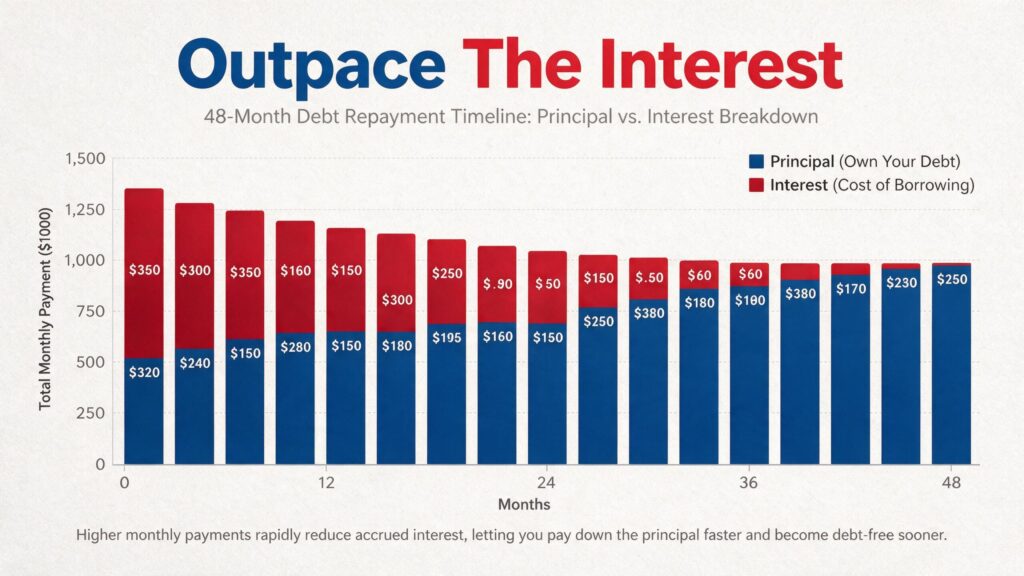
This specific mathematical concept destroys wealth faster than anything else. Every single day you carry a balance, the bank calculates a tiny interest charge and tacks it onto your total. The very next day, they calculate interest on that new, slightly larger balance. The debt feeds on itself. Your primary goal is to use the debt payoff calculator to find a payment large enough to outpace and crush this daily compounding growth.
Total Interest Paid
This metric defines the absolute true cost of your poor financial leverage. It totals every single dollar you send to the lender above and beyond your original principal balance. When formulating your strategy, this is the most critical metric to monitor. Your only job is to drive this specific number as close to zero as humanly possible by accelerating your payment velocity.
Debt-Free Date
This is the exact month and year your balance strikes $0.00. This date assumes you make the exact fixed payment you entered into the calculator, without adding a single new charge to the account. It provides a definitive timeline. A definitive timeline builds aggressive discipline. Discipline builds net worth.
Unveiling the Formula: The Math Behind the Calculator
Lenders build fortunes on your mathematical ignorance. They hand you an app with a sleek interface and a big green “Pay Minimum” button. They intentionally hide the raw mechanics of your loan.
When you use our debt payoff calculator, you completely bypass their interface. You plug directly into the exact amortization algorithm they use to assess your account.
If you want to know exactly how many months it takes to kill a balance based on a fixed payment, the calculator does not guess. It uses a logarithmic equation to isolate time (N). The standard formula powering this tool looks like this:
N = -log(1 – (B * r) / P) / log(1 + r)
Here is exactly how the calculator interprets your financial data:
- N (Number of Months): This is the output. This is your definitive timeline to a zero balance.
- B (Principal Balance): The total outstanding amount you owe the lender today.
- r (Monthly Periodic Rate): Lenders quote an Annual Percentage Rate (APR), but they charge you monthly (or daily). The formula takes your APR and divides it by 12. A 24% APR becomes a 2% monthly rate (r = 0.02).
- P (Monthly Payment): The fixed dollar amount you commit to sending the bank every single billing cycle.
Look closely at the numerator inside the parenthesis: (B * r). That specific calculation represents the pure interest generated in a single month.
This reveals a brutal financial truth. If your chosen monthly payment (P) is equal to or less than the monthly interest (B * r), the formula physically breaks. You will generate a negative number, which cannot be processed by a logarithm. Why? Because mathematically, if you do not pay enough to cover the interest, your debt will grow to infinity. You will never pay it off.
Our tool runs this exact formula instantly. It calculates your timeline with absolute precision. If you make the exact payment required, and you refuse to add a single dollar of new debt to the account, the date projected on your screen is an absolute mathematical certainty.
5 Critical Factors That Influence Your Numbers
A calculator provides a sterile, perfect environment. Your real life is messy. Financial markets fluctuate, lender policies change, and your personal cash flow takes unexpected hits.
If you want the timeline generated by your calculation to hold true, you must defend your payoff strategy against these five massive external threats.
1. Macroeconomic Rate Hikes
Most consumer debt is variable. Credit cards and home equity lines of credit (HELOCs) are tied directly to the U.S. Prime Rate. When inflation surges, the government steps in. According to consumer credit data from the Federal Reserve, credit card interest rates recently spiked to record historical highs following aggressive federal rate hikes. If the Fed raises rates by 0.50%, your credit card APR increases automatically. A payoff timeline you calculated in January might suddenly stretch by three extra months in July simply because the debt became more expensive.
2. The Inflationary Squeeze on Cash Flow
Aggressive debt elimination relies on your excess cash flow. You need discretionary income to fund that heavy monthly payment. Inflation directly attacks your discretionary income. When groceries, gas, and utilities surge in price, your budget tightens. Borrowers often react by quietly lowering their extra debt payments just to cover daily living expenses. If you drop your monthly debt payment by $150, your perfectly calculated timeline extends drastically, and your total interest costs explode.
3. The Average Daily Balance Mechanism
Banks do not simply calculate your interest on the day your statement closes. They track your balance every single day of the month, average those numbers together, and apply the interest rate. Timing matters. If you wait until day 29 of your billing cycle to make your massive monthly payment, you suffer 28 days of high-interest accumulation. Paying your bill two weeks early forces your average daily balance down, mathematically reducing your monthly interest charge.
4. Credit Score Utilization Shifts
As you aggressively execute your payoff plan, your principal balance drops. This drastically lowers your credit utilization ratio. Your FICO score will rapidly increase. This presents a massive strategic opportunity. A higher credit score makes you eligible for lower-interest balance transfer cards or cheaper personal consolidation loans. If your score jumps 40 points mid-payoff, you should actively look to refinance your 25% debt into a 10% product, completely altering your calculated timeline for the better.
5. The “New Charge” Disruption
This is the number one reason people fail to hit their calculated debt-free date. They set up an aggressive $600 monthly payment, but continue to use the credit card for their $50 weekly gas purchases. When you carry a revolving balance, your interest grace period is gone. That $50 gas purchase begins generating compounding interest the literal second you swipe the card. The calculator assumes you have completely stopped borrowing. You must freeze the account.
Real-World Scenarios: The Calculator in Action
Theory is useless without execution. To truly understand the leverage this math provides, you must see it applied to real human situations. Different financial goals demand entirely different payment strategies.
Here is exactly how the debt payoff calculator cuts through the noise to engineer three distinctly different financial rescues.
Scenario 1: The Struggling Homebuyer (Mark’s Reset)
Mark is a 34-year-old manager making $90,000 a year. He wants to buy his first house within 18 months. However, he is carrying an $18,000 balance on a high-interest travel rewards card. His debt-to-income (DTI) ratio is heavily skewed. He knows that before he can accurately use a Mortgage Rate Calculator to shop for a home loan, he absolutely must kill this credit card balance. The mortgage lender will demand it.
Mark sets a hard timeline of 15 months to clear the debt before he starts house hunting.
| Input Variable | Mark’s Data |
|---|---|
| Principal Balance | $18,000 |
| Current APR | 22.5% |
| Target Payoff Timeline | 15 Months |
| Result: Required Monthly Payment | $1,389 |
| Result: Total Interest Paid | $2,835 |
| Total Out of Pocket Cost | $20,835 |
Strategic Analysis:
Mark has to endure 15 months of financial pain. Sending nearly $1,400 to the bank every month requires a ruthless budget. He stops eating out. He halts his vacation plans. However, the math proves the sacrifice is worth it. In exactly 15 months, he reclaims $1,400 of monthly cash flow. His DTI plummets. He instantly transforms from a risky borrower into a prime mortgage candidate, potentially saving tens of thousands of dollars on his future home loan interest rate.
Scenario 2: The Aggressive Investor (Sarah’s Arbitrage)
Sarah is 29 and heavily focused on building her investment portfolio. She owes $12,000 on a personal loan, but the interest rate is a relatively moderate 8.5%. She has $800 of extra cash flow every month. She is torn between paying off the loan rapidly or investing that $800 into the S&P 500, which historically returns around 10%.
She uses the calculator to measure exactly what that 8.5% debt is costing her.
| Input Variable | Sarah’s Data |
|---|---|
| Principal Balance | $12,000 |
| Current APR | 8.5% |
| Monthly Payment Strategy | $800 (Aggressive) |
| Result: Time to Debt-Free | 16 Months |
| Result: Total Interest Paid | $742 |
| Total Out of Pocket Cost | $12,742 |
Strategic Analysis:
Sarah looks at the total interest paid: just $742. She realizes that while 8.5% is annoying, it is not a financial emergency. If she drops her payment down to the required $350 minimum, the loan drags on for 39 months, costing her roughly $1,600 in interest. She decides to split the difference. She pays $500 a month toward the loan to clear it in two years, and funnels the remaining $300 a month into her brokerage account to capture market growth. The calculator allowed her to balance debt reduction with asset accumulation.
Scenario 3: The Conservative Saver (Tom’s Cash Bleed)
Tom is 45 and terrified of financial ruin. He holds $25,000 in a high-yield savings account earning 4.5%. However, he also carries $14,000 in credit card debt at a brutal 26% APR from a previous medical emergency. He refuses to touch his savings because he wants a “safety net.” He is currently paying $350 a month toward the credit card.
Tom runs his numbers to see the reality of his defensive strategy.
| Input Variable | Tom’s Data |
|---|---|
| Principal Balance | $14,000 |
| Current APR | 26.0% |
| Monthly Payment Strategy | $350 (Fixed) |
| Result: Time to Debt-Free | 82 Months (6.8 Years) |
| Result: Total Interest Paid | $14,480 |
| Total Out of Pocket Cost | $28,480 |
Strategic Analysis:
The math exposes Tom’s massive error. He is clinging to a 4.5% return on his savings while bleeding out 26% on his debt. You can see how long-term fixed interest works on our Mortgage Interest Calculator, but 26% compounding revolving interest is toxic. His $14,000 debt will ultimately cost him over $28,000. It will take nearly seven years to pay off. The “safety net” is an illusion. Tom must immediately take $14,000 out of his savings and kill the credit card in a single day. He will still have an $11,000 emergency fund left over, and he instantly stops a $14,000 interest hemorrhage.
Hidden Pitfalls: 3 Biggest Mistakes People Make
A mathematical projection is only as strong as your discipline. The debt payoff calculator gives you a flawless map. But borrowers constantly drive themselves right off the cliff.
People fail because they mix emotion with mathematics. They assume small slip-ups do not matter. They do matter. If you want to successfully execute your calculated timeline, you must aggressively defend your strategy against these three massive financial blunders.
Mistake 1: The “Grace Period” Illusion
You formulate a perfect 18-month payoff plan. You commit to sending $700 to the bank every month. Then, you decide to keep using the card for small daily expenses, assuming you will just pay off those new charges at the end of the week.
This destroys your calculation. When you carry a revolving balance from month to month, you forfeit your interest grace period entirely. Every single new transaction—whether it is a $4 coffee or a $50 tank of gas—begins generating daily compounding interest the exact microsecond it posts to your account. The calculator assumes a frozen balance. If you are actively attacking a debt, you must physically stop using that specific credit line. Cut the card. Delete it from your phone.
Mistake 2: Deferring to the Minimum Payment Anchor
Banks are masters of behavioral psychology. By printing a heavily bolded “Minimum Payment Due” on your statement, they anchor your brain to that specific number. If the minimum is $85, paying $100 feels like a massive victory.
It is a trap. Lenders engineer minimum payments to barely cover the accrued interest, ensuring your principal balance drops at a microscopic rate. If you anchor your strategy to the bank’s suggested number, you willingly accept a multi-decade repayment timeline. You must completely ignore their requested minimum. Rely exclusively on the fixed payment output generated by the calculator to dictate your monthly cash outflow.
Mistake 3: The Emotional Balance Transfer Shuffle
Borrowers often panic when they see their total interest projections. To fix it, they open a new 0% balance transfer card and move the debt. This feels like progress.
It is usually a mirage. Moving debt does not eliminate debt. Most people pay a 3% to 5% transfer fee, adding hundreds of dollars to their principal balance, and then they fail to adjust their spending habits. Within six months, they run up a new balance on the original card while making tiny payments on the new 0% card. When the 12-month promotional window closes, the interest rate spikes to 28%. They end up with twice the debt. If you transfer a balance, you must use the calculator to structure a ruthless payoff plan that ends exactly one month before the promo expires.
Expert Strategies: How to Optimize Your Results
You have your timeline. You know the pitfalls. Now, it is time to optimize the mechanics.
Financial planning is about finding leverage. You can manipulate the banking system’s mathematical rules to forcefully accelerate your timeline and strip away massive amounts of interest. Here are five expert-level strategies to deploy immediately.
Strategy 1: Execute Bi-Weekly Micro-Payments
Lenders calculate your interest charges based on your average daily balance. You can weaponize this metric. Do not hold your money in a checking account waiting for the 30th of the month. If your calculated monthly payment is $800, cut it in half. Send the bank $400 every 14 days.
This does two things. First, paying early forcefully drives down your average daily balance, which mathematically shrinks your monthly interest charge. Second, because there are 52 weeks in a year, paying every two weeks results in 26 half-payments. You end up making 13 full payments over the year instead of 12. This invisible extra payment drastically accelerates your debt-free date.
Strategy 2: Pause Amortization Prepayments
Aggressive savers love to overpay their low-interest debts. They want to be completely debt-free. But math dictates a strict hierarchy of execution.
If you have a 4% home loan and a 24% credit card, paying extra on the house is mathematically destructive. Check the numbers on our Extra Mortgage Payment Calculator. Shaving years off a mortgage is an excellent long-term wealth strategy, but it completely fails if you are actively bleeding cash to high-interest revolving debt. Stop prepaying your mortgage. Stop making extra payments on a 5% student loan. Redirect every single available dollar to the 24% debt. Once the toxic debt is dead, you can resume accelerating your asset payoffs.
Strategy 3: Liquidate Underperforming Safety Nets
People love the psychological comfort of a large savings account. They will proudly hold $20,000 in a high-yield savings account earning a 4% return, while simultaneously carrying $15,000 in credit card debt costing them 25%.
This is financial self-sabotage. You are actively losing 21% on your money every single day. The bank is paying you pennies while charging you hundreds. Keep a small $1,000 to $2,000 emergency buffer, and instantly liquidate the rest of those underperforming cash assets to execute a massive lump-sum payment against your high-interest debt.
Strategy 4: The 0% Arbitrage Trapdoor
If your credit score remains strong, you can buy yourself time. Apply for a balance transfer card offering a 0% introductory rate for 15 to 18 months. Move your most toxic debt.
Do not guess the outcome. Take the new total balance (which now includes the 3% transfer fee) and run it through the calculator. Set the APR strictly to 0%. Set your target timeline to 14 months (one month prior to the expiration). This locks in your required fixed payment. You completely halt the compounding interest machine and force 100% of your capital directly into principal reduction.
Strategy 5: Tactical Consolidation Refinancing
If you have massive, high-interest unsecured debt and substantial home equity, you have leverage. You can fundamentally change the math.
Consider using a cash-out refinance or a home equity loan to pay off your 25% credit cards. You are shifting volatile revolving debt into a stable, lower-rate fixed amortization schedule. Run your new potential loan terms through a Mortgage Refinance Calculator to verify that the closing costs do not outweigh your long-term interest savings. If the math clears, execute the refinance. But be warned: if you clear your credit cards and immediately run them back up, you put your actual house at risk of foreclosure.
Frequently Asked Questions (FAQs)
Q: How does a debt payoff calculator determine my timeline?
A: The calculator uses a standard logarithmic formula to solve for time based on your balance, interest rate, and monthly payment. It factors in daily compounding interest against your fixed payment to calculate exactly how many billing cycles it takes to reach a zero balance.
Q: Will paying my credit card twice a month save me money?
A: Yes. Because credit card interest is calculated based on your average daily balance, making payments earlier in the billing cycle reduces that daily average. A lower average daily balance results directly in a lower monthly interest charge from the bank.
Q: Should I use the debt snowball or the debt avalanche method?
A: The debt avalanche method is mathematically superior. The avalanche targets your highest APR debt first, which minimizes the exact dollar amount of total interest you pay. The snowball method targets smaller balances for psychological wins, which costs you significantly more money over time.
Q: Why does my payoff date keep changing even though I make the same payment?
A: Your payoff date will shift if your debt carries a variable Annual Percentage Rate (APR). Most credit cards are tied to the federal prime rate. When the Federal Reserve raises benchmark interest rates, your APR increases, causing more of your fixed payment to go toward interest rather than principal.
Q: Will paying off a large debt completely ruin my credit score?
A: No, paying down revolving debt like credit cards drastically improves your credit score. It immediately lowers your credit utilization ratio. However, paying off and fully closing a fixed installment loan (like a car loan) can cause a slight, temporary dip in your score due to changes in your credit mix.
Q: Should I cash out my 401(k) to pay off my credit cards?
A: Absolutely not. Cashing out a 401(k) before age 59½ triggers a massive 10% IRS penalty, plus standard income taxes on the entire withdrawn amount. You instantly lose 30% or more of your capital, while simultaneously destroying decades of future tax-advantaged compound market growth.
Q: Can I use this calculator for a 0% promotional balance?
A: Yes. Enter your total balance and set the interest rate field to exactly 0%. Then, select a target payoff timeline that ends at least one full month before the bank’s promotional period expires. The calculator will output the exact fixed payment required to beat the expiration date.
Stop letting compounding interest drain your net worth. Scroll to the top of this page to run your exact numbers through our free Debt Payoff Calculator today, and once your liabilities are cleared, check out our Mortgage Payment Calculator to see how your newly freed-up cash flow can build real estate wealth.
Disclaimer: The Debt Payoff Calculator provided by Nxfly Finance is for educational and informational purposes only. It does not constitute specific financial, investment, or tax advice. Please consult with a licensed financial advisor, fiduciary, or CPA before making any major financial decisions.