

The Hidden Financial Dangers Threatening Your Dream Home
Signing the final closing documents on your first house feels like a massive victory. You receive the keys, walk through the front door, and imagine the beautiful memories you will build. However, paying for that dream home over the next few decades can quickly turn into a stressful burden if you lack the right strategy. In my experience, I have seen many people make small billing errors during their first few months of homeownership that spiral into massive debt.
When you do not fully understand how home loans work, bad information causes severe financial struggles. Committing even minor mortgage payment mistakes can lead to the following long-term problems:
- Wasted income: Paying thousands of dollars in unnecessary interest charges because you applied extra funds incorrectly.
- Unexpected bill spikes: Facing sudden escrow shortages that make your affordable monthly bill jump out of your budget.
- Credit score damage: Missing hidden deadlines that trigger late fees and severely hurt your credit profile.
- Lost equity: Failing to build actual ownership in your property despite making consistent monthly payments.
Falling into these traps destroys your peace of mind and shatters your confidence as a new homeowner. Financial anxiety creeps into your daily life when you worry about losing your property. However, identifying these mortgage payment mistakes early completely changes the game. By taking control of your housing costs, you secure your family’s future, keep more money in your pocket, and transform an intimidating debt into a powerful wealth-building tool. Let us review the exact steps to protect your budget.
Understanding the Mechanics of Your Monthly Bill
Before you can spot mortgage payment mistakes, you need to understand exactly where your money goes every single month. Many new buyers assume their entire check pays off the house. This is a dangerous assumption. Your monthly bill actually splits into four distinct categories, commonly known as PITI.
PITI stands for Principal, Interest, Taxes, and Insurance. When you mail your check or set up an auto-draft, the lending institution divides the funds based on a strict mathematical formula. The principal portion directly reduces your loan balance. The interest portion pays the bank for the privilege of borrowing their money.
The remaining funds go into a special holding account to pay your property taxes and homeowner’s insurance when those massive bills become due. Failing to monitor how your lender divides this money is one of the most frequent mortgage payment mistakes I see today. If you do not track your PITI breakdown, you risk paying unnecessary fees and missing key opportunities to save money.
Misunderstanding Amortization and Interest Traps
Your home loan does not behave like a standard credit card. Mortgages use an amortization schedule. This means the bank front-loads the interest charges during the first several years of your loan. During year one, almost your entire monthly payment goes directly toward interest, while only a tiny fraction touches the actual principal balance.
Many first-time homebuyers ignore this fact. They make standard payments for five years, decide to sell the house, and realize they barely dented the original loan amount. This lack of awareness ranks among the worst mortgage payment mistakes you can make. You can easily visualize this heavy interest burden by running your numbers through a Mortgage Amortization Calculator to see exactly how little equity you build in the early years.
Pro Tip: Always ask your lender for a complete, printed amortization schedule on closing day. Keep it in your desk and cross off every payment you make. This visual aid helps you stay highly motivated to attack the principal balance.

The Escrow Shortage Surprise
If there is one thing that terrifies new homeowners, it is an escrow shortage. When you first buy your house, the lender estimates your future property taxes and insurance premiums. They divide this estimate by twelve and add it to your monthly principal and interest payment.
However, property taxes and insurance premiums rarely stay the same. As local property values rise or insurance companies hike their rates, your escrow account will not have enough money to cover the actual bills. The lender will pay the difference to protect the house, but they will immediately demand that you pay them back.
Ignoring your annual escrow analysis statement leads directly to shocking mortgage payment mistakes. Suddenly, your lender increases your monthly bill by hundreds of dollars to cover the shortage and fund next year’s higher expenses. According to the Consumer Financial Protection Bureau (CFPB), lenders must provide an annual escrow statement outlining these changes, yet thousands of buyers throw this envelope in the trash thinking it is junk mail.
To prevent this shock, you must actively research your local tax assessments. When the city mails you a notice indicating your property value went up, you should immediately assume your monthly housing bill will rise shortly after. Planning ahead saves you from scrambling to find extra cash at the last minute.
Improperly Applying Extra Funds
Once new homeowners realize how much interest they pay, they naturally want to speed up the process. They decide to send an extra $200 every month. This is a fantastic financial move, but poor execution transforms it into one of the most common mortgage payment mistakes.
If you just write a larger check or send extra cash through an online portal without specific instructions, the bank might not apply it to your principal balance. Instead, they often hold the extra money in a “suspense account” or apply it toward your next month’s standard payment. This does absolutely nothing to reduce your long-term interest charges.
You must explicitly instruct your servicer to apply any overpayment exclusively to the principal balance. Call customer service and ask them how to format extra funds. Most modern online payment portals feature a separate, clearly labeled box for “Additional Principal.” Always double-check your next statement to verify they followed your instructions. You can use an Extra Mortgage Payment Calculator to see how accurately applied funds shave years off your debt.
Ignoring the Private Mortgage Insurance (PMI) Threshold
If you purchased your home with a down payment of less than twenty percent, your lender likely forced you to buy Private Mortgage Insurance (PMI). This monthly fee protects the bank if you default on the loan. It offers zero protection to you, yet it costs you hundreds of dollars every month.
Many buyers commit massive mortgage payment mistakes by letting PMI linger on their accounts long after they qualify for removal. Under the Homeowners Protection Act, your lender must automatically cancel PMI when your principal balance reaches 78 percent of the home’s original value. However, you have the legal right to request cancellation the moment your balance hits 80 percent.
Waiting for the bank to automatically remove the fee costs you a fortune. Keep a close eye on your balance. If you make improvements to the house or local real estate values surge, you can even hire an appraiser to prove you reached the 20 percent equity mark ahead of schedule. Track your progress carefully using a PMI calculator so you know exactly when to submit your cancellation request to the bank.
Setting and Forgetting Autopay
Automation makes managing personal finances easier. Setting up an automatic draft for your housing bill guarantees you never miss a deadline. However, a “set it and forget it” mentality breeds dangerous mortgage payment mistakes.
Lenders regularly sell the servicing rights to home loans. You might close your loan with Bank A, only to receive a letter three months later stating Bank B now collects your money. If you ignore this mail and leave your autopay running to Bank A, your money goes into a black hole. Your new lender will report you as late, charge hefty penalties, and ruin your credit score.
Always open every piece of mail from your lender. Check your bank account on the third day of every month to verify the correct company drafted the exact right amount. Automation is a tool for convenience, not an excuse to stop managing your personal budget. For help organizing your cash flow to ensure you always have enough funds on draft day, read our guide on how to create a monthly budget that is easy to follow.
Advanced Strategies to Optimize Your Monthly Housing Costs
Now that we covered the basic structural traps, we need to focus on optimization. Surviving your first year of homeownership is a great milestone. However, thriving over the next decade requires advanced financial tactics. Let us explore expert-level secrets that will save you time, stress, and massive amounts of money.
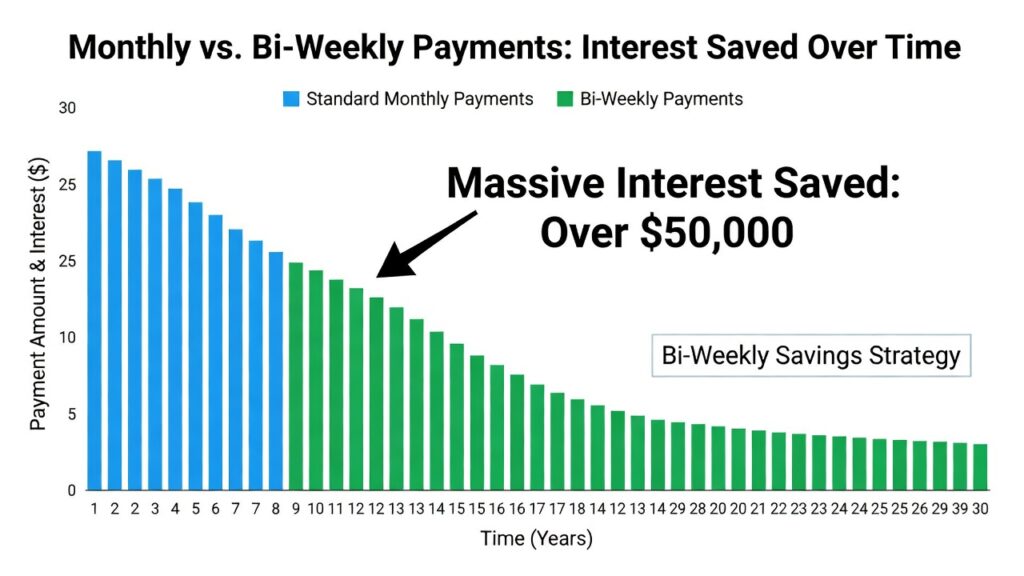
One of the most effective strategies involves changing your payment schedule. Instead of making one full payment every month, consider making half a payment every two weeks. Because there are 52 weeks in a year, a bi-weekly schedule results in 26 half-payments. This perfectly equals 13 full payments over the course of a year.
This simple math trick forces you to make one entire extra payment annually without feeling a painful pinch in your monthly budget. Over the life of a standard 30-year term, this strategy cuts several years off your payoff date and saves you tens of thousands in interest. However, do not fall for third-party companies that charge you a setup fee to arrange bi-weekly drafts. You can accomplish this entirely on your own for free. Just ensure you communicate clearly with your lender to avoid unnecessary mortgage payment mistakes regarding partial funds.
The Recast vs Refinance Dilemma
At some point, you might receive a large financial windfall. An inheritance, a massive work bonus, or the sale of another asset leaves you with a large pile of cash. You want to dump this money into your house to lower your monthly burden.
Many people immediately assume they must refinance their entire loan to lower their monthly bill. Refinancing replaces your old debt with a brand-new loan, which requires paying thousands of dollars in closing costs. Making a massive principal reduction followed by a costly refinance is one of the most expensive mortgage payment mistakes you can make.
Instead, ask your current lender about a “recast.” A mortgage recast allows you to drop a large lump sum onto the principal balance. The bank then recalculates your future monthly payments based on the new, smaller balance, while keeping your original interest rate and remaining timeline exactly the same.
Recasting usually costs a tiny administrative fee of just a few hundred dollars, saving you massive closing costs. Before making this choice, crunch your numbers using a Mortgage Refinance Calculator to see if a full refinance actually makes mathematical sense compared to a simple, cheap recast.
Behavioral Pitfalls: The Worst Mortgage Payment Mistakes You Can Make
Numbers and charts only tell half the story. The rest of your success relies entirely on human behavior. Financial psychology dictates how you react under pressure. When an emergency strikes, homeowners often make irrational decisions that permanently damage their financial health.
Relying on the Grace Period
Almost all home loans feature a 15-day grace period. If your bill is due on the first of the month, the lender will not charge a late fee as long as the money arrives by the fifteenth.
Treating the fifteenth of the month as your actual due date is a terrible habit. I have seen many people make this mistake. They delay writing the check until the fourteenth, a holiday weekend interrupts the mail, and the bank processes the funds on the seventeenth. The lender instantly slaps a hefty penalty on the account.
Make your payment on the first day of the month, every single month. The grace period exists for genuine emergencies, not for lazy cash flow management. Chronic late payments breed sloppy financial habits that eventually lead to severe mortgage payment mistakes and potential default.
Canceling Required Coverages
When money gets incredibly tight, desperate homeowners look for expenses to cut. Some buyers attempt to call their insurance agent to cancel their homeowner’s policy, hoping to save a few hundred dollars and lower their escrow requirements.
This is an absolute disaster. Your mortgage contract strictly requires you to maintain adequate insurance on the property at all times. If you cancel your policy, the lender will instantly find out. They will then purchase a policy on your behalf, known as “force-placed insurance.”
Force-placed insurance is notoriously expensive. It often costs twice as much as a standard policy, and it only protects the bank’s financial interest in the structure. It offers zero coverage for your personal belongings inside the house. Never attempt to cancel required coverages to save a buck. You will trigger some of the most expensive mortgage payment mistakes possible.
Missing Out on Tax Advantages
Owning a home provides excellent leverage during tax season, but only if you track your payments correctly. The interest you pay on your housing debt, along with your local property taxes, can often be deducted from your federal income.
First-time buyers often misplace their Form 1098, the official document your lender mails you in January detailing exactly how much interest you paid the previous year. Failing to hand this document to your accountant means you leave thousands of dollars in potential tax refunds on the table. You can verify the current rules regarding property tax deductions directly through the IRS.gov official guidelines to ensure you claim every legal advantage available to you.
Case Study: The Danger of Forbearance Misunderstanding
During times of widespread economic hardship, banks sometimes offer a “forbearance” program. This allows you to temporarily pause your monthly payments without facing immediate foreclosure.
Many desperate buyers jump at this offer without reading the fine print. They commit massive mortgage payment mistakes by assuming the paused months are simply tacked onto the end of the 30-year term.
In reality, many forbearance agreements require a “balloon payment.” If you pause your $2,000 monthly bill for six months, the bank might demand a single, immediate payment of $12,000 on the first day the forbearance period ends. If you spent that six months ignoring your budget rather than saving cash, you instantly face foreclosure. Never enter a payment relief program without demanding a clear, written explanation of exactly how you must repay the paused funds.
Your Action Plan for Tomorrow
Avoiding basic errors transforms homeownership from a terrifying financial burden into a joyful, wealth-building journey. You hold the power to dictate your financial future by staying organized, reading your mail, and understanding the math behind your debt.
Take a few specific actions tomorrow morning to lock in your success. First, locate your original closing documents and find your amortization schedule. Highlight the date where your loan balance reaches the 80 percent equity mark so you can aggressively cancel your PMI. Next, log into your online servicing portal and verify that any extra funds you submit are explicitly routed to your principal balance.
Finally, open a dedicated savings account specifically for housing maintenance and unexpected escrow shortages. Shielding yourself from surprise bills prevents panic. By eliminating these common mortgage payment mistakes, you protect your family, safeguard your hard-earned equity, and ensure your dream home remains a permanent blessing.
Frequently Asked Questions (FAQs)
Does paying an extra $100 a month on my mortgage help?
Yes, paying an extra $100 a month helps significantly. By applying this small extra amount directly toward your principal balance, you actively reduce the total interest you owe. Over a standard 30-year term, this consistent habit shaves several years off your repayment schedule. It acts as a powerful strategy to prevent long-term mortgage payment mistakes.
Can mortgage payment mistakes negatively impact my credit score?
Yes, making continuous errors will severely hurt your credit score. If a misapplied payment or a bank transfer error causes your bill to go beyond 30 days late, the lender reports it to the major credit bureaus. This single negative mark instantly drops your score and makes future borrowing incredibly expensive.
Is a grace period the same as a due date extension?
No, a grace period does not legally change your actual due date. Your payment remains legally due on the first of the month, but the lender simply agrees not to charge a penalty fee until the fifteenth. Relying on this window every single month leads to dangerous financial habits and accidental late fees.
Should I always pay off my mortgage early if I have extra cash?
No, you should not always rush to pay off your home if you have high-interest consumer debt. Paying off a housing loan with a low 4 percent interest rate makes no mathematical sense if you currently hold credit card debt charging 22 percent. You must evaluate your entire financial profile before dumping all your liquidity into your house.
Will my monthly mortgage payment stay exactly the same forever?
No, your total monthly bill will likely fluctuate over the years. While your actual principal and interest amounts remain locked on a fixed-rate loan, your property taxes and homeowner’s insurance premiums will rise and fall. These changing escrow requirements guarantee your total out-of-pocket expense changes almost every single year.
Can I remove Private Mortgage Insurance (PMI) myself to lower my bill?
Yes, you can actively request PMI removal to lower your monthly costs. Once your loan balance drops to 80 percent of the home’s original purchase price, you have the legal right to demand the bank cancel this expensive fee. Failing to track this milestone is one of the most frequent mortgage payment mistakes buyers make.
Are escrow accounts mandatory for all first-time homebuyers?
No, escrow accounts are not universally mandatory, though lenders highly prefer them. If you put down a massive down payment of 20 percent or more, some banks allow you to waive the escrow requirement. This forces you to save and pay your own property taxes and insurance bills directly, which requires extreme financial discipline.
The information provided in this article is for educational and informational purposes only. It does not constitute professional financial, investment, tax, or legal advice. The content on Nxfly Finance (nxfly.com) is intended to help you understand general financial concepts and should not be used as a substitute for personalized advice from a qualified financial advisor, CPA, tax professional, or licensed attorney.
Every individual’s financial situation is unique. Results, outcomes, and experiences discussed or implied in this article may vary significantly based on your personal circumstances, income, credit profile, location, and market conditions. No financial outcome, return, or result is guaranteed.
Nxfly Finance does not endorse, promote, or recommend any specific financial product, service, lender, institution, or investment. Any tools, calculators, or estimates provided on this website are for illustrative and planning purposes only and should not be solely relied upon for making financial decisions.
Always conduct your own due diligence and consult with a licensed financial professional before making any financial, investment, or borrowing decisions. By reading and using this content, you acknowledge and agree that Nxfly Finance and its authors are not liable for any financial decisions made based on the information provided here.
For more information on financial regulations and consumer protections in the United States, visit the Consumer Financial Protection Bureau (CFPB) or the U.S. Securities and Exchange Commission (SEC).