

The Silent Stress of Not Knowing Your Real Numbers
I speak with small business owners every single week who feel incredibly overwhelmed. You watch money flow into your bank account from daily sales, yet at the end of the month, your actual cash balance barely moves. You lie awake at night wondering where all that hard-earned money went. This happens because high revenue does not always equal high profitability. If you never take the time to calculate business profit margin, you are essentially flying blind. You might be working 80-hour weeks just to break even without realizing it.
When you operate with bad financial information, you invite a series of stressful struggles into your daily life. Let us look at what happens when you avoid the math:
- You underprice your products and accidentally pay your customers to take your inventory.
- You spend heavy on marketing but generate zero actual returns for your bank account.
- You take on debt you cannot comfortably repay because you misjudged your cash flow.
- You face unexpected tax bills that drain your emergency reserves instantly.
Professionally speaking, financial ambiguity destroys your mental peace and business confidence. I have seen many people make this exact mistake, hoping their accountant will just fix everything at tax time. However, waiting months to understand your financial health leaves you vulnerable to sudden economic shifts. When you sit down to calculate business profit margin step by step, you take back control. You stop guessing and start making strategic, data-driven decisions. Understanding these metrics gives you the deep confidence needed to grow, hire new staff, or take a much-needed vacation.
Why Profit Margins Dictate Your Business Survival
Before you learn the math, you must understand exactly what a profit margin represents. A profit margin is simply the percentage of revenue your company keeps after paying different types of expenses. If you want to build a lasting company, you must calculate business profit margin accurately across three specific levels. These levels are gross profit, operating profit, and net profit.
In my experience, many new entrepreneurs mix up markup and margin. Markup is what you add to your cost to get your selling price. Margin is the percentage of the selling price that turns into profit. Confusing the two leads to terrible pricing models. To truly master your finances, you need an organized system. Much like creating a monthly budget that is easy to follow, organizing your business math requires discipline and the right framework.
According to guidelines from the Small Business Administration (SBA), regular financial monitoring prevents cash flow emergencies. By tracking your numbers, you spot small leaks before they sink your ship. Let us break down the first specific metric you need to master.
Understanding Gross Profit Margin
Your gross profit margin shows the financial efficiency of your core production process. This metric only considers the direct costs required to produce your goods or deliver your services. We call these direct expenses the Cost of Goods Sold (COGS). When you calculate business profit margin at the gross level, you ignore rent, marketing, and administrative payroll. You only look at raw materials and direct production labor.
The Gross Profit Margin Formula:
Gross Profit Margin = [(Total Revenue – Cost of Goods Sold) / Total Revenue] x 100
To calculate business profit margin effectively here, you must accurately define your COGS. According to the Internal Revenue Service definition of Gross Receipts and COGS, you include the wholesale cost of items you resell, raw materials, packaging, and direct factory labor. You do not include your personal salary or office supplies.
Case Study: The Local Coffee Shop
Let us look at a practical scenario. Sarah owns a local coffee shop. Last month, her shop generated $20,000 in total revenue. She spent $6,000 on coffee beans, milk, syrups, and disposable cups. These are her direct costs.
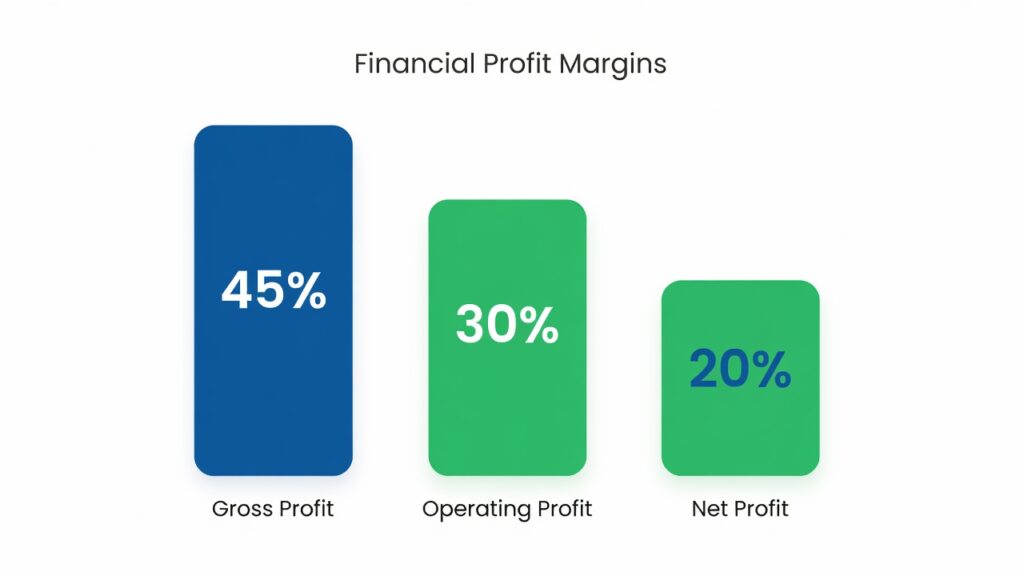
To calculate business profit margin for her gross profit, Sarah subtracts $6,000 from $20,000, leaving a gross profit of $14,000. Next, she divides that $14,000 by her $20,000 revenue. The result is 0.70. She multiplies this by 100 to get a 70% Gross Profit Margin.
This means for every dollar Sarah makes, she retains 70 cents to cover her remaining overhead expenses. If this number drops to 40%, Sarah knows her supplier prices went up or her baristas are wasting too much milk. You should calculate business profit margin at the gross level monthly to catch pricing issues immediately.

Digging Deeper with Operating Profit Margin
Once you understand your gross profit, you must look at your everyday operating costs. Your operating profit margin reveals how well you manage your entire overhead structure. This step includes rent, utilities, marketing, software subscriptions, and administrative payroll. When you calculate business profit margin at this stage, you get a clear picture of your actual business model’s viability.
The Operating Profit Margin Formula:
Operating Profit Margin = (Operating Income / Total Revenue) x 100
Operating income is your gross profit minus all operating expenses. Do not include taxes or interest payments on debt yet. This metric purely judges the operational efficiency of your management team. If you have a high gross margin but a terrible operating margin, your overhead is eating you alive.
Managing High Overhead Scenarios
Let us return to Sarah’s coffee shop. We know she has a gross profit of $14,000. Now, we factor in her overhead. She pays $4,000 in rent, $3,000 in administrative and manager salaries, and $1,000 for marketing and utilities. Her total operating expenses equal $8,000.
Sarah subtracts $8,000 from her $14,000 gross profit. Her operating income is now $6,000. To calculate business profit margin for her operations, she divides $6,000 by her original $20,000 revenue. This equals 0.30. Multiplied by 100, Sarah has a 30% Operating Profit Margin.
If Sarah ever decides to calculate business profit margin and sees her operating margin shrinking, she needs to negotiate lower rent, cut software costs, or reduce marketing spend. A healthy operating margin proves your underlying business model works before government taxes and bankers take their cut.
Mastering the Net Profit Margin
The net profit margin is the ultimate bottom line. This is the exact percentage of revenue you actually get to keep or reinvest into your business. When investors or lenders evaluate your company, they calculate business profit margin at the net level to see your true profitability. This calculation includes absolutely everything – COGS, operating expenses, taxes, interest payments, and any one-time unexpected costs.
The Net Profit Margin Formula:
Net Profit Margin = (Net Income / Total Revenue) x 100
Your net income is your total revenue minus every single expense your business incurred during that period. If you carry business debt, those interest payments hit your net margin hard. This is why calculating your monthly loan payments accurately is a major part of forecasting your net profit. If your loan payments are too high, your net margin turns negative very fast.
The Ultimate Bottom Line Reality
Let us finish Sarah’s coffee shop example. She has an operating income of $6,000. Now, she must pay $1,000 in taxes and $1,000 in interest on her small business loan.
She subtracts $2,000 from her $6,000 operating income. Her final net income is $4,000. To calculate business profit margin at the net level, she divides her $4,000 net income by her $20,000 total revenue. This equals 0.20. Multiplied by 100, Sarah has a 20% Net Profit Margin.
This means for every dollar a customer hands Sarah, exactly 20 cents ends up as pure profit. The remaining 80 cents pays for coffee beans, rent, marketing, taxes, and bank interest. By learning how to calculate business profit margin step by step, Sarah knows exactly how much cash she can safely withdraw or use for expansion.
Comparing Your Metrics Side-by-Side
To truly grasp your financial health, you should compare all three margins simultaneously. Do not calculate business profit margin in isolation. Use this simple overview to keep your definitions straight:
- Gross Margin: Measures direct production efficiency (Revenue – COGS).
- Operating Margin: Measures everyday overhead management (Gross Profit – Overhead).
- Net Margin: Measures total overall profitability (Operating Profit – Taxes & Interest).
When you calculate business profit margin across these three tiers, you create a diagnostic tool. If gross margin drops, fix your supplier costs. If operating margin drops, cut your office expenses. If net margin drops, restructure your debt or tax strategies. You hold the power to fix issues fast because you know exactly where the leak is located.
Hidden Strategies to Improve Your Bottom Line
Once you know how to calculate business profit margin step by step, your next goal is pushing those numbers higher. You cannot just cut costs forever; eventually, you must increase perceived value. As an industry expert, I want to share several advanced methods to widen your margins naturally and sustainably.
Implement Strategic Value-Based Pricing
Most business owners use a simple cost-plus pricing model. They calculate business profit margin, look at their costs, and slap a 20% markup on top. This leaves money on the table. Instead, you should price your products based on the value they provide to the consumer. If your software saves a client 10 hours a week, charge them based on the value of those 10 hours, not the cost of your server space. When you switch to value-based pricing, your gross margins expand dramatically without increasing your production costs.
Negotiate Aggressively with Suppliers
Do not accept your supplier’s first price. As your order volume grows, your per-unit cost should decrease. Schedule quarterly reviews with your vendors. If you calculate business profit margin and notice your COGS creeping up, politely ask your suppliers for bulk discounts or better shipping terms. Even a small 3% reduction in raw material costs flows directly down to your net profit line.
Harness the Power of Upselling and Cross-Selling
Acquiring a new customer is expensive. Marketing costs heavily impact your operating margins. To fix this, sell more to the customers you already have. Introduce complementary products at checkout. If you run a landscaping service, offer a discounted gutter-cleaning add-on. Because you already paid the marketing cost to acquire that customer, the revenue from the upsell carries a much higher profit margin.
Optimize Your Debt Structure
High-interest debt destroys net margins. If you have multiple business loans or high-interest credit cards, your net income will suffer significantly. Consider refinancing your debt to secure a lower interest rate. You can use tools like a mortgage loan calculator if your business debt is tied to commercial real estate. Lowering your monthly interest payments provides an immediate, guaranteed boost to your net profit margin. Much like understanding how compound interest helps savings grow, managing debt interest works the same way in reverse.
Destructive Pricing Mistakes That Drain Your Bank Account
Even smart entrepreneurs fall into common financial traps. When you calculate business profit margin regularly, you can avoid these severe pitfalls. I see business owners destroy their cash flow by making these exact mistakes.
Mistake 1: Forgetting Hidden Variable Costs
Many people calculate business profit margin using only obvious costs like raw materials. They completely forget variable costs like credit card processing fees, packaging tape, and shipping materials. If you pay a 3% merchant fee on every transaction and fail to factor that into your pricing, your true net margin will be significantly lower than your spreadsheet says. Always account for every penny attached to a sale.
Mistake 2: Discounting Without Doing the Math
Running a 20% off sale sounds like a great way to boost revenue. However, if your net profit margin is only 15%, a 20% discount means you are losing money on every single sale. You are literally paying people to take your products. Before you launch any promotional campaign, you must calculate business profit margin to determine your break-even point. Never discount past your net margin threshold.
Mistake 3: The Underpricing Contractor Scenario
Consider a local contractor who bids on a bathroom remodel. He adds up the cost of tiles and labor, then adds 15% for profit. He wins the job. Halfway through, his truck breaks down, his insurance premiums go up, and he has to buy extra drill bits. Because he did not calculate business profit margin properly to include overhead and contingency funds, he finishes the month with less money than he started. Do not bid on projects without factoring in comprehensive operating expenses.
Your Next-Day Action Plan for Financial Clarity
You now have the tools and formulas needed to master your business finances. Reading about numbers is helpful, but applying them is what changes your bank account. Tomorrow morning, before you answer emails or check inventory, complete this simple action plan.
First, gather your income statements from the last three months. Second, calculate business profit margin for your gross revenue to see if your suppliers are overcharging you. Third, calculate your operating margin and immediately cancel two software subscriptions you no longer use. Finally, calculate your net margin and compare it to industry averages. If you actively track these three numbers every single month, your business will grow stronger, leaner, and more profitable over time.
Frequently Asked Questions (FAQs)
What is a good profit margin for a small business?
A good net profit margin generally falls between 10% and 20% depending on your specific industry. Restaurants usually operate on very thin margins around 5%, while software companies often see margins exceeding 20%. You should regularly calculate business profit margin and compare your specific numbers against direct competitors in your local market to gauge success.
How do you find net income?
You find net income by subtracting total expenses, including taxes and interest, from your total revenue. This is the final number on your income statement. You must identify this exact figure before you can calculate business profit margin at the net level, as it represents your true bottom-line profitability.
Can you have a negative profit margin?
Yes, a negative profit margin occurs when your total expenses exceed your total revenue. This simply means your business is operating at a loss. If you calculate business profit margin and see a negative percentage, you must immediately cut costs, raise prices, or increase sales volume to prevent bankruptcy.
What is the difference between markup and margin?
Markup is the percentage added to your cost to determine the final selling price, while margin is the percentage of revenue that remains as profit. For example, a 100% markup on a $50 item gives you a $100 selling price, which equals a 50% profit margin. Mixing these two terms up creates severe pricing errors.
Why is operating margin important?
Operating margin shows how well you manage your daily overhead expenses before taxes and debt interest are applied. It proves whether your core business model is actually sustainable. If you calculate business profit margin and your operating margin is low, you need to reduce administrative costs, lower rent, or cut marketing waste.
How often should I calculate business profit margin?
You should calculate business profit margin at least once every single month when you review your financial statements. Waiting until the end of the year is dangerous because it prevents you from making quick adjustments. Monthly reviews help you catch rising costs and correct underperforming product lines immediately.
Do loan payments affect profit margins?
Yes, the interest portion of your loan payments directly reduces your net profit margin. While the principal payment affects cash flow, the interest is recorded as a direct expense. This is why you should always review terms carefully before borrowing, and regularly check your metrics to ensure the debt is not destroying your net profitability.
The information provided in this article is for educational and informational purposes only. It does not constitute professional financial, investment, tax, or legal advice. The content on Nxfly Finance (nxfly.com) is intended to help you understand general financial concepts and should not be used as a substitute for personalized advice from a qualified financial advisor, CPA, tax professional, or licensed attorney.
Every individual’s financial situation is unique. Results, outcomes, and experiences discussed or implied in this article may vary significantly based on your personal circumstances, income, credit profile, location, and market conditions. No financial outcome, return, or result is guaranteed.
Nxfly Finance does not endorse, promote, or recommend any specific financial product, service, lender, institution, or investment. Any tools, calculators, or estimates provided on this website are for illustrative and planning purposes only and should not be solely relied upon for making financial decisions.
Always conduct your own due diligence and consult with a licensed financial professional before making any financial, investment, or borrowing decisions. By reading and using this content, you acknowledge and agree that Nxfly Finance and its authors are not liable for any financial decisions made based on the information provided here.
For more information on financial regulations and consumer protections in the United States, visit the Consumer Financial Protection Bureau (CFPB) or the U.S. Securities and Exchange Commission (SEC).