
Why Knowing Where You Put Your Money Matters Most
Have you ever looked at your savings account and wondered if your money is actually working for you? The thought of putting your hard-earned cash into the stock market can feel terrifying to many beginners. This fear usually comes from one main source: a basic misunderstanding of investment risk. When you do not fully grasp how investment risk functions, you end up making choices driven by panic rather than logic.
Bad information causes people to struggle financially in several predictable ways:
- You keep all your money hidden in cash, quietly losing purchasing power to inflation.
- You panic sell during normal market drops, permanently locking in heavy financial losses.
- You trust flashy social media influencers instead of following proven mathematical principles.
- You avoid growth opportunities because you assume all investment risk leads to disaster.
In my experience, carrying this constant financial anxiety drains your daily energy. When you lack a clear plan for managing investment risk, every negative news headline about the economy feels like a direct, personal threat. Understanding exactly how investment risk works changes everything. You transition from hoping for the best to designing a highly effective, math-backed plan. The moment you define your strategy, you replace financial stress with lasting confidence.
The Core Definition of Investment Risk
Let’s break this down into simple terms. At its core, investment risk is the chance that your actual financial return will differ from your expected return. This includes the possibility of losing some or all of your original money. Whenever you buy an asset, you take on some level of investment risk. You trade the total safety of holding cash for the potential to earn a higher, wealth-building return.
Beginners often view investment risk as an entirely negative concept. I want to change that perspective today. Taking on calculated investment risk is simply the price of admission for long-term financial growth. Without accepting some investment risk, your money cannot outpace the rising cost of living. People who grow massive wealth do not avoid investment risk; they learn how to manage it intelligently.
By carefully evaluating how much investment risk you can handle, you set realistic expectations for your portfolio. The stock market will go up, and the stock market will go down. If you understand the baseline investment risk attached to your specific assets, these normal market swings will not catch you off guard.
The Hidden Danger of Doing Nothing
Many people believe that keeping money locked in a basic checking account completely eliminates investment risk. They feel incredibly safe seeing the exact same dollar balance every single day. However, this overly cautious strategy introduces a massive hidden danger known as inflation risk. Inflation slowly, consistently erodes the buying power of your dollars over the decades.
If your money earns zero interest, you are mathematically guaranteed to lose value as everyday items become more expensive. To combat this silent wealth killer, you need tools to project your potential growth. For example, using our compound interest calculator shows exactly how your money can multiply over time when invested wisely. It helps you visualize why accepting a moderate amount of investment risk is necessary to reach true financial independence.
Different Flavors of Investment Risk You Must Know
To master investment risk, you need to understand the different forms it takes. Not all investment risk behaves the same way in your portfolio. Breaking these categories down helps you protect your assets systematically.
Market Risk: This is the chance that the entire financial market will decline at the same time. Events like economic recessions, sudden political instability, or global health crises trigger massive market risk. You cannot completely dodge this type of investment risk. According to the Securities and Exchange Commission, all investments carry some degree of market risk, and recognizing this reality helps you build a highly resilient financial strategy.
Interest Rate Risk: When national interest rates go up, the market value of existing bonds usually goes down. If you hold a large number of fixed-income assets, interest rate changes directly impact your account balance. This specific investment risk heavily affects conservative investors who rely on bonds for steady income.
Business Risk: This happens when you buy stock in one specific, isolated company. If that individual company suffers from terrible management, intense competition, or a flawed product, its stock price will drop sharply. You face incredibly high business-related investment risk if you fail to spread your money across different companies.

How to Measure Your Personal Comfort Zone
Risk tolerance is your emotional and financial ability to handle drops in your portfolio value. Understanding your personal tolerance for investment risk is essential before you buy any asset. In my experience, many people wildly overestimate their tolerance when the stock market is going straight up. They happily accept high investment risk until a sudden market crash happens. Then, raw panic sets in.
The Time Horizon Factor
Your time horizon is the exact number of months or years until you need to spend your invested money. This single metric is the biggest factor in determining your capacity for investment risk. If you are saving for a down payment on a house that you plan to buy next year, your capacity for investment risk is extremely low. You need that cash to be safe, secure, and instantly available.
In this specific scenario, checking a high-yield savings calculator makes perfect sense to find a low-risk, predictable return. However, if you are saving for a retirement that is thirty full years away, your capacity for investment risk is very high. You have three long decades to recover from any temporary market dips, allowing you to chase much higher returns.
Emotional Capacity for Market Volatility
Financial math tells you one logical thing, but your human emotions tell you another. Can you sleep soundly at night if your portfolio drops 20% in a single week? If checking your retirement account balance causes actual physical anxiety, you are taking on way too much investment investment risk. A truly solid strategy perfectly balances your mathematical need for financial growth with your emotional need for daily stability.
Building Your Defensive Emergency Buffer
Before you take on any aggressive market-related investment risk, you need a strong, unshakeable cash foundation. An emergency fund protects you from being forced to sell your stocks at a massive loss when life happens. I strongly recommend keeping three to six months of basic living expenses in a completely secure, easily accessible bank account.
You can easily map out this exact savings goal using an emergency fund calculator. Having this dedicated cash buffer acts as a psychological shield. It allows you to handle long-term investment risk with total confidence because you know your immediate needs are fully covered.
Decoding the Risk-Return Tradeoff
You cannot separate investment risk from potential financial returns. They function as two inseparable sides of the exact same coin. The risk-return tradeoff is a fundamental, unbreakable principle in personal finance. It states that the potential return rises directly with an increase in investment risk. If you want higher financial gains, you must willingly accept a higher possibility of temporarily losing your money.
Low investment risk assets include government treasury bills, bank certificates of deposit, and standard savings accounts. These provide incredibly steady, highly predictable income. The downside? The overall returns are usually quite low.
Moderate investment risk assets include large-cap dividend stocks and stable corporate bonds. These offer a much better chance at outperforming inflation while still providing some downside stability. High investment risk assets include small-cap stocks, emerging market funds, and alternative digital assets. These aggressive assets can double your money quickly, but they carry enough investment risk to wipe you out entirely if you are not careful.
The Myth of the “Safe and High-Yield” Asset
I’ve seen many people make this terrible mistake: chasing shady investments that promise exceptionally high returns with zero investment risk. Let me be incredibly direct with you. If someone pitches you an opportunity with massive financial guarantees and absolutely no investment risk, run the other way immediately. It is almost certainly a predatory scam.
Financial markets operate with incredible efficiency. Any asset offering a return noticeably above the standard market rate carries hidden additional investment risk. Understanding this basic, undeniable truth protects your hard-earned wealth from deceptive financial schemes.
Why Beginners Frequently Misjudge Investment Risk
Most beginners view investment risk purely as the immediate chance of losing a dollar today. They fail to look at the massive, long-term big picture. Let’s say you invest $10,000 into a broad stock market fund. A month later, the account shows a balance of $9,000. It feels exactly like you lost $1,000. But unless you actively sell those shares, you have not realized any actual loss.
You still own the exact same number of mutual fund shares. Their current market price just dropped temporarily due to normal market fluctuations. This specific shift in mindset is incredibly powerful. Long-term wealth building heavily requires you to tolerate these temporary declines. When you stop viewing every single dip as a permanent failure, you finally start mastering investment risk.
Capacity vs. Tolerance: Knowing the Difference
There is a highly distinct difference between risk capacity and risk tolerance. Risk capacity is the cold, mathematical amount of investment risk you can literally afford to take. It depends entirely on your steady income, your monthly expenses, and your investing timeline. Risk tolerance, on the other hand, is your deep psychological ability to endure investment risk without panicking.
You might have a massive capacity for investment risk because you have a highly stable job and zero consumer debt. However, you might have a very low tolerance because you grew up in a household that constantly struggled with money, making you naturally cautious. A brilliant financial plan respects both of these elements equally. You never want to force yourself into a high investment risk portfolio if it ruins your mental health, even if the math says you can afford it.
Advanced Tactics to Balance Investment Risk
Once you understand the basic mechanics of investment risk, you can apply professional-level strategies to actively manage it. You do not need to be a Wall Street insider to protect your money. You just need to follow a few tested, highly disciplined frameworks that automatically keep your investment risk in check.
The True Magic of Asset Allocation
Asset allocation is your absolute first line of defense against excessive investment risk. This term simply means dividing your money among different major asset categories, such as domestic stocks, international stocks, bonds, and cash. How you allocate your assets depends entirely on your specific timeline and goals.
If your retirement portfolio holds 90% aggressive stocks and 10% stable bonds, you have a very high level of overall investment risk. If you hold 50% stocks and 50% bonds, you significantly lower your total investment risk. Your asset allocation drives the vast majority of your overall portfolio returns. Picking individual winning stocks matters far less than choosing the right overall mix.
To figure out the perfect mix for your future, you might use a savings calculator to project exactly how different return rates impact your long-term wealth goals. This helps you visually understand why asset allocation heavily dictates your final net worth.
Diversification: Your Financial Seatbelt
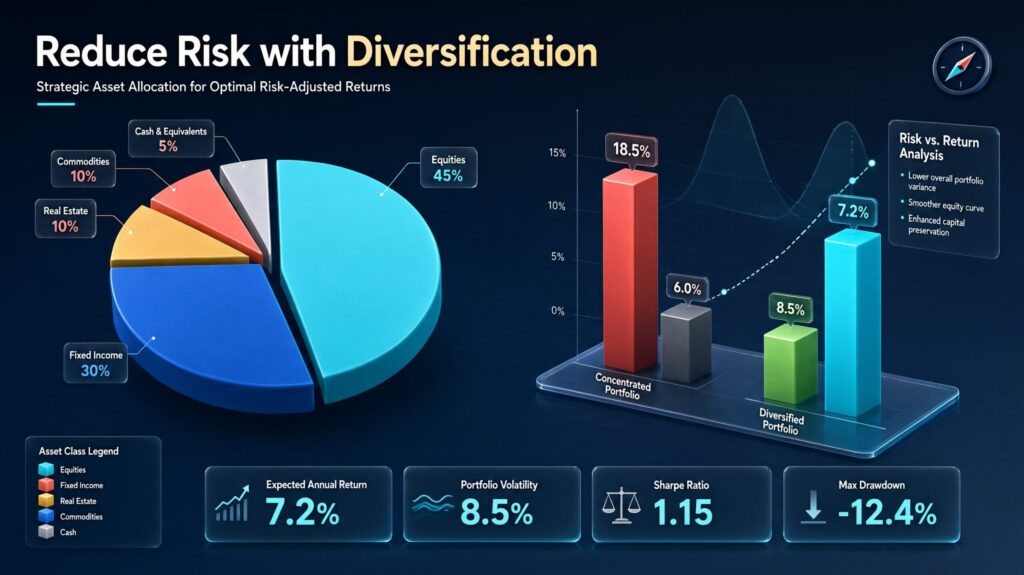
Diversification goes hand-in-hand with smart asset allocation. Once you decide exactly what percentage of your money goes into stocks, you must spread that money across many different individual companies. If you put all your stock money into one single technology company, your investment risk skyrockets instantly. If that one company fails, your entire retirement disappears.
By buying a broad index fund, you instantly own a tiny piece of hundreds of different successful companies. This strategy completely neutralizes business-specific investment risk. According to the financial experts at Investopedia, spreading your investments across various economic sectors ensures that a sharp loss in one area can easily be offset by a strong gain in another.
Diversification does not provide a magical guarantee against all losses, but it is the single most effective way to actively manage investment risk in any economic climate.
Dollar-Cost Averaging to Reduce Timing Risk
Timing the stock market is mathematically impossible over the long run. You will never consistently buy at the absolute bottom or sell at the absolute top peak. Attempting to guess these market movements drastically increases your daily investment risk. Instead, you should use a highly proven strategy called dollar-cost averaging.
This simple method means investing a fixed, specific amount of money at regular intervals, regardless of what the broader market is doing. If you automatically invest $500 every single month, you naturally buy more total shares when prices are low and fewer total shares when prices are high.
This completely removes human emotion from the equation and significantly smooths out your overall investment risk. Over time, dollar-cost averaging results in a highly favorable average purchase price for all your assets, heavily protecting you from buying at the absolute worst times.
Costly Mistakes That Increase Investment Risk
Let’s talk about the specific financial traps that frequently trip up eager beginners. Avoiding these common errors will save you thousands of dollars and endless emotional frustration. Unmanaged investment risk destroys wealth quietly.
Reacting Emotionally to Financial News
Financial media thrives on creating massive panic. They write terrifying headlines solely to get your clicks. If you drastically change your portfolio every single time you read a scary news article, you maximize your investment risk immediately. You will end up constantly buying high out of pure greed and selling low out of raw fear. A highly disciplined investor completely ignores the daily noise and sticks strictly to their long-term mathematical plan.
Chasing Past Market Performance
Just because a specific asset went up 50% last year does not mean it will do the same exact thing this year. In fact, yesterday’s massive market winners frequently become tomorrow’s biggest losers. Pouring your hard-earned money into a trendy, hyped-up stock after it has already skyrocketed is a terrible, highly dangerous way to handle investment risk.
Overlooking Regular Portfolio Rebalancing
Over time, your carefully planned asset allocation will naturally drift. If your stock funds have an amazing year, they will suddenly make up a much larger percentage of your total portfolio than you originally planned. This quietly and dangerously increases your investment risk. You must periodically review your portfolio and rebalance it. This means systematically selling off a small portion of your winners and buying more of your underperforming assets to return exactly to your original target.
Taking Advice from Unqualified Sources
Your neighbor’s hot stock tip is not a valid, reliable financial strategy. Listening to random online video influencers massively inflates your exposure to terrible investment risk. Always base your major financial decisions on proven academic research and your personal financial numbers. If you need highly secure, predictable growth with virtually zero downside, you should look into fixed-rate options and verify the exact math using our CD calculator.
Your Action Plan for Tomorrow
You now possess a deeply solid understanding of exactly how investment risk works in the real world. The most important next step is putting this powerful knowledge into forward motion. Start by completing these simple, highly effective tasks over the next few days to secure your money.
- Write Down Your Deadlines: Clearly define exactly what you are investing for and the exact month you need the money. This directly dictates your maximum acceptable level of investment risk.
- Determine Your Core Mix: Decide on a basic percentage split between growth stocks and stable bonds that lets you sleep peacefully at night without checking your phone constantly.
- Automate Your Monthly Contributions: Set up automatic bank transfers into your main investment accounts to practice dollar-cost averaging. This eliminates emotional decision-making and controls investment risk beautifully.
- Establish the Cash Shield: Verify your emergency savings is fully funded so you never have to interrupt your compounding growth during a temporary market panic.
Frequently Asked Questions (FAQs)
What is the best way for a beginner to handle investment risk?
Yes, beginners can easily handle investment risk by starting small and using highly diversified index funds. The best approach involves combining broad market funds with a consistent, automated monthly contribution strategy. Over time, spreading your money across many different economic sectors greatly lowers your individual business risk. This proven method keeps your money positioned for aggressive long-term compounding growth without requiring daily monitoring.
Does high investment risk always equal high return?
No, taking on high investment risk does not mathematically guarantee a high financial return. It simply means there is a much wider range of possible outcomes, including the total, devastating loss of your money. You are rewarded for taking smart, calculated risks in broad markets, but taking foolish, concentrated risks usually results in massive permanent losses rather than massive wealth.
Can you completely avoid investment risk?
No, completely avoiding all forms of investment risk is literally impossible in our modern economy. Even if you securely keep your money hidden in the backyard or sitting lazily in a checking account, you face severe, ongoing inflation risk. Because the basic cost of living constantly goes up, money that earns zero interest quickly loses its real-world purchasing power every single year.
How does inflation affect my investment risk?
Yes, high inflation directly increases the hidden investment risk of holding raw cash. When national inflation rates rise, the actual buying power of your bank savings drops dramatically and permanently. You must purposefully invest your money in aggressive assets that historically outpace inflation, like broad stocks or real estate, to protect your wealth and maintain your current standard of living over the coming decades.
Should I sell my investments when the market drops to lower investment risk?
No, selling out during a temporary market decline is usually the absolute worst way to manage investment risk. When you hastily sell out of sheer fear, you instantly turn temporary paper losses into permanent, locked-in financial damage. The smartest, most profitable strategy is to hold your well-diversified investments through the turbulence, as historical data clearly shows that broad markets eventually recover.
How often should I reassess my tolerance for investment risk?
Yes, you should actively review your personal investment risk tolerance at least once a single year. Major, life-altering events like getting married, buying a large home, having a child, or nearing retirement age change your financial timeline drastically. Adjusting your core asset allocation during these major transitions ensures that your portfolio always aligns perfectly with your current real-life situation.
What is the safest investment for beginners worried about investment risk?
Yes, nervous beginners can find high financial safety in government-backed assets. The safest possible options with the absolute lowest investment risk include high-yield savings accounts, traditional Certificates of Deposit (CDs), and standard U.S. Treasury bonds. While these highly conservative options offer profound stability and perfectly protect your principal balance, they yield much lower long-term returns compared to the broader stock market.
The information provided in this article is for educational and informational purposes only. It does not constitute professional financial, investment, tax, or legal advice. The content on Nxfly Finance (nxfly.com) is intended to help you understand general financial concepts and should not be used as a substitute for personalized advice from a qualified financial advisor, CPA, tax professional, or licensed attorney.
Every individual’s financial situation is unique. Results, outcomes, and experiences discussed or implied in this article may vary significantly based on your personal circumstances, income, credit profile, location, and market conditions. No financial outcome, return, or result is guaranteed.
Nxfly Finance does not endorse, promote, or recommend any specific financial product, service, lender, institution, or investment. Any tools, calculators, or estimates provided on this website are for illustrative and planning purposes only and should not be solely relied upon for making financial decisions.
Always conduct your own due diligence and consult with a licensed financial professional before making any financial, investment, or borrowing decisions. By reading and using this content, you acknowledge and agree that Nxfly Finance and its authors are not liable for any financial decisions made based on the information provided here.
For more information on financial regulations and consumer protections in the United States, visit the Consumer Financial Protection Bureau (CFPB) or the U.S. Securities and Exchange Commission (SEC).