
By Marcus Thorne, CFP® | Reviewed by the Nxfly Finance Team
Earning 0.01% at a mega-bank is a losing game. You know it. I know it. Every single day your money sits in a traditional checking account earning zero interest, you lose purchasing power.
Inflation eats idle cash. That is a hard financial law.
But a solid cash reserve is non-negotiable for building genuine wealth. You need a safe place to park your emergency fund, store your house down payment, or hold your tax reserves. This is exactly where a high-yield savings account (HYSA) steps in to stop the bleeding. And to see exactly how much you can make, you need a precise mathematical tool.
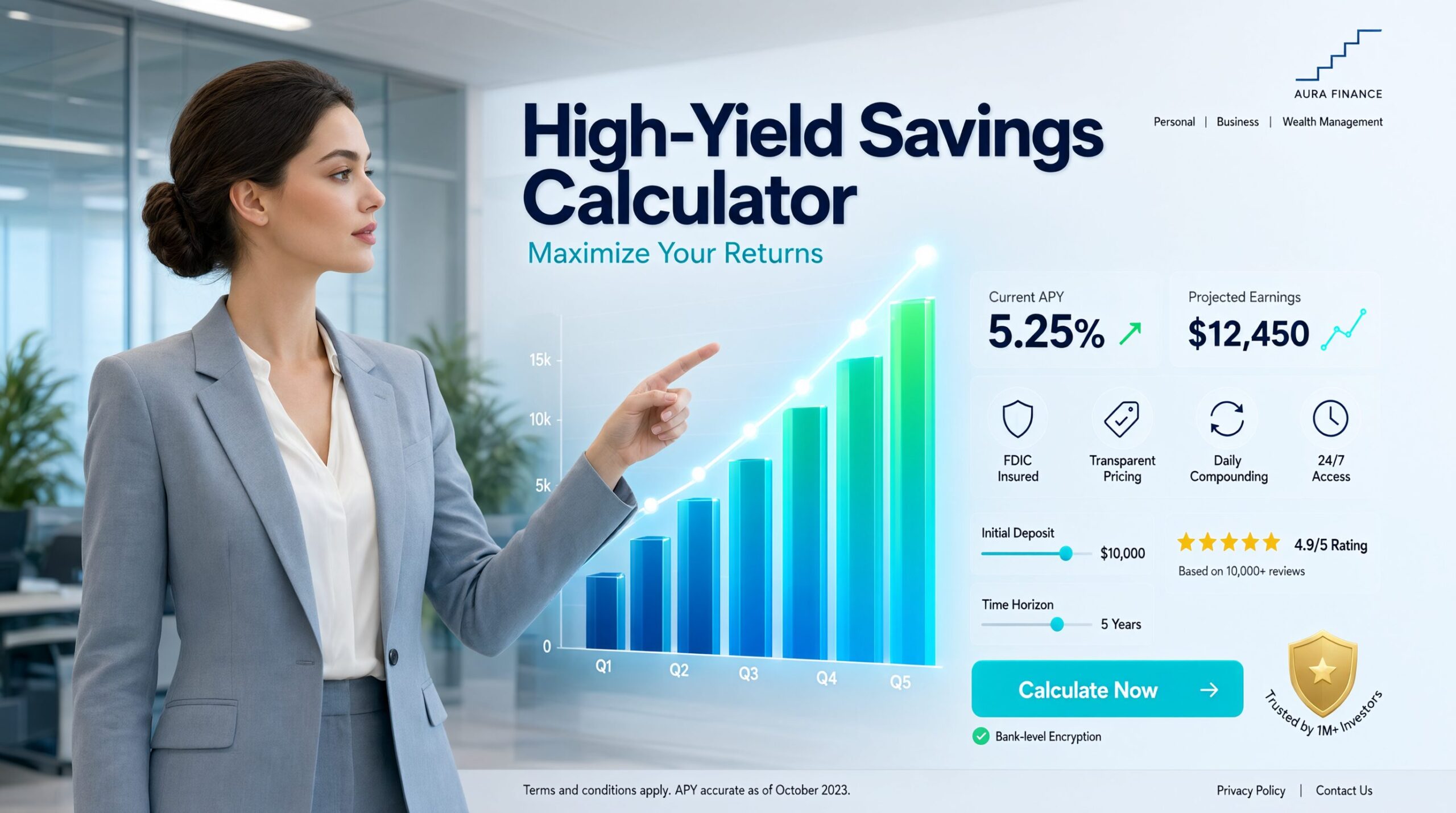
Our High-Yield Savings Calculator shows you the unvarnished math of what happens when you treat your cash properly.
Most people severely underestimate the power of compound interest applied over a short timeframe. They think a few percentage points won’t move the needle. They are wrong. When you plug your exact numbers into our High-Yield Savings Calculator, you instantly see how a 4% or 5% APY transforms a stagnant lump sum into a reliable, passive income stream.
Stop leaving free money on the table. It is literally that simple.
Using a dedicated High-Yield Savings Calculator gives you clarity. You get to test different financial scenarios in real-time. Want to know what happens if you add an extra $500 a month to your emergency fund? Run the numbers. Need to know how long it will take to hit $50,000 for a down payment at a 4.5% interest rate? Let the math tell you.
Many clients ask me if they should aggressively pay down debt or hoard cash in an HYSA. The answer is always found in the math. You can actually run your mortgage numbers through our Extra Mortgage Payment Calculator and compare the exact interest saved against the interest earned right here in our High-Yield Savings Calculator.
Math eliminates emotion. It gives you an actionable baseline. Now, let’s break down exactly how you can project your future wealth step-by-step using this tool.
📈 High-Yield Savings Calculator
See how much your money grows with APY vs traditional savings & fee impact
| Year | Balance | Contributions | Interest | Fees |
|---|
The Mechanics: How to Use the Nxfly High-Yield Savings Calculator
A calculator is only as good as the numbers you feed into it. Garbage in, garbage out. To get the most accurate projection possible, you must understand exactly how the inputs inside this High-Yield Savings Calculator dictate your final results. Let’s walk through the exact mechanics.
Step 1: Your Initial Deposit
This is your starting line. The initial deposit represents the cash you currently have available to immediately fund the account.
If you just sold a vehicle, received a year-end bonus, or finally transferred your $10,000 emergency fund out of a zero-yield brick-and-mortar bank account, enter that total here. Inside the High-Yield Savings Calculator, this initial number acts as the heavy lifter. Because of compound interest, the larger your starting balance, the harder your money works for you from day one.
Step 2: Monthly Contributions
This is the single most powerful lever you control. Earning a high interest rate is great, but consistently adding fresh capital to the account is what actually builds wealth.
Enter the exact dollar amount you plan to automatically transfer into your savings account every single month. Be realistic. If you budget $300 a month for savings, enter $300. Consistency beats intensity. By committing to a monthly contribution, you supercharge the compounding effect. You start earning interest on your old interest, plus interest on your new deposits.
Step 3: APY (Annual Percentage Yield)
Here is where the magic happens. The Annual Percentage Yield (APY) reflects the real rate of return earned on your savings, taking into account the effect of compounding interest.
Check the current rate offered by your target online bank or credit union and plug it directly into the High-Yield Savings Calculator. Online banks typically offer vastly superior APYs compared to traditional banks because they lack the massive overhead costs of physical branches. When you enter a 4.5% or 5.0% APY here, you force the algorithm to compute a highly aggressive growth curve.
Step 4: Time Horizon (Years to Save)
Patience pays literal dividends. The time horizon is simply the number of years you plan to leave the money alone.
Are you saving for a wedding in 2 years? Enter 2. Are you parking a massive emergency fund for the next decade? Enter 10. The High-Yield Savings Calculator requires this timeframe to map out the exact compounding schedule. The longer you stretch this timeline, the more parabolic your total interest earned becomes. Time heavily outweighs the initial deposit if you stretch it far enough.

The Anatomy of the Calculation: Key Terms & Deep Concepts
Running numbers blindly is dangerous. To master your cash strategy, you need to deeply understand the financial concepts powering the High-Yield Savings Calculator. Let’s strip away the complex banking jargon. Here are the core terms and mechanisms working behind the scenes.
1. Compound Interest
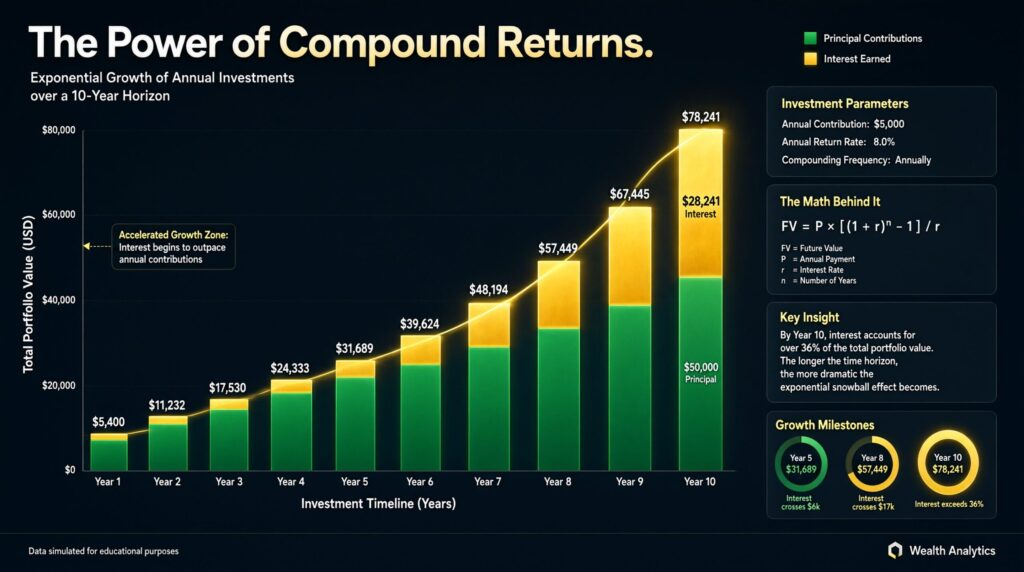
Compound interest is the snowball effect applied to your cash. You earn interest on the money you deposit. Then, you earn interest on the interest you just made.
Unlike simple interest, which only pays out based on the principal amount, compound interest accelerates your timeline. Most high-yield savings accounts compound daily and pay out monthly. The High-Yield Savings Calculator automatically factors in this compounding structure to give you an accurate, real-world estimate of your future balance. For a rigid, legal definition, you can read the Investor.gov definition of Compound Interest straight from the SEC.
2. Annual Percentage Yield (APY) vs. Interest Rate
These terms are often used interchangeably. They shouldn’t be.
The interest rate is the baseline percentage the bank pays you. The APY is the actual amount you earn over a year once the compounding frequency is factored in. APY is always slightly higher than the baseline interest rate because it accounts for your money growing on itself throughout the year. When you look at banking advertisements, they always quote the APY because it is the higher, more attractive number.
3. The Mathematics of Compounding (The Formula)
You do not need to do this by hand. That is exactly why our High-Yield Savings Calculator exists. However, as a CFP, I want you to know the exact formula running in the background:
A = P (1 + r/n)^(nt)
- A = The future value of the investment/loan, including interest.
- P = The principal investment amount (the initial deposit).
- r = The annual interest rate (decimal format).
- n = The number of times that interest is compounded per unit t (usually 365 for daily).
- t = The time the money is invested for in years.
When you add monthly contributions into the mix, the formula becomes significantly more complex, requiring an additional Future Value of a Series formula. We automate all of this for you.
4. The Federal Funds Rate
Why does your APY change? HYSAs have variable rates. They are not locked in like a Certificate of Deposit (CD).
Your APY fluctuates based heavily on the Federal Funds Rate set by the Federal Reserve. When the Fed raises rates to fight inflation, banks raise their APY to attract your deposits. Conversely, when the Fed cuts rates, your HYSA yield drops. Understanding this macro-economic trigger helps you anticipate your savings growth. By the way, when interest rates change, so do borrowing costs. You can read exactly how US mortgage payments are calculated to see how Fed policy dictates the flip side of the interest rate coin.
5. Principal Balance
Your principal balance is the raw cash you actually deposited. It includes your starting lump sum plus every single monthly contribution you make.
The principal completely ignores the interest you have earned. Our High-Yield Savings Calculator clearly separates your Total Principal from your Total Interest Earned at the end of your calculation. This stark visual contrast is vital. It shows you exactly how much of your final wealth came from your own sweat, and how much came purely from the math.
6. Dollar-Cost Averaging for Savings
We usually hear about Dollar-Cost Averaging (DCA) in the stock market. But the concept applies perfectly to a high-yield savings account.
By aggressively making automated, recurring monthly transfers into your HYSA, you are practicing DCA for your cash reserves. You are constantly feeding the machine regardless of what the interest rate is doing that month. Using the High-Yield Savings Calculator to track this specific habit proves that consistency easily outperforms waiting on the sidelines to deposit a giant lump sum.
Unveiling the Formula: The Math Behind the Calculator
You do not build real wealth by guessing. You build it by knowing your exact numbers.
The engine powering our High-Yield Savings Calculator relies on a massive mathematical principle: the future value of a compound interest series. Calculating simple interest is easy. You multiply your balance by the rate. But simple interest is for amateurs. High-yield savings accounts pay compound interest, usually compounding every single day. Furthermore, if you are making regular monthly deposits, the math becomes exceptionally heavy.
To prove the total accuracy of our tool, you need to see the exact formula running behind the scenes. This is math. Pure and simple.
Our High-Yield Savings Calculator actually merges two distinct mathematical formulas together. First, it calculates the compound interest on your initial starting deposit. Second, it calculates the future value of your recurring monthly contributions.
Here is the standard WordPress-friendly mathematical breakdown:
Total Future Value = [ P * (1 + r/n)^(nt) ] + [ PMT * ( ((1 + r/n)^(nt) – 1) / (r/n) ) ]
Do not let the alphabet soup intimidate you. Let us break down exactly what each variable represents inside the High-Yield Savings Calculator:
- P (Principal): This is your initial lump-sum deposit. The money you start with on day one.
- PMT (Payment): This is your recurring monthly contribution. Every time you transfer a portion of your paycheck, this variable increases your baseline.
- r (Annual Interest Rate): The APY offered by your bank, expressed as a decimal. For example, a 5% yield is written as 0.05.
- n (Compounding Frequency): The number of times interest is calculated per year. Most high-yield accounts compound daily, meaning this number is 365. The interest is then credited to your account once a month.
- t (Time): The total number of years you allow the money to sit and grow.
Doing this calculation by hand is a massive waste of your time. If you misplace a single parenthesis or use the wrong decimal, your entire projection fails. You will end up planning your financial future on broken math. Trusting an automated High-Yield Savings Calculator removes human error from the equation entirely.
When you hit calculate, our algorithm instantly executes this dual-formula. It projects the exact trajectory of your starting cash. It maps out your ongoing deposits. Then, it aggressively calculates the daily compounding interest applied to both pots of money over your entire timeframe.
You instantly get a crystal-clear look at your financial future.
5 Critical Factors That Influence Your Numbers
A calculator operates in a perfect vacuum. Reality does not.
While the mathematical output of a High-Yield Savings Calculator is 100% precise, your real-world results will fluctuate. External economic forces and your personal financial habits constantly push and pull at your cash flow. If you want to accurately map your future wealth, you must understand the five external factors directly impacting your final balance.
1. Federal Reserve Rate Fluctuation
Your high-yield savings APY is completely variable. You are not buying a fixed-rate bond. You are holding liquid cash.
The APY you enter into your High-Yield Savings Calculator today will likely change in six months. Why? Because banks base their savings rates closely on the Federal Funds Rate. When the Federal Reserve hikes rates to cool the economy, your savings account yield skyrockets. Banks suddenly want your deposits, so they pay a premium. When the Fed cuts rates to stimulate borrowing, your APY drops fast. You must adjust your projections periodically to account for these massive macroeconomic shifts.
2. The Invisible Tax of Inflation
Earning 5% in your savings account feels amazing. It feels less amazing when inflation is running at 4%.
Inflation aggressively erodes your actual purchasing power over time. If a carton of eggs or a gallon of gas costs 4% more this year than last year, your “real” return on a 5% yield is technically only 1%. You can track the exact inflation numbers through the Consumer Price Index via the Bureau of Labor Statistics (BLS.gov). It is vital to compare current CPI data against the output of your High-Yield Savings Calculator to see if your cash is genuinely growing, or merely treading water. If inflation outpaces your yield, your money is dying a slow death.
3. Taxes on Your Interest Income
The IRS always wants its cut. The interest you earn in a standard high-yield savings account is taxed as ordinary income.
At the end of the year, your bank will send you a 1099-INT tax form. You must report this passive income on your federal tax return. Our High-Yield Savings Calculator displays gross interest earned before taxes. Depending on your tax bracket, you might owe a significant chunk of that interest back to the government. If you are a high-income earner holding a massive emergency fund, plan for this tax liability. High returns create high taxes.
4. Compounding Frequency Variations
How often does your bank calculate your interest? This matters.
The vast majority of top-tier online banks compound your interest daily. Every single night, they calculate your new balance, add a micro-fraction of interest, and start the next day with a slightly larger principal. However, some traditional banks compound monthly or even annually. Daily compounding mathematically generates more money over the long term. Running your numbers through a High-Yield Savings Calculator that properly assumes optimal compounding frequencies highlights why switching to a modern online bank is highly lucrative.
5. Competing Debt Priorities
Should you save your money, or aggressively pay down debt? This is the most common question I get as a financial planner.
If you hold credit card debt at a 24% interest rate, parking your cash in a 5% savings account is financial suicide. You are mathematically losing money every month. You must compare your savings yield against your borrowing costs. For example, if you have a massive mortgage, you might wonder if extra cash should go to the principal or the bank. You can test this directly by running your mortgage numbers through our Mortgage Payoff Calculator, comparing the interest saved against the exact interest earned shown here. Follow the math, not your emotions.
Real-World Scenarios: The Calculator in Action
Theory is useless without execution. Using a High-Yield Savings Calculator makes sense on paper, but you need to see how it dictates real-life financial strategy. Let’s look at three completely different financial profiles.
I will show you exactly how these individuals plug their specific numbers into the High-Yield Savings Calculator to solve their core financial problems. Pay close attention to the input tables.
Scenario 1: The Emergency Fund Builder (Sarah, The Conservative Saver)
Sarah is 28. She just experienced a massive layoff scare at her tech job. She realized she literally has zero cash reserves. She currently has $1,500 sitting in a dead checking account earning nothing. Her goal is to build a rock-solid $20,000 emergency fund. She commits to aggressively saving $400 a month and finds an online bank offering a 4.25% APY.
She opened our High-Yield Savings Calculator to see exactly how long this financial safety net will take to build.
| Input Variable | Sarah’s Exact Data |
|---|---|
| Initial Deposit | $1,500 |
| Monthly Contribution | $400 |
| Annual Percentage Yield (APY) | 4.25% |
| Time Horizon | 4 Years |
| Projected Final Balance | $22,608.13 |
| Total Interest Earned | $1,908.13 |
The Strategic Analysis:
Sarah exceeded her $20,000 goal slightly ahead of schedule. But look closely at the math. Over four years, Sarah contributed $19,200 of her own hard-earned money. The bank paid her nearly $2,000 completely free just for holding her cash. If she had left this money in her zero-yield checking account, inflation would have destroyed her spending power. According to the High-Yield Savings Calculator, that 4.25% APY effectively protected her emergency fund from rotting away.
Scenario 2: The House Down Payment Hustler (Mark, The Aggressive Investor)
Mark is 33. He wants to buy his first home in exactly three years. He already has $15,000 saved from a recent inheritance. He needs a massive down payment to avoid high monthly mortgage costs. He plans to funnel a highly aggressive $1,200 a month into his savings account. He locked in an aggressive 5.00% APY at a top-tier digital bank.
Before he started, he plugged his target into the High-Yield Savings Calculator to ensure his timeline was realistic. By the way, to verify if his final savings amount will buy the house he wants, Mark cross-references this exact balance over at our Mortgage Affordability Calculator.
| Input Variable | Mark’s Exact Data |
|---|---|
| Initial Deposit | $15,000 |
| Monthly Contribution | $1,200 |
| Annual Percentage Yield (APY) | 5.00% |
| Time Horizon | 3 Years |
| Projected Final Balance | $65,038.27 |
| Total Interest Earned | $6,838.27 |
The Strategic Analysis:
Mark’s aggressive monthly deposits triggered massive compounding. He built a $65,000 down payment in just 36 months. Running this through the High-Yield Savings Calculator proves the sheer power of a high initial deposit combined with ruthless consistency. By earning almost $7,000 in free interest, Mark effectively secured a much larger down payment than his own salary could provide. This extra cash will dramatically lower his future mortgage rate.
Scenario 3: The Idle Cash Hoarder (David, Holding a Large Lump Sum)
David is 45. He is terrified of the stock market. He sold a small rental property two years ago and parked $100,000 in a traditional brick-and-mortar savings account earning a pathetic 0.05%. He makes zero monthly contributions. He is simply letting the money sit.
After reading about inflation, he finally used a High-Yield Savings Calculator to see what he is missing by not moving his money to a modern 4.5% APY account for the next five years.
| Input Variable | David’s Exact Data |
|---|---|
| Initial Deposit | $100,000 |
| Monthly Contribution | $0 |
| Annual Percentage Yield (APY) | 4.50% |
| Time Horizon | 5 Years |
| Projected Final Balance | $124,618.19 |
| Total Interest Earned | $24,618.19 |
The Strategic Analysis:
This scenario is shocking, yet incredibly common. David does not add a single dime to this account for five years. Yet, because he started with a massive principal of $100,000, compounding interest did all the heavy lifting. The High-Yield Savings Calculator proves he will generate almost $25,000 in pure, passive income just by switching banks. In his old bank earning 0.05%, he would have made a laughable $250. This is exactly why leaving large sums of cash at traditional mega-banks is a severe financial error.
Hidden Pitfalls: 3 Biggest Mistakes People Make
Mathematical models assume perfect behavior. Human beings are rarely perfect.
When you use a High-Yield Savings Calculator, you are looking at an optimized, frictionless projection. The math works perfectly on the screen. However, in the real world, people sabotage their own compounding curves constantly. They make emotional decisions. They misunderstand basic banking mechanics. They ignore external financial friction.
To hit the exact numbers projected on your screen, you must avoid these three massive mistakes.
Mistake 1: Chasing Temporary Teaser Rates Blindly
Banks are aggressive marketers. They want your deposits.
Often, an online bank will advertise a massive 5.50% APY to hook new customers. People immediately move their entire life savings to capture that yield. But they fail to read the fine print. That massive rate is only guaranteed for three to six months. After the promotional period ends, the rate plummets to a dismal 1.00%.
Your High-Yield Savings Calculator assumes the APY you enter remains constant over your entire timeframe. If you enter a teaser rate and project it out over five years, your final number will be totally fake. Stop moving your money every three weeks for an extra fraction of a percent. Find a highly reputable online bank that consistently offers a competitive, sustainable rate. Consistency builds wealth. Rate-chasing wastes time.
Mistake 2: Forgetting the IRS Owns a Cut
Earning $5,000 in passive interest feels fantastic. Keeping all $5,000 is a fantasy.
Interest generated in a savings account is not tax-free. It is taxed as ordinary income at your highest marginal tax bracket. If you are a high-income earner in the 32% tax bracket, you owe a massive chunk of that yield straight back to the federal government. Furthermore, your state might tax it too.
When you look at the “Total Interest Earned” output on our High-Yield Savings Calculator, remember that this is a gross figure. It is pre-tax money. Failing to account for this tax liability can leave you severely short if you are relying on that exact dollar amount to fund a specific purchase, like a massive real estate down payment.
Mistake 3: Hoarding Too Much Cash (Opportunity Cost)
Saving money is smart. Over-saving is mathematical negligence.
A high-yield account is designed for capital preservation and short-term liquidity. It is the perfect place for your six-month emergency fund. It is a terrible place for your retirement money. Once you hit your specific cash target, stop funneling money into the account.
Inflation is relentless. Even at a 5% yield, after taxes and a 3% inflation rate, your real return is barely above zero. You are just treading water. If you leave $150,000 sitting in cash for a decade, you suffer a catastrophic opportunity cost. That money should be in index funds, real estate, or other appreciating assets. Use the High-Yield Savings Calculator to build your safety net. Once the net is built, start investing aggressively elsewhere.
Expert Strategies: How to Optimize Your Results
Knowing the math is step one. Manipulating the math to your advantage is step two.
As a CFP, I do not just hand my clients a calculator and walk away. I give them the exact tactical plays required to beat the system. You have run your numbers. You see your baseline. Now, it is time to force those numbers higher.
Implement these five strategic moves immediately.
Strategy 1: Automate on Payday, Not “Someday”
Willpower is a terrible financial strategy. You will fail.
If you plan to manually transfer $500 to your savings account at the end of the month, you will find an excuse to spend it first. Set up an automated clearing house (ACH) transfer to hit your checking account the exact morning your paycheck clears. Pay yourself first. The High-Yield Savings Calculator assumes you never miss a single monthly deposit. Automation ensures that mathematical assumption becomes your reality.
Strategy 2: Attack High-Cost Debt with Your Yield
Do not let your cash sit idle while your debts drain you.
If you are carrying a massive mortgage, the interest you pay the bank over 30 years is staggering. Take the passive income you generate from your savings and apply it directly to your loan principal. You can see exactly how fast this accelerates your payoff date by running your numbers through our Mortgage Amortization Calculator. A few hundred extra dollars a month in pure interest applied to your house can shave years off your loan.
Strategy 3: Target Pesky Insurance Premiums
Stop paying fees that offer zero financial return.
If you put down less than 20% on your home, you are likely paying Private Mortgage Insurance (PMI). This protects the lender, not you. It is dead money. Funnel the exact interest yield from your savings account directly against your mortgage balance to reach that magical 20% equity mark faster. You can verify exactly when you will cross that threshold using our PMI calculator. Let your bank’s interest pay off your bank’s fees.
Strategy 4: Reassess Your Bank Annually
Loyalty to a bank is a one-way street. They do not care about you.
You must act like a mercenary with your cash reserves. Set a calendar reminder every twelve months to check the national average for high-yield savings accounts. If your bank has quietly dropped your APY while competitors are raising theirs, move your money. It takes exactly fifteen minutes to open a new digital banking account. Do not leave thousands of dollars on the table out of sheer laziness. Recalculate your projections annually.
Strategy 5: Segment Your Cash into “Sinking Funds”
Mental accounting matters. Staring at one giant lump sum of cash can be dangerous. It makes you feel artificially rich.
Instead of dumping everything into one generic bucket, use your bank’s “sub-account” or “vault” features. Create specific buckets for specific goals. Label one “Emergency Fund,” another “Property Taxes,” and a third “New Car.” Run each individual goal through the High-Yield Savings Calculator separately. This gives you exact micro-timelines for every financial objective. It stops you from accidentally spending your roof repair money on a vacation.
Frequently Asked Questions (FAQs)
Q: Is the interest earned in a high-yield savings account taxable?
A: Yes. The IRS classifies any interest generated in a savings account as ordinary taxable income. Your bank will issue a 1099-INT form at the end of the year if you earn more than $10. You must claim this amount on your federal tax return, which effectively lowers your real-world yield.
Q: Will my high-yield savings account ever lose money?
A: No, your principal balance will never decrease due to market volatility. High-yield savings accounts are FDIC-insured up to $250,000 per depositor, per institution. The only way you “lose” money is silently through inflation, if the inflation rate is higher than your current APY.
Q: How often do APY rates change on savings accounts?
A: APY rates are entirely variable and can change at any time without prior notice. Banks typically adjust their rates in direct response to the Federal Reserve raising or lowering the federal funds rate. Some banks may change their rates multiple times a year based on economic conditions.
Q: Why is my APY different from my interest rate?
A: Your interest rate is the base percentage the bank pays, while the APY (Annual Percentage Yield) includes the mathematical effect of compounding over a full year. Because you earn interest on your interest daily, your APY will always be slightly higher than your flat interest rate.
Q: Can compounding interest in a savings account make me rich?
A: No. A savings account is built for wealth preservation, not massive wealth creation. While our High-Yield Savings Calculator shows excellent growth, these accounts are meant to securely hold emergency funds and short-term cash. To build generation-shifting wealth, you must invest in the stock market or real estate.
Q: Should I pay off debt or put money in a high-yield savings account?
A: You must always compare the two interest rates mathematically. If your debt costs you 22% in credit card interest, but your savings only pays 5%, you are losing money. Always aggressively clear high-interest consumer debt before hoarding large amounts of cash.
Q: How much money should I keep in my high-yield savings account?
A: A standard baseline is holding three to six months’ worth of essential living expenses. If your monthly bare-bones budget is $4,000, aim for $12,000 to $24,000. Freelancers, self-employed individuals, or single-income households should push for a fully funded nine to twelve-month cash reserve.
Stop letting inflation slowly eat your hard-earned cash reserves. Scroll back up and plug your exact monthly deposits into the High-Yield Savings Calculator right now to build a bulletproof financial safety net. If you are currently juggling real estate debt, take a moment to also review your true borrowing costs with our Mortgage Interest Calculator to see where your money is really going.
Disclaimer: The High-Yield Savings Calculator provided by Nxfly Finance is for educational and informational purposes only. It does not constitute specific financial, investment, or tax advice. Please consult with a licensed financial advisor, fiduciary, or CPA before making any major financial decisions.