

By Michael Trenton, CFP® | Reviewed by the Nxfly Finance Team
Cash sitting in a standard checking account is losing money. Inflation silently eats your purchasing power. You already know this.
You need a safe harbor. Certificates of Deposit (CDs) offer that exact safety. They provide a guaranteed rate of return over a fixed timeline. But knowing that a rate is “guaranteed” is only half the battle. You need to know the exact dollar amount that will hit your bank account when that term ends.
Guessing your returns is for amateurs. Math matters.
That is exactly why you need a reliable CD Calculator. Bank marketing materials love to throw around percentages. They flash high APY numbers in bold fonts to get your attention. Yet, they rarely show you the raw dollar amounts applied to your specific deposit. We built this CD Calculator to cut through the bank marketing noise. You get complete transparency.
Compound interest is an incredible wealth-building tool. However, the manual math behind it is tedious. A fraction of a percent difference in your interest rate completely alters your payout. Compounding daily versus monthly changes your final yield. Doing this on a napkin will lead to errors. Running your numbers through our CD Calculator guarantees precision.
You deposit your money. You lock it up. You wait.
Before you agree to lock up your liquidity for six months, a year, or five years, you must demand exact projections. Financial planning is about certainty. This CD Calculator delivers that certainty instantly. By typing your principal amount, term length, and interest rate into the CD Calculator below, you can map out your entire fixed-income strategy in seconds.
See your future wealth today. Stop trusting bank estimates. Verify the numbers yourself.
🏦 CD Calculator
Calculate maturity value, interest earned, & early withdrawal penalty impact
| Month | Balance | Interest Earned | Cumulative Interest |
|---|
The Mechanics: How to Use the Nxfly CD Calculator
A calculator is only as good as the data you feed it. Garbage in equals garbage out.
To get a flawless projection from our CD Calculator, you need to understand exactly what each input field represents. The variables seem simple. However, tweaking just one of these inputs alters your entire financial timeline.
Here is exactly how to fill out the CD Calculator to guarantee a hyper-accurate projection.
Step 1: Initial Deposit (Your Principal)
This is the raw cash you are bringing to the table. It is the upfront lump sum you plan to hand over to the bank or brokerage.
Type your exact starting amount into the CD Calculator. Do not use commas. Do not estimate. If you are depositing $14,500, type exactly 14500. This baseline number dictates the sheer volume of interest you will generate. Larger deposits amplify the effects of compound interest dramatically.
Step 2: CD Term Length
How long are you willing to part with your money?
CDs require commitment. The term is the exact duration your money is locked inside the account. Our CD Calculator allows you to test different time horizons. You can run scenarios for short-term 3-month CDs or long-term 5-year CDs.
Play with this input. Sometimes, locking your money up for an extra six months yields a disproportionately higher payout. This helps you build a “CD Ladder”—a strategy where you open multiple CDs with staggering term lengths to maintain rolling access to cash.
Step 3: Interest Rate (APY)
This is the engine of your investment.
Banks advertise the Annual Percentage Yield (APY). Input this exact percentage into the CD Calculator. Even a 0.25% difference creates massive wealth gaps over a multi-year term. If your bank offers 4.75%, enter 4.75.
Always shop around. Use the CD Calculator to compare the yield of your local brick-and-mortar bank against a high-yield online bank. The visual difference in total payout usually shocks people.
Step 4: Compounding Frequency
This is where the magic happens.
Does your bank compound your interest daily, monthly, quarterly, or annually? Check the fine print on the bank’s offer. Enter that specific frequency into the CD Calculator. Daily compounding generates slightly more money than monthly compounding because your interest starts earning its own interest faster.
Most premium banks compound daily. Some credit unions compound monthly. Never assume. Verify the frequency and let the CD Calculator do the heavy lifting of the complex math.

The Anatomy of the Calculation: Key Terms & Deep Concepts
Financial literacy requires speaking the language of wealth.
When you use a CD Calculator, you are interacting with foundational principles of finance. Knowing what the numbers do is helpful. Knowing why they do it makes you a smarter investor.
Let’s break down the actual anatomy of a Certificate of Deposit. You need to fully grasp these terms before you sign any paperwork.
Principal
Your initial investment. This is the seed money. In the fixed-income space, preserving your principal is the primary goal. Unlike stocks, a traditional CD guarantees that your principal will never decrease due to market volatility. You will always get this initial lump sum back, plus the interest.
Annual Percentage Yield (APY)
APY is the real rate of return earned on your investment over a year, taking into account the effects of compounding interest. This is entirely different from the simple interest rate.
If you want the strict, legal definition of APY and how financial institutions are required to report it, you can read the direct guidelines on Annual Percentage Yield (APY) provided by the U.S. Securities and Exchange Commission (SEC).
When our CD Calculator processes your inputs, it is projecting the true APY, meaning it calculates the interest you earn on top of your previously earned interest.
Maturity Date
This is the finish line. The maturity date is the exact calendar day your CD contract expires. On this day, the bank releases your principal and all accrued interest back to you without penalty. Knowing this date helps you time your cash flow. If you know you need money for a real estate down payment in exactly 18 months, you buy an 18-month CD. The maturity date aligns with your spending needs.
Compounding Interest
Compounding is a two-way street in finance.
When you deposit money into a CD, compounding works for you. Your money breeds more money. Conversely, when you take out a loan, compounding works against you. You can see this harsh reality firsthand by running a loan scenario through our Mortgage Interest Calculator. The same math that builds your wealth in a CD is the math that drains your wallet on a 30-year loan. Understanding this dual nature of compounding is what separates the wealthy from the middle class.
Early Withdrawal Penalty
Liquidity is not free.
When you open a CD, you enter a binding contract. The bank agrees to pay you a high guaranteed rate. In exchange, you agree to leave the money alone. If you break that promise, the bank drops the hammer.
Early withdrawal penalties are severe. Usually, they cost you several months’ worth of earned interest. In some aggressive cases, if you withdraw too early, the penalty can actually eat into your principal. Our CD Calculator assumes you will hold the asset until maturity. Never put emergency funds into a locked CD. Only deposit cash you are absolutely certain you will not need before the maturity date.
Grace Period
When your CD hits its maturity date, it does not just sit there forever.
Banks typically give you a 7 to 10-day window to make a decision. This is the grace period. You can withdraw your cash, or you can move it. If you do nothing, the bank will automatically renew the CD for the exact same term length.
Here is the trap: They will renew it at the current market rate, not your old rate. If rates have tanked, you just accidentally locked your money into a terrible return for another five years. Always track your maturity dates. Always use a CD Calculator to run the numbers on current market rates before allowing an auto-renewal.
Unveiling the Formula: The Math Behind the Calculator
You want to know exactly how the numbers pop out of this CD Calculator? Good.
Blind trust in a digital tool is foolish. You should always understand the engine under the hood. The math powering every single projection on this page is the standard compound interest formula. It is the same equation banks use to price your deposit. It is the same equation the SEC requires them to disclose.
Here is the exact formula:
A = P (1 + r/n)^(nt)
Let us break this down variable by variable. No jargon. Just raw math.
A equals the final maturity value. This is your total payout. It includes your original deposit plus every penny of interest earned. This is the big number you see when you hit “calculate” on our CD Calculator.
P stands for Principal. This is your initial deposit. The lump sum you hand to the bank on day one. If you put in $10,000, P equals 10000.
r is the annual interest rate expressed as a decimal. If the bank advertises 5.00%, you convert that to 0.05. The CD Calculator handles this conversion for you automatically, but you should know it happens behind the scenes.
n represents the number of times interest compounds per year. Daily compounding means n = 365. Monthly compounding means n = 12. Quarterly means n = 4. Annually means n = 1. This variable is where the magic lives. A higher “n” means your interest starts earning interest faster.
t is the time in years. A 1-year CD means t = 1. A 5-year CD means t = 5.
Let us run a quick proof. Say you deposit $50,000 into a 3-year CD at 5.00% APY, compounded daily.
P = 50000
r = 0.05
n = 365
t = 3
A = 50000 (1 + 0.05/365)^(365 x 3)
A = 50000 (1 + 0.000136986)^(1095)
A = 50000 (1.16182)
A = $58,091.12
Your interest earned is $8,091.12.
Run that exact scenario through our CD Calculator. You will see $58,091.12 staring back at you. Every single time.
We built this tool using server-side precision. No rounding errors. No hidden fees baked into the math. The formula is static. It does not change based on your browser or your device. It is pure, uncorrupted arithmetic.
This is why we insist you use a dedicated CD Calculator before signing any bank agreement. Banks round their numbers. They truncate decimals. They bury the fine print. Our tool gives you the raw, unfiltered output. You get the exact dollar amount you will hold on maturity day.
5 Critical Factors That Influence Your Numbers
The math is static. The world is not.
Your actual return on a CD depends on forces completely outside your control. The CD Calculator gives you a perfect projection based on the inputs you provide. But reality is messy. Five major factors will dictate whether that projected number actually buys you what you think it will.
Federal Reserve Interest Rate Policy
The Federal Open Market Committee (FOMC) sets the federal funds rate. This is the baseline cost of money in the United States. When the Fed raises rates, CD yields climb. When they cut rates, yields plummet.
Banks adjust their CD offerings within 24 to 48 hours of a Fed meeting. If you are shopping for a CD today, you are shopping in the current rate environment. Locking in a 5-year CD right now means you are betting that rates will drop in the future. If they rise, you are stuck with a lower rate while everyone else gets the new, higher one.
Inflation and Purchasing Power
A 5% return sounds great. Until inflation runs at 6%.
Now you are losing purchasing power. You made money in nominal terms, but you lost money in real terms. The CD Calculator projects nominal returns. It does not subtract inflation. You must do that mental math yourself.
According to recent data from the Bureau of Labor Statistics, Consumer Price Index (CPI) measures the average change in prices over time for a basket of goods. Always compare your CD’s projected APY against the current CPI. If the APY is lower than inflation, your wealth is shrinking.
Bank Competition and Deposit Flows
Banks do not offer high CD rates out of charity. They offer them because they need cash.
If a regional bank is losing deposits to a fintech app, they will spike their CD rates to lure your money back. This is why online banks consistently beat brick-and-mortar institutions. They have lower overhead. They pass those savings to you. Shopping around for the best rate is not optional. It is mandatory.
Your Tax Bracket
Interest earned on a CD is fully taxable as ordinary income.
It is not taxed at the lower capital gains rate. It is taxed at your marginal income tax rate. If you sit in the 32% tax bracket, a 5% CD yield drops to 3.4% after taxes. Our CD Calculator shows pre-tax numbers. Always factor in your tax liability before celebrating a high yield.
The Opportunity Cost of Locked Capital
Every dollar in a CD is a dollar not in the stock market. Not in real estate. Not paying off debt.
If you are carrying high-interest credit card debt, a 5% CD return is irrelevant. You are losing 20% on your debt while earning 5% on your deposit. That is financial suicide. Use a tool like our Mortgage Payoff Calculator to see how extra payments on debt generate a guaranteed, tax-free return equal to your interest rate. Sometimes the best “investment” is destroying bad debt.
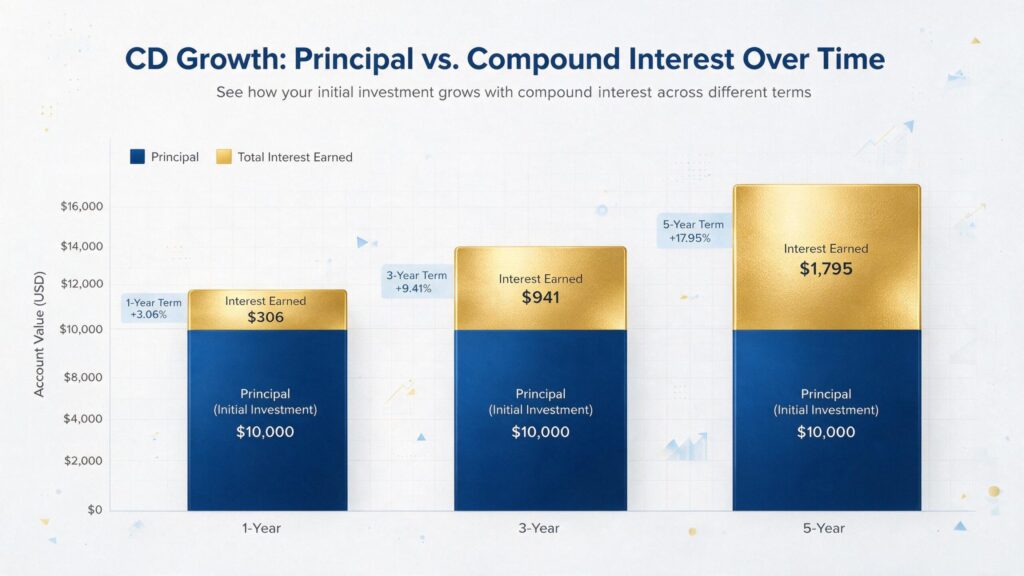
Real-World Scenarios: The Calculator in Action
Theory is useless without application.
Let us put this CD Calculator to work. We are going to run three distinct profiles through the tool. Each person has different goals, different risk tolerances, and different timelines. The numbers will tell a completely different story for each of them.
Scenario 1: The Conservative Saver
Meet Sarah. She is 58, two years from retirement, and she has zero appetite for risk. The stock market crash of 2022 still haunts her. She has $100,000 in a savings account earning 0.01%. She is furious about the lost opportunity. She wants guaranteed growth. She wants sleep-at-night money.
She opens a 12-month CD at a top-tier online bank offering 5.25% APY, compounded daily.
| Input | Value |
|---|---|
| Initial Deposit (Principal) | $100,000 |
| CD Term | 1 Year |
| Interest Rate (APY) | 5.25% |
| Compounding Frequency | Daily |
| Output | Value |
|---|---|
| Maturity Value | $105,389.16 |
| Total Interest Earned | $5,389.16 |
Strategic Analysis: Sarah does not care about getting rich. She cares about not getting poor. That $5,389.16 is a guaranteed, risk-free win. In two years, when she retires, she will have roughly $10,778 in extra cash to cover her first year of property taxes. She used the CD Calculator to prove to herself that locking this money up was the right move. It was.
Scenario 2: The Aggressive Investor
Marcus is 31. He maxes out his 401(k) every year. He owns rental properties. He is aggressive. But he just sold a property and has $250,000 in cash sitting idle for the next 18 months while he hunts for his next deal. He refuses to let that cash rot.
He splits the cash. $100,000 goes into a 6-month CD at 5.35%. $150,000 goes into an 18-month CD at 5.15%. Let us look at the 18-month CD.
| Input | Value |
|---|---|
| Initial Deposit (Principal) | $150,000 |
| CD Term | 1.5 Years (18 Months) |
| Interest Rate (APY) | 5.15% |
| Compounding Frequency | Daily |
| Output | Value |
|---|---|
| Maturity Value | $161,987.42 |
| Total Interest Earned | $11,987.42 |
Strategic Analysis: Marcus is not investing for retirement. He is parking cash. That $11,987.42 is essentially free money for doing absolutely nothing. It will cover his closing costs on his next rental property. He used the CD Calculator to ensure the 18-month term aligned perfectly with his acquisition timeline. It did.
Scenario 3: The Struggling Homebuyer
Elena is 27. She wants to buy a house in exactly 3 years. She needs a 20% down payment on a $400,000 home, which means she needs $80,000 in cash. She currently has $60,000 saved. She can afford to lock $50,000 of that away for 3 years.
She uses our Mortgage Affordability Calculator to confirm her target price, then she runs her CD numbers.
| Input | Value |
|---|---|
| Initial Deposit (Principal) | $50,000 |
| CD Term | 3 Years |
| Interest Rate (APY) | 5.00% |
| Compounding Frequency | Daily |
| Output | Value |
|---|---|
| Maturity Value | $58,091.12 |
| Total Interest Earned | $8,091.12 |
Strategic Analysis: Elena needs $80,000. She has $60,000 now. The CD will return $58,091.12. That leaves her with $10,000 still in her checking account plus the $58,091.12 from the CD. Total: $68,091.12. She is still short of $80,000.
This is where the CD Calculator saves her from a disaster. Without it, she might have assumed the interest alone would bridge the gap. The math shows her she still needs to save an additional $11,908.88 over the next 3 years. That is roughly $330 per month. She can do that. She adjusted her budget the same day she ran the numbers.
Hidden Pitfalls: 3 Biggest Mistakes People Make
You run the numbers. You feel confident. You sign the paperwork. Then you lose money.
It happens more often than you think. People treat a CD Calculator like a magic wand. They type in a number, see a big payout, and blindly commit. That is not financial planning. That is gambling with a spreadsheet.
The math is simple. Human behavior is not. Here are the three most common blunders that destroy wealth in the fixed-income space.
Ignoring the Early Withdrawal Penalty
This is the silent wealth killer.
You lock $50,000 into a 5-year CD at 5.00% APY. Two years in, your car dies. Your roof leaks. Your kid needs braces. You need cash. So you break the CD.
The bank does not care about your emergency. They enforce the penalty. Most institutions charge 3 to 6 months of interest for early withdrawal. On a $50,000 CD, that is $625 to $1,250 gone. Poof. Vanished.
Some banks are even crueler. If you withdraw within the first few days, they claw back the principal. You walk away with less than you started with.
Always run your CD Calculator projection, then ask yourself one question: “What is the absolute worst thing that could happen in the next 12 months that would force me to touch this money?” If the answer is anything, keep that cash in a high-yield savings account. Do not lock it up.
Confusing APY with APR
This mistake costs people hundreds of dollars every single year.
APR is the Annual Percentage Rate. It is the simple interest rate. It does not account for compounding. APY is the Annual Percentage Yield. It includes the effect of compounding.
Banks love to advertise the lower APR number in small print while flashing the higher APY number in giant bold text. They want you to think you are getting a better deal than you actually are.
When you input your rate into the CD Calculator, make sure you are using the APY. If a bank advertises “5.00% interest,” ask them explicitly: “Is that APY or APR?” The difference between 5.00% APR compounded daily and 5.00% APY is real money. On a $100,000 deposit over 3 years, that fractional difference is worth over $100 in your pocket.
Forgetting About Inflation Erosion
Your CD Calculator says you will make $8,000 in interest. You celebrate.
Meanwhile, the price of groceries jumped 7%. Gas costs 15% more. Rent went up 10%.
That $8,000 buys you significantly less than it did three years ago. Inflation is the invisible tax on fixed-income investors. It does not show up on your bank statement. It shows up at the checkout line.
If your CD yields 4.5% and inflation runs at 5.5%, you lost 1% in real purchasing power. You worked for nothing. You took on liquidity risk for zero real return. Always subtract the current inflation rate from your projected APY. If the number is negative, you are losing wealth. Period.
Expert Strategies: How to Optimize Your Results
Most people use a CD the way a hamster uses a wheel. They run in circles. They deposit. They withdraw. They repeat.
That is amateur hour.
Sophisticated investors use certificates of deposit as precision instruments. They deploy them to hedge risk, time cash flows, and generate predictable income. Before you commit a single dollar, run your numbers through the CD Calculator and apply these five expert-level strategies.
Build a CD Ladder
A CD ladder is the single most effective strategy for fixed-income investors who still want liquidity.
You do not put all your money into one 5-year CD. You split it. Take $50,000. Put $10,000 into a 1-year CD. $10,000 into a 2-year CD. $10,000 into a 3-year CD. $10,000 into a 4-year CD. $10,000 into a 5-year CD.
Every year, one CD matures. You get $10,000 back plus interest. You can spend it, or you can roll it into a new 5-year CD.
This strategy gives you the highest possible yield because longer terms pay more, while guaranteeing you access to cash every 12 months. Run each rung of your ladder through the CD Calculator to project your exact annual cash flow.
Match Terms to Life Events
Your CD term should never be arbitrary. It should be tied to a specific, known future expense.
Are you buying a house in 18 months? Buy an 18-month CD. Is your child starting college in 4 years? Buy a 4-year CD. Are you retiring in 2 years? Buy a 2-year CD.
This eliminates the early withdrawal penalty entirely. You are not guessing when you will need the money. You know. The CD Calculator helps you project exactly how much you will have by that date, so you can adjust your savings rate today to hit your target.
Shop Across Institutions
Loyalty is expensive.
Your local credit union might offer 3.50% APY on a 1-year CD. An online bank across the country might offer 5.25% APY for the exact same term. That 1.75% difference on $100,000 is $1,750.
FDIC insurance covers up to $250,000 per depositor, per institution. You are fully protected. There is zero risk in moving your money to a higher-yielding bank.
Use the CD Calculator to compare the exact dollar difference between institutions. Sometimes the gap is so large that it is literally free money to open a new account.
Reinvest Interest Strategically
When your CD matures, you have a choice. You can take the interest as cash, or you can reinvest it.
If you reinvest the interest into a new CD, you are compounding your compounding. You are accelerating your wealth curve.
However, if you are in a high tax bracket, that reinvested interest is still taxable. You will owe taxes on money you never touched. In that case, it may make more sense to take the interest as cash to cover your tax bill, and only reinvest the principal.
For a deeper look at how interest accumulates and how amortization works on the debt side of your balance sheet, use our Mortgage Amortization Calculator to see the exact mirror image of how interest eats into payments over time.
Use CDs as Collateral for Low-Rate Loans
This is a strategy most retail investors never consider.
You have $100,000 locked in a 5-year CD earning 5.00%. You need $20,000 for a home renovation. You could break the CD and lose $1,000 in penalties. Or, you could take out a CD-secured loan for $20,000 at 3.50%.
You keep earning 5.00% on your full $100,000. You pay 3.50% on the $20,000 loan. You pocket the 1.50% spread. You avoided the penalty. You kept your liquidity intact.
Banks love these loans because they are fully collateralized. They offer them at rates below prime. It is a win-win, provided you actually need the cash and are not just borrowing for the sake of borrowing.
If you are evaluating whether to use cash or take a loan for a major purchase, run the numbers on our Extra Mortgage Payment Calculator to see how redirecting that $20,000 toward your mortgage principal would generate a guaranteed, tax-free return equal to your mortgage interest rate.
Frequently Asked Questions (FAQs)
Q: How do I calculate CD interest?
A: You multiply your principal by the interest rate, adjusted for compounding frequency and time. The standard formula is A = P(1 + r/n)^(nt), where A is the final amount, P is principal, r is the rate, n is compounding periods per year, and t is time in years. Our CD Calculator does this instantly so you never have to touch a scientific calculator.
Q: What is a good APY for a CD?
A: A good APY depends entirely on current Federal Reserve rates and inflation, but anything above 4.50% in today’s environment is considered strong. You should always compare the APY against the current Consumer Price Index to ensure your return outpaces inflation. Use the CD Calculator to project the exact dollar value of any APY you are considering before committing.
Q: Is CD interest taxable?
A: Yes, all interest earned on a certificate of deposit is taxed as ordinary income at your marginal tax rate. The bank will send you a 1099-INT form at the end of the year reporting the exact interest you earned. You must report this on your federal tax return, and in most cases, your state tax return as well.
Q: Can I lose money on a CD?
A: You cannot lose your principal to market crashes because CDs are FDIC or NCUA insured up to $250,000 per institution. However, you can lose money to early withdrawal penalties if you break the contract before maturity. You can also lose purchasing power if inflation runs higher than your CD’s APY.
Q: How often do CDs compound interest?
A: Most banks compound CD interest daily, though some credit unions compound monthly or quarterly. Daily compounding yields slightly more money because interest is calculated and added to your balance every single day. Always verify the compounding frequency with your bank and input it accurately into the CD Calculator for a precise projection.
Q: What happens when a CD matures?
A: When a CD reaches its maturity date, the bank returns your principal plus all accrued interest. Most institutions provide a grace period of 7 to 10 days where you can withdraw the funds or choose a new term. If you do nothing, the bank will automatically renew the CD at the current market rate, which may be higher or lower than your original rate.
Q: Is a CD better than a savings account?
A: A CD offers a higher, guaranteed interest rate in exchange for locking your money away for a fixed term. A savings account offers instant liquidity but typically pays a fraction of the yield. If you do not need the cash for 6 months or longer, a CD is mathematically superior. Run both scenarios through the CD Calculator to see the exact dollar difference.
Call to Action: Stop guessing your returns. Head to the top of this page, enter your numbers into the CD Calculator, and see exactly how much wealth your deposit will generate. Then, compare your fixed-income strategy against your debt obligations to ensure every dollar is working for you.
Disclaimer: The CD Calculator provided by Nxfly Finance is for educational and informational purposes only. It does not constitute specific financial, investment, or tax advice. Please consult with a licensed financial advisor, fiduciary, or CPA before making any major financial decisions.