

By Marcus Vance, CFP® | Reviewed by the Nxfly Finance Team
Most people are one bad Tuesday away from financial ruin.
You lose your job. The transmission drops out of your car. A medical emergency hits your family. Panic sets in instantly. You scramble to cover the bills, maxing out high-interest credit cards just to stay afloat.
Why does this happen? People rely on generic advice instead of a precise Emergency Fund Calculator.
Financial influencers love throwing around arbitrary numbers. They tell you to save a flat $1,000. They tell you to save $10,000. Generalizations are dangerous. Your life is not a generic template. Your financial safety net must reflect your specific geographic location, your exact debt obligations, and your specific family size.
Math does not care about rules of thumb.
You need cold, hard facts. You need an exact dollar amount that guarantees you can survive a sudden total loss of income. That is exactly why we engineered this Emergency Fund Calculator. Without an accurate baseline, you are simply guessing. Guessing leads to underfunding your safety net, which forces you into predatory debt when a crisis inevitably arrives.
Your largest monthly threat is always your housing payment. If you have recently used a Mortgage Affordability Calculator to stretch into a new home, your cash reserve needs instantly skyrocketed. A higher mortgage payment demands a thicker cash shield.
This Emergency Fund Calculator cuts out the noise. It strips away discretionary fluff and isolates your non-negotiable survival numbers. It factors in your housing, your groceries, your mandatory insurance, and your minimum debt payments. Then, it multiplies that baseline by your risk tolerance to give you an exact cash target.
Life is entirely unpredictable. Your savings strategy should not be.
Let’s look at the numbers and build your fortress.
Emergency Fund Calculator
Figure out how much you need in your emergency fund, and how long it will take to get there based on what you can save each month.
The Mechanics: How to Use the Nxfly Emergency Fund Calculator
Garbage inputs lead to garbage outputs.
If you underestimate your expenses inside the Emergency Fund Calculator, you will build a fragile safety net. A minor economic shock will tear right through it. You must be brutally honest about what it costs to keep the lights on and the bill collectors away.
Here is exactly how to set up your variables inside the tool to get a bulletproof target.
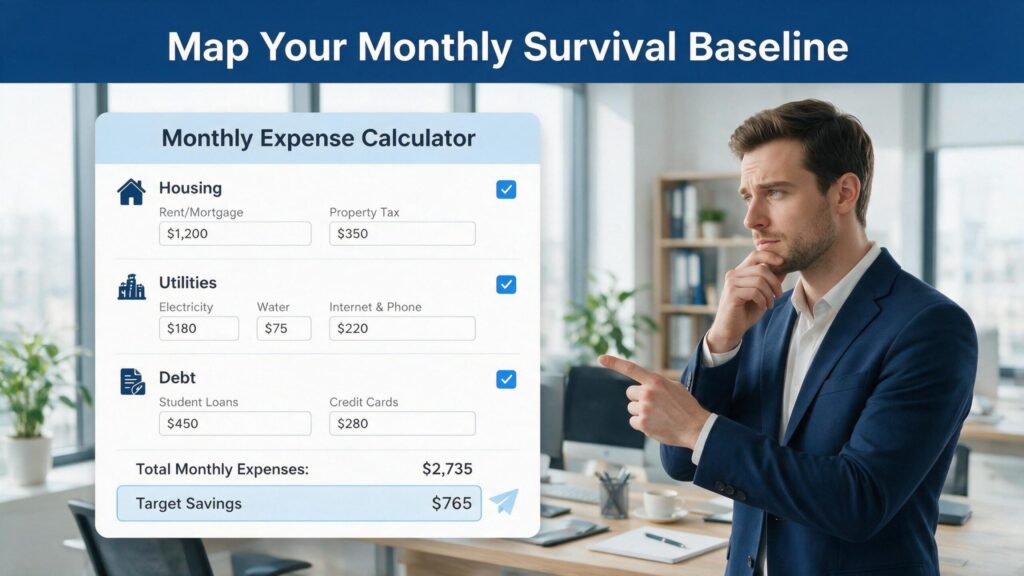
Step 1: Core Housing Costs (Rent or Mortgage)
This is your largest baseline expense. Enter your exact monthly housing obligation. If you own a home, this number must include principal, interest, taxes, and insurance. If you are unsure of your exact breakdown, run your loan details through a Mortgage Payment Calculator first. Do not guess this number. If you miss housing payments during a job loss, foreclosure proceedings begin rapidly.
Step 2: Non-Negotiable Living Expenses
This field inside the Emergency Fund Calculator is for survival items only. Think groceries, electricity, water, and basic transportation to find new employment.
Do not include dining out. Do not include streaming services. Do not include vacation funds. This is the raw cost of existing. If you lose your income tomorrow, your lifestyle immediately shrinks to these bare essentials. Inflating this number artificially bloats your savings target and traps cash that should be invested elsewhere.
Step 3: Required Debt Obligations
Creditors do not care if you lose your job. They demand their money on the first of the month.
Enter the absolute minimum monthly payments for your auto loans, student loans, and credit cards. Your Emergency Fund Calculator target must cover these minimums to protect your credit score during a crisis. A damaged credit score makes finding a new job, a new apartment, or a cheaper insurance rate significantly harder.
Step 4: The Time Horizon (Months of Coverage)
This is the multiplier. How many months of expenses do you want to keep in liquid cash?
Standard advice dictates three to six months. However, the Emergency Fund Calculator lets you customize this based on your specific industry. If you work in a highly specialized field where finding a new job takes eight months, set this multiplier to eight. If you are a freelancer with highly volatile income, set it to twelve.
Step 5: Existing Liquid Cash
Enter what you already have saved in accessible checking or savings accounts. The Emergency Fund Calculator subtracts this from your total target goal. The resulting number is your exact savings deficit. This tells you exactly how much more cash you need to stockpile before aggressively investing in the stock market.
The Anatomy of the Calculation: Key Terms & Deep Concepts
Financial literacy requires understanding the vocabulary of money.
Banks and financial advisors use specific terminology to describe risk and liquidity. To fully grasp the math powering the Emergency Fund Calculator, you must master a few foundational concepts. These are the principles that dictate whether your savings strategy will actually hold up under severe stress.
We refuse to use complex jargon to confuse you. Here is your straightforward mini-glossary of the terms defining your safety net.
- Liquid Assets: This is the most critical concept in emergency planning. Liquidity refers to how quickly you can convert an asset into spendable cash without losing its value. A high-yield savings account is highly liquid. A house is incredibly illiquid. Your Emergency Fund Calculator results represent cash that must be held in liquid assets. Do not put this money into stocks or real estate.
- Essential vs. Discretionary Spending: Essential spending keeps you alive and legally compliant (food, shelter, taxes, minimum debt payments). Discretionary spending is a luxury (concert tickets, restaurant meals, designer clothes). The Emergency Fund Calculator strictly focuses on essential spending to give you a lean, realistic survival number.
- Income Replacement Ratio: This is the percentage of your former income that you need to maintain your baseline standard of living. If you made $10,000 a month but your essential expenses are only $4,000, your necessary replacement ratio is 40%. Lowering your ratio makes building your cash shield much easier.
- Cash Equivalents: These are short-term, highly secure investment vehicles that act like cash. Examples include Treasury bills, money market funds, or short-term Certificates of Deposit (CDs). According to the U.S. Securities and Exchange Commission (SEC), cash equivalents offer a safe place to park your money while earning slightly more yield than a standard checking account. They are perfect vehicles for housing the total amount dictated by your Emergency Fund Calculator.
- Opportunity Cost: Every dollar has a job. When you hold massive amounts of cash in a basic savings account, you lose the opportunity to invest that money in the stock market for higher returns. This is the opportunity cost of safety. A properly calibrated Emergency Fund Calculator prevents you from over-saving, ensuring you do not suffer massive opportunity costs from hoarding too much cash.
- Inflation Drag: Cash loses purchasing power every single year due to inflation. If you stuff your emergency fund under a mattress, it slowly becomes worthless. You must hold your reserve in an account that pays enough interest to offset standard inflation.
- Target Safety Net: The final output of the calculation. It is the exact monetary threshold where financial panic ends and stability begins.
Hitting the number generated by the Emergency Fund Calculator fundamentally changes your psychology. It transitions you from playing defense to playing offense with your money.
Unveiling the Formula: The Math Behind the Calculator
Building a safety net is not an emotional exercise. It is a strict mathematical equation.
Many financial tools rely on bloated algorithms that try to predict your future lifestyle choices. We reject that approach. The math powering our Emergency Fund Calculator is aggressively simple, highly transparent, and ruthlessly effective. We use exact arithmetic to isolate your baseline survival costs and scale them against your specific risk timeline.
You do not need a black-box algorithm to tell you what you need to survive. You need raw data.
Here is the exact formula processing your numbers in the background:
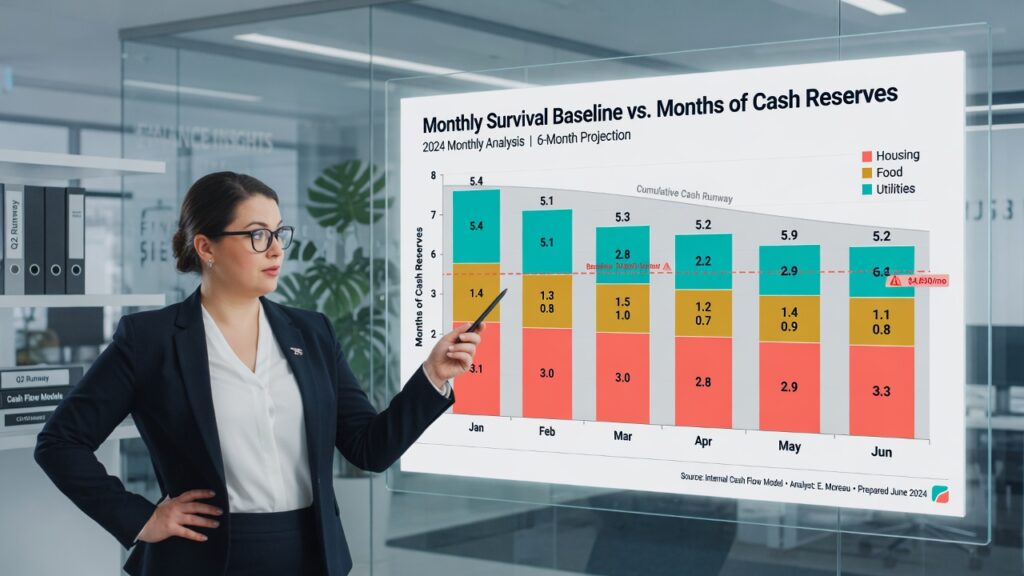
Target Safety Net = [(H + U + F + D + I) × M]
Let’s break down each specific variable in this equation so you understand exactly what the tool is doing.
- H (Housing): Your monthly rent or mortgage payment.
- U (Utilities): The absolute bare minimum cost to keep the lights, water, and heat running.
- F (Food): The monthly cost of basic groceries.
- D (Debt): The legally required minimum payments on credit cards, student loans, or auto loans.
- I (Insurance): Mandatory health, auto, and life insurance premiums.
- M (Months of Coverage): Your risk multiplier. This is the timeline you expect to be without income.
Once the Emergency Fund Calculator establishes this total target, it runs a secondary calculation to determine your immediate action plan. It subtracts your current liquid cash from the target.
Savings Deficit = Target Safety Net – Current Liquid Savings
If your deficit is a negative number, congratulations. You are fully funded. You have officially eliminated short-term financial panic from your life.
If your deficit is a positive number, that is your immediate marching order. Every spare dollar you earn must attack that deficit before you invest in the stock market or upgrade your lifestyle. This tool’s accuracy comes from its refusal to include discretionary fluff. By focusing purely on the (H+U+F+D+I) variables, the calculator gives you a highly achievable, realistic target that actually protects you when a crisis hits.
5 Critical Factors That Influence Your Numbers
A static number on a screen is dangerous if you ignore the outside world.
Your financial life operates within a volatile macroeconomic environment. While the Emergency Fund Calculator gives you a mathematically perfect target for today, you must constantly adjust your inputs based on shifting realities. If you blindly set your savings target and never revisit it, your safety net will eventually fail.
You must monitor these five external and personal factors to keep your numbers accurate.
1. Macroeconomic Volatility and the Job Market
Recessions change the rules of the game. When the economy is booming, finding a replacement job might take three weeks. When the economy contracts, corporate hiring freezes take over. According to the U.S. Bureau of Labor Statistics (BLS), the average duration of unemployment frequently spikes above 20 weeks during economic downturns. If the national job market weakens, you must open your calculator and increase your “Months of Coverage” multiplier immediately.
2. Inflationary Pressure on Core Expenses
Your baseline survival number is a moving target. Three years ago, $400 a month covered a family’s basic grocery needs. Today, that same cart of groceries costs $600. Utility rates climb. Insurance premiums rise. Inflation silently degrades the protective power of your cash reserve. You should rerun your numbers through the Emergency Fund Calculator every single January to ensure inflation has not secretly hollowed out your safety net.
3. Fixed vs. Variable Debt Obligations
Your housing cost dictates the size of your required cash reserve. If you have a fixed-rate mortgage, your primary expense remains perfectly stable, making your savings target highly predictable. If you are a renter facing annual 10% rent hikes, your target constantly increases. If cash flow is tight and your fixed costs are too high, run your numbers through a Mortgage Refinance Calculator to see if securing a lower rate can reduce your monthly obligations. Lower monthly obligations mean a smaller required emergency fund.
4. Health Insurance Deductibles and Out-of-Pocket Maximums
Medical emergencies are a dual threat. They often cause a sudden loss of income while simultaneously triggering massive medical bills. Your emergency fund must cover your baseline living expenses plus your health insurance deductible. Check your policy. If your out-of-pocket maximum is $6,000, you must mentally add that $6,000 to the final target generated by the calculator. Do not get caught underfunded during a health crisis.
5. Income Stability and Career Structure
A tenured teacher with a union contract has high income stability. A freelance graphic designer or a real estate agent on straight commission has extreme income volatility. The less predictable your income, the larger your cash buffer must be. Freelancers should never accept a standard three-month target. They must configure their Emergency Fund Calculator to project out nine to twelve months to absorb the natural feast-or-famine cycles of contract work.
Real-World Scenarios: The Calculator in Action
Theory is useless without execution.
To truly understand how to leverage our Emergency Fund Calculator, we need to apply it to real human situations. Different lifestyles demand entirely different cash reserve strategies.
Let’s examine three distinct financial profiles. We will look at a single renter with a stable job, a single-income family with heavy debt, and a high-income freelancer dealing with severe income volatility.
Scenario 1: Clara, The Single Renter (The Lean Saver)
Clara is 28 years old. She works as a registered nurse, giving her incredible job security. She rents a modest apartment and has no dependents. Her expenses are low, and her debt is limited to a small car payment. Because her job is highly secure and she can easily pick up extra shifts at a different hospital if needed, she only wants a lean 3-month safety net. She currently has $2,000 in her savings account.
The Inputs Used:
- Housing (Rent): $1,200
- Utilities/Groceries: $500
- Minimum Debt/Insurance: $300
- Months of Coverage: 3
- Current Savings: $2,000
| Metric | Amount |
|---|---|
| Total Monthly Baseline | $2,000 |
| Target Safety Net (3 Months) | $6,000 |
| Current Liquid Cash | -$2,000 |
| Total Savings Deficit | $4,000 |
Strategic Analysis:
Clara’s situation is highly manageable. The Emergency Fund Calculator reveals she only needs a $6,000 total reserve to survive a quarter of a year without income. Because she already has $2,000 saved, her actual deficit is only $4,000. She can aggressively cut discretionary spending for just a few months, hit this goal rapidly, and then immediately pivot to investing heavily into her retirement accounts.
Scenario 2: The Miller Family (The Defensive Planners)
Tom and Sarah Miller are homeowners with two young children. Tom is the sole income earner, working in corporate tech sales. Their housing costs are high, and they have significant monthly obligations, including a mortgage, two car loans, and life insurance premiums. If Tom loses his job, the entire household faces immediate financial danger. They want a robust 6-month cash reserve. They currently have $10,000 saved in a standard checking account.
The Inputs Used:
- Housing (Mortgage & Taxes): $2,800
- Utilities/Groceries: $1,200
- Minimum Debt/Insurance: $800
- Months of Coverage: 6
- Current Savings: $10,000
| Metric | Amount |
|---|---|
| Total Monthly Baseline | $4,800 |
| Target Safety Net (6 Months) | $28,800 |
| Current Liquid Cash | -$10,000 |
| Total Savings Deficit | $18,800 |
Strategic Analysis:
This is a high-stress reality check for the Millers. Their Emergency Fund Calculator results show they need nearly $30,000 just to survive six months. Their current $10,000 only covers about two months of expenses. They are highly vulnerable. To lower their risk profile over the long term, they should utilize a Mortgage Payoff Calculator to build a strategy for eliminating their housing debt entirely, which would massively drop their monthly baseline survival number. For now, they must pause all vacations and aggressively attack that $18,800 deficit.
Scenario 3: Marcus, The Commission-Based Freelancer (High Volatility)
Marcus is a freelance software developer. He makes $150,000 a year, but his income is violently erratic. He might earn $30,000 in one month and zero dollars for the next three. He has zero debt, but his rent in a major tech city is expensive. Because of his unpredictable cash flow, a standard 3-month reserve is reckless. He demands a full 12-month ironclad cash shield. He has $20,000 sitting in a high-yield savings account.
The Inputs Used:
- Housing (Rent): $3,500
- Utilities/Groceries: $800
- Minimum Debt/Insurance: $200
- Months of Coverage: 12
- Current Savings: $20,000
| Metric | Amount |
|---|---|
| Total Monthly Baseline | $4,500 |
| Target Safety Net (12 Months) | $54,000 |
| Current Liquid Cash | -$20,000 |
| Total Savings Deficit | $34,000 |
Strategic Analysis:
Marcus has high income but high risk. His Emergency Fund Calculator projection demands a massive $54,000 cash stockpile. While holding this much cash means he suffers some opportunity cost by not investing it in the market, it is the mandatory price of freelance freedom. His current $20,000 buffer is respectable, but his $34,000 deficit shows he is not truly protected against a prolonged dry spell in client contracts. He must funnel his next few major commission checks directly into his cash reserves before upgrading his lifestyle.
Hidden Pitfalls: 3 Biggest Mistakes People Make
Most people sabotage their financial safety net before it ever gets fully funded.
They treat cash reserves as an afterthought. Or worse, they treat them as an investment vehicle. Both approaches guarantee failure. When you run your numbers through an Emergency Fund Calculator, you establish a mathematical perimeter around your household. If you mismanage that perimeter, it collapses the second real economic pressure hits.
Here are the three most common blunders destroying people’s cash reserves.
1. Investing the Safety Net for Yield
This is the single fastest way to lose your money when you need it most. People look at a massive cash pile and hate that it is not earning an 8% return in the stock market. They get greedy. They move their reserve into index funds or volatile assets.
The stock market frequently crashes at the exact same time mass layoffs occur.
If you lose your job during a recession, you will be forced to sell your stocks at a massive loss just to buy groceries. A fully funded target from your Emergency Fund Calculator is an insurance policy, not an investment. Its sole purpose is liquidity. It exists to protect your highly volatile investments from being liquidated at the wrong time. Leave it in cash. Accept the lower yield as the cost of safety.
2. Inflating the Baseline with Lifestyle Fluff
Many people lie to themselves about their survival expenses. They include gym memberships, weekly restaurant trips, and streaming subscriptions in their baseline.
This creates a wildly inflated target. If your true survival number is $3,000, but you pad it up to $5,000, your 6-month safety net goal suddenly jumps from $18,000 to $30,000. That massive, artificially high number feels impossible to hit. You get discouraged and stop saving entirely. The Emergency Fund Calculator is designed strictly for survival mode. Strip the fluff. Keep the target lean, realistic, and highly achievable.
3. The Set-It-And-Forget-It Trap
Your baseline expenses change every single year. Rent goes up. Car insurance premiums skyrocket. A new child joins the family.
If you calculated your cash target five years ago, your reserve is now dangerously underfunded. You are operating on outdated math. Inflation silently degrades the purchasing power of your savings. You must treat your cash reserve as a living, breathing metric. Open the Emergency Fund Calculator every single January. Recalibrate your inputs. If your core living expenses increased by $400 a month last year, you must immediately top off your safety net to match that new reality.
Expert Strategies: How to Optimize Your Results
Knowing your exact deficit is just the starting line. Now you must close the gap.
Building a robust cash reserve requires aggressive behavioral changes. You cannot simply hope there is money left over at the end of the month. You must engineer your cash flow to force the savings. Once you hit the exact number generated by your Emergency Fund Calculator, you gain a massive psychological advantage over debt.
Here are five expert-level strategies to hit your target faster and optimize your liquidity.
Strategy 1: Isolate the Funds Geographically
Do not keep your safety net at the same bank where you do your daily checking. If you see the money every time you log in to pay a bill, you will eventually spend it.
Open a High-Yield Savings Account (HYSA) at a completely different financial institution. Force friction into the withdrawal process. It should take two to three business days to transfer those funds back to your checking account. This minor delay stops impulsive spending while keeping the money perfectly liquid for a true crisis. Your Emergency Fund Calculator target must live in quarantine.
Strategy 2: Attack Your Fixed Housing Costs
The easiest way to lower your required cash reserve is to lower your required monthly expenses. Housing is the biggest offender.
If you carry a massive mortgage balance, your monthly baseline will always be dangerously high. You can actively reduce your long-term risk profile by paying down principal early. Run some scenarios through an Extra Mortgage Payment Calculator. By throwing an extra $200 at your principal each month, you drastically shorten the life of the loan. While this does not lower your immediate monthly payment, eliminating the debt entirely drops your future Emergency Fund Calculator requirements to rock bottom.
Strategy 3: Execute a Tiered Liquidity Ladder
If your savings target is exceptionally high (e.g., $40,000 for a 9-month reserve), you do not need all of it completely liquid on day one. You can build a yield ladder.
Keep the first month of expenses directly in your primary checking account as a fast-action buffer. Keep months two through four in a HYSA. Put months five through nine into short-term Certificates of Deposit (CDs) or Treasury Bills. This strategy satisfies the total output of the Emergency Fund Calculator while safely squeezing higher interest rates out of the back half of your money.
Strategy 4: Eradicate Ghost Expenses Like PMI
Ghost expenses quietly bloat your monthly survival number without adding any value to your life. Private Mortgage Insurance (PMI) is the worst offender.
If you bought a home with less than 20% down, you are paying a penalty fee strictly to protect the lender. This fee artificially inflates your required cash reserve. Track your home equity aggressively. As soon as you hit 20% equity, contact your lender to drop the insurance. Use a PMI calculator to see exactly how much cash this frees up. Redirect that dead money straight into fully funding your safety net.
Strategy 5: Treat Savings as a Predatory Creditor
Most people pay their bills first, buy discretionary items second, and save whatever is left. There is never anything left.
Flip the system. Treat the deficit shown on your Emergency Fund Calculator as a past-due bill from a ruthless creditor. Set up an automated transfer on payday. Before you even see the money, have $200 instantly routed to your isolated high-yield savings account. You cannot spend what you cannot see. Pay yourself first, and force your lifestyle to adapt to the remaining cash flow.
Frequently Asked Questions (FAQs)
Q: How much should I have in my emergency fund?
A: You should have a minimum of three to six months of absolute bare-minimum living expenses saved in liquid cash. If your job industry is highly volatile, or you are a freelance contractor, you must increase this baseline target to nine or twelve months of expenses.
Q: Where is the best place to keep an emergency reserve?
A: Keep your cash reserve in a High-Yield Savings Account (HYSA) or a money market account. These accounts protect your principal completely, offer easy liquidity without penalties, and pay a decent interest rate that helps combat inflation over time. Do not invest this money in the stock market.
Q: Should I pay off debt or build an emergency fund first?
A: Build a small, one-month starter reserve first to stop the bleeding. Once you have a basic $1,000 to $2,000 buffer, temporarily pause your savings to aggressively pay off high-interest toxic debt like credit cards. After the credit cards are dead, return to your Emergency Fund Calculator to fully fund the three-to-six-month target.
Q: What qualifies as a true financial emergency?
A: A true emergency is an unexpected, mandatory, and immediate expense that threatens your survival or your ability to earn an income. Job loss, sudden medical crises, major car repairs for your commuting vehicle, and critical home repairs (like a broken furnace in winter) qualify. A vacation or a holiday sale does not.
Q: Does an emergency fund calculator include discretionary spending?
A: No, an accurate calculation strictly excludes discretionary spending. It removes dining out, entertainment, subscriptions, and travel. A properly calibrated Emergency Fund Calculator isolates only the mathematical baseline required to keep you legally compliant and physically sheltered during a sudden loss of income.
Q: How long does it take to save a fully funded emergency reserve?
A: The timeline depends entirely on your income and your financial discipline. For the average household aggressively cutting expenses and redirecting 15% to 20% of their take-home pay, fully funding a six-month target defined by an Emergency Fund Calculator typically takes one to two years of focused effort.
Q: Do I need an emergency fund if I have high-limit credit cards?
A: Yes, absolutely. Relying on credit cards during a crisis is financial suicide. Credit cards charge exorbitant interest rates, often exceeding 24% APY. If you lose your job and fund your life with credit, you will trigger a compounding debt trap that can take a decade to escape. Cash is your only true protection.
Scroll back to the top of this page to run your household numbers through the Emergency Fund Calculator and find your exact survival target. Stop guessing and start mathematically protecting your family today. If you want to further optimize your monthly cash flow, explore our highly accurate Mortgage Amortization Calculator to see exactly how your housing payments break down over time.
Disclaimer: The Emergency Fund Calculator provided by Nxfly Finance is for educational and informational purposes only. It does not constitute specific financial, investment, or tax advice. Please consult with a licensed financial advisor, fiduciary, or CPA before making any major financial decisions.