

By Marcus Vance, CFP® | Reviewed by the Nxfly Finance Team
Car dealerships are not designed to sell you a vehicle. They are designed to sell you a financing contract.
The moment you sit down at the salesman’s desk, they will ask you a highly manipulative question. “What monthly payment are you looking for?” Do not answer that question. It is a financial trap. If you tell them you want to pay $500 a month, they will gladly hit that target. But they will stretch your loan out to 84 months and quietly inflate your interest rate. You will drive off the lot feeling victorious, completely unaware that you just committed to paying thousands of dollars in hidden bank fees.
You have to take the math into your own hands.
You need a reliable, institutional-grade auto loan calculator to protect your wealth. A vehicle is a rapidly depreciating asset. It loses value the exact second its tires hit the public street. When you finance a depreciating asset with compounding interest, you are burning money from both ends. Unlike buying a home—where you can use a Mortgage Amortization Calculator to track how your debt builds long-term equity—car debt strictly drains your net worth.
Every extra dollar you pay the dealership’s finance office is a dollar stolen from your future.
I see clients make catastrophic vehicle purchases constantly. They fall in love with a shiny new truck, ignore the underlying mathematics, and sign a contract they barely understand. Three years later, they are massively upside down on the loan. They owe the bank $30,000, but the car is only worth $18,000. They are trapped.
We built the Nxfly Finance auto loan calculator to stop this cycle of debt. This tool strips away the showroom illusions. It forces you to look at the cold, hard numbers. Understanding the mechanics of amortized debt is a foundational skill. It applies to houses, as seen in our guide on how US mortgage payments are calculated, and it applies aggressively to cars.
Do not let a finance manager dictate your budget. Plug your exact numbers into our auto loan calculator below. See your true monthly payment, expose the total interest you will pay, and walk into the dealership with total leverage.
🚗 Auto Loan Calculator
Calculate monthly car payments, total interest, and see how down payment & trade-in affect your loan
The Mechanics: How to Use the Nxfly Auto Loan Calculator
Dealership finance software is programmed to maximize their profit. Our auto loan calculator is programmed to protect your wallet.
To get an accurate result, you cannot use rough estimates. You have to feed the tool exact, realistic data. If you ignore taxes or overestimate your trade-in, the output will be entirely wrong. You will walk into the dealership expecting one payment and walk out with a completely different reality.
Here is exactly how to fill out each input field to guarantee flawless mathematical accuracy.
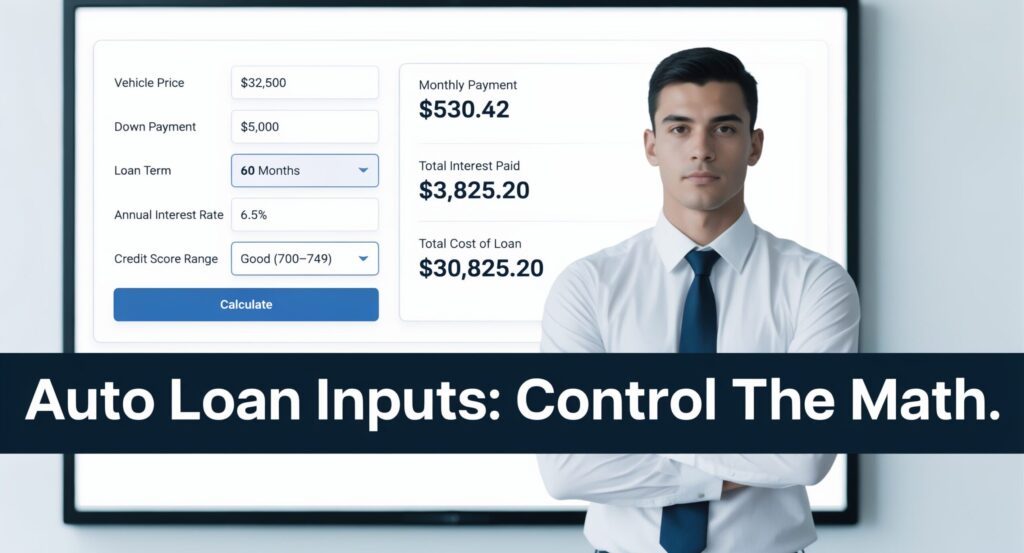
Step 1: Enter the Vehicle Purchase Price
Do not input the manufacturer's suggested retail price (MSRP) unless that is the exact price you negotiated. Dealerships add destination fees, documentation fees, and market adjustments. You want to enter the "out-the-door" price of the car before your trade-in or cash down payment is applied. If the sticker says $35,000 but the dealer is charging $38,000 out-the-door, you must input $38,000 into the auto loan calculator.
Step 2: Input Your Cash Down Payment
Cash is your greatest shield against depreciation. Enter the exact dollar amount of cold cash you are bringing to the finance office. The calculator will automatically subtract this amount from the total vehicle price. A larger down payment immediately shrinks your principal loan balance. This permanently lowers your monthly payment and drastically reduces the total amount of interest the bank can charge you over the life of the loan.
Step 3: Add Your Trade-In Value
If you are trading in your current vehicle, enter its actual cash value here. Do not guess this number based on emotional attachment. Check realistic trade-in values on sites like Kelley Blue Book or Edmunds. Furthermore, if you still owe money on your current car, you must subtract that remaining loan balance from the trade-in value. If the dealer offers you $10,000 for your old car, but you still owe $6,000 to the bank, your actual trade-in equity is only $4,000.
Step 4: Define the Interest Rate
This is the cost of borrowing the bank's money. Dealerships frequently mark up the interest rate they get from the bank to pocket the difference as a hidden commission. Check your local credit union for baseline auto rates before you shop. Enter the exact percentage into the box. Even a 2% difference on a car loan alters your financial obligation by thousands of dollars.
Step 5: Select the Loan Term
How many months will you be making this payment? The standard historical term was 48 or 60 months. Today, dealers push 72 or 84-month terms to artificially lower your monthly obligation. Longer terms are incredibly dangerous. They stretch the interest out, keeping you underwater on the car for years. Enter your target timeframe to see exactly how your timeline impacts the amortization curve.
The Anatomy of the Calculation: Key Terms & Deep Concepts
The automotive industry has its own language. It is designed to sound friendly while completely obscuring the financial damage taking place on the paperwork.
When you sit in the finance office, you will hear a rapid-fire string of financial terms. If you nod your head without understanding them, you give away your power. You need to know exactly what the output of your auto loan calculator means in plain English. Here is an expanded breakdown of the core financial concepts driving your car payment.
Principal Balance
This is the raw dollar amount of debt you are taking on. Your principal is calculated by taking the out-the-door price of the car, adding your sales tax, and subtracting your down payment and trade-in equity. You want this number to be as low as humanly possible. The bank uses your principal balance as the exact baseline to calculate how much interest they get to charge you every single month.
Annual Percentage Rate (APR)
Many buyers confuse the interest rate with the APR. They are not the same thing. The interest rate is the base cost of borrowing the principal. The APR includes the interest rate plus any mandatory upfront lender fees, origination charges, or processing costs rolled into the loan. As defined by the Consumer Financial Protection Bureau (CFPB), the APR represents the broader, true cost of the loan. This is the percentage you should use to compare two different financing offers.
Negative Equity (Upside Down)
This is a financial nightmare. Negative equity occurs when you owe the bank more money than the car is actually worth on the open market. Because cars depreciate violently, almost every buyer is temporarily upside down the moment they drive off the lot. However, if you take out a 72-month loan with zero money down, you will stay upside down for four or five years. If you total the car during that time, your insurance company will only pay the market value. You will have to write a massive check out of your own pocket to cover the remaining bank debt.
Amortization
Amortization is the strict mathematical schedule the bank uses to break down your monthly payments. On an auto loan, your payment amount never changes. But the ratio of where that money goes shifts every month. In the first year, a massive chunk of your monthly payment goes straight to the bank as interest. Only a small fraction pays down your actual principal debt. As the months pass, the math slowly flips. The auto loan calculator processes this exact amortization curve to show your total interest burden.
Vehicle Depreciation
Depreciation is the invisible thief hiding in your garage. It is the rate at which your car loses its monetary value over time. A brand-new car typically loses 20% of its value in the first twelve months. It loses roughly 15% every year after that. While depreciation is not a line item on your loan contract, it is the primary reason car debt is so destructive. You are paying compounding interest on an asset that is aggressively destroying its own value every single day.
Gap Insurance
Guaranteed Asset Protection (GAP) insurance is a specific policy designed to save you from negative equity. If you buy a $40,000 car with zero money down, and total it a week later, standard insurance might only value the car at $32,000. You still owe the bank $40,000. Gap insurance covers that $8,000 difference. Dealerships heavily mark up the price of Gap insurance in the finance office. You can almost always buy it significantly cheaper directly through your standard auto insurance provider.
Unveiling the Formula: The Math Behind the Calculator
You cannot negotiate a car deal based on mental math.
A salesman will look you in the eye, punch a few numbers into a desktop calculator, and hand you a slip of paper with a monthly payment. Do not trust that piece of paper. Dealership software frequently bakes hidden fees and inflated rates into that final number. To protect yourself, you have to use a tool that relies on strict, objective mathematics.
Our tool uses the standard amortized loan formula. It is the exact same equation used by national banks. It looks like this:
A = P [ i(1 + i)^n ] / [ (1 + i)^n - 1 ]
To understand why your car payment is so expensive, we have to look inside the equation. This is what these variables actually mean for your bank account:
- A (Monthly Payment Amount): This is the fixed dollar amount you owe the bank every 30 days. It never changes.
- P (Principal Balance): This is your raw debt. It equals the total out-the-door price of the car minus your down payment and trade-in.
- i (Monthly Interest Rate): The formula does not use your annual interest rate. You must take your quoted APR (e.g., 6.0%) and divide it by 12 to find your monthly periodic rate (0.5%).
- n (Total Number of Months): This is your loan term. A 60-month loan equals 60 payments.
The formula is rigid. It ensures the bank extracts maximum profit early. Because your principal balance is massive during the first year of the loan, the interest calculated against it is massive. In month one, your payment might be $600, but $150 of that goes straight to the bank. Only $450 actually pays down the car. By the time you reach month 59, the math flips. You might only pay $5 in interest and $595 toward the principal.
You can visualize this exact curve by running your car loan through our Mortgage Amortization Calculator. While the tool says "mortgage," the mathematical amortization logic governing the debt is absolutely identical. Our auto loan calculator processes this complex formula instantly, stripping away the dealership's marketing illusions and handing you the raw, institutional-grade truth.
5 Critical Factors That Influence Your Numbers
Your car payment is not randomly assigned. It is the direct result of personal financial decisions crashing into global economic conditions.
If you want to lower your monthly payment, you have to manipulate the specific levers that control the math. You have total control over some of these variables. Others are dictated entirely by the bond market. Here are the five primary factors that force your car payment up or down.
1. The Dealership's Finance Markup
This is the dirtiest secret in the automotive industry. When you finance through the dealership, they act as a middleman. The dealer submits your credit profile to a bank. The bank approves you for a 5.0% interest rate. The dealer does not tell you this. Instead, they tell you they secured a 7.0% rate. The dealer legally pockets the 2.0% difference as a hidden commission. This markup artificially inflates your monthly payment. You combat this by securing pre-approval from a local credit union before you ever step foot on the car lot.
2. Your FICO Credit Score Tier
Your credit score is your financial reputation. Banks use it to determine the exact mathematical probability that you will stop making payments. If you have an 800 FICO score, you get access to the bank's lowest promotional rates. If your score sits below 650, you are labeled a subprime borrower. Subprime borrowers are hit with massive risk penalties. A borrower with bad credit will frequently pay interest rates exceeding 15%. This pushes the monthly payment through the roof and guarantees the buyer will be aggressively upside down on the loan.
3. The Length of the Loan Term
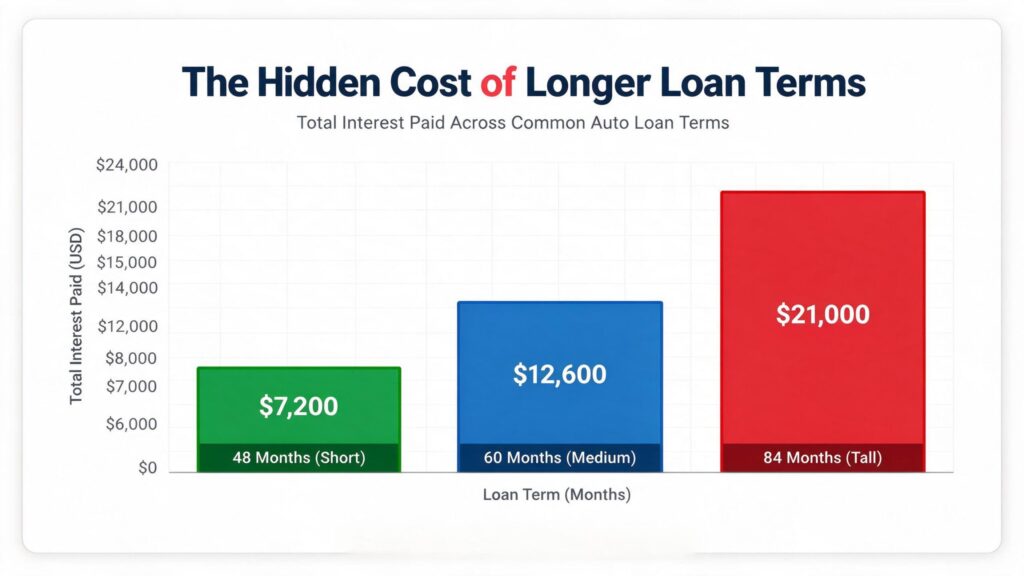
Time is the most deceptive variable in an auto loan. Extending the loan term from 48 months to 84 months drastically lowers your monthly payment. Dealerships push long terms aggressively because it makes expensive cars look affordable. But time is incredibly expensive. Extending the loan allows the bank to compound their interest over an extra three years. You end up paying thousands of dollars more in total interest. According to the Federal Reserve's consumer finance guidelines, longer loan terms significantly increase your risk of negative equity.
4. Macroeconomic Federal Interest Rates
You do not control the broader economy. Auto loan interest rates are heavily influenced by the Federal Reserve. When the Fed raises their baseline target rate to fight inflation, the cost of borrowing money across the entire banking system spikes. Auto lenders pass this increased cost directly to you. If you bought a car when national rates were 3%, and try to buy the exact same car two years later when rates are 7%, your monthly payment will be drastically higher simply because the macroeconomic environment shifted.
5. Sales Tax and Dealership Fees
Do not ignore the out-the-door costs. Most buyers only calculate their payment based on the sticker price of the car. This ruins your budget. Depending on your state, sales tax can instantly add 6% to 10% to the total cost of the vehicle. Dealerships will also tack on mandatory documentation fees, title fees, and processing charges. If you roll these massive taxes and fees into your loan instead of paying them in cash, you pay compounding interest on them for the next five years.
Real-World Scenarios: The Calculator in Action
Theory does not protect your bank account. Action does.
To show you exactly how this math plays out in a dealership finance office, let's run three completely different real-world scenarios through the auto loan calculator. These case studies represent the exact mistakes and triumphs I see in my financial planning practice. Watch how these buyers use the tool to expose hidden traps and optimize their daily cash flow.
Scenario 1: The Cash-Strapped Commuter
Sarah desperately needs a reliable car for her new job. She only makes $45,000 a year and has a strict monthly budget. She finds a used sedan with a sticker price of $22,000. She only has $2,000 to put down. The dealership tells her not to worry. They run her credit and offer her a 72-month loan at 9.0%. They tell her the payment will "easily fit her budget."
Before Sarah signs anything, she steps outside and runs the numbers herself to see the total cost.
| Input Variable | Sarah's Loan Data |
|---|---|
| Out-the-Door Price | $24,500 (Includes Tax & Fees) |
| Cash Down Payment | $2,000 |
| Total Loan Amount | $22,500 |
| Interest Rate | 9.00% |
| Loan Term | 72 Months |
| Monthly Payment | $405 |
| Total Interest Paid | $6,692 |
Strategic Analysis:
The tool exposes the trap. The monthly payment is $405, which technically fits Sarah's budget. But the long 72-month term combined with a 9% interest rate forces her to pay $6,692 in pure interest. She is paying over $31,000 total for a used car that will be worth $8,000 by the time she finally pays it off. Armed with this data, Sarah refuses the deal. She looks for a cheaper $15,000 car, drastically cutting her principal balance and lowering her long-term financial risk.
Scenario 2: The Aggressive Negotiator
David is buying a brand-new $55,000 truck. He has excellent credit (810 FICO). He secures a pre-approval letter from his local credit union for 60 months at 4.5%. He brings $10,000 in cash for a down payment. He walks into the dealership and negotiates the out-the-door price to exactly $58,000.
The finance manager tries to intercept David's credit union deal. The manager offers David a 60-month loan at 5.5%, but throws in a $1,000 cash rebate if David uses the dealership's bank. David runs the math to see if the upfront cash rebate outweighs the higher interest rate.
| Input Variable | Credit Union Offer | Dealership Offer (With Rebate) |
|---|---|---|
| Out-the-Door Price | $58,000 | $57,000 (Rebate Applied) |
| Cash Down Payment | $10,000 | $10,000 |
| Total Loan Amount | $48,000 | $47,000 |
| Interest Rate | 4.50% | 5.50% |
| Loan Term | 60 Months | 60 Months |
| Monthly Payment | $895 | $898 |
| Total Interest Paid | $5,690 | $6,864 |
Strategic Analysis:
The calculator proves the dealership's "rebate" is a mathematically terrible deal. Even though the rebate lowers David's starting loan amount by $1,000, the higher 5.5% interest rate forces him to pay an extra $1,174 in interest over five years. His monthly payment is actually higher with the dealership's offer. David immediately rejects the finance manager's trap and sticks with his credit union pre-approval, saving himself hundreds of dollars.
Scenario 3: The Conservative Wealth Builder
Mark and Elena despise debt. They view cars strictly as depreciating liabilities. They are buying a modest $30,000 family SUV. They have $15,000 in cash from a recent trade-in.
They can easily afford a standard 60-month payment. But they want to see how much money they save if they aggressively compress the loan into a tight 36-month window. The interest rate for both terms is fixed at 5.0%.
| Input Variable | 60-Month Option | 36-Month Option |
|---|---|---|
| Out-the-Door Price | $33,000 | $33,000 |
| Cash Down Payment | $15,000 | $15,000 |
| Total Loan Amount | $18,000 | $18,000 |
| Interest Rate | 5.00% | 5.00% |
| Monthly Payment | $340 | $539 |
| Total Interest Paid | $2,381 | $1,421 |
Strategic Analysis:
Compressing the loan term requires a heavier monthly commitment. The payment jumps from $340 to $539. But the tool highlights the massive long-term benefit. By taking the 36-month loan, Mark and Elena save nearly $1,000 in pure interest fees. More importantly, they own the car completely free and clear two full years earlier. They accept the higher monthly payment, knowing they will recapture massive monthly cash flow in year four without being burdened by negative equity.
Hidden Pitfalls: 3 Biggest Mistakes People Make
Most car buyers negotiate backward. They let the salesman dictate the rules of engagement. When you walk into a dealership without understanding the mathematics of depreciating debt, you become a target.
I review my clients' cash flow daily. Auto loans are consistently the number one destroyer of their monthly budgets. Buyers make the same three calculation errors over and over again. When you ignore the output of an auto loan calculator, you sign away thousands of dollars in pure bank profit. Avoid these massive financial blunders.
Rolling Negative Equity into a New Loan
This is a financial disaster. People get tired of their current car before they have actually paid it off. They owe $15,000 on a vehicle that is only worth $10,000. Instead of paying off that $5,000 difference in cash, they let the dealer roll that "negative equity" into the new car loan.
Do not do this.
If you buy a $30,000 car and roll $5,000 of old debt into it, your new principal balance is $35,000. You are immediately paying compounding interest on a ghost car that you no longer own. If you total the new car the next day, the insurance company will only cut a check for $30,000. You will personally owe the bank the remaining $5,000 immediately. Never trade an upside-down vehicle. Pay it down to zero first.
Financing Dealership Warranties and Add-Ons
Finance managers are not doing paperwork. They are salesmen. Their job is to sell you high-margin products right before you sign the contract. They pitch extended warranties, gap insurance, and tire protection plans.
They will tell you these items only add "ten dollars a month" to your payment. That is a manipulative metric. If you take a $3,000 extended warranty and roll it into a 72-month loan at 8% interest, you are not just paying $3,000. You are paying interest on that warranty for six straight years. If you absolutely want an extended warranty, pay for it in cash. Never finance dealership add-ons.
Focusing Strictly on the Monthly Payment
I said it in Part 1, and I will say it again. Buying a car based strictly on the monthly payment is a terrible strategy.
Dealers use the monthly payment as a smokescreen. If you tell them your budget is $400, they will hit exactly $400. But they will quietly stretch your loan term from 48 months to 84 months to make the math work. You just agreed to pay the bank for an extra three years. The total cost of the vehicle skyrockets, but you do not notice because the monthly payment feels safe. Always demand to see the total out-the-door price and the total interest charge before you sign the bottom line.
Expert Strategies: How to Optimize Your Results
You ran the math. You know your exact payment. Now you have to take control of the debt.
A car loan does not have to ruin your financial trajectory. You just have to manage it aggressively. I train my financial planning clients to treat auto debt like an emergency. You want to execute the contract, get the vehicle, and destroy the principal balance as fast as mathematically possible. Use these five expert strategies to optimize your loan and minimize bank interest.
1. Execute a Bi-Weekly Payment Strategy
Do not wait for the monthly due date. Cut your minimum payment in half and pay it every two weeks.
Because there are 52 weeks in a year, this strategy results in 26 half-payments. That equals 13 full payments per year instead of the standard 12. That single extra payment completely bypasses the bank's profit margin. It goes 100% toward your principal debt. On a standard 60-month car loan, this simple payment schedule change will shave several months off your term and save you hundreds of dollars in interest.
2. Cap Your Loan Term at 48 Months
Time is the enemy of auto finance. Cars depreciate too fast to justify long loan terms.
Adopt the strict 20/4/10 rule. Put at least 20% down. Cap your loan term at a maximum of four years (48 months). Keep your total vehicle expenses (including insurance) under 10% of your gross monthly income. A 48-month loan forces your monthly payment higher, but it mathematically ensures you pay off the principal faster than the car depreciates. You will almost never be upside down on the loan.
3. Protect Your Real Estate DTI Ratio
A massive car payment destroys your ability to buy a house. Mortgage lenders track your Debt-to-Income (DTI) ratio relentlessly.
If you commit to an $800 monthly truck payment, that debt drastically limits your mortgage pre-approval amount. Before you sign an auto contract, project exactly how this new car payment impacts your housing goals. Run your adjusted income numbers through a Mortgage Affordability Calculator. If the car payment pushes your total DTI past 36%, you are actively sabotaging your ability to secure a favorable mortgage rate in the future. Buy a cheaper car. Protect your real estate leverage.
4. Secure Independent Pre-Approval
Never walk onto a dealership lot without independent financing. The dealership is a secondary lender.
Go to your local credit union. Apply for an auto loan directly. The credit union will assess your FICO score and hand you a pre-approval letter stating your exact, un-marked-up interest rate. Take this letter to the dealership. You now have total control. Tell the finance manager they can either beat the credit union's rate, or you will simply write a draft from your bank. This strategy completely eliminates the dealer's hidden interest markup.
5. Redirect the Paid-Off Cash Flow
This is where wealth is built. When you finally make that last car payment, do not immediately trade the vehicle in for a new one.
Keep driving the paid-off car. Take that exact $500 monthly payment and redirect it directly into a wealth-building asset. Do not absorb it into your lifestyle. Route that $500 straight into your mortgage principal. Verify the massive mathematical impact of this strategy by running the numbers through a Mortgage Payoff Calculator. You will instantly see how redirecting a dead car payment into an appreciating real estate asset shaves decades off your mortgage timeline.
Frequently Asked Questions (FAQs)
Q: What is a good interest rate for an auto loan?
A: A good auto loan interest rate currently sits between 4.0% and 6.0% for borrowers with excellent credit (780+ FICO). Your exact rate will fluctuate based on the Federal Reserve's macroeconomic target rate. Borrowers with lower credit scores will face significantly higher subprime rates, often exceeding 10%.
Q: Does putting more money down lower my car payment?
A: Yes. Every extra dollar you put down directly lowers your starting principal balance. Lowering your principal mathematically forces your required monthly payment down and significantly reduces the total amount of interest the bank can charge you over the lifetime of the loan.
Q: Should I finance my car through the dealership or my bank?
A: You should almost always secure pre-approval from your own bank or local credit union first. Dealerships frequently mark up their internal financing rates to pocket a hidden commission. Having outside financing forces the dealer to either beat your baseline rate or lose the financing profit entirely.
Q: Is an 84-month car loan a bad idea?
A: Yes, an 84-month car loan is an incredibly dangerous financial move. Cars depreciate rapidly. Stretching a loan over seven years guarantees you will owe the bank far more than the vehicle is actually worth for the vast majority of the loan term, creating massive negative equity.
Q: Can I pay off my auto loan early to avoid interest?
A: Absolutely. Most modern auto loans use simple interest formulas with zero prepayment penalties. Every extra dollar you apply directly to your principal balance bypasses the bank's amortization curve, instantly saving you from future interest charges and shortening your total repayment timeline.
Q: Does my trade-in reduce the sales tax on a new car?
A: In most states, yes. Dealerships will subtract your trade-in value from the total purchase price of the new vehicle before calculating your state sales tax. This tax advantage effectively makes your trade-in mathematically worth more than a strictly equivalent cash sale to a private buyer.
Q: How much car can I afford based on my salary?
A: Financial experts strongly recommend keeping your total monthly auto payment below 10% of your gross monthly income. Furthermore, your total transportation costs—which include the car payment, auto insurance, gas, and routine maintenance—should never exceed 15% of your total gross budget.
Stop letting dealerships dictate your financial future. Scroll back to the top of the page, plug your specific vehicle pricing data into the Nxfly Finance Auto Loan Calculator, and expose your exact monthly payment today. Once you verify your true car budget, head over to our Mortgage Affordability Calculator to ensure this new debt does not destroy your home-buying power.
Disclaimer: The Auto Loan Calculator provided by Nxfly Finance is for educational and informational purposes only. It does not constitute specific financial, investment, or tax advice. Please consult with a licensed financial advisor, fiduciary, or CPA before making any major financial decisions.