

By Marcus Thorne, CFP® | Reviewed by the Nxfly Finance Team
Debt is mathematical warfare. Your lenders are strictly operating on hard numbers, compounding interest, and highly optimized amortization schedules. If you are fighting back based purely on emotion or guesswork, you are going to lose.
You need a strategy that strips away the noise. You need the debt avalanche calculator.
Most financial talking heads preach the “debt snowball” method. They tell you to pay off your smallest balances first to score quick psychological wins. That advice feels good. It provides a dopamine hit. But mathematically? It is deeply flawed. While you are busy celebrating the payoff of a $500 medical bill at 0% interest, your $10,000 credit card balance sitting at a brutal 26% APR is actively draining your net worth.
Feelings do not build wealth. Math builds wealth.
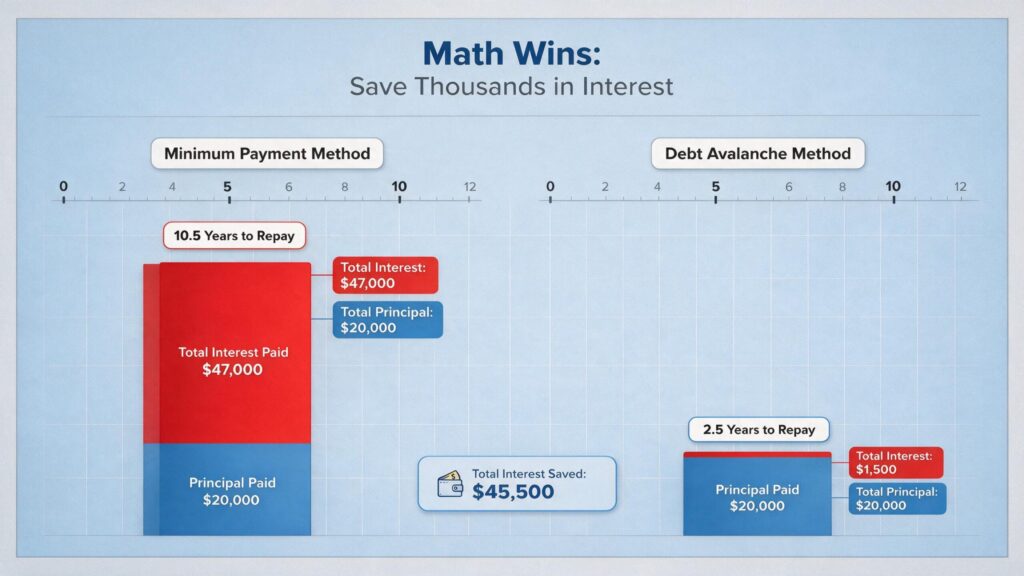
The debt avalanche calculator is designed for borrowers who want to save the absolute maximum amount of money. It is the most financially efficient payoff strategy in existence. The premise is entirely logical. You list all your debts. You ignore the total balances. You rank every single liability based exclusively on its Annual Percentage Rate (APR). You then throw every single available dollar of extra cash at the debt carrying the highest interest rate, while paying the strict legal minimums on everything else.
When you use our tool, the fog lifts. You stop guessing.
You will see exactly how many months it will take to become completely debt-free. You will see precisely how much money you save in interest compared to traditional minimum payment plans. If you are eventually planning to buy a home, rapidly killing your consumer debt is mandatory. You cannot accurately use tools like our Mortgage Affordability Calculator until you drop your debt-to-income ratio to a healthy level.
This guide pulls no punches. We will break down exactly how the avalanche sequence operates, why your lenders hate it when you use it, and how to structure your cash flow to trigger a massive financial rollover.
Grab your latest statements. Find your highest APR. Let’s get to work.
🌊 Debt Avalanche Calculator
Target highest interest rates first to save the most money & eliminate debt faster
| Payoff Order | Original Balance | APR | Months to Clear | Interest Paid |
|---|
The Mechanics: How to Use the Nxfly Debt Avalanche Calculator
Data entry dictates your success. A calculator cannot generate a flawless mathematical timeline if you feed it rough estimates. To harness the true power of the debt avalanche calculator, you must approach your inputs like a forensic accountant.
Here is exactly how to structure your data to generate a realistic, aggressive payoff timeline.
Step 1: Inventory Your Entire Debt Portfolio
You cannot defeat an enemy you refuse to look at. Log into every single account. Student loans, credit cards, auto loans, personal lines of credit. For each specific account, you need three exact numbers: the current principal balance, the current minimum monthly payment, and the specific Annual Percentage Rate (APR). Do not round down. Enter these exact figures into the calculator’s ledger.
Step 2: Establish the Minimum Baseline
The tool automatically adds up the minimum payments for all your entered debts. This sum represents your financial floor. This is the absolute minimum amount of cash flow required simply to keep your accounts in good standing and avoid late fees or credit score damage. If your total minimums equal $800, that $800 is spoken for. You cannot negotiate this number.
Step 3: Inject the “Avalanche Power” Payment
This is the single most important variable in the entire calculation. Your “Avalanche Power” is the extra monthly cash you commit to throwing at your debt above and beyond your minimum baseline.
Where does this money come from? You cut lifestyle expenses. You cancel subscriptions. You pick up weekend freelance work. If your minimum baseline is $800, and you can squeeze an extra $350 out of your monthly budget, your total monthly commitment becomes $1,150. You enter that extra $350 into the extra payment field.
Step 4: Analyze the Rollover Timeline
Once you run the calculation, the tool sorts your debt by the highest APR. It funnels your entire extra payment directly to that specific target. Watch what happens when that first debt hits zero. The tool does not let you pocket that extra cash flow. It takes the old minimum payment from the cleared debt, combines it with your extra payment, and rolls the entire massive sum onto the next highest interest rate.
This is the avalanche in action. The payments grow larger and more aggressive as you progress down the list, mathematically accelerating your debt-free date.

The Anatomy of the Calculation: Key Terms & Deep Concepts
Financial literacy requires speaking the language of the banking industry. Lenders design their statements to be confusing. They bury the true cost of your debt in the fine print.
To fully leverage the outputs of our debt avalanche calculator, you must understand the exact mechanisms driving your loan balances. Here is your plain-English glossary for multi-debt mathematics.
The Avalanche Method
This is a mathematically optimized debt repayment strategy. You organize all liabilities in descending order based strictly on their interest rate. The balance size is completely ignored. You pay the minimum on everything, but direct 100% of your excess cash flow to the debt with the highest rate. Once paid off, you roll the freed-up cash flow into the debt with the next highest rate. It saves the maximum amount of money possible.
Annual Percentage Rate (APR)
Your APR is the true cost of borrowing money over a yearly period. According to the Consumer Financial Protection Bureau (CFPB), your APR determines how much interest gets added to your unpaid balance daily. A 25% APR on a credit card compounds significantly faster than an 8% APR on a student loan. The higher the APR, the faster your debt grows. The avalanche method treats high APRs as a financial emergency.
Minimum Payment Floor
Every lender sets a minimum payment. For revolving debt like credit cards, this is usually 1% to 2% of your total balance plus the month’s accrued interest. This is a trap. Lenders calculate minimum payments to stretch your repayment timeline out for decades, maximizing their profit. The avalanche strategy completely overrides this trap by forcing accelerated principal reduction.
Fixed vs. Revolving Debt
Your portfolio likely contains a mix of both. Fixed debt (like a car loan or a student loan) has a set term and a fixed amortization schedule. Revolving debt (like a credit card) fluctuates daily based on your balance and usage. If you want to understand how fixed amortization slowly eats away at a massive principal over decades, read our guide on How US Mortgage Payments are Calculated. The avalanche method excels because it attacks highly volatile, rapidly compounding revolving debt first.
Debt Rollover (The Snowballing Payment)
This is the engine of the calculator. When you eliminate your highest-rate debt, you do not keep the extra money you were paying toward it. You roll it over. If you were paying $300 a month toward a cleared credit card, you take that $300 and add it to the minimum payment of the next debt in your sequence. Your total monthly cash outflow remains identical from month one until you are completely debt-free.
Interest Savings Target
This represents the exact dollar amount you keep in your own pocket by using the avalanche method compared to making standard minimum payments. It is hard profit. When you look at the results of the debt avalanche calculator, this number proves why math-based strategies always outperform emotion-based strategies.
Target Payoff Date
This is the definitive finish line. Assuming you stick perfectly to the rollover schedule and do not take on a single dollar of new debt, this is the exact month and year your total liability balance hits zero.
Unveiling the Formula: The Math Behind the Calculator
Managing multiple debts is not a single math problem. It is a cascading sequence of exponential equations.
When you use our tool, you are not just calculating one payoff date. You are running a complex, looping algorithm that dynamically reallocates your cash flow every time a balance hits zero. Doing this by hand on a spreadsheet is extremely tedious. A single miscalculation in month four will corrupt your entire three-year projection.
Our debt avalanche calculator eliminates human error. It relies on the absolute mathematical truth of amortization.
To determine the exact time it takes to kill a single debt, the system uses a logarithmic formula to isolate the number of months (N). The standard formula looks exactly like this:
N = -log(1 – (B * r) / P) / log(1 + r)
Here is how the machine interprets your inputs to solve the equation:
- N (Time in Months): This is the answer the formula seeks. It calculates the exact number of billing cycles required to drive the principal balance to zero.
- B (Principal Balance): The total amount owed on that specific account.
- r (Monthly Periodic Rate): The calculator takes your stated Annual Percentage Rate (APR) and divides it by 12. If your credit card charges a 24% APR, the formula uses a 2% monthly rate (0.02) to calculate your daily interest accumulation.
- P (Total Monthly Payment): For the highest APR debt, this number equals the account’s required minimum payment plus your entire extra “Avalanche Power” cash flow.
The genius of the calculator is the rollover sequence.
Once the formula solves for on your worst, highest-interest debt, the algorithm immediately shifts to your second-highest rate. It takes the entire payment () from the first debt and physically adds it to the minimum payment of the second debt. The variable grows massive. The formula runs again. Because is now so large relative to the remaining balance (), the time () drops drastically.
This looping process continues until every single account registers a zero balance. By forcing the math to attack the highest (interest rate) first, the calculator physically prevents the banks from compounding their most expensive debt against your net worth. It is mathematical precision applied to financial survival.
5 Critical Factors That Influence Your Numbers
A calculator provides a perfect, sterile environment. The real world is volatile. Financial conditions change, and lender policies constantly shift to extract more revenue from your accounts.
If you want the timeline generated by your calculation to hold true in reality, you must defend your strategy against these five external factors.
1. The Macroeconomic Rate Hike Threat
Most consumer credit cards feature variable interest rates directly tied to the prime rate. When inflation runs hot, the government steps in. According to the Board of Governors of the Federal Reserve System, raising the federal funds rate is the primary tool used to cool an overheated economy. When the Fed hikes rates, your credit card APR increases automatically within one to two billing cycles. A payoff plan calculated at a 20% APR will physically take longer if your bank quietly bumps your rate to 24.5%. You must audit your statements monthly and adjust your inputs if your rates climb.
2. The Inflation Squeeze on Cash Flow
The avalanche method relies entirely on your excess cash flow. You need that extra “Avalanche Power” payment to accelerate the math. However, severe inflation actively destroys your purchasing power at the grocery store and the gas pump. When the cost of living spikes, borrowers frequently reduce their extra debt payments just to survive. If you cut your extra payment by $200 a month, your mathematically perfect timeline will violently extend by several months, and your total interest costs will surge.
3. Promotional APR Time Bombs
Many borrowers carry balances on store cards or balance transfer cards offering “0% APR for 12 Months.” This feels like a relief. It is actually a trap. These agreements almost always contain deferred interest clauses. If you do not pay the entire balance in full before the promotional window closes, the bank retroactively applies a massive 28% interest rate back to day one. If you have promotional debt, you may need to temporarily pause the strict avalanche method to forcefully clear that specific balance before the time bomb detonates.
4. Minimum Payment Recalculations
As you aggressively pay down a large credit card balance, the bank will often automatically lower your minimum required payment. If you owe $10,000, your minimum might be $250. When you drop that balance to $3,000, the bank might lower your minimum to $75. Do not fall for this. If you lower your actual payment to match their new suggested minimum, you instantly lose the momentum of your rollover strategy. You must manually force your payments to remain flat and aggressive.
5. Credit Score Utilization Shifts
As you execute the avalanche strategy, your credit utilization ratio plummets. This causes your credit score to skyrocket. This is excellent news, but it requires strategic action. A higher credit score suddenly makes you eligible for lower-interest personal loans or elite balance transfer cards. Halfway through your payoff timeline, you might be able to refinance your remaining high-APR debt into a much cheaper product. If you do this, you must run your new numbers back through the calculator to map out a totally new, even faster, timeline.
Real-World Scenarios: The Calculator in Action
To truly grasp the financial leverage this strategy provides, you must observe it applied to real life. People carry bizarre mixes of debt. Auto loans blend with medical bills. Student loans clash with maxed-out credit cards.
Here is exactly how the debt avalanche calculator cuts through the chaos to engineer three distinctly different financial rescues.
Scenario 1: The Future Homebuyer (David’s Reset)
David is 31 and makes a solid salary of $85,000. He desperately wants to buy a house in a competitive market. However, his debt-to-income ratio is terrible. He is carrying a massive truck loan and a high-interest credit card from his college days. Before he can even think about looking at a Mortgage Loan Calculator to see what he can afford, he needs to wipe the slate clean. He has an extra $600 a month in his budget to attack this problem.
He lists his debts strictly by APR. The calculator prioritizes the credit card.
| Debt Account | Balance | APR | Minimum Payment |
|---|---|---|---|
| Target 1: Credit Card | $12,500 | 24.9% | $350 |
| Target 2: Auto Loan | $22,000 | 7.5% | $450 |
| Avalanche Power Payment | $600/month | N/A | N/A |
| Total Monthly Commitment | $1,400/month | ||
| Result: Time to Debt-Free | 28 Months | ||
| Result: Total Interest Paid | $6,140 |
Strategic Analysis:
David’s situation was severe, but his heavy cash flow saved him. The calculator routed his $350 minimum plus the $600 extra directly to the 24.9% credit card. He sent $950 a month to that specific account. It died quickly. He then rolled that entire $950 into his $450 truck payment, paying an aggressive $1,400 a month on the vehicle. In just over two years, David will be completely debt-free. He instantly reclaims $1,400 a month in cash flow, positioning him perfectly to qualify for a prime mortgage rate.
Scenario 2: The Drowning Graduate (Chloe’s Defense)
Chloe is 25. She recently graduated with federal student loans, but a period of unemployment forced her to live on two separate credit cards. She is panicking. She only has $250 of extra cash left over at the end of every month. She feels like she is drowning in payments and getting nowhere.
She uses the calculator to stop the bleeding and formulate a mathematical defense.
| Debt Account | Balance | APR | Minimum Payment |
|---|---|---|---|
| Target 1: Chase Card | $4,200 | 28.9% | $120 |
| Target 2: Discover Card | $3,800 | 22.5% | $110 |
| Target 3: Student Loan | $35,000 | 5.5% | $380 |
| Avalanche Power Payment | $250/month | N/A | N/A |
| Total Monthly Commitment | $860/month | ||
| Result: Time to Debt-Free | 68 Months | ||
| Result: Total Interest Paid | $12,450 |
Strategic Analysis:
Without the avalanche method, Chloe’s 28.9% Chase card would have compounded into an unmanageable disaster. The calculator forcefully directs her $250 extra cash exclusively to the Chase card. It neutralizes the most dangerous threat first. While 68 months (5.6 years) feels like a long time, the math reveals something vital: her credit cards will actually be completely paid off in less than 20 months. The remaining time is spent solely executing the heavy $35,000 student loan at a relatively low 5.5% rate. The calculator turns a panic situation into a controlled, phased rollout.
Scenario 3: The Rate Arbitrage Investor (Mark’s Optimization)
Mark is a highly analytical 40-year-old manager. He owes money, but he also has investments. He carries a 0% promotional furniture loan, a moderate-rate personal loan, and a high-rate rewards card he accidentally left a balance on. He wants to clear his expensive debt, but refuses to pay off cheap debt if his money can earn more in the stock market.
He uses the tool specifically to isolate and destroy his expensive liabilities.
| Debt Account | Balance | APR | Minimum Payment |
|---|---|---|---|
| Target 1: Rewards Card | $8,000 | 21.0% | $200 |
| Target 2: Personal Loan | $15,000 | 9.5% | $350 |
| Target 3: Furniture Promo | $4,000 | 0.0% | $100 |
| Avalanche Power Payment | $800/month | N/A | N/A |
| Total Monthly Commitment | $1,450/month | ||
| Result: Time to Debt-Free | 21 Months | ||
| Result: Total Interest Paid | $2,820 |
Strategic Analysis:
Mark uses brute force on the highest rates. He throws $1,000 a month directly at the 21% rewards card. It is gone in less than nine months. He then rolls that cash to the 9.5% personal loan, killing it quickly. Notice the 0% furniture loan at the bottom. Mark is perfectly happy letting a $4,000 loan sit at 0% while he makes the minimum payment. The calculator proves that rushing to pay off 0% debt is mathematically wasteful when that capital could be invested. He optimizes his exact cash flow to minimize interest damage while preserving capital.
Hidden Pitfalls: 3 Biggest Mistakes People Make
The math behind our debt avalanche calculator is flawless. Human behavior is not. You can map out a perfect, interest-destroying timeline on a Tuesday, only to completely derail your financial trajectory by Friday.
People fail at debt elimination because they lose focus. They allow emotion to override logic. If you want to successfully execute this highly aggressive strategy, you must actively defend your system against these three catastrophic mistakes.
Mistake 1: The Emotional Relapse (Breaking the Math)
The avalanche method targets your highest interest rate first. Often, that highest rate is attached to your largest balance. This requires intense mental endurance. You might spend ten months throwing $800 a month at a massive $15,000 credit card, and visually, the balance still looks huge. Meanwhile, you have a tiny $500 medical bill sitting at 0% interest just begging to be paid off.
Borrowers cave. They get tired. They take their $800 extra payment and kill the medical bill to get a “quick win.”
You just broke the math. By diverting capital away from the 26% compounding credit card to pay off a 0% loan, you instantly cost yourself hundreds of dollars in unnecessary interest. You prolonged your exact debt-free date. Math does not care about your feelings. Stay strictly on the target generated by the calculator.
Mistake 2: The Rollover Failure (Pocketing the Cash)
The entire avalanche strategy relies on the rollover sequence. When you pay off your first targeted account, you instantly free up a block of cash flow. If your extra payment was $400 and the old minimum was $150, you suddenly have $550 floating in your checking account.
This is the exact moment most people fail. They view that $550 as a raise. They lease a new car. They book a vacation. They upgrade their apartment.
If you absorb that freed-up capital back into your lifestyle, the avalanche stops immediately. You revert back to making slow, expensive minimum payments on your remaining debts. You must forcefully roll that entire $550 into the next highest-rate account on your list. No exceptions.
Mistake 3: Accumulating New Debt on Cleared Accounts
Lenders are exceptionally skilled at re-trapping escapees. When you pay off a massive credit card, your available credit spikes. The bank will often send you promotional offers, increased limits, and shiny cash-back incentives.
You think you are safe. You think you can use the card for a tank of gas and just pay it off on Friday. You forget that by carrying a balance on other cards, or by slipping up on your grace period, you instantly restart the daily compounding interest cycle. If you are executing the avalanche method, every single revolving credit line you clear must be locked, frozen, or physically cut up until you are 100% debt-free. Do not finance your lifestyle while you are fighting for your financial life.
Expert Strategies: How to Optimize Your Results
You have your baseline numbers. You understand the required discipline. Now, we accelerate the timeline.
Financial institutions use specific mathematical rules to maximize their profits. You can use those exact same rules against them. Here are five expert-level strategies to optimize the outputs of your calculation and strip away even more interest from the banks.
Strategy 1: The Mid-Cycle Micro-Payment Strike
Credit card interest is calculated daily using your average daily balance. Do not hold your money in a checking account waiting for the monthly due date. Weaponize your cash flow. If your calculator dictates an $800 monthly payment to your primary target, split it. Send the bank $200 every single week. By physically lowering the principal balance earlier in the 30-day billing cycle, you artificially drag down your average daily balance. The bank is mathematically forced to charge you less interest that month.
Strategy 2: Pause Low-Interest Asset Prepayment
Aggressive savers love to overpay their mortgages. They want to own their home outright. This is fundamentally a good idea, but it is a horrific mathematical strategy if you carry consumer debt.
Look closely at the numbers using our Mortgage Payoff Calculator. Prepaying a 4% or 5% home loan saves you money over 30 years. However, a 25% credit card is compounding against you right now. You are losing capital at a five-to-one ratio. Stop prepaying your mortgage. Stop overfunding your investment accounts. Redirect every single available dollar of capital to the top of your avalanche list. You can resume building home equity once the high-interest fires are completely extinguished.
Strategy 3: The 0% Balance Transfer Injection
You can manipulate the APR inputs on your calculator using outside leverage. If you have an excellent credit score, apply for a 0% introductory balance transfer card. Move your most toxic, highest-APR debt onto that new card.
This totally upends your avalanche structure. That specific debt immediately drops to the bottom of the priority list because its interest rate is now zero. This allows you to aim your massive “Avalanche Power” payment directly at the next most expensive debt. You are effectively buying 12 to 18 months of time where a large chunk of your principal is shielded from compound interest.
Strategy 4: Windfall Capital Allocation
Throughout the year, you will likely encounter unexpected infusions of cash. Tax refunds, annual work bonuses, inheritance, or selling a vehicle.
People generally spread this money around. They put a little in savings, pay a little on a student loan, and buy a new television. That is inefficient. When you receive a windfall, apply 100% of that capital as a one-time lump sum payment directly to your current avalanche target. This massive principal reduction severely alters your remaining amortization schedule, violently shortening your timeline to zero.
Strategy 5: Refinancing to Lower the Ceiling
As you aggressively pay down credit cards, your credit utilization ratio plummets. Your FICO score will rise significantly.
Use this newly improved score as a weapon. Go to a local credit union and apply for a fixed-rate personal loan to consolidate your remaining high-interest accounts. If you can drop a 22% credit card into an 8% personal loan, you instantly save thousands. If your debt involves high-interest home equity lines, you might even consider running the numbers through a Mortgage Refinance Calculator to see if restructuring your primary debt makes mathematical sense. Always update your avalanche tool with the new, lower APRs to establish your faster finish line.
Frequently Asked Questions (FAQs)
Q: Is the debt avalanche method mathematically better than the debt snowball?
A: Yes, it is mathematically superior. The avalanche method minimizes the exact dollar amount of interest you pay over the life of your loans by relentlessly targeting the most expensive debt first. The snowball method targets smaller balances for psychological wins, which forces you to carry high-interest debt much longer, costing you significantly more money.
Q: Should I include my primary mortgage in the debt avalanche calculation?
A: Generally, no. A mortgage is a massive, secured loan tied to an appreciating asset, usually carrying a significantly lower, fixed interest rate. The avalanche method is designed specifically to aggressively wipe out high-interest, rapidly compounding consumer debt like credit cards, personal loans, and high-rate auto loans.
Q: What happens if two separate debts have the exact same interest rate?
A: If two accounts carry the exact same APR, target the account with the smaller principal balance first. Because the mathematical weight of the interest is identical, taking out the smaller balance provides a rapid boost to your cash flow, allowing you to roll that minimum payment over much faster.
Q: How does a 0% promotional balance transfer affect the avalanche method?
A: A 0% balance transfer completely changes your targeting priority. By dropping an expensive balance to a 0% APR, that specific debt immediately moves to the bottom of your avalanche list. You then redirect your massive extra payments to the next highest APR in your portfolio, maximizing your interest savings.
Q: Will executing the debt avalanche method hurt my credit score?
A: No, it will dramatically improve your credit score. As you force heavy payments onto your highest-rate accounts—which are typically maxed-out credit cards—your credit utilization ratio drops rapidly. Since utilization makes up roughly 30% of your total FICO score, your credit rating will surge higher as your balances decrease.
Q: Do I keep making minimum payments on all my other accounts while using this method?
A: Absolutely. You must always pay the required legal minimums on every single account you hold. The avalanche method only dictates where you send your extra available cash flow. Missing a minimum payment on a lower-priority debt will trigger late fees, penalty APRs, and severe credit score damage.
Q: Where do I find the exact APR to input into the calculator?
A: You must locate your most recent official billing statement. For credit cards, banks bury the exact APR on the second or third page under a section usually titled “Interest Charge Calculation.” Do not guess this number, as variable rates change constantly based on federal monetary policy.
Stop wasting your cash flow on unnecessary interest charges. Scroll back to the top of this page to run your exact numbers through our free Debt Avalanche Calculator, and formulate your definitive escape plan today. Once your consumer debt is cleared, use our Mortgage Affordability Calculator to see exactly how much real estate your new debt-free income can purchase.
Disclaimer: The Debt Avalanche Calculator provided by Nxfly Finance is for educational and informational purposes only. It does not constitute specific financial, investment, or tax advice. Please consult with a licensed financial advisor, fiduciary, or CPA before making any major financial decisions.