

The Hidden Weight of Homeownership Dreams
Buying a home should be one of the happiest moments of your life. You imagine painting the living room, setting up the perfect backyard, and finally having a place to call your own.
But right before you get the keys, reality hits hard. The financial paperwork feels like a massive, confusing maze.
You look at your estimated monthly bill and wonder, “How did it get this high?” The math simply does not match the basic price of the house you wanted to buy.
This creates a deep sense of panic and helplessness for everyday buyers.
Why Finding the Right Answers Feels Impossible:
- Information Overload: You search online for simple answers, but you are instantly hit with complicated banking terms that make no sense to a normal person.
- Hidden Expenses: Most online calculators only show you the basic loan cost. They completely ignore the extra fees, leaving you unprepared for the real monthly bill.
- Conflicting Advice: One website tells you to worry about interest rates, while another says property taxes are your biggest enemy. You never know who to trust.
- Predatory Practices: Some lenders intentionally make the math confusing. They want you to focus on the monthly payment instead of the long-term debt you are actually taking on.
The Heavy Toll on Your Mental Peace:
- Constant Anxiety: Waking up in the middle of the night wondering if you can actually afford your new home month after month.
- Loss of Confidence: Feeling completely uneducated during meetings with real estate agents and bankers, forcing you to just nod and agree.
- Budget Paralysis: Being too afraid to spend money on furniture or repairs because you are terrified of hidden loan fees suddenly appearing.
- Relationship Strain: Couples often argue over housing budgets simply because neither person truly understands how the bank came up with the final number.
Unlocking the Mystery Behind the Math
You do not need an advanced degree in finance to understand your home loan. You just need someone to explain the moving parts in plain English.
Let us clear up the confusion right now. Your monthly bill is not just one big random number generated by a bank computer.
It is actually made up of four very specific puzzle pieces. In the real estate industry, we call this PITI.
This stands for Principal, Interest, Taxes, and Insurance. Once you understand how these four pieces fit together, the math becomes incredibly simple.
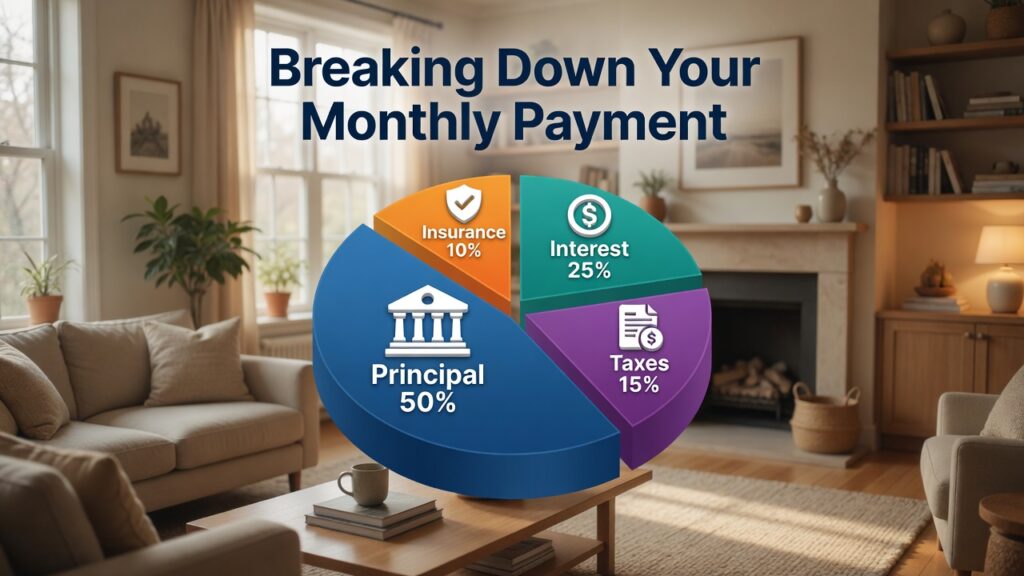
Step 1: Breaking Down the Core Debt (Principal & Interest)
The first two pieces of the puzzle go directly to your lender. This is the actual cost of buying the house and the cost of borrowing their money.
The Principal Amount
Think of the principal as the pure price tag of your home, minus whatever cash you paid upfront. If you buy a home for $300,000 and put down $60,000 in cash, your principal loan is $240,000.
Every time you make a monthly payment, a small chunk of your money goes toward shrinking this $240,000 debt.
The Interest Rate
Interest is simply the fee the bank charges you for the privilege of using their money. This is calculated as a percentage of your total loan.
If your interest rate is high, the bank takes a much larger cut of your monthly payment. In the early years of your loan, most of your money goes straight toward paying this interest, not the actual house.
Myth vs. Reality:
- Myth: If I pay $2,000 a month, my total debt drops by $2,000.
- Reality: In the beginning, maybe only $400 goes toward the debt (principal). The remaining $1,600 goes directly into the bank’s pocket as interest.
Step 2: The Unavoidable Extras (Taxes & Insurance)
Here is where most new buyers get completely blindsided. The bank wants to protect their investment, so they force you to pay for extra protections every single month.
They collect this money from you and put it into a special holding area called an Escrow Account.
Property Taxes
Local governments charge property taxes to fund schools, roads, and emergency services. Your tax bill is divided by 12, and that amount is added directly to your monthly mortgage payment.
If your town decides to raise taxes next year, your monthly mortgage bill will automatically go up.
Homeowners Insurance
If your house burns down or gets destroyed by a storm, the bank loses their money. To prevent this, they require you to carry active homeowners insurance.
Just like taxes, the annual premium is sliced into 12 equal parts and added to your monthly bill.
Private Mortgage Insurance (PMI)
This is a sneaky extra fee that catches many people off guard. If you buy a house but put down less than 20% in cash, the bank considers you a “risky” buyer.
To protect themselves, they force you to pay for PMI. This adds anywhere from $50 to $300 to your monthly bill, and it offers zero protection for you. It only protects the lender if you stop paying.
A Real-Life Scenario: Let’s Do the Math
To make this completely clear, let us look at a practical example. Imagine you are buying a lovely home for $350,000.
You saved up a 10% down payment, which is $35,000. This means you need a loan for the remaining $315,000.
Let us assume you get a 30-year fixed loan with an interest rate of 6.5%.
Your Monthly Breakdown:
- Principal & Interest: This will cost you roughly $1,991 every month based on a standard loan calculator.
- Property Taxes: Let us say your local taxes are $4,200 a year. That adds $350 to your monthly bill.
- Homeowners Insurance: A standard policy might cost $1,200 a year. That is another $100 per month.
- PMI: Because you only put down 10%, you have to pay PMI. This might be around $130 a month.
The Grand Total:
When you add $1,991 + $350 + $100 + 130,yourtotalactualmonthlypaymentbecomes∗∗130,yourtotalactualmonthlypaymentbecomes∗∗2,571**.If you only looked at the basic loan cost, you would have expected to pay under two thousand dollars. But the real-world math added over five hundred dollars in extra obligations.
Step 3: Mastering the Amortization Schedule
Now that you know what goes into the payment, you need to understand how the bank schedules your debt over time.
This process is called Amortization. It sounds like a complex medical term, but it is actually just a simple timeline of your loan.
When you get your loan documents, you will receive a chart showing every single payment for the next 30 years.
The Front-Loaded Trap
Banks are smart businesses. They want their profit (the interest) as fast as possible.
Because of this, your payment schedule is completely lopsided. For the first 10 to 15 years, the massive majority of your monthly payment goes directly toward interest.
Why This Matters to You
If you decide to sell your house after just five years, you might be shocked to see how little of the actual home you own.
You have been making huge payments every month, but your principal balance has barely moved.
Expert Pro Tip:
If you make just one extra payment per year directly toward your principal balance, you can shave several years off a 30-year loan. It completely disrupts the bank’s amortization schedule in your favor.
Comparing Your Loan Options
The type of loan you choose completely changes how your math works out. You essentially have two major paths to choose from.
1. The Fixed-Rate Mortgage
This is exactly what it sounds like. Your interest rate is locked in stone for the entire life of the loan.
If you sign up for 30 years, the Principal and Interest part of your payment will never change. It offers incredible stability and peace of mind.
Even if the economy crashes or spikes, your basic housing cost remains perfectly predictable.
2. The Adjustable-Rate Mortgage (ARM)
With an ARM, the lender offers you a slightly cheaper interest rate for the first few years.
However, after that introductory period ends, your rate will adjust up or down based on the current economy.
If rates go up, your monthly payment will suddenly increase. This makes ARMs highly unpredictable for long-term homeowners.
| Feature | Fixed-Rate Mortgage | Adjustable-Rate (ARM) |
| Payment Stability | 100% predictable | Can change dramatically |
| Initial Cost | Usually slightly higher | Often starts cheaper |
| Best For | Long-term forever homes | Short-term home ownership |
| Risk Level | Very Low | Moderate to High |
Understanding the Impact of the Loan Term
Another massive factor in your monthly calculation is the length of your loan. In the US, the 30-year option is by far the most popular choice.
It stretches your debt out over three decades, making the monthly burden much smaller and easier to manage.
However, this lower monthly cost comes with a massive hidden penalty. Because you are borrowing the money for 30 years, you end up paying an unbelievable amount of total interest over your lifetime.
The 15-Year Alternative
If you choose a 15-year loan, your monthly payments will be significantly higher.
But because you pay the debt off twice as fast, the total interest you hand over to the bank drops dramatically. You can literally save hundreds of thousands of dollars just by changing the length of your loan.
Your choice entirely depends on your current monthly budget versus your long-term financial goals.
By taking the time to understand these components, you strip away the fear and confusion. You are no longer just guessing at numbers.
You can now confidently look at a house price, estimate the taxes and insurance, and know exactly what you are getting into before you sign any paperwork.
Taking Total Control of Your Monthly Statements
Getting the keys to your new property is just the beginning of your financial journey. You now have a massive debt that requires careful, active management.
If you just set your bills on auto-pay and forget about them, you will lose a lot of money. You need to actively manage this obligation so it does not control your daily life.
Let us look at some professional strategies that everyday buyers rarely use. These methods will help you save thousands of dollars and keep your budget perfectly safe.
The Hidden Danger of Escrow Shortages
Many new buyers think their fixed-rate mortgage payment will never ever change. They assume the math is locked in stone until the house is completely paid off.
But your actual monthly payment can unexpectedly jump up by hundreds of dollars. This frightening surprise is called an escrow shortage.
This happens because local property taxes and home insurance premiums naturally increase over time. When your bank pays these updated bills from your escrow account, they might find a negative balance.
If your account is short, the bank will advance their own money to cover the gap. However, they will aggressively demand that you pay them back immediately.
They typically raise your monthly mortgage bill for the next 12 months to recover their missing funds. This sudden, steep increase can easily ruin a tight household budget.
To protect your family, you should always build a solid emergency savings buffer long before buying a home. Having a dedicated cash reserve ensures an escrow shortage never causes a panic attack in your household.
The Magic of the Bi-Weekly Calendar Hack
Want to beat the big banks at their own mathematical game? You can use a remarkably simple calendar trick to save massive amounts of interest.
Instead of making one full payment on the first of every month, cut that specific number exactly in half. Send that half-payment to your lender every two weeks.
Because there are 52 weeks in a calendar year, you end up making 26 half-payments. This perfectly equals 13 full monthly payments instead of the standard 12.
You will barely notice the extra expense in your daily living budget. Yet, this one extra payment goes entirely toward shrinking your principal balance.
This tiny automatic habit can easily shave several years off your total repayment schedule. It is one of the smartest ways to understand long-term amortization and interest savings on a practical level.
Expert Warning: Do not pay a third-party company to set this up for you. Most banks allow you to set up bi-weekly automatic transfers for free directly through their online portal.
Recasting vs. Refinancing: What You Need to Know
Question: What happens if I receive a large chunk of money, like an inheritance or a big work bonus? Should I refinance my home to get a lower monthly bill?
Answer: Refinancing a home costs thousands of dollars in closing fees and requires endless paperwork. Instead, you should simply ask your current lender for a “mortgage recast.”
When you request a recast, you hand the bank a lump sum of cash to put directly against your principal balance. The bank then recalculates your monthly schedule based on this new, much smaller loan size.
Your original interest rate stays exactly the same, which is great if you already have a low rate. You just get a much smaller monthly bill for a tiny processing fee.
Let us look at a real-life scenario to make this crystal clear. Imagine you currently owe $200,000 on your house and your payment feels too heavy for your budget.
You sell a secondary car and suddenly have $20,000 in cash. If you just make a standard extra payment, your loan ends faster, but your current monthly bill stays the same.
If you recast with that $20,000, your lender completely resets the math. Now, your monthly obligation drops significantly, giving your family instant financial breathing room.
These specific tactics turn you from a passive borrower into an active financial manager. You stop being afraid of the math and start using it entirely to your advantage.

Costly Missteps Every New Homebuyer Must Dodge
Even highly intelligent people make terrible mathematical mistakes when dealing with real estate. The emotional excitement of finding a dream home often clouds basic common sense.
If you fall into these common traps, you might end up feeling completely suffocated by your own property. Let us look at the biggest errors you need to actively identify and avoid.
1. Forgetting the Hidden Association Fees
You calculate your principal, interest, taxes, and insurance perfectly. You feel completely confident about your final math and your monthly budget.
Then, you move into a beautiful neighborhood and get a surprise invoice from the Homeowners Association (HOA). These regular fees cover community upkeep, pool maintenance, and trash removal.
HOA fees are almost never included in your standard mortgage payment with the bank. If you ignore them during your planning phase, you might suddenly face hundreds of dollars in extra monthly obligations.
Always ask the real estate agent for a written history of the HOA fees before you make an offer.
2. Believing PMI Drops Off Magically
Earlier, we discussed Private Mortgage Insurance and how it protects the bank, not you. You only pay this annoying fee when you own less than 20% of your home.
Many optimistic buyers assume the bank will instantly cancel this extra charge the second they hit that target mark. Unfortunately, lending institutions are rarely that helpful or proactive.
According to the Consumer Financial Protection Bureau guidelines on mortgage insurance, lenders must legally drop it automatically at 22% equity. If you want it removed at exactly 20%, you must write a formal request letter.
If you just wait silently for the bank to do the right thing, you could end up paying thousands of dollars in useless premiums. Track your home value actively and demand the removal when the time is right.
3. Draining Your Cash for a Bigger Down Payment
It feels incredibly satisfying to put a massive down payment on a house to shrink the monthly bill. But from a safety perspective, this is actually a very dangerous move.
Houses break down constantly and completely without warning. Roofs start to leak, air conditioners fail in the summer, and hidden pipes burst.
If you empty your savings account to buy the house, you will have absolutely no cash left for sudden repairs. This forces many new buyers to take out extremely expensive credit card debt just to fix a broken window.
Before taking on any high-interest debt for home repairs, you must understand the strict requirements for getting personal loans to avoid predatory offers. The best defense is to always keep a healthy cash reserve sitting safely in your bank.
4. Buying at the Absolute Maximum Approval Limit
Your chosen lender might look at your income history and happily approve you for a $500,000 loan. This absolutely does not mean you should actually spend that much money.
Banks do not care about your child’s expensive daycare costs, your weekly grocery bills, or your future vacation plans. They only care about your gross income on a piece of paper.
If you spend every single dollar the bank approves you for, you become what experts call “house poor.” You have a visually stunning home, but you cannot afford to put decent furniture inside it.
Missing a house payment is incredibly stressful and damages your financial reputation. If you ever find yourself struggling, it feels exactly like dealing with the harsh consequences of a missed loan installment, except the risk here is losing your actual home.
5. Never Shopping Around for Better Home Insurance
Your home insurance premium is a massive part of your monthly escrow calculation. Yet, most buyers pick a random insurance company on the day they close and never look at it again.
Insurance companies are famous for quietly raising your premiums little by little every single renewal period. Because the bank pays the bill through your escrow, you probably never even notice the price going up.
You should treat home insurance like any other regular shopping experience. According to expert advice on managing homeowner expenses, comparing rates annually is the easiest way to keep your bills low.
Make it a yearly habit to call three different insurance agents and ask for competing quotes. If you find a cheaper policy, switching can instantly lower your total monthly mortgage payment.
Your Blueprint for Confident Homeownership
We have covered a massive amount of important ground today. You now clearly understand exactly how the banking system looks at your hard-earned money.
You do not have to be a mathematical genius to own a home safely. You just need to pay close attention to the specific details that most regular people ignore.
Let Us Review Your Daily Action Plan
First, always demand a complete breakdown of the PITI before making a final offer on any house. Knowing the exact local taxes and insurance estimates prevents painful surprises later on.
Second, set a permanent calendar reminder to check your home equity every single year. The moment you hit that magical 20% mark, aggressively demand that your lender remove the PMI charge.
Third, take ten minutes today to log into your banking portal and explore bi-weekly payment options. It is a completely painless way to beat the banking system and own your home years earlier than expected.
Protecting Your Future Peace of Mind
Your new home should always be your safe space, not a constant source of daily financial panic. By taking absolute control of the numbers, you protect your family’s happiness and stability.
If you currently have other heavy debts weighing you down, try to clear them out early. You might want to explore smart ways to combine your existing financial obligations before taking on a massive home loan.
A clean financial slate makes the entire home-buying process so much easier and less stressful. You can walk into any bank with complete confidence and negotiate the best possible terms for your family.
Take these practical strategies and apply them directly to your household budget today. You have the absolute power to make your real estate journey a massive success.
Keep learning about your money, stay highly vigilant against hidden fees, and enjoy the wonderful experience of true homeownership.
Disclaimer: The information provided in this article is strictly for educational and informational purposes only. It does not constitute formal financial, legal, or real estate advice. Always consult with a licensed financial advisor, certified tax professional, or mortgage expert before making any major financial decisions or signing legal contracts.